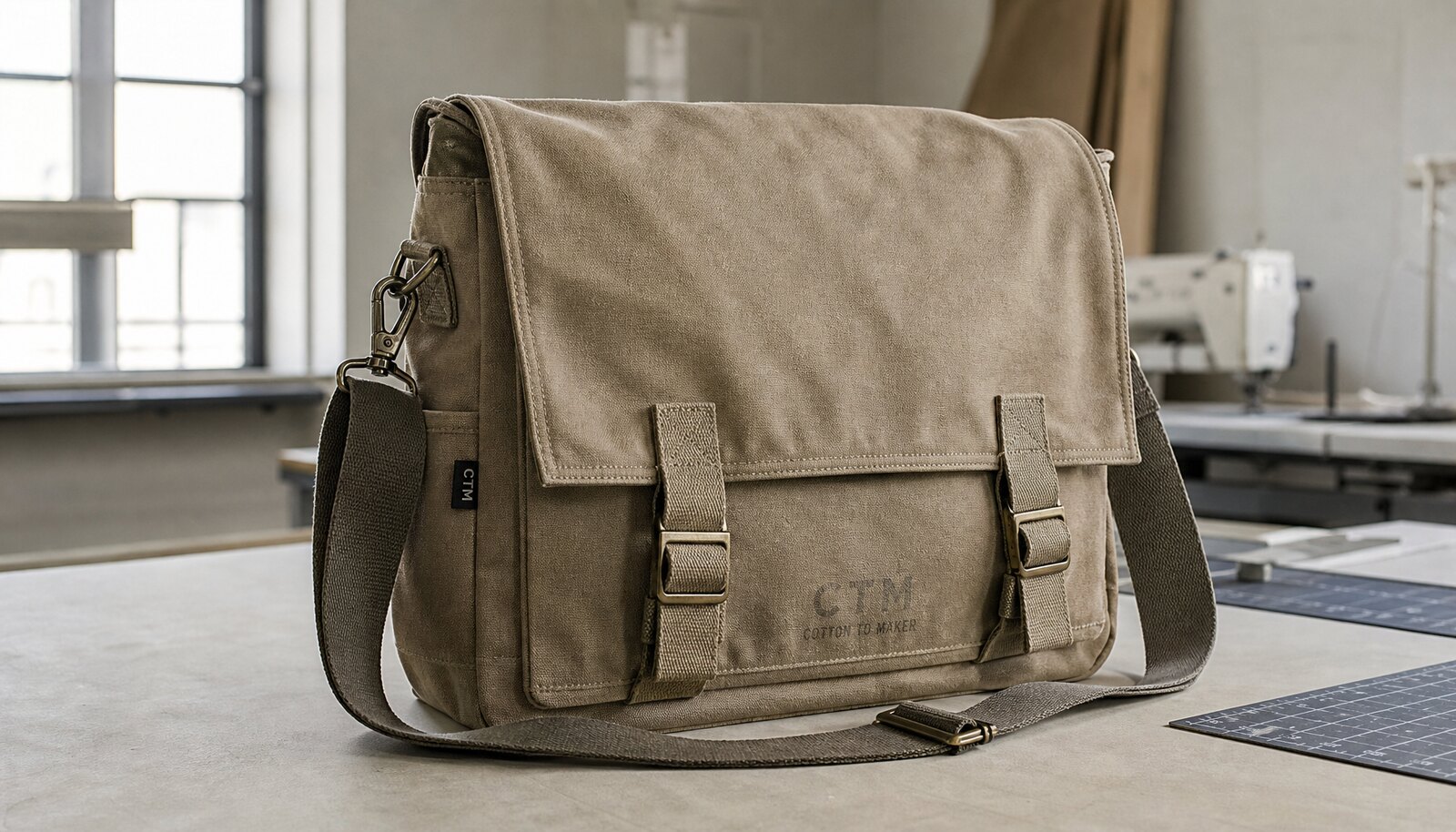
What Heavy Duty Should Mean In Your RFQ
For heavy duty messenger bags, the phrase is only useful if it translates into measurable requirements. A buyer should not send a supplier a line that says heavy duty and expect the same interpretation across factories. One factory may think 12 oz canvas and a basic flap closure is enough. Another may quote 16 oz canvas, a lined interior, and reinforced strap anchors. If the use case is a laptop bag, commuter bag, or field bag, the supplier needs the target load, daily carry frequency, and expected service life before the quote is meaningful.
The fastest way to clean up the RFQ is to define the job the bag must do. A promo-style messenger bag and a retail messenger bag can share the same silhouette but not the same structure. The first may only need a decent outer shell and a simple logo print. The second may need a stronger bottom panel, wider webbing, a padded strap, and a lining that keeps the interior from collapsing. Put the use case in writing first, then let the fabric and construction follow it.
- State the intended load in kilograms or pounds, not just heavy use.
- Name the carry type: shoulder carry, crossbody, laptop carry, or commuter use.
- Set the expected life: promo giveaway, seasonal retail, or repeat reorder program.
- List any hard requirements such as a laptop sleeve, trolley sleeve, or bottle pocket.
Fabric Weight And Reinforcement Choices That Actually Matter
Canvas weight is the first number buyers compare, but it should not be the only one. For heavy duty messenger bags, 12 oz canvas can work for lighter loads or promotional programs, especially if the bag has a decent lining and reinforced seams. Around 14 oz canvas is usually the balanced point for buyers who want a durable feel without making the bag too stiff or expensive. 16 oz canvas is closer to a premium, high-structure build and makes sense when the bag will carry weight, be sold at retail, or need a stronger visual impression on shelf. In GSM terms, those weights are roughly 407 gsm, 475 gsm, and 610 gsm, though finishing and weave density still matter.
A thick fabric without reinforcement is still a weak bag. What holds the load is the complete structure: canvas body, seam allowance, bottom construction, strap anchoring, and any stabilizer layer inside. Ask how the factory handles the stress points. The bag should not rely on a single seam line where the strap meets the body. Look for double stitching, box-x stitching, or bar-tacks at the load points. If the bag is supposed to stand up better on a counter or in a retail photo, ask for a bottom board, a structured base, or a denser canvas panel.
- Use 12 oz for lighter price-sensitive programs with controlled loads.
- Use 14 oz for a broad commercial middle ground.
- Use 16 oz when the bag needs more body, better shelf presence, or heavier carrying performance.
- Ask whether the canvas is raw, washed, or pre-shrunk so dimensions do not drift after finishing.
Build Details That Carry Load Without Looking Overbuilt
Messenger bags fail at the details buyers often skip. Strap width, seam construction, lining choice, and zipper grade matter more than a broad description of durability. For a bag that will actually carry weight, 38 mm webbing is often a better baseline than narrow tape because it spreads the load on the shoulder and gives the factory more surface to stitch into the body. For larger laptop formats or bags intended to carry documents and devices, a wider strap or padded shoulder section can reduce customer complaints even when the bag looks identical from the front.
The interior layout should support the product use, not just add pockets for the sake of it. A padded sleeve is useful if the bag carries electronics. A clean open cavity may be better for document transport or retail packaging. Zipper choice should match the price tier and the carry expectation. A nylon coil zipper with a stable pull is usually easier to live with than a decorative closure that looks good on a sample but jams after repeated use. If the flap uses a magnetic snap, test whether the magnet placement interferes with lining or pocket structure.
- Use box-x stitching or multiple bar-tacks at all strap attachment points.
- Keep seam allowances generous enough for production tolerance and repeat sewing.
- Choose a lining that supports the target price, such as 210D polyester for value or cotton twill for a more natural hand feel.
- Do not overload the bag with pockets if the main use case is document or laptop carry.
Branding Methods: Pick The One That Survives Real Use
Branding on heavy duty messenger bags should be chosen for wear, not just for appearance in a presentation file. Large front logos on canvas usually price and perform best with screen print, especially when the design is bold and uses limited colors. Embroidery adds perceived value but can distort lighter canvas or pucker on larger logos if the backing is not well controlled. For multicolor marks or smaller detailed branding, a woven patch or sewn label often gives a cleaner result than trying to force detail into embroidery.
The placement matters almost as much as the method. Print on a flat front panel if you want low setup complexity. Use a woven side label, a flap patch, or a subtle debossed PU label if the bag is meant to look more restrained at retail. Avoid placing major branding across a seam, a fold line, or a high-stress point unless you are willing to accept distortion. In the RFQ, define the logo size in millimeters, the exact location, and the artwork file format. A supplier cannot price a print accurately from a casual instruction like logo on the front.
- Screen print for simple logos, flat cost control, and large front branding.
- Embroidery for smaller marks or premium positioning, with extra care on backing and placement.
- Woven patch for detail, color control, and a clean retail look.
- Ask for a strike-off or print proof before bulk production, especially on dark or washed canvas.
Which Supplier Route Fits Your Order Size And Control Needs
The same messenger bag can be sourced through very different channels, and the quote spread often reflects the route rather than the actual product. A blank stock bag plus local printing is usually the quickest way to launch a small test, but it limits control over the exact body spec. A direct cut-and-sew factory gives the best control over dimensions, lining, and reinforcement, but it usually needs a cleaner tech pack and a more serious order commitment. Trading companies can reduce communication friction when the project has multiple trims or sourcing requirements, though the buyer must understand where QC responsibility really sits.
Use the comparison table as a route filter, not as a universal ranking. The cheapest route is not always the lowest-risk route if the bag is meant for retail shelves or repeat replenishment. For a short-run campaign, a local decorator can be a sensible tradeoff. For a brand program that needs consistent reorders, a direct factory with an approved sample and clear packing spec is usually the safer path. The point is to match the route to the commercial job, not to the product name alone.
- Match the route to the quantity, lead time, and required spec control.
- Treat low MOQ and full customization as competing priorities unless the supplier has a strong stock base.
- Ask who owns the final QC sign-off before shipment.
- Do not compare a stock blank quote with a fully custom factory quote as if they are the same product.
What A Clean Quote Should Show Before You Compare Suppliers
A single unit price is not enough to compare heavy duty messenger bag quotes. The buyer should see what is included, what is extra, and what assumptions sit underneath the number. If one supplier includes packing, logo setup, and a woven label while another only prices the sewn body, the quote is not comparable. Ask for separate lines where possible: body fabric, lining, strap, hardware, print or decoration, labels, packaging, sample fees, and any special tooling. This makes the real cost visible and reduces the chance of a surprise later in the order.
For landed-cost work, keep the incoterm consistent. Compare EXW to EXW or FOB to FOB, not a mixed set of terms. Then add the downstream costs that matter to your business: ocean freight or air freight, duty, customs clearance, domestic delivery, warehouse handling, and any relabeling or carton rework. A quote that looks stronger at factory gate can lose once the carton count, gross weight, and shipping method are included. A clean quote is not just cheaper; it is easier to audit when the order changes.
- Ask for a full breakdown of unit price, sample fee, tooling, and setup charges.
- Keep the incoterm identical across all suppliers.
- Request carton size, units per carton, and gross weight with the quote.
- If a supplier will not separate costs, assume the quote needs extra scrutiny.
Sample Approval And QC Thresholds For A Bag That Must Hold Up
Sample approval should not be treated as a formality. For heavy duty messenger bags, the sample is where strap geometry, seam behavior, zipper movement, and print quality are checked against the target use. A good process usually has three steps: artwork proof, pre-production sample, and golden sample. The artwork proof locks the logo and dimensions. The pre-production sample confirms materials and construction. The golden sample is the reference the factory should follow during bulk production. If the supplier skips a stage or asks you to approve from photos only, the risk moves to bulk.
Set acceptance criteria that a sewing team can actually work to. Size tolerance, strap length, pocket position, and print registration should all be written down. A useful load test is one that matches the real use case, not a random number chosen to make the sample look tough. If the bag is for documents and a laptop, the sample should carry that load without seam opening, hardware slip, or visible distortion. Shade variation, odor, and rough trimming should also be checked, because a structurally strong bag can still be rejected by retail or brand teams if the finish looks unfinished.
- Approve the sample under normal daylight or neutral lighting, not only in a factory photo.
- Check the print, label, and strap placement against a marked spec sheet.
- Run the zipper, snap, and buckle enough times to expose weak hardware.
- Keep one signed sample as the reference for bulk inspection and reorders.
Packing, Cartons, And Retail Readiness
Packing is part of product quality, not an afterthought. A messenger bag that arrives crushed, damp, or mislabeled creates work for your warehouse and hurts the customer experience before the bag is even sold. Ask the supplier to define how the bag is folded, whether it goes into a polybag, whether a paper insert or stiffener is required, and how many units fit into each inner pack and master carton. The bag should reach the market in the same shape the sample had when approved, or as close as practical for the route and price point.
Carton sizing affects freight cost and damage risk. Overpacked cartons crush canvas and warp hardware. Loose cartons waste cube and increase shipping cost. For retail or e-commerce programs, the supplier should also mark the cartons with SKU, color, quantity, gross weight, and destination information in a consistent format. If your order will be stored in a humid warehouse or shipped in a long transit lane, add moisture control and make sure the packing method does not trap odors. The cheapest packing method is not cheap if it creates returns or repacking labor.
- Specify polybag type, insert, and carton count before production starts.
- Ask for a carton that protects the bag shape without wasting shipping cube.
- Require clear carton marks and barcode labels if the bags will flow into retail or e-commerce.
- If the product is retail-facing, decide whether a hangtag, care label, or origin label is required at the factory.
Lead Time, Reorders, And The Risks That Slow A Program Down
Lead time for heavy duty messenger bags is usually a chain of smaller steps, not one simple date. Sample development can take a week or two if the spec is clear, longer if the logo, fabric, or trim needs sourcing. Bulk lead time then depends on fabric availability, print method, sewing capacity, and packing complexity. Custom canvas color, special hardware, or an unusual label can add time even when the bag shape is simple. If the schedule matters, the buyer should ask the factory to separate material lead time from sewing lead time and to state where the longest delay usually happens.
The most common schedule problem is not the sewing line. It is delayed approval. When the buyer changes artwork after the sample stage, adjusts the packing spec late, or waits too long to approve a proof, the calendar slips fast. Reorders are easier if the factory keeps the approved sample, the same fabric lot is still available, and the carton spec was already locked. If you expect repeat business, ask the supplier what can be held as a replenishment standard and what will need revalidation on the next order.
- Separate sample timing, bulk timing, and shipping timing in the project plan.
- Freeze artwork and packing early if you are working to a retail launch date.
- Allow time for holiday congestion, fabric sourcing, and print approval.
- For reorder programs, document what is fixed and what can change without reopening the whole spec.
How To Write The RFQ So Quotes Match Instead Of Drift
A clear RFQ is the fastest way to reduce price noise. Start with the bag dimensions, target load, canvas weight, lining, strap type, closure, decoration method, and packing requirement. Then attach a simple drawing or tech pack that shows the front, back, side, and inside details. If the bag needs a laptop sleeve, bottle pocket, or adjustable flap, note those dimensions too. The supplier should be able to quote without guessing what matters most. The goal is not more paperwork. The goal is fewer assumptions.
When the RFQ is clean, you can compare suppliers on a like-for-like basis and spot the weak assumptions. If one factory quotes a lighter canvas, one fewer print color, or a different carton count, you can see why the price changed. That is what prevents bad procurement decisions. For heavy duty messenger bags, the winning quote is not the cheapest line on paper; it is the quote that matches the intended use, passes sample approval, and can be reordered without rebuilding the spec from scratch.
- Include dimensions, canvas weight, strap spec, closure type, decoration method, and packing spec.
- Attach artwork and mark the exact print size and placement.
- State the destination and incoterm so freight assumptions do not distort the comparison.
- Ask each supplier to quote the same sample scope and the same MOQ tier.
Specification comparison for buyers
| Spec decision | Recommended option | When it fits | Buyer risk to check |
|---|---|---|---|
| Need the lowest landed cost | Stock canvas bag with local print | Simple promo run with limited size or pocket changes | Check whether the blank bag, print, and packing are all quoted on the same basis |
| Need the fastest first shipment | Domestic stock supplier or local decorator | Launch deadlines are tight and volume is modest | Stock can hide fabric or hardware variation from batch to batch |
| Need custom size, lining, and pocket layout | Direct cut-and-sew factory | Retail, brand, or laptop carry program with a fixed spec | Confirm the factory actually controls sewing and not only sourcing |
| Need low MOQ for a market test | Blank bag plus print house | Pilot order, event merch, or regional test SKU | The bag body may not match the final production spec you want to scale |
| Need strong brand control | Direct factory with in-house decoration | You need exact placement, color, and repeatability | Verify artwork handling, strike-off approval, and print registration control |
| Need a middleman to manage complexity | Trading company with factory network | Multiple SKUs, mixed trims, or many compliance tasks | Ask who owns QC and what evidence you get before shipment |
| Need retail-ready packing | Full-service factory or packaging-capable supplier | B2B retail, e-commerce, or club store programs | Check carton strength, barcode labeling, and inner pack counts |
| Need repeatable reorder quality | Direct factory with approved golden sample | Ongoing replenishment after the first buy | Make sure the exact sample that was approved is stored and referenced in writing |
Buyer checklist before sampling
- Write the target load, bag dimensions, and carry use case before asking for a quote.
- Specify canvas weight in oz or GSM and say whether you want raw, washed, or pre-shrunk fabric.
- Lock the strap width, webbing type, reinforcement method, and any laptop or bottle pocket needs.
- Attach artwork with logo size, placement, Pantone references, and the decoration method you want quoted.
- State the incoterm, destination port or warehouse, and whether you need door delivery or factory pickup.
- Define the sample approval sequence: artwork proof, pre-production sample, and golden sample.
- Ask for packaging detail: polybag, insert, hangtag, carton count, carton size, and gross weight limit.
- Set the acceptable tolerance for size, shade, print alignment, and seam finish.
- Request the MOQ breakpoints for blank, printed, and fully custom versions.
- Confirm the reorder lead time separately from the first-order lead time.
Factory quote questions to send
- What canvas weight are you quoting, and is it measured before or after washing or finishing?
- What is included in the unit price: body, lining, straps, print setup, labels, and packing?
- What are the MOQ breakpoints and price tiers for blank, printed, and fully custom versions?
- Which print method is included, and what is the surcharge for extra colors or larger print areas?
- Can you separate sample fee, tooling fee, and refundable setup charge from the production price?
- What is the expected lead time after sample approval, and what changes it materially?
- What QC standard do you use for stitch strength, print alignment, and load testing?
- What carton size, units per carton, and gross weight will you ship for this item?
Quality-control points to confirm
- Measure body size, strap length, and pocket positions against the approved spec with a clear tolerance band.
- Inspect all stress points for bar-tacks, box-x stitching, or double stitching where the strap and body meet.
- Load test the bag to the target carrying weight and look for seam opening, strap slip, or hardware failure.
- Check print placement, color, and registration under daylight or a neutral light source.
- Run zippers, snaps, buckles, and magnetic closures several times and reject any rough movement or snagging.
- Review canvas shade across the batch so panel-to-panel color variation stays within an acceptable range.
- Inspect lining, binding, and raw edge finishing for exposed fibers, skipped stitches, or twisted seams.
- Verify carton count, inner pack count, barcode labels, country-of-origin marks, and shipping marks before release.