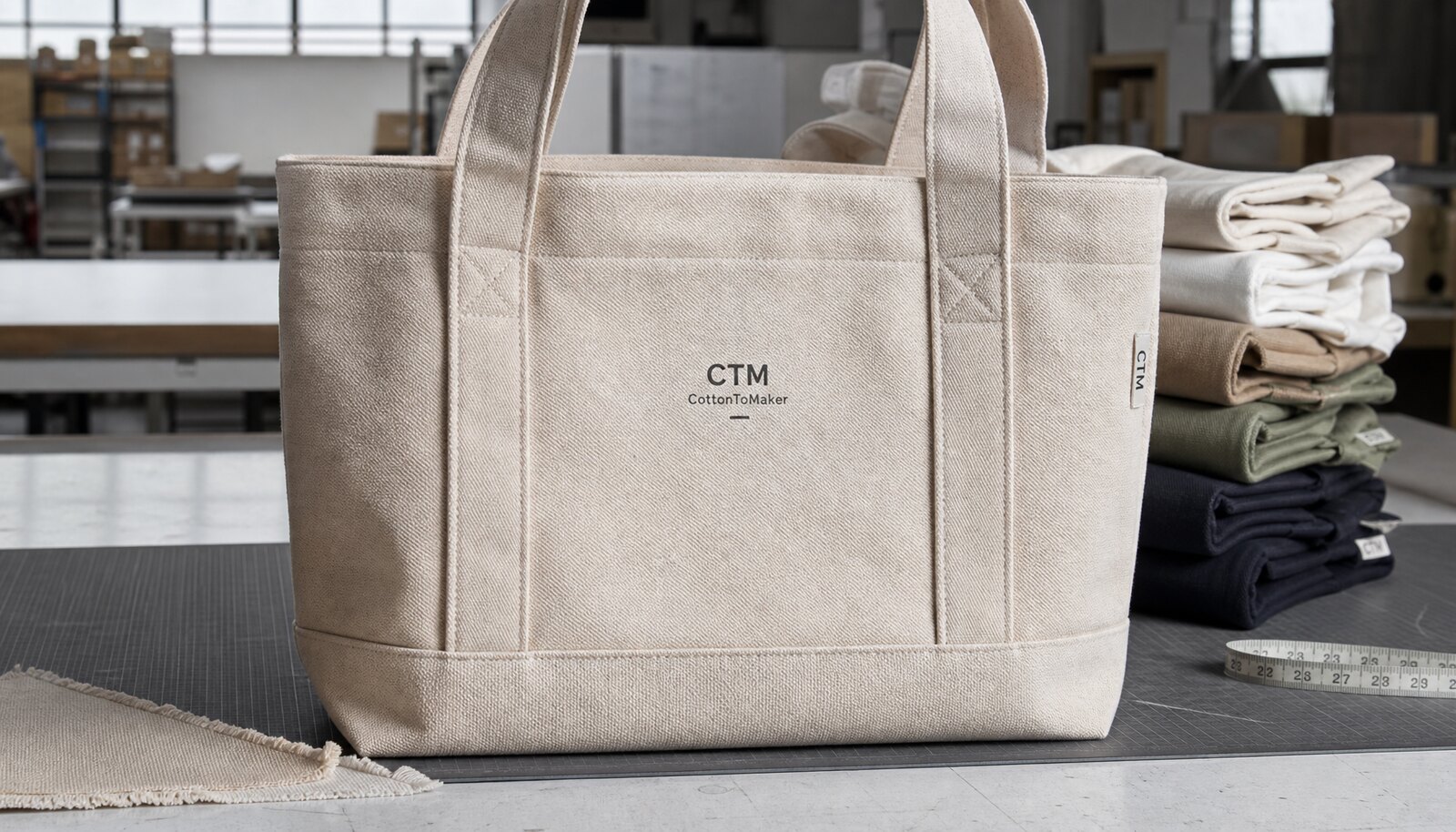
What makes a canvas bag truly heavy duty
For procurement teams, heavy duty canvas bags are not defined by a marketing phrase. They are defined by how the bag behaves when it is filled, carried, packed, and stored. A bag can look thick in a photo and still fail if the weave is loose, the handles are under-built, or the bottom corners collapse after a few uses. The sourcing problem is not just appearance. It is whether the product will survive the real load profile without complaints, returns, or emergency reorders.
The useful definition starts with three controls: enough fabric weight to give the bag body, enough reinforcement where force concentrates, and a construction style that matches the contents. For most buyer programs, that means a canvas in the 12 oz to 16 oz range, with the upper end reserved for products that must carry heavier items or stand upright. If a supplier cannot tell you whether they mean oz, GSM, or finished bag weight, the quote is too vague to compare.
- Tie the spec to the real use case, not to the word heavy alone.
- Use one measurement system in the RFQ, either GSM or oz, and require the supplier to repeat it back exactly.
- Define the bag by material plus construction, not by material alone.
Choose fabric weight, weave, and finish together
Fabric weight drives more than price. It affects structure, print sharpness, drape, sewing speed, and even how the bag folds into a carton. A 12 oz canvas often works well for general-purpose retail and promotional bags because it gives enough body without making sewing difficult. As you move toward 16 oz, the bag becomes stiffer and more premium, but sewing gets slower, needles wear faster, and the factory may need more careful handling at the corners and seams.
Weave density matters just as much as weight. A tighter plain weave or duck-style canvas gives a cleaner print surface and better abrasion resistance. A looser weave can look more rustic, but it may telegraph through printing and fray faster on cut edges. If the program requires a washed look, garment dye, or a softened hand feel, state that separately. Those choices change shrinkage, color behavior, and the final size of the bag.
- Use 12 oz to 14 oz for balanced retail and promotional programs.
- Move to 16 oz only when load, premium feel, or structure justify the added sewing difficulty.
- Write wash or dye effects into the spec because they change size, color, and hand feel.
Reinforcement choices that prevent field failures
The most common failure point on heavy duty canvas bags is not the body panel. It is the handle attachment and the lower stress areas near the gusset or bottom corners. Buyers often focus on fabric weight and forget that a heavy load transfers force into the seam, bar-tack, and corner reinforcement. A thicker fabric without reinforcement can still fail early if the bag is used for books, bottles, tools, or grocery loads. The construction note should name the reinforcement method, not just say strong stitching.
For a simple program, self-fabric handles with bar-tack reinforcement are acceptable if the attachment length and stitch density are defined. For stronger carry performance, webbing inside the handle or a folded double-layer handle improves durability. A boxed gusset adds volume and stabilizes the load, especially for retail bags that need to stand upright. The price increase is justified when the bag is sold as a long-life item or when the buyer expects full loading in daily use.
- Specify handle width, handle drop, and attachment length in millimeters.
- State whether you want bar-tacks, cross-stitching, or a boxed seam at the stress points.
- Use a gusset when the bag needs more volume than a flat tote can hold.
Print methods should match artwork and order volume
Decoration is where many heavy duty canvas bags go wrong in procurement. A logo that looks fine on a screen can blur, crack, or shift once it hits textured canvas. For large simple graphics, screen printing is usually the best value because it is durable and repeatable when the color count is limited. For a smaller or more premium brand mark, a woven label, sewn patch, or embroidery may be a better long-term choice. The right answer is not what looks nicest in a mockup. It is what the factory can execute consistently at your quantity.
Each method has its own production risk. Screen print has setup logic and color limits. Embroidery can distort fine detail and adds thread-density control issues. Heat transfer can be useful for short runs or complex artwork, but it should not be assumed to age like a stitched label. If the design has fine lines, gradients, or small text, force a strike-off or decorated sample before approving the bulk run.
- Keep the artwork simple if you want lower setup cost and better consistency.
- Require a strike-off or decorated sample before bulk approval.
- Do not blend print method and decoration method in one vague line item.
How to compare supplier quotes without getting misled
The lowest quote for heavy duty canvas bags is rarely the lowest landed cost. One supplier may quote a lighter fabric, another may omit handle reinforcement, and a third may include a print method that only works on paper. Procurement teams need an apples-to-apples quote sheet that forces every supplier to name the same inputs: fabric weight, weave, dimensions, handle build, print method, packing, and Incoterms. Without that discipline, price comparisons are mostly noise.
A useful quote also separates recurring cost from one-time charges. Sample fees, print screens, embroidery setup, special cartons, and retail insert cards should be visible. If the supplier hides these costs in a single unit price, it becomes hard to understand the real margin pressure on reorder business. Ask for the first-order cost and the repeat-order cost where relevant. That shows whether the factory is pricing fairly or planning to recover setup cost later.
- Compare quotes only when the spec sheet is identical across suppliers.
- Separate one-time tooling or setup charges from per-unit manufacturing cost.
- Ask for a repeat-order quote, not only the first production quote.
MOQ logic is a production decision, not a sales answer
MOQ for heavy duty canvas bags is usually driven by fabric sourcing, print setup, sewing line efficiency, and packing labor. A supplier may be willing to accept a small trial order, but the unit price can rise quickly if the fabric color is special, the print has multiple colors, or the bag needs unusual reinforcement. That is normal. The mistake is treating MOQ as a single number without understanding what drives it. Buyers should ask whether MOQ is tied to dye lot, print screen setup, or carton pack configuration.
For repeat programs, MOQ should be discussed by component. A factory may be able to keep the bag body stable while changing the print or label at a lower minimum. That matters for retail buyers who run seasonal graphics or multiple SKUs. If the supplier cannot explain MOQ by fabric, decoration, and packaging separately, the quote is too coarse for a controlled buying decision. A clean answer usually means the factory understands production planning rather than just selling by habit.
- Treat MOQ as the sum of fabric, decoration, and packing constraints.
- If you need multiple SKUs, ask which elements can stay common across styles.
- Do not approve special dye colors unless the order size justifies the dye lot risk.
Samples should prove build quality, not only appearance
A sample is useful only if it proves the production risk. For heavy duty canvas bags, that means the sample must show the real fabric weight, real thread behavior, real print method, and real finishing. If the sample is assembled from hand-picked panels or stitched more carefully than the bulk run, it can hide production issues. Buyers should request a pre-production sample that uses the intended fabric lot or a close approved lot, and they should keep a sealed golden sample for size, color, print position, handle construction, and fold behavior.
The sample review should include a quick abuse test that reflects use. Load the bag with the expected weight, check handle stretch, observe seam tension, and confirm whether the bag stands and folds as expected. If the product is meant for retail, look at how it hangs on a shelf and whether it creases in a way that hurts presentation. A good approval note should list what was accepted, what still needs correction, and what must not change in bulk production.
- Approve the sample on measurements, print location, and structural behavior, not only aesthetics.
- Keep one sealed golden sample for QC reference.
- Test the bag with a realistic load before signing off on bulk production.
Packing details affect damage rate and retail readiness
Packing is not a warehouse afterthought. A heavy duty canvas bag can arrive with wrinkles, dirty marks, crushed decoration, or broken folds if the packing method is weak. Some buyers want bulk-packed cartons to minimize cost, while others need individual polybags, insert cards, or retail barcodes. The right answer depends on channel. Wholesale and trade programs usually favor efficient master carton packing, while retail programs need cleaner presentation and tighter fold control. Both can be correct, but they are not interchangeable.
The RFQ should define how each bag is folded, whether it is polybagged, whether silica gel or board inserts are needed, and how many units go into each carton. Also state carton marks and barcode placement if the product will move through a retail or 3PL system. If a supplier quotes without packing detail, the landed cost is incomplete. Packing labor, carton size, and cube efficiency can change freight cost more than many buyers expect.
- Define fold method so the logo is not creased across the print area.
- Specify polybag, insert card, barcode, and master carton mark requirements upfront.
- Use pack-out requirements to compare freight efficiency, not only factory price.
Lead time risk comes from fabric booking and finishing capacity
Lead time on heavy duty canvas bags is rarely just sewing time. The real schedule risk sits in fabric availability, dye lot approval, print setup, sample sign-off, and final inspection. If the order uses a stock natural canvas, the schedule is usually more predictable. If it uses a custom dyed fabric or a multi-color print, the lead time can stretch because each stage depends on buyer approval. Procurement teams should ask for a timeline by milestone, not only a single promised ship date.
A practical schedule includes sample approval, material booking, bulk cutting and sewing, decoration, packing, and final inspection. If the supplier cannot break the timeline into those steps, they may not be managing production tightly enough. Buyers should also ask what happens if there is a fabric shortage, print failure, or QC rework. The answer reveals whether the factory has buffer capacity and whether the quoted lead time is realistic under normal production conditions.
- Get a milestone timeline with sample, material booking, bulk, packing, and inspection dates.
- Treat custom dye and complex decoration as schedule risks, not routine steps.
- Ask what backup plan exists if one stage fails or slips.
Use QC limits that a factory can actually measure
QC for heavy duty canvas bags should be specific enough that a supplier can inspect against it and a buyer can reject against it. Vague instructions like strong stitching or good quality do not help when a carton fails at final inspection. Buyers should set measurable thresholds for fabric weight, seam allowance, stitch density, load testing, shrinkage, rub resistance, and print placement. That gives the supplier a target and makes the rejection decision defensible.
A practical rule set starts with the body seam and handle attachment. Main seams are commonly controlled at 8 to 10 stitches per inch, with 10 to 12 mm seam allowance on body panels and 12 to 15 mm at stress points. For load performance, a static hold at 1.5x the intended working load for 30 minutes is a reasonable procurement test. For dyed or printed bags, ask for dry rub 4+ and wet rub 3+ if the bag is expected to face normal handling and occasional moisture. If the bag is washed, set a shrinkage limit before production starts, not after failure shows up.
- Write stitch density, seam allowance, and load test criteria into the PO or spec sheet.
- Require the supplier to record test results against the golden sample.
- Reject any run that passes visually but fails the agreed measurement or load threshold.
Specification comparison for buyers
| Spec decision | Commercial baseline | Typical cost driver | Buyer pass/fail rule |
|---|---|---|---|
| Fabric weight | 12 oz to 14 oz canvas, about 340 to 400 GSM | Heavier cloth increases material cost and slows sewing | Require the supplier to state GSM or oz, the measurement method, and a swatch approval before bulk |
| Very heavy build | 16 oz canvas or above, often 450 GSM plus | Thicker fabric raises needle wear, rejects, and labor time | Use only when the bag must carry heavy contents or stand upright; reject if the factory cannot sew it cleanly |
| Seam allowance | 10 to 12 mm on body seams, 12 to 15 mm at stress points | More allowance reduces seam failure but uses more fabric and sewing time | Reject any sample with exposed seam margin, skipped topstitch, or visibly narrow allowances |
| Stitch density | 8 to 10 stitches per inch on main seams | Too few stitches weakens seams; too many can perforate thick canvas | Check SPI on the approved sample and require the bulk run to match it within the factory tolerance |
| Handle build | Self-fabric or webbing-reinforced handles with bar-tacks | Reinforced handles increase labor and may need stronger thread | Approve only if handle attachment length, bar-tack count, and placement are defined in writing |
| Load test | Static hold at 1.5x intended working load for 30 minutes | Requires time, fixtures, and possible rework if failures appear | Fail any bag with seam opening, handle slip, or permanent distortion beyond the agreed limit |
| Colorfastness | Dry rub 4+ and wet rub 3+ for dyed or printed bags | Better dyes, inks, and fixing steps can raise cost | Demand test results or a written supplier commitment tied to the approved sample |
| Shrinkage | 3% or less for unwashed bags; 5% or less after wash for prewashed styles | Prewashing, dyeing, and finishing add cost and can change lead time | Reject any style that loses fit, twists, or shrinks beyond the agreed tolerance after the specified care test |
| Packing | Flat packed, folded to the same template, with carton count and barcode spec defined | Polybags, inserts, and retail labeling add material and labor cost | Do not compare landed cost unless fold method, pack count, and carton dimensions are identical across suppliers |
Buyer checklist before sampling
- Define the use case first: promotional handout, retail tote, grocery carry, tool bag, or premium gift bag.
- State the declared carrying load or contents weight so the fabric and reinforcement can be sized to the job.
- Lock the fabric spec in GSM or oz, plus weave style, finish, and whether the bag is bleached, natural, dyed, or washed.
- Specify target dimensions, gusset depth, handle length, handle width, and handle drop in millimeters.
- Define seam allowance, topstitch style, reinforcement method, and the minimum stitch density for the main seams.
- Choose the decoration method before quoting: screen print, heat transfer, woven label, patch, or embroidery.
- Set the maximum number of print colors, print placement window, and acceptable registration tolerance.
- Ask for a pre-production sample or golden sample that uses the intended fabric, thread, and decoration method.
- Define the load test, wash test, and any colorfastness or rub test requirements in the RFQ.
- Tell suppliers how to pack the bag: fold method, polybag use, insert cards, barcode label, and carton count.
Factory quote questions to send
- What is the exact fabric weight in GSM or oz, how was it measured, and can you share a swatch or lab reference?
- Is the canvas plain weave, duck canvas, washed, dyed, coated, or lined, and what finish changes the hand feel or shrinkage?
- What seam allowance, stitch density, needle type, and thread spec do you use on the body, handle, and gusset seams?
- How are the handles built: self-fabric, webbing insert, folded handle, or double-layer handle, and how are they reinforced?
- What is the minimum static load test you can support, and what failures count as a reject under your normal QC standard?
- Which decoration method do you recommend for this artwork, and what are the setup charges, color limits, and durability limits?
- What is your MOQ by fabric color, print design, and packing style, and what changes if we place a repeat order?
- Can you quote first-order and repeat-order pricing separately, including any tooling, screens, embroidery setup, or sample charges?
- What sample stage is included before bulk production, how many revision rounds are allowed, and which sample becomes the golden sample?
- How do you pack the bags for shipment, and what are the exact fold method, carton quantity, carton dimensions, and gross weight target?
Quality-control points to confirm
- Fabric weight must match the agreed spec within a defined tolerance, and the factory should identify the measurement method used.
- Main seams should use the agreed seam allowance, typically 10 to 12 mm, with no exposed seam margin after turning or topstitching.
- Stitch density should stay within the approved range, typically 8 to 10 stitches per inch on main seams, with no skipped stitches or thread breaks.
- Handle attachment points should include the agreed reinforcement, such as bar-tacks or cross-stitching, with no slippage, twisting, or loose ends.
- Seams, gussets, and bottom corners should pass a static load test at 1.5x intended working load for 30 minutes without seam opening or permanent distortion beyond the agreed limit.
- For bags sold as washable or prewashed, shrinkage should stay within the approved limit, typically 3% or less for unwashed styles and 5% or less after the specified wash test.
- Dyed or printed styles should meet the agreed colorfastness target, commonly dry rub 4+ and wet rub 3+ for buyer-controlled acceptance.
- Print placement should stay inside the approved location window, with no major skew, misregistration, cracking, smudge, or ink bleed beyond the golden sample.
- Thread color, label placement, fold method, and carton markings should match the approved packing spec on every carton sampled at inspection.
- The shipment should be checked against the golden sample for color, hand feel, smell, size, and overall construction consistency before release.