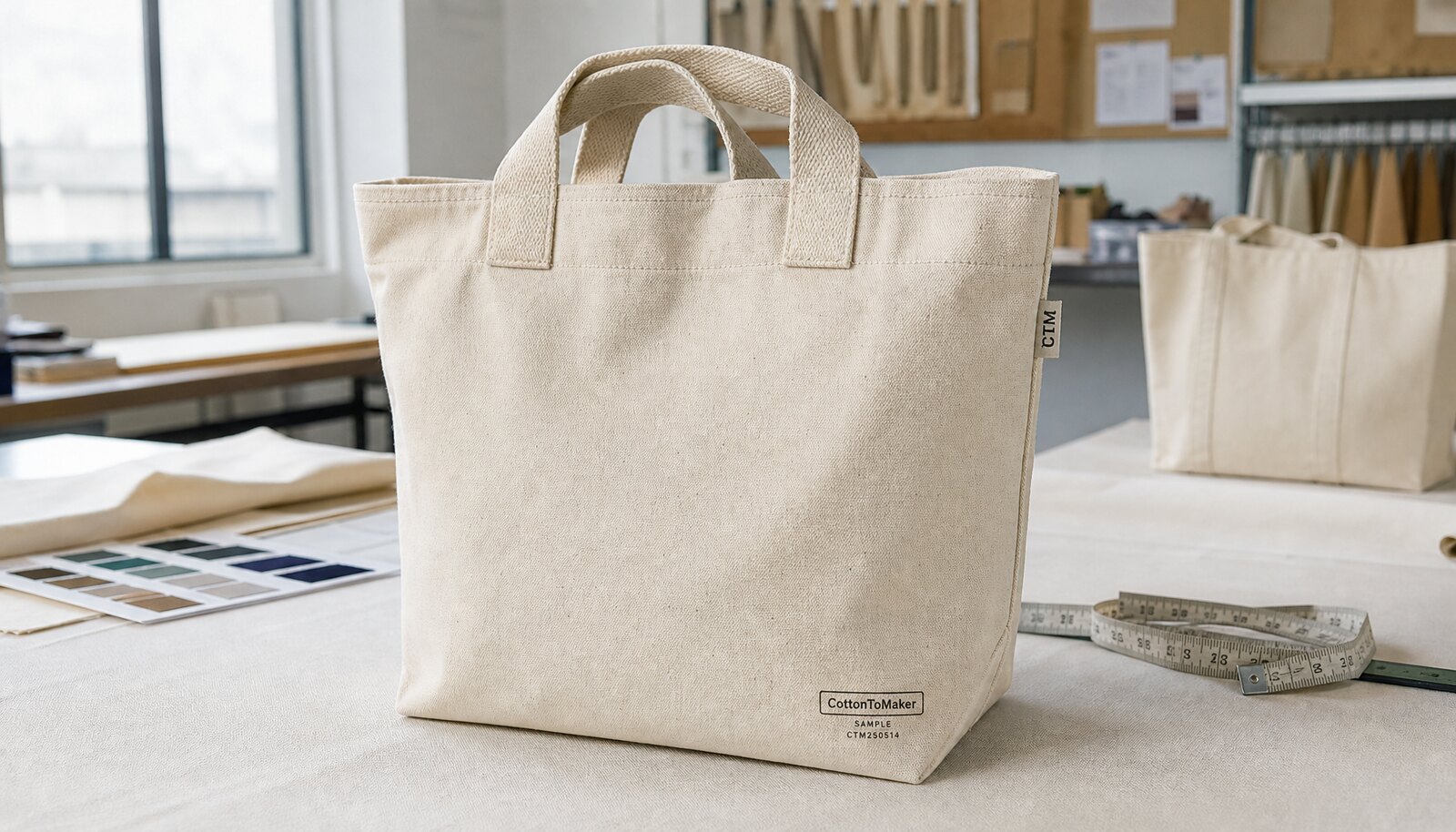
Why gift buyers need a quote guide before asking for price
A heavy canvas tote looks simple until procurement tries to compare quotes. One supplier may assume a 12 oz natural cotton canvas tote with a one-color screen print and bulk packing. Another may quote 16 oz canvas, bar-tacked handles, a boxed bottom, individual polybags, barcode stickers, and export cartons. Both quotes may say heavy canvas tote, but the product, labor content, freight weight, and inspection risk are very different.
For gift programs, the tote is often part of a larger promise. It may carry a welcome kit, hold a premium retail product, present a corporate client gift, or act as the reusable outer packaging for a seasonal campaign. The bag must look intentional, not like an afterthought. It also needs to arrive in a format that the fulfillment center, warehouse, or kitting team can receive without relabeling or repacking.
The job of a wholesale quote guide is not to push every buyer toward the heaviest or most expensive bag. It is to make the assumptions visible. When the RFQ states fabric weight, construction, decoration, MOQ splits, sample stages, quality criteria, packing, and lead-time triggers, suppliers can quote the same target. That makes the final decision about value instead of guesswork.
- A low unit price is not meaningful unless fabric, construction, decoration, packing, and lead-time assumptions match.
- Gift buyers should quote the tote as a managed SKU, not as a generic promotional item.
- The RFQ should separate must-have requirements from optional upgrades so cost tradeoffs are easy to see.
Match the tote specification to the gift program scenario
Start with the use case. A tote for an employee onboarding kit has different requirements from a luxury hotel amenity bag or a retail gift-with-purchase tote. The onboarding tote may need to hold a notebook, bottle, apparel item, and small electronics without handle stress. A retail gift-with-purchase tote may need stronger shelf appearance, clean folding, consistent logo placement, and barcode labeling. A conference sponsor tote may prioritize unit cost and delivery reliability, but it still needs to survive a day of carrying catalogs and samples.
Buyers should describe the contents in the RFQ instead of only describing the bag. A supplier can make better decisions if the request says the tote will carry two glass jars, a boxed candle, and an insert card, or that it must fit inside a 350 mm x 250 mm gift box. Capacity is not only about width and height. Gusset depth, base shape, handle drop, and fabric stiffness decide whether the tote works in real use.
Presentation also matters. Some gift buyers want the bag to stand upright in photography or on a reception table. Others need it to fold flat and fit into a mailer. A stiff 16 oz canvas tote may look premium but can increase folded thickness. A softer 12 oz or 14 oz tote may pack more efficiently but may not hold a crisp shape. Put that priority in the brief before pricing begins.
- For boxed gifts, quote the internal usable space, gusset, and base style, not only the flat bag dimensions.
- For retail or hospitality programs, include presentation requirements such as upright shape, clean seams, and visible label position.
- For fulfillment programs, specify folded size, barcode placement, carton quantity, and receiving-label format.
Define dimensions, gusset, base, and carrying load in measurable terms
A strong RFQ uses finished dimensions, not vague size labels. Terms like medium tote or large shopper can vary by factory. State the finished width, height, side gusset or bottom gusset, handle width, handle length, and handle drop. If the bag has a boxed bottom, clarify whether the base is formed by the gusset, reinforced with an additional canvas layer, or supported with an insert board.
Dimensional tolerance should be agreed before production. Cotton canvas can shrink, stretch, and respond differently after cutting, dyeing, washing, printing, and sewing. For many canvas tote orders, buyers use practical tolerances such as +/- 5 mm for handle drop and smaller features and +/- 10 mm for larger body dimensions. If the tote must fit a rigid gift box or a warehouse slot, tighter tolerances may be necessary and should be priced accordingly.
Carrying load should be described in practical language. A buyer does not need to over-engineer every tote, but the supplier should know whether the bag carries brochures, apparel, bottles, jars, books, or electronics. For heavier contents, specify a target load and ask the factory how it will support that load through fabric weight, seam construction, handle width, and reinforcement. The most common failure point is not the center of the fabric panel; it is the handle root, side seam, bottom corner, or stress point where a gusset meets the body.
- Include a simple product-fit note, such as must hold one 2 kg gift box and remain comfortable to carry.
- Specify handle drop based on the user experience: hand carry, elbow carry, or shoulder carry.
- Ask for a load expectation in the quote rather than assuming heavy canvas automatically means heavy-duty construction.
Fabric weight, finish, and construction decisions that change price
Heavy canvas is not a single material grade. A 12 oz canvas, about 407 gsm, is common for a sturdy but still flexible tote. A 14 oz canvas, about 475 gsm, gives more body and a more premium hand. A 16 oz canvas, about 542 gsm, feels stronger and more structured but increases material cost, sewing resistance, carton weight, and sometimes the number of cartons required. If the RFQ only says heavy canvas, suppliers may choose different weights and still believe they met the request.
Fabric finish matters as much as weight. Natural cotton canvas can show shade variation, seed flecks, slubs, and small weaving irregularities. Some buyers like this because it looks authentic and sustainable. Others need a cleaner retail appearance. If the program requires a smooth print face or a specific tone of natural canvas, ask whether the fabric is stock, bleached, dyed, washed, calendered, or otherwise finished. Dyed canvas may require color approval and can add lead time.
Construction should be quoted line by line. Ask how the top hem is finished, whether inside seams are overlocked, whether handles are double-folded, and whether handle joins use bar-tacks, cross-stitches, or box stitches. A bag with a clean inside seam and reinforced handle attachment may cost more, but it also reduces loose threads, fraying, and returns. If the buyer wants a premium feel without a full lining, upgraded seam finishing can be a better value than adding unnecessary accessories.
- Request fabric weight in both oz and approximate GSM to avoid regional misunderstanding.
- Ask whether natural canvas shade variation is acceptable and how shade will be controlled across cartons.
- Compare handle reinforcement and seam finishing before comparing unit price.
Decoration choices: screen print, embroidery, patches, and labels
Decoration often decides whether the tote feels like a branded gift or a commodity bag. For simple logos, one- or two-color screen print is usually a practical choice on heavy canvas. It is repeatable, cost-efficient at volume, and works well on natural cotton when artwork is prepared correctly. However, screen print still needs clear details: artwork size, number of colors, Pantone references if required, print placement, print side, and whether the print can pass over a seam or gusset.
Embroidery, woven labels, and sewn patches can create a more premium appearance, especially when the logo is small. They also introduce different cost drivers. Embroidery may require digitizing and has stitch-count implications. Woven labels may have their own MOQ and lead time. Patches need edge finishing and sewing placement control. A quote that includes only the bag and not the label tooling or patch sewing is incomplete.
For gift buyers managing multiple brands, regions, or seasonal campaigns, artwork version control is critical. A single base tote with different printed logos may appear easy, but each artwork can require a separate screen setup, approval file, sample check, and packing segregation. If the program has five logos across one total order quantity, ask whether the price break is based on total units or units per artwork. This prevents surprise setup charges and mixed-carton errors.
- For screen print, specify ink color, print size, side, placement from top and side seams, and approval method.
- For embroidery, ask for stitch count, backing method, thread color, digitizing charge, and acceptable puckering level.
- For labels or patches, confirm MOQ, tooling, sewing charge, placement tolerance, and whether spare labels are required.
MOQ, price breaks, and how size or color splits affect the quote
MOQ is not only a factory preference. It is affected by fabric sourcing, cutting efficiency, print setup, machine changeover, label MOQ, packing labor, and inspection complexity. A one-size natural canvas tote with one logo will normally quote cleaner than a program split across three sizes, four fabric colors, and eight regional logos. The total order may be large, but the factory still has to manage small production lots inside that order.
Buyers should request price breaks in a structured way. Instead of asking only for your target quantity, request logical tiers such as 500, 1,000, 2,500, 5,000, and 10,000 units when those volumes are realistic. Then ask whether the break applies to the total order or only to each exact SKU. A supplier may quote 5,000 units attractively for one design, but the price can change if the order becomes 1,000 units each across five artwork versions.
Setup charges also need to be visible. Screen charges, embroidery digitizing, woven label tooling, patch setup, special cutting patterns, lab dips, and pre-production samples may be one-time costs or repeated by artwork version. If a buyer compares only unit price, a low quote can become more expensive once these items are added. For annual gift programs or repeat buying, ask whether setup can be reused for reorders and how long screens, dies, or digital files are retained.
- Ask for MOQ by size, by canvas color, by print colorway, and by artwork version.
- Request unit price and setup charges separately so replenishment math is clear.
- If several gift tiers use the same base tote, ask whether one blank production run can be decorated and packed into separate SKUs.
RFQ line-item structure that makes supplier quotes comparable
A procurement-friendly RFQ should read like a build sheet. The goal is not to make the document long; the goal is to prevent suppliers from filling in important blanks differently. A useful line item starts with the finished tote specification, then shows decoration, packing, sample requirement, inspection requirement, delivery terms, and exclusions. If the supplier cannot price one part, they should mark it as excluded instead of hiding it inside an unclear unit price.
One practical approach is to require suppliers to return the quote using fixed columns. Include item number, bag size, fabric weight, construction, decoration method, artwork version, quantity, unit price, setup charge, sample charge, packing cost if separate, carton details, lead time, payment terms, quote validity, and exclusions. This structure makes it easy to see why one quote is lower and whether the saving is real.
Common exclusions should be requested in writing. These include international freight, duty, import tax, local delivery, third-party testing, third-party inspection, artwork redraw, additional sample rounds, barcode generation, warehousing, split shipments, pallet charges, and after-hours delivery windows. None of these exclusions are unusual, but they become a problem when the buyer assumes they are included.
- Use a fixed quote template so all suppliers answer the same questions in the same order.
- Require separate lines for unit price, setup, sample, packing, inspection, freight, and tooling where relevant.
- Ask suppliers to state assumptions and exclusions, not just provide a total price.
Sample stages and approval checkpoints for heavy canvas totes
Sampling should match the risk of the order. A blank sample is useful for checking canvas weight, hand feel, sewing quality, handle comfort, and basic size. It does not prove print quality, logo placement, barcode packing, or final carton count. A decoration strike-off or printed panel is useful when artwork color, opacity, cure, or fine detail matters. A pre-production sample should use the actual bulk fabric, real decoration process, final label or patch, and intended packing method.
For many gift programs, a practical sequence is blank sample, decoration strike-off, pre-production sample, and then top-of-production photos or sample before full production continues. The sequence can be compressed when timing is tight, but the buyer should understand the risk being accepted. If the first decorated sample is also the production approval, any artwork or placement mistake can affect the entire order.
Inspect samples in a disciplined way. Measure the body, gusset, base, handle length, and handle drop. Check that the tote can hold the intended gift contents. Look at the logo from normal viewing distance and close inspection distance. Rub the print lightly with a dry white cloth and, where appropriate, a damp cloth. Fold the bag the way it will be packed and confirm the decoration is not creased in a way that damages appearance. A sample approval should include written comments, photos, and the final signed specification.
- Do not approve bulk production from a showroom sample unless it matches the quoted construction and material.
- For decorated orders, approve print color, size, placement, cure, and edge quality before mass production.
- For kitting programs, approve the folded sample and carton pack, not only the open bag.
Quality-control criteria buyers should define before the PO
Quality control becomes stronger when acceptance criteria are agreed before the purchase order. For a heavy canvas tote, the buyer should define tolerances for finished dimensions, handle drop, logo placement, color variation, seam quality, print durability, label accuracy, and packing. Without these points, the factory may produce a commercially reasonable bag that still fails the buyer's receiving standard.
A practical inspection plan can reference AQL 2.5 for major defects and AQL 4.0 for minor defects, with critical defects set at zero tolerance when safety, brand, barcode, or legal labeling is affected. The exact standard should be agreed by both sides. Major defects may include broken handles, open seams, wrong logo, severe print defects, wrong size beyond tolerance, missing required labels, or cartons mixed by SKU. Minor defects may include small loose threads, slight natural slub variation, minor fold marks, or small appearance issues that do not affect use or brand presentation.
Measurable checks reduce arguments. For example, finished dimensions may be allowed within +/- 5 mm to +/- 10 mm depending on feature size. Logo placement may be allowed within +/- 3 mm to +/- 8 mm depending on artwork size and production method. Handle pull expectations should be tied to the intended load and agreed test method, such as a static load for a specified time with no tearing, stitch breakage, or major deformation. Print checks can include dry rub, wet rub, tape adhesion, scratch observation, and wash or soak checks only if washability is claimed.
Canvas is a natural textile, so the buyer should also define appearance boundaries. Natural flecks and minor slubs may be acceptable; oil stains, holes, weak spots, heavy shade mismatch, and visible dirt are not. If the tote is a premium gift item, the front logo face may require a stricter visual standard than the back or inside seams. Tell the factory this before cutting and printing begin.
- Agree on AQL level, sample size method, critical defects, major defects, and minor defects before production.
- Use tolerances for size, handle drop, and print placement instead of subjective approval language.
- Define basic rub, adhesion, load, barcode, and carton checks that match the actual program risk.
Packing, carton marking, palletization, and warehouse receiving details
Packing is often treated as an afterthought, but it can change the final landed cost and the success of the receiving process. Bulk-folded totes are usually cheaper and more compact than individually polybagged totes. Retail-ready totes with hangtags, insert cards, barcode labels, or paper bands require more labor and more inspection. If the tote is going into a gift kit, the folded dimensions may affect the size and cost of the entire kit carton.
Ask for inner quantity and master carton quantity. A carton of 100 bulk-folded totes may be efficient for freight, but it may be too heavy or inconvenient for a fulfillment line. A carton of 25 or 50 may improve handling but increase carton count. Master carton strength should match the shipping method and warehouse handling environment. For export or long transit, buyers should ask whether cartons are double-wall or an appropriate board grade, how they are sealed, and whether units shift inside the carton.
Carton markings should be specified. At minimum, many warehouses need PO number, item number, SKU, artwork version, quantity, carton number, country of origin where required, gross weight, net weight, and carton dimensions. If barcode labels are required on cartons, provide the data format and placement. If cartons are palletized, specify pallet type, maximum pallet height, pallet pattern, stretch wrap requirement, pallet label position, and whether mixed SKUs are allowed on one pallet.
Packing also affects inspection. Inspectors should confirm the correct artwork version is in the correct carton, labels scan properly, carton quantities match the packing list, and cartons are strong enough for handling. For gift buyers shipping to multiple locations, split packing and carton numbering should be agreed before production. Repacking after goods arrive is expensive, slow, and avoidable.
- Quote the bag and pack-out together: folded size, inner quantity, master quantity, carton dimensions, and gross weight.
- State carton marking and barcode requirements exactly as the warehouse expects them.
- If palletization is required, confirm pallet size, height limit, mixed-SKU rules, and pallet label format.
Specification comparison for buyers
| Quote variable | Common options | When it fits | Cost and risk tradeoff |
|---|---|---|---|
| Fabric weight | 12 oz canvas, about 407 gsm; 14 oz canvas, about 475 gsm; 16 oz canvas, about 542 gsm | 12 oz for lighter gift carriers and cost-sensitive programs; 14-16 oz for premium gifting, retail resale, boxed items, or stronger structure | Heavier fabric increases material cost, sewing time, carton weight, and freight impact; lighter fabric may sag, wrinkle more, or feel less premium |
| Finished size and gusset | Flat tote; side gusset; bottom gusset; boxed bottom; wide base | Flat totes suit documents and light giveaways; gusseted or boxed-bottom totes suit candles, bottles, jars, apparel sets, and gift boxes | More gusset depth uses more fabric and may require extra sewing control; a wider base improves capacity but changes folding, carton count, and shelf presentation |
| Base style | No reinforcement; self-fabric bottom; double-layer base; insert board or removable base | Self-fabric or double-layer base works for heavier gift sets; insert boards help the bag stand upright for presentation | Reinforced bases add material and packing complexity; insert boards may need separate packing, carton protection, and confirmation that the board is included in the quote |
| Handle construction | Single stitched handle; double-fold cotton webbing; cross-stitch; bar-tack; full-wrap handle | Double-fold handles with bar-tacks are a practical baseline for reusable gift totes; full-wrap handles suit heavier contents or premium retail positioning | Stronger handles raise sewing cost but reduce pull-out risk; weak handle joins are one of the most visible failures after delivery |
| Seam type and top hem | Plain lockstitch; overlock plus topstitch; French seam; double-needle top hem | Overlock plus topstitch is common for balanced durability; French seams give a cleaner interior when no lining is used | Cleaner seams take more labor; poorly finished raw edges can fray and create quality complaints even if the bag remains usable |
| Lining or no lining | Unlined canvas; cotton lining; laminated lining; pocket lining | Unlined works for most promotional and gift-kit totes; lining suits premium retail, cosmetics, hospitality, or programs where interior finish matters | Lining increases material, labor, dimensional tolerance risk, and inspection time; it can also change how the tote folds into cartons |
| Decoration method | Screen print; embroidery; woven label; sewn patch; heat transfer; inside label | Screen print fits simple logos and repeat programs; embroidery, labels, or patches suit smaller premium branding zones | Each method has different setup charges, MOQ effects, color limits, approval samples, and defect modes; confirm whether setup and artwork conversion are included |
| Artwork split | One logo and one placement; multiple SKUs; variable event logos; seasonal colors | One artwork version gives the cleanest price break; multiple versions fit regional campaigns, VIP tiers, or co-branded gifts | Each artwork version can trigger separate screens, digitizing, label MOQ, setup time, and packing segregation |
| Packing format | Bulk fold; individual polybag; paper band; hangtag; insert card; barcode label; kitting-ready pack | Bulk fold is lower cost; retail or warehouse-ready packing is needed when the tote goes to stores, fulfillment centers, or gift-kit assembly | Packing labor, label accuracy, folded size, carton quantity, and master carton strength can affect the landed cost more than buyers expect |
Buyer checklist before sampling
- Define the buying scenario first: employee welcome kit, client gift, retail add-on, hospitality amenity, event sponsor bag, or e-commerce gift bundle.
- Confirm finished width, height, gusset depth, base style, handle length, and handle drop in writing, with units and tolerance.
- State the intended contents and target load, such as boxed candle set, bottle, catalog pack, apparel bundle, or mixed gift kit.
- Specify fabric weight in oz and approximate GSM, and state whether natural shade variation is acceptable.
- Confirm whether the bag must stand upright, fold flat into a gift box, or arrive retail-ready with tags and barcode labels.
- Define construction: seam type, top hem width, handle material, handle width, stitch pattern, bar-tack requirement, and thread color.
- Define decoration: print method, artwork size, number of colors, Pantone references if required, placement from seams, and whether decoration appears on one or both sides.
- Request MOQ and price breaks by total quantity, by bag color, by size, and by artwork version; do not assume mixed versions share one price break.
- Ask for setup charges separately, including screens, embroidery digitizing, woven label tooling, patch molds, artwork cleanup, and sample freight.
- Ask for a blank sample, decoration strike-off, pre-production sample using bulk materials, and top-of-production photos or sample when timing allows.
Factory quote questions to send
- What exact fabric weight, weave, finish, and natural or dyed color are included in the quote?
- Is the quoted canvas stock fabric or made to order, and does the MOQ change if we split colors or sizes?
- What finished dimensions, gusset depth, base construction, and dimensional tolerances are assumed?
- What handle material, handle width, handle length, handle drop, stitching pattern, and reinforcement are included?
- Are handle joins single-stitched, cross-stitched, bar-tacked, or full-wrap, and what load expectation can you support for this construction?
- What seam type, top hem width, inside edge finishing, and thread color are included?
- What decoration method is assumed, how many colors are included, and what setup charges are separate?
- What is the exact decoration area, placement tolerance, and distance from the top seam, side seam, or gusset?
- If the order has multiple logos, colors, or gift tiers, how is MOQ calculated by size, color, and artwork version?
- Can you quote price breaks at 500, 1,000, 2,500, 5,000, and 10,000 units, or at the most realistic breaks for your factory?
Quality-control points to confirm
- Use the approved pre-production sample, signed spec sheet, artwork file, and packing instruction as the inspection reference set.
- Check finished width, height, gusset, and base dimensions against the approved spec; a common working tolerance is +/- 5 mm for smaller dimensions and +/- 10 mm for larger body dimensions unless the buyer requires tighter control.
- Measure handle length and handle drop on both sides; a common tolerance is +/- 5 mm for handle drop and visible left-right symmetry, with no twisting or uneven attachment.
- Inspect handle root stitching for secure lockstitching, no skipped stitches, no loose thread nests, and bar-tacks or cross-stitches positioned consistently at stress points.
- Perform a practical handle pull or load check based on the intended contents; for heavier gift kits, buyers should agree on a target static load, hold time, and pass/fail condition before production.
- Review seam strength and seam allowance at side seams, bottom seam, gussets, and top hem; reject open seams, broken stitches, severe puckering, raw-edge fraying beyond the agreed finish, and misaligned gusset corners.
- Verify fabric weight and hand feel against the approved sample; note natural canvas shade variation limits and reject stains, holes, oil marks, weak spots, excessive slubs, or prominent weaving defects on the logo face.
- Check print placement with a ruler or template; a common placement tolerance is +/- 3 mm to +/- 5 mm for small logos and +/- 5 mm to +/- 8 mm for larger artwork unless otherwise agreed.
- Inspect print quality for registration, opacity, pinholes, bleeding, cracking, uneven cure, color mismatch, and distortion over seams or thick fabric areas.
- Run basic decoration checks appropriate to the method: dry rub, wet rub, tape adhesion check, light scratch check, embroidery thread trimming, patch edge security, and label alignment.