1. Start With the Real Buying Problem
Most heavy canvas tote quotes look comparable until you ask what is actually inside the price. One factory may be quoting a 12 oz bag with light stitching and bulk packing, while another quotes 16 oz finished canvas, reinforced handles, a cleaner print process, and export cartons. If you only compare unit price, you will miss the real cost drivers and end up approving a bag that fails the brief or costs more after corrections.
The first job in a wholesale tote RFQ is to lock down the commercial use case. A tote for trade show giveaways can tolerate a lighter build and simpler packing. A tote for retail, book programs, garden products, or premium brand merchandising needs stronger fabric, better construction, and tighter print control. If you are buying for resale or brand use, define what failure looks like before you ask for quotes.
- Decide whether the tote is for giveaway, retail resale, internal merchandising, or fulfillment.
- State the acceptable carry weight if the bag will hold books, bottles, or boxed goods.
- Note whether price or appearance is the primary buying constraint.
2. Define Heavy Canvas in a Way Suppliers Cannot Misread
The phrase heavy canvas means different things to different factories. One supplier may call 10 oz heavy, while another reserves that term for 16 oz or above. That is why the RFQ should specify fabric weight in ounces and GSM, plus whether the number refers to greige fabric, dyed fabric, or finished fabric after shrinking and washing. Without that detail, you are comparing different materials under the same label.
For wholesale buying, 16 oz canvas is often the practical middle ground for a heavy tote. It usually gives better structure, more premium hand-feel, and better print presentation than lighter cotton canvas. For more demanding retail or carrier use, 18 oz or 20 oz may be justified, but the extra weight also affects cost, sewing difficulty, carton weight, and freight. The right answer is not the heaviest fabric available; it is the lightest fabric that still meets your use case and margin target.
- Specify fabric weight in GSM and ounces.
- Ask whether the fabric is plain woven, washed, brushed, or coated.
- Confirm shrinkage allowance and finished size after washing if the bag is prewashed.
3. Know How MOQ Actually Moves the Unit Price
MOQ is not just a factory rule; it is how the factory spreads setup cost across the order. Cutting, printing screens, sewing line setup, label placement, and packing preparation all carry fixed cost. When your order is small, those costs sit on fewer units, so the unit price rises. When the order is large, the same fixed cost is diluted and the price drops. That is why a quote for 500 pieces can look disproportionately expensive compared with 3,000 pieces.
The key is to ask whether MOQ is driven by total quantity or by each variant. Heavy canvas tote pricing often changes by fabric color, print color, handle color, lining, label type, and packaging style. A supplier may agree to 2,000 total pieces, but still require 1,000 pieces per color or 500 pieces per print version. If you do not split the MOQ by component, you will underestimate the real minimum buy.
- Ask for MOQ by bag color, print color, trim color, and packing format.
- Request a price ladder at 500, 1,000, 3,000, and 5,000 units if possible.
- Check whether sample charges are deductible from bulk or separate.
4. Compare Print Methods Before You Compare Prices
Print choice has a direct impact on both appearance and cost. Screen print is usually the most economical for simple logos with one to three colors and clean vector artwork. It is a good fit when you want high opacity and a durable brand mark on a heavy canvas surface. Embroidery, woven labels, and debossed or embossed patches cost more, but they can make the tote feel more premium and reduce the risk of print cracking or fading.
The mistake many buyers make is asking for a unit price before they have chosen the print method. A one-color screen print can be materially cheaper than a stitched patch or multicolor artwork with registration risk. If you want a premium retail tote, it may be worth paying for a woven side label or a stitched patch instead of a large printed logo. If the bag is for a promotion, a simpler print may protect margin and reduce lead time.
- Use screen print for bold, flat logos and repeatable volume orders.
- Use embroidery or woven labels when the brand wants a more finished retail look.
- Ask for print area dimensions and registration tolerance before approving artwork.
5. Build a Quote Sheet That Exposes Hidden Cost
A strong RFQ should let suppliers quote on the same basis. Include bag dimensions, canvas weight, handle size, stitching requirement, logo method, packing method, and delivery terms. If you omit any of these, the factory will make assumptions, and you will spend the next round of emails correcting them. A precise quote sheet also helps your internal team compare suppliers without translating each response line by line.
For heavy canvas tote wholesale orders, the most useful price breakdown is not just unit price. Ask for the cost of fabric, cutting, sewing, printing, labels, packing, and cartonization. Some suppliers will not give a full cost sheet, but they should at least confirm whether the quote includes print setup, sample charges, polybags, and export cartons. If those items are excluded, compare the true landed cost, not just the headline piece price.
- Include full bag dimensions, not only nominal size.
- State the logo file format and color count.
- Ask for a line-item quote if the project is complex or multi-SKU.
6. Use Sample Checks to Prevent Production Mistakes
The pre-production sample is where most avoidable tote problems should be caught. Check fabric hand-feel, body structure, handle strength, print placement, label alignment, and overall bag proportion. Heavy canvas should stand with some structure and should not collapse like a soft promotional tote unless that is the design intent. If the sample looks right but the factory cannot explain how it will repeat that result in bulk, the sample is not enough.
Do not approve a sample without measuring it. Compare the sample against your size spec, stitch count, handle length, and print position. If the fabric shade looks close but not exact, ask whether the factory expects shade variation across lots and whether the bulk will match the approved swatch. A sample is not just for visual approval; it is the reference used to police the bulk order.
- Measure width, height, and gusset against the spec sheet.
- Test handle pull and seam integrity with a realistic load.
- Review print clarity, color density, and alignment under neutral light.
7. Check Packing and Carton Terms Before the PO
Packing affects both shipping cost and retail readiness. Heavy canvas totes are dense, so carton size and packing method matter more than buyers often expect. Bulk packing usually gives the lowest unit cost and best freight efficiency. Retail packing, barcode labeling, inserts, hangtags, or individual polybags add labor and material cost, and they should be treated as separate quote items rather than assumed extras.
You should also ask how the factory handles carton marks, carton quantity, and packing lists. If the tote is going into distribution channels, your receiving team may need a specific carton count and label format. If the quote is based on 50 pieces per carton but you need 25, the carton count may change freight efficiency and warehouse handling. These details are small on paper and expensive in practice.
- Confirm whether quotes are based on bulk packing or individual retail packing.
- Specify carton count, carton dimensions, and max gross weight if needed.
- Ask whether polybags are included, optional, or prohibited for your market.
8. Set Acceptance Criteria That Match the Price Tier
A cheap tote and a premium tote should not be judged by the same standard, but both need clear acceptance criteria. Decide what defects are rejectable, what is cosmetic, and what can be tolerated in the lot. For heavy canvas, the usual failure points are uneven stitching, weak handle reinforcement, crooked print, broken seams, stains, and excessive shade mismatch. If you do not define these before production, disputes become subjective during inspection.
Tie your acceptance standard to the use case. A promo tote may allow slight variation in thread tone or minor print offset. A retail tote should have tighter control on size, label placement, and visual consistency. If your buyer team wants a lower quote, it should be paired with a realistic quality spec. If they want premium retail presentation, the inspection criteria must support that target.
- Define critical defects, major defects, and minor defects in writing.
- Set stitch, size, and placement tolerances before bulk starts.
- Agree on whether shade variation is acceptable within one lot.
9. Negotiate the Quote Around Volume, Not Just Unit Price
The best negotiation is usually not about forcing the lowest price on the first line. It is about changing the order structure so the factory can price more efficiently. Larger order splits by color, fewer print variants, standardized packing, and repeatable fabric selection all reduce waste in the factory. When you reduce process complexity, the supplier can often lower the quote without cutting quality.
If the first quote is above target, ask the factory which variables move the number most. Fabric weight, print colors, handle construction, labels, and packing are usually the biggest levers. You can often keep the same bag design while trimming cost by reducing print colors, simplifying the label, or changing the carton configuration. The goal is not to buy the cheapest tote. The goal is to buy the right tote at the lowest defensible cost.
- Ask the supplier which spec change gives the biggest cost reduction.
- Reduce print complexity before reducing fabric quality.
- Use repeat orders to negotiate setup and sampling terms more effectively.
10. A Practical Sourcing Workflow for Heavy Canvas Tote Orders
A clean sourcing workflow keeps the project moving and reduces quote noise. Start with a one-page spec sheet, then request a factory quote on exactly that basis. Review sample photos or a physical sample, lock the approval reference, and then confirm production details in the purchase order. Once the order is in production, keep a record of the approved fabric, print art, packing format, and carton marks so the inspection team can compare against the same baseline.
This workflow matters because tote projects often change late. Marketing may adjust the logo size, merchandising may ask for a different handle length, and logistics may want a different carton count. Every change can affect MOQ, price, or lead time. Keep a clear change log. If the supplier revises pricing after a change, the reason should be visible and tied to the spec delta, not buried in email threads.
- Use one master spec sheet for RFQ, sample approval, and PO.
- Record every artwork or packing revision with a version number.
- Keep the approved sample and reference carton label accessible to QC and receiving.
Specification comparison for buyers
| Spec decision | Recommended option | When it fits | Buyer risk to check |
|---|---|---|---|
| Fabric weight | 16 oz or 18 oz washed canvas | When the tote must hold heavier retail goods, books, or bundled promo kits | Confirm finished GSM after washing, not just loom weight; some suppliers quote greige fabric only |
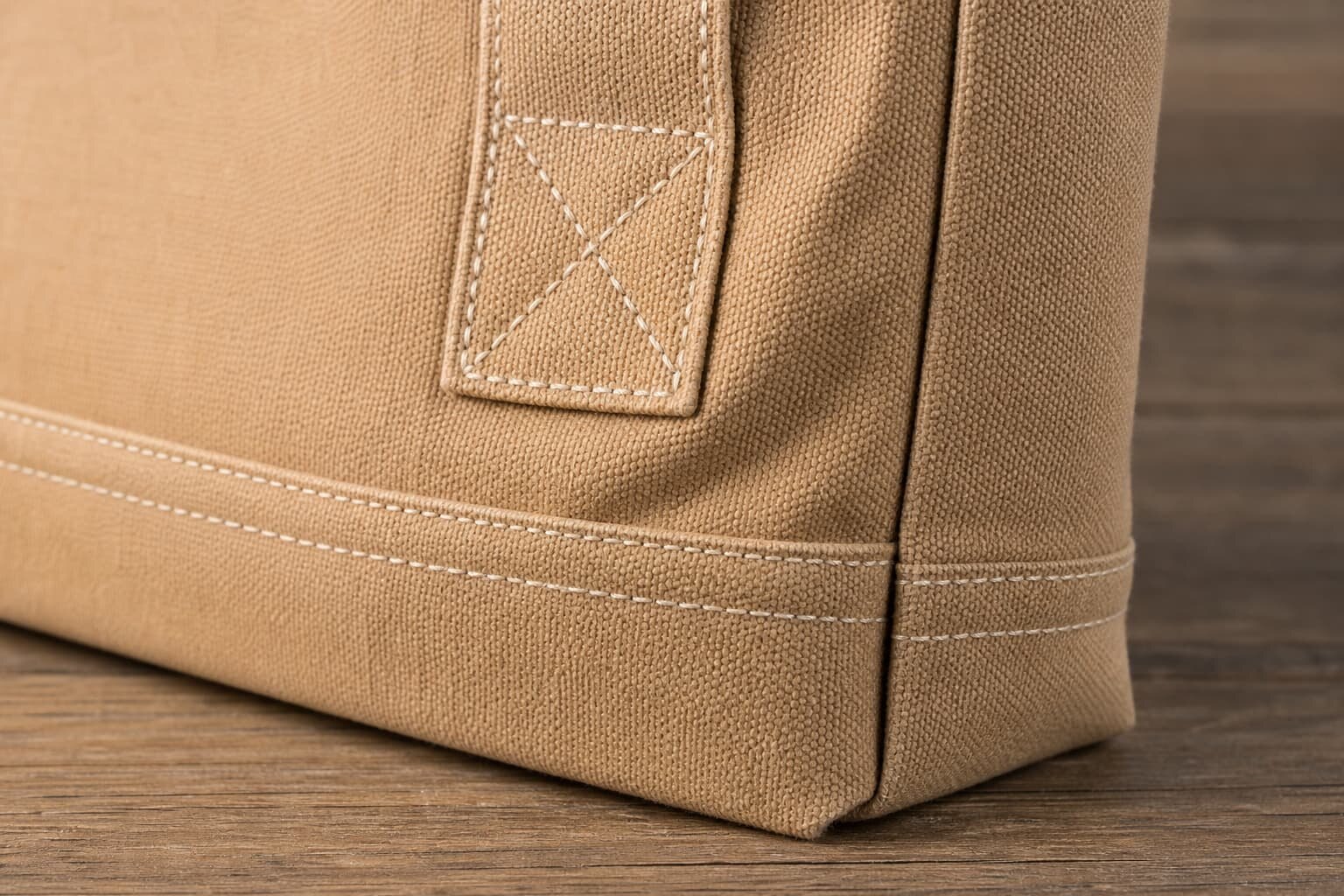
| Handle construction | Self-fabric handles with box-X stitching and bar-tacks | When the bag will carry daily retail use or repeated distribution | Check handle length, width, stitch density, and whether reinforcement is on both ends |
| Print method | Screen print for simple logos, embroidery or woven label for premium positioning | When artwork is limited to 1 to 3 colors or the buyer wants a durable brand mark | Ask for print size limits, color matching tolerance, and wash or rub resistance requirements |
| MOQ structure | Split MOQ by fabric color, print color, and trim color | When you need flexibility across SKUs or seasonal programs | Watch for hidden per-color minimums that make the quote look lower than it is |
| Packing format | Bulk packed with size and carton marks unless retail packing is required | When freight cost matters more than shelf-ready presentation | Confirm polybag specs, carton quantity, and whether inserts or hangtags are included |
| Lead time model | Pre-production sample plus 30 to 45 days for bulk after sample approval | When artwork, fabric dye, or custom trim needs approval before mass production | Check whether the factory is quoting calendar days from PO, sample approval, or deposit receipt |
Buyer checklist before sampling
- Confirm the exact canvas weight in GSM or ounces, plus whether that figure refers to greige, dyed, or finished fabric.
- Specify tote dimensions, gusset depth, handle length, handle width, and reinforcement stitching on the RFQ.
- State the print method, number of colors, print area, and whether artwork is on one side or both sides.
- Ask the factory to separate MOQ by fabric color, print color, and accessory color so the quote is comparable.
- Request sample photos, a pre-production sample, and any shade band or hand-feel reference for the fabric.
- Confirm packing method, polybag requirement, carton quantity, carton marks, and barcode or hangtag needs.
- Ask for target lead time from sample approval, not just from order placement.
- Get written clarification on tolerances for size, weight, stitch count, and color variance before approval.
Factory quote questions to send
- What is the fabric weight in GSM after finishing, and what tolerance do you allow from the stated spec?
- Is your MOQ based on bag color, print color, or total order quantity across all variants?
- What is included in the quoted unit price: bag only, printing, labeling, packing, and carton export marks?
- Which print method is being quoted, and what is the cost difference between one-color and multi-color artwork?
- Can you share a pre-production sample timeline and what approvals are required before bulk starts?
- What stitching standard do you use for handles, side seams, and bottom reinforcement?
- What packing configuration is used for the quote, and how does it change if we need retail polybags or inserts?
- What defect rate or QC standard do you apply for size, stains, broken stitches, and print misalignment?
Quality-control points to confirm
- Fabric weight matches the approved sample and finished GSM is checked, not only the supplier's raw fabric claim.
- Bag dimensions, gusset depth, and handle length fall within the agreed tolerance.
- Handle attachment uses box-X stitching, reinforced ends, and consistent stitch density.
- Print position, color, opacity, and edge sharpness match the approved reference sample.
- Seams are straight, seam allowance is consistent, and there are no skipped stitches or loose thread ends.
- No major shade variation appears across the same production lot unless the buyer approved intentional piece-dye variation.
- Carton quantity, packing style, and carton marks match the packing list and commercial invoice.
- Polybags, inserts, labels, and barcodes are applied exactly as approved.