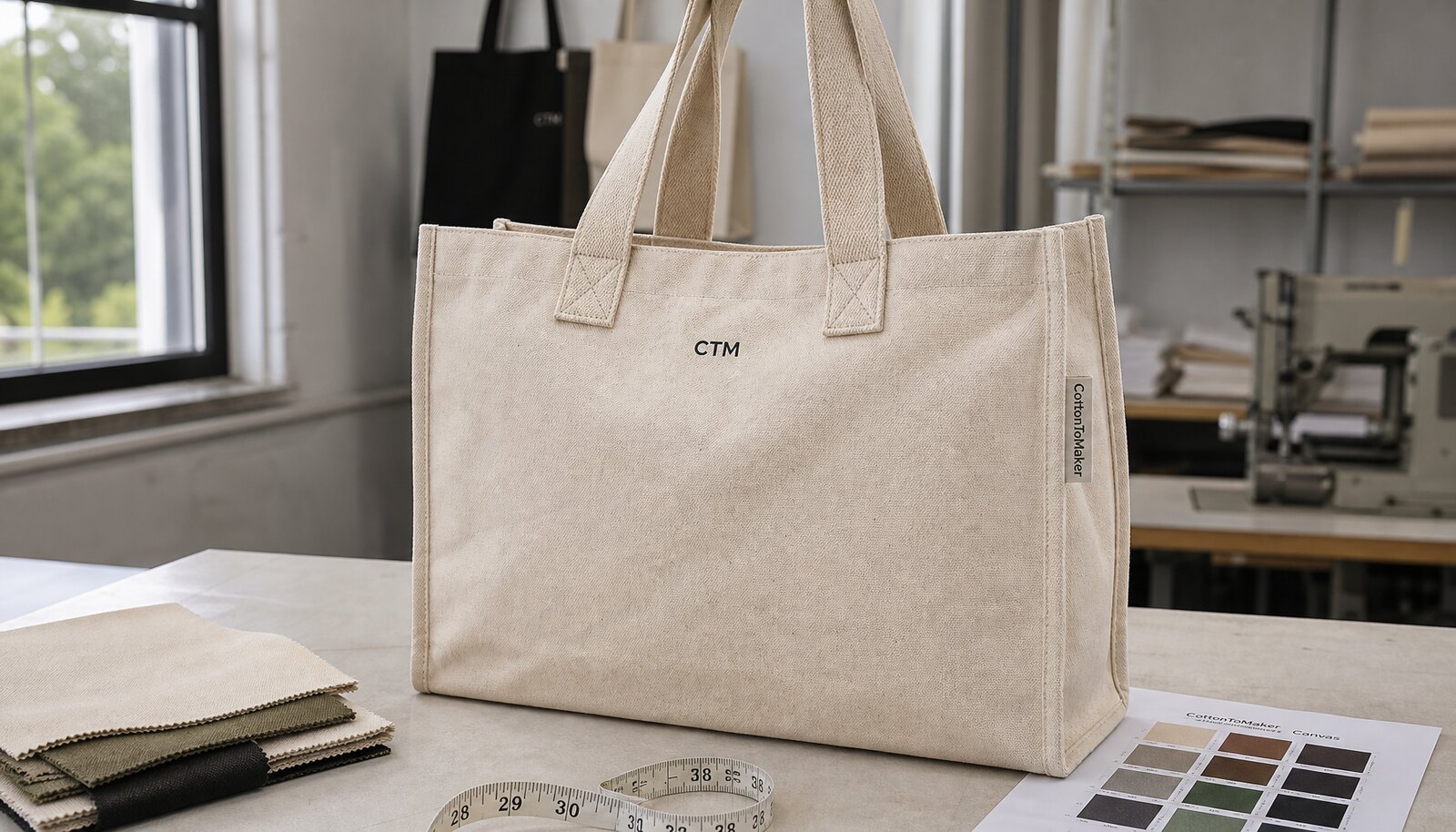
1. Why the sample approval memo matters for heavy canvas totes
A heavy canvas tote looks simple, but it is not a low-risk item when ordered in wholesale volume. The buyer is usually approving fabric weight, bag structure, print performance, handle strength, packing shape, and retail appearance at the same time. If the approval is only a short email saying “sample approved”, the factory may treat the sample as a general direction rather than a controlled production standard.
A sample approval memo is the document that turns a physical sample into a usable production reference. It tells the factory what is approved, what is rejected, what is still conditional, and which tolerances apply. For procurement teams and importers, it also becomes the bridge between the RFQ, quotation, purchase order, inspection checklist, and final shipment dispute resolution.
- Use the memo before bulk cutting, not after production starts.
- Keep one signed physical sample with the buyer and one with the factory production team.
- Attach photos and measurements because samples can be misplaced, compressed, or changed over time.
- Write down accepted imperfections, especially natural cotton seed marks and canvas slub.
2. Define the exact bag you are approving
The first part of the memo should identify the heavy canvas tote in plain manufacturing language. Do not rely only on a style name or marketing title. A factory may have several similar tote patterns with different gussets, seam methods, and handle constructions. Your approval memo should describe the physical product in enough detail that production, QC, and packing teams can all recognize the correct version.
For a wholesale buyer, the most important details are finished dimensions and construction. Finished size means the actual bag after sewing, trimming, pressing, and packing, not the paper pattern size. Heavy canvas can shrink, relax, or distort at seams, so the memo should state a tolerance that both sides can inspect consistently.
- Example size line: finished width 380 mm, height 420 mm, bottom gusset 100 mm, side gusset 100 mm, tolerance plus or minus 10 mm unless otherwise specified.
- Handle line: self-fabric canvas handles, 30 mm finished width, 600 mm total length, 280 mm handle drop measured from top edge to handle peak.
- Construction line: side seams bound inside with cotton binding tape, bottom gusset folded and double stitched, handle attached with cross-box reinforcement.
- Branding line: one-color screen print on front center, 220 mm wide, top of logo 110 mm below bag opening.
3. Fabric weight and canvas quality: do not approve by hand feel alone
Heavy canvas is commonly discussed in ounces, but buyers should also request GSM. A 12 oz canvas is often around 407 GSM, 14 oz around 475 GSM, and 16 oz around 542 GSM, depending on the measurement basis and finishing. Some quotations use commercial names rather than tested weight. This is why a signed fabric cutting or swatch should be attached to the approval memo.
Fabric weight alone does not decide bag quality. Yarn count, weave density, finishing, washing, and coating can all change hand feel and strength. A stiff 12 oz canvas can feel heavier than a softer 14 oz fabric, while a loosely woven canvas may look thick but fray badly at seams. The buyer should approve both numeric weight and practical appearance.
- Natural 12 oz canvas works for many corporate and retail programs where cost and print clarity matter.
- 14 oz canvas gives a more substantial hand feel for bookstore, merchandise, and premium gifting orders.
- 16 oz canvas is suitable for high perceived value but increases sewing difficulty, freight weight, and carton volume.
- Ask whether the fabric is greige, bleached, dyed, washed, enzyme washed, or treated with softener.
- If sustainability claims are involved, separate the material claim from the construction approval and request the relevant documentation from the supplier.
4. Print approval on heavy canvas: artwork that works on paper may fail on fabric
Heavy canvas has an uneven surface. The yarn texture, slub, and natural cotton particles affect how ink sits on the fabric. Thin lines, small reversed text, large solid ink blocks, and tight registration can all behave differently on 14 oz or 16 oz canvas compared with smooth cotton sheeting. A proper approval memo should reference the actual print strike-off on the final fabric, not only the digital artwork.
Screen print is usually the practical choice for solid logos and wholesale runs. Heat transfer can handle more detail, gradients, and photographic artwork, but it may change the hand feel and can look less integrated with a heavy natural tote. Embroidery is possible on some designs but can pucker heavy canvas if the panel is not stabilized correctly. The memo should state print method, ink type if important, color reference, placement, and accepted tolerance.
- Use Pantone references as a target, but approve the physical print because ink color changes on natural canvas.
- Specify logo placement from fixed bag edges, not only “centered”.
- For large solid prints, check cracking, pinholes, edge sharpness, and ink build-up.
- For multicolor screen print, approve registration tolerance and trapping method.
- Avoid approving a print strike-off made on a different fabric unless it is only for color direction.
5. Handle and seam construction: where wholesale tote failures usually start
Most heavy canvas tote failures are not caused by the front panel fabric tearing. They happen at handles, side seams, bottom corners, or poorly finished internal edges. The approval memo should describe reinforcement in a way that a sewing line can follow. Phrases like “strong handles” or “good stitching” are too subjective for inspection.
For heavier bags, self-fabric handles with cross-box stitching are common because they match the body and support the premium look. Cotton webbing handles may be cleaner and more consistent, especially for dyed bags, but shade matching can be an issue. Internal seam binding improves appearance and reduces fraying, while overlock-only seams may be acceptable for cost-sensitive promotional programs but should be approved knowingly.
- Check cross-box stitch size and position; it should fully catch the handle end and not be too close to the raw edge.
- Review stitch density, commonly around 7 to 10 stitches per inch depending on fabric and thread.
- Inspect bottom corners for bulk, skipped stitches, and fabric distortion.
- Ask if stress points use bartack, cross-box, double row stitching, or another defined method.
- For load-bearing claims, request a test method and target load rather than relying on a verbal promise.
6. MOQ logic: why the cheapest low-MOQ quote may not match the approved sample
MOQ for heavy canvas totes is not only a bag quantity. It is controlled by fabric availability, dyeing minimums, print setup, label production, cutting efficiency, and packing materials. A natural canvas tote with one-color screen print may have a lower practical MOQ than a dyed 16 oz tote with custom handles, woven label, hangtag, and retail barcode sticker. If the RFQ does not separate these factors, supplier quotes will be difficult to compare.
A sample approval memo helps prevent a common mistake: approving a beautiful sample made from leftover premium fabric, then receiving a bulk quote based on a different stock canvas. Before confirming the order, ask the factory to state which sample elements are included in the MOQ and quotation. If an element requires a higher minimum, decide whether to increase quantity, pay a surcharge, or simplify the specification.
- Natural canvas normally has more flexible material sourcing than custom dyed canvas.
- Custom dyed fabric may require a dye lot minimum even if the bag quantity is small.
- Woven labels, custom zipper pulls, metal hardware, and branded cartons may each have separate MOQs.
- Multiple print colors increase setup time and may affect sample and production cost.
- Retail packing can create a higher labor cost than the bag itself suggests.
7. Quote data buyers should collect before approving the sample
Sample approval should not be separated from commercial approval. A heavy canvas tote sample can be technically acceptable but commercially wrong if the quotation excludes setup charges, packing, inland freight, or inspection support. Before you sign the memo, confirm that the sample version is the same version used for the final quoted unit price.
For quote comparison, build a data line that includes fabric, construction, branding, packing, MOQ, lead time, and charge items. If two factories quote the same bag but one includes internal seam binding and the other uses overlock seams, their prices are not comparable. The memo should make hidden specification differences visible.
- Unit price by quantity tier, such as 500, 1,000, 3,000, and 5,000 pieces if relevant.
- Fabric specification: composition, weight, color, finish, and whether dyed to order or stock.
- Print charge: number of colors, setup cost, screen cost, strike-off cost, and repeat order handling.
- Sample charge: prototype, revised sample, pre-production sample, and courier fee.
- Packing data: pieces per carton, carton dimensions, gross weight, net weight, and whether cartons are export grade.
- Lead time basis: after artwork approval, after sample approval, after deposit, or after all materials arrive.
8. Packing approval: heavy canvas totes can be damaged by the carton, not the factory floor
Packing is often treated as an afterthought, but it affects the final appearance of heavy canvas totes. Thick canvas holds creases, especially if a printed panel is folded sharply or compressed under heavy cartons. For retail buyers, distributors, and ecommerce brands, the packing method should be approved together with the product sample.
There is no single correct packing method. Flat packing gives a clean presentation but increases carton size. Folding reduces freight volume but can create crease lines across the logo. Individual polybags protect from dust and moisture but may conflict with plastic reduction policies. Kraft belly bands, hangtags, and barcode labels improve retail handling but add labor and inspection points.
- State whether the bag is packed flat, half-folded, tri-folded, or rolled.
- Avoid placing a hard fold directly through a large printed logo when possible.
- Confirm if tissue paper, paper insert, or cardboard support is required for retail shape.
- Specify carton ply strength if cartons will be stacked for long sea freight.
- Include carton mark content, barcode placement, and mixed SKU rules if the order has multiple colors or designs.
9. Lead time and approval sequence: what should happen before mass cutting
A realistic production timeline starts before the factory cuts fabric. For heavy canvas totes, the approval sequence may include fabric swatch, lab dip for dyed goods, print strike-off, first sample, revised sample, pre-production sample, bulk material purchase, cutting, sewing, printing if printed after sewing, trimming, pressing, packing, inspection, and shipment booking. If the buyer approves only the first sample but later changes print size or packing, the timeline resets in practice.
The sample approval memo should state what the factory is allowed to do next. Sometimes approval means the factory can purchase bulk fabric but must wait for print strike-off approval. Sometimes it means full mass production can begin. Being precise protects both sides: the buyer avoids unwanted bulk production, and the factory avoids holding materials without clear authorization.
- Use separate approval statuses: approved, approved with comments, revise and resubmit, or rejected.
- List open points that are not approved yet, such as carton marking or final barcode file.
- Confirm whether bulk fabric can be cut before the final print strike-off is approved.
- Set a deadline for buyer feedback because delayed approval affects shipment date.
- Ask the factory to send a sealed or signed production reference sample to the sewing line.
10. Acceptance criteria to write into the memo
The strongest sample approval memo is not long because it repeats the PO. It is strong because it defines what will be accepted during inspection. For natural cotton canvas, some variation is normal. For logo placement, size, stitching, and packing, tighter control is usually possible. The buyer should separate natural material character from avoidable factory defects.
If your importer, distributor, or retail team uses third-party inspection, the memo should be shared with the inspection company before the inspection date. Otherwise, inspectors may judge the goods against generic standards that do not reflect the approved sample. A clear memo reduces arguments about whether a seed mark, shade variation, or slight handle drop difference is acceptable.
- Size tolerance: define plus or minus tolerance for finished width, height, gusset, and handle drop.
- Print tolerance: define acceptable color difference by approved sample, placement tolerance, and visible defect limits.
- Fabric tolerance: define acceptable natural flecks, slub, minor shade variation, and unacceptable stains or holes.
- Stitching tolerance: reject open seams, broken stitches at stress points, loose handles, severe puckering, and exposed raw edges if binding is approved.
- Packing tolerance: reject wet cartons, crushed cartons, wrong carton marks, incorrect SKU mix, and folds that permanently damage the logo.
- Reference hierarchy: purchase order, signed sample, sample approval memo, approved artwork, approved packing instruction, and inspection checklist.
Specification comparison for buyers
| Spec decision | Recommended option | When it fits | Buyer risk to check |
|---|---|---|---|
| Fabric weight | 12 oz / 407 GSM to 16 oz / 542 GSM cotton canvas | Retail merchandise, corporate gifting, bookstore, grocery, and reusable promotion programs | Some suppliers quote ounce by square yard while others use GSM; confirm conversion and actual fabric before washing or finishing |
| Construction | Side gusset with bottom gusset and internal seam binding | Orders needing higher loading capacity and cleaner inside finish | Unbound seams may fray after use; check whether binding tape is cotton, polyester, or self-fabric |
| Handle type | Self-fabric canvas handles with cross-box reinforcement | Heavier contents, premium look, matching body color | Handle drop may shrink after washing; confirm finished drop length, not only cut length |
| Print method | Screen print for solid logos; heat transfer only for detailed multicolor artwork | Most wholesale logo programs with one to four colors | Heavy canvas texture can break fine lines; approve print on final fabric, not on smooth test cloth |
| Color treatment | Natural/off-white canvas for fastest approval; dyed canvas for brand color programs | Natural canvas suits eco, craft, and retail campaigns; dyed canvas suits private label ranges | Dyed heavy canvas can vary by lot; ask for tolerance and confirm handle/body shade match |
| Sampling | Pre-production sample using bulk-intended fabric, trim, stitching, print, and packing | Before deposit release or before mass cutting on custom orders | A sales sample made from available stock fabric may not represent bulk order hand feel or shrinkage |
| Packing | Flat packed with paper insert or bulk carton packing depending on sales channel | Retail buyers may need flat presentation; distributors may prefer lower freight volume | Over-tight carton packing can crease heavy canvas and distort printed panels |
| MOQ logic | MOQ based on fabric dyeing, print setup, and cutting efficiency, not only bag quantity | Custom fabric color, large logo, or branded packing orders | Very low MOQ may force stock fabric substitution or higher unit cost; clarify what changes at each quantity tier |
Buyer checklist before sampling
- Confirm whether the approved sample is a sales sample, size set sample, or true pre-production sample made from bulk-intended materials.
- Record finished bag dimensions: width, height, bottom gusset, side gusset, handle width, and handle drop after pressing.
- Check fabric weight by GSM or oz/yd² and keep a small signed fabric cutting with the approval file.
- Confirm canvas composition: 100% cotton, recycled cotton blend, cotton-poly blend, or organic cotton if required by your program.
- Review fabric hand feel, stiffness, slub, seed marks, dye shade, and any wash or finish effect before approving bulk cutting.
- Measure stitch density and review cross-box, bartack, or reinforced handle construction under expected loading.
- Approve logo size, placement, print color, ink hand feel, edge sharpness, and registration on the actual heavy canvas fabric.
- Check whether internal seams are overlocked, bound, French seamed, or raw edge; write the accepted construction into the memo.
- Confirm packing method, folding direction, carton quantity, carton size, barcode position, polybag use, and any plastic-free requirement.
- List acceptable tolerances for size, fabric shade, print position, stitching, and minor natural cotton marks.
Factory quote questions to send
- Is the quoted canvas weight based on finished fabric GSM, greige fabric, or supplier commercial ounce rating?
- Can you provide fabric swatch, lab dip, and print strike-off before making the full pre-production sample?
- Will bulk production use the same fabric mill lot, dye lot, handle material, thread, and binding tape as the approved sample?
- What are the size tolerances for heavy canvas totes after cutting, sewing, pressing, and packing?
- Which print method is included in the quote, and what is the maximum printable area on this bag size?
- Are screen setup charges, mold charges, artwork adjustment, lab dip, sample fee, courier fee, and bank charges included or separate?
- What MOQ applies to natural canvas, dyed canvas, custom webbing, branded label, and retail packing separately?
- What is the production lead time after sample approval, and what activities must be completed before the lead time clock starts?
- How many pieces per export carton, what is the estimated carton size and gross weight, and can packing be optimized for our freight method?
- What inspection standard will you accept before shipment, and can the sample approval memo be used as the reference document during final inspection?
Quality-control points to confirm
- Fabric weight verification against approved swatch using GSM cutter or weighed cutting method.
- Finished measurement check for width, height, gusset, handle width, and handle drop using the same measuring method as approval.
- Handle strength review including stitch reinforcement, thread breaks, loose ends, and seam slippage.
- Print adhesion and appearance check on heavy canvas texture, including rubbing, cracking, pinholes, registration, and color difference.
- Needle damage, skipped stitches, puckering, fraying, and seam allowance inspection on stress points.
- Shade matching between body panels, gusset panels, handles, binding tape, and any external pocket.
- Logo placement tolerance check from top edge, side seam, and bag centerline.
- Packing check for folding marks across printed areas, carton compression, moisture protection, and retail label accuracy.
- Metal detection or needle policy confirmation if required by retailer compliance.
- Final inspection against signed sample, approval memo, purchase order, artwork file, and approved packing standard.