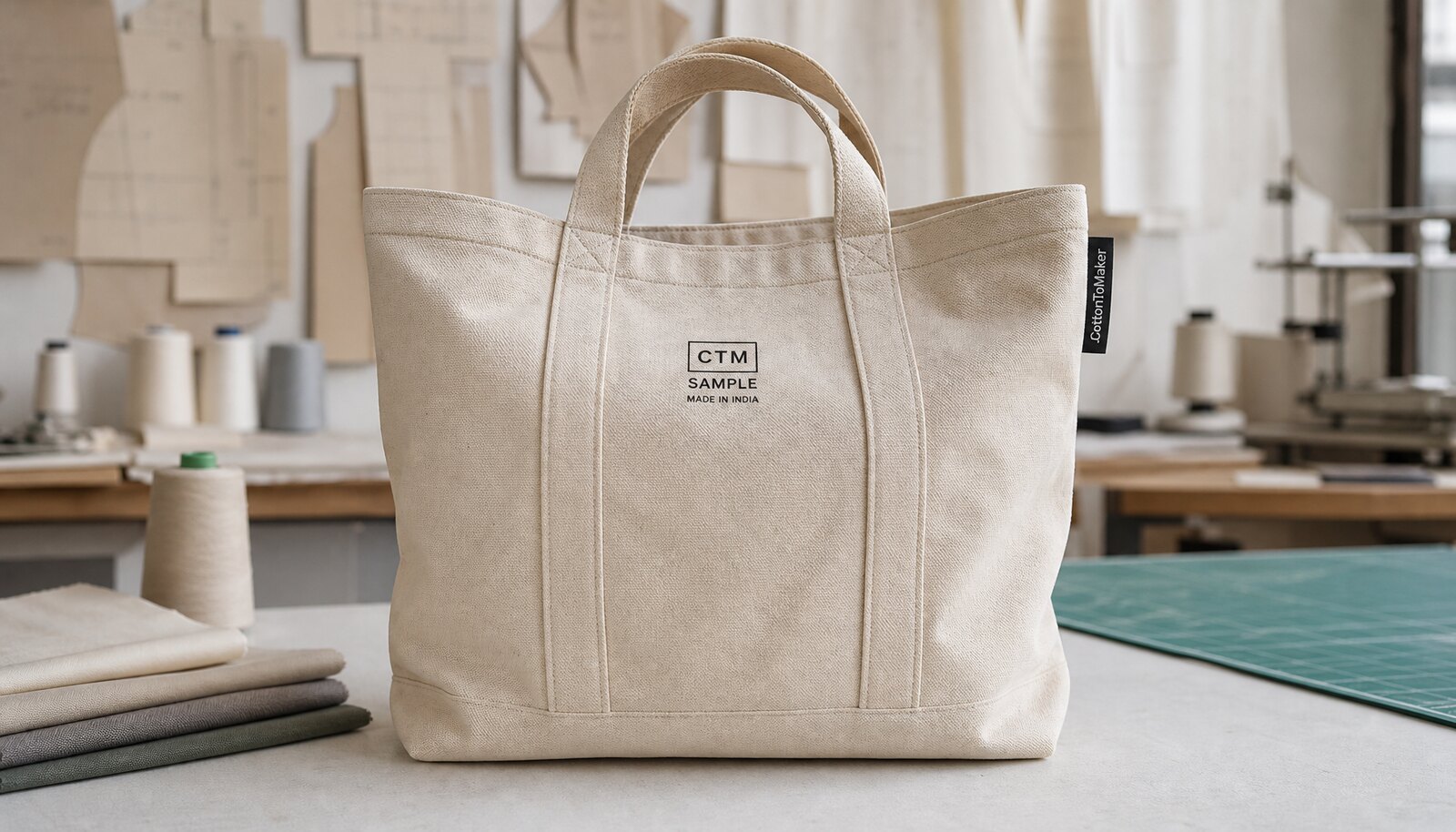
Start With a True Spec, Not a Generic Tote
A heavy canvas tote looks straightforward until you compare supplier quotes line by line. One factory may be quoting 12 oz canvas with a basic turned handle, while another is pricing 16 oz fabric, reinforced bartacks, and a cleaner print process. If you do not define the spec first, the lowest quote often just means the lightest build. For wholesale buyers, that creates the worst kind of problem: the sample can look acceptable, but bulk production misses the use case.
Before you ask for pricing, write the bag down as a product, not a category. State the finished dimensions, fabric weight, handle length, closure, gusset, lining, logo method, and pack format. That sounds basic, but it is the fastest way to filter out factories that only sell generic promo totes and cannot hold a stable production standard. A serious supplier should quote the same bag every time, not reinterpret it on each reply.
- State exact finished size in inches or cm.
- Specify canvas weight in gsm or ounce weight.
- Define handle material and attachment style.
- Name the logo method and print location.
- Fix the packing method before comparing quotes.
Audit Fabric Weight, Finish, and Shrinkage
The word heavy is not a spec. For canvas totes, buyers usually need the finished fabric weight, not a marketing description. A practical wholesale range is often around 12 oz to 16 oz, which roughly maps to about 400 to 560 gsm depending on weave and finish. Twelve ounce canvas can work for value programs, but if the bag is meant to carry books, samples, wine, or retail purchases, 14 oz or 16 oz usually gives a better hand feel and better shape retention. Ask the supplier whether the weight is measured before or after washing, coating, or dyeing, because that changes the real comparison.
Also ask how the fabric behaves after cutting and sewing. Heavy canvas can shrink, skew, or soften differently from one mill lot to the next, especially if the supplier uses mixed yarn sources or a loose weave. For a buyer, the most useful check is not only the weight number but also the swatch itself: fold it, rub it, and look at the weave density. A bag that feels stiff in the sample room but relaxes after washing can change dimensions enough to affect print placement and carton packing.
- Ask for finished gsm, not only raw cloth weight.
- Request a swatch from the same dye lot as the quote.
- Check for shrinkage after a wash or steam test.
- Look at weave density, not just the fabric name.
- Confirm color consistency across roll lots.
Check Construction Where the Bag Carries Load
The failure points on a heavy canvas tote are usually the same: the handle attachment, the bottom corners, and the top edge near the opening. If the quote does not describe those areas clearly, the supplier is leaving the most important strength decisions open. A good production spec should say whether the handles are cotton webbing, self-fabric, or folded canvas, and whether the attachment uses a box stitch, cross stitch, or bartack. For heavier fills, bartacks on each stress point are worth the small cost increase because they keep the bag from tearing at the first hard use.
The body construction matters too. A gusset adds usable volume and helps the bag stand better, but it also changes seam load and print alignment. A reinforced base, double-needle stitching, or a bound seam can make a big difference in how the tote survives retail handling and repeated carry cycles. Buyers should not approve a sample just because it looks neat on a table. Lift it with a realistic load, watch the handle attachment, and check whether the side seam twists or the base collapses.
- Prefer box stitch plus bartack on handle ends.
- Check seam allowance and stitch straightness.
- Test the bag with a realistic loaded weight.
- Review gusset symmetry and bottom alignment.
- Ask for the stitch method in the quote, not after sample approval.
Choose the Right Logo Method for Heavy Canvas
Heavy canvas takes decoration differently from a smooth poly surface. For a simple one-color logo, screen print is usually the cleanest and most cost-effective choice because the fabric can hold ink well if the mesh, cure, and pressure are controlled. For richer brand programs, embroidery, a woven label, or a sewn patch can look more premium, but they also change the cost structure, the minimum order, and the production schedule. If the buyer wants sharp line art or a small logo with fine detail, the supplier should explain whether the artwork needs simplification before production.
What matters most is matching the logo method to the weave and the market. Thick canvas can make tiny type look fuzzy, and oversized prints can stiffen the panel too much. Ask the factory to tell you the print size in centimeters, the placement from the top seam and side seam, the number of colors, and whether the artwork needs a separate screen or embroidery file. This is where many quote comparisons fail: one supplier includes setup cost, another splits it out, and a third quietly assumes a different logo size. You want the same artwork, the same position, and the same finish from every factory you compare.
- Use screen print for simple brand marks and repeat orders.
- Use embroidery or woven labels for premium positioning.
- Confirm print size and placement in centimeters.
- Ask how the method affects hand feel and stiffness.
- Verify whether setup fees are included in the unit price.
Use Samples to Lock the Approval Standard
A sample is useful only if it behaves like a contract. Ask for a pre-production sample that reflects the exact fabric weight, handle material, print method, and packing format. Do not approve from a polished sales sample if the bulk order will use a different roll lot or a different print screen. The strongest approval file usually has one signed physical sample, one set of measurements, and one written note on any accepted variation. That gives both sides a clear reference when the first bulk carton comes off the line.
When you review the sample, inspect more than appearance. Measure the body and handle, check symmetry, pull on the attachment points, and verify the print registration. If the bag has a zipper, inner pocket, lining, or side label, inspect those too because every added component introduces another place for dimensional drift. Ask the supplier to send photos of the exact sample with a ruler in frame if you need a remote review, but do not let photos replace the physical approval if the order is material.
- Approve a measured pre-production sample, not a sales sample.
- Record acceptable tolerances for size and logo placement.
- Keep one signed reference sample on both sides.
- Check pull strength, seam finish, and print registration.
- Confirm any optional parts before bulk begins.
Work Out MOQ and Price Drivers Before Comparing Quotes
MOQ is not just a factory rule. It is usually the result of fabric roll usage, print setup, sewing efficiency, and packing economics. A heavy canvas tote with one logo color and a standard handle can often support a lower MOQ than a tote with multiple colors, lining, and custom labels. Once you add embroidery, woven tags, zipper pockets, or a special carton format, the lot size has to absorb more setup time and more scrap. That is why two quotes can be far apart even when the unit bag looks similar on paper.
A useful quote should break out what is driving the price. Ask for the fabric cost, sewing cost, logo cost, packing cost, carton cost, and any special setup fee. Then compare the MOQ for the exact same spec, not for a simplified version of it. If a supplier offers a very low MOQ but refuses to state whether the sample fee is credited, whether the print screen is reusable, or whether the same price applies on reorder, the quote is not really complete. It is just light on detail.
- Ask for price by spec, not by generic tote category.
- Separate unit price from setup and artwork fees.
- Check reorder MOQ and whether screens or files are reusable.
- Confirm if multiple colors change the minimum lot.
- Request the price ladder for 1,000, 3,000, and 5,000 units if relevant.
Inspect Packing and Carton Data, Not Just Unit Price
A tote can be perfect in the sewing room and still arrive damaged if packing was treated as an afterthought. Heavy canvas holds shape, but it also takes up space, so the fold method and carton plan matter. Ask whether the bags are flat folded, rolled, polybagged, or packed loose, and whether a moisture barrier or desiccant is used for long ocean transit. For retail or distributor programs, the buyer should know how many pieces go into each inner bag and how many pieces fit into one master carton without crushing the fabric edge or print surface.
Packing data also affects landed cost. Two suppliers can quote the same unit price, but one uses a compact carton that saves freight while the other ships a bulky box with poor pallet efficiency. Ask for carton dimensions, gross weight, ship marks, and whether the carton is drop-tested or compression-tested. If the tote has a structured base or attached accessories, check how the packing method protects those parts. This is not administrative detail. It is where good product margins can disappear if nobody looked closely.
- Request the inner pack and master carton count.
- Confirm folding direction and print protection.
- Check carton size, gross weight, and pallet fit.
- Ask for moisture protection on export shipments.
- Verify that pack data matches the quote and the sample.
Review Lead Time as a Production Schedule, Not a Promise
Lead time for a heavy canvas tote usually depends on more than sewing capacity. Raw fabric availability, dye lot timing, print screen setup, label sourcing, sample approval, and packing material all affect the calendar. When a factory gives a single number without a production breakdown, you cannot tell where the risk sits. A better answer divides the timeline into sampling, material reservation, bulk cutting, sewing, printing, finishing, and carton packing. That is especially useful for seasonal retail programs or launch dates with a fixed ship window.
The fastest supplier is not always the safest one. A rushed tote order often fails at the exact moment the buyer needs it to be stable: the artwork is approved from a low-res file, the fabric lot changes after sample signoff, or the carton spec is adjusted without notice. Ask what triggers a delay and what happens if one part is late. That tells you whether the factory manages production with discipline or just hopes the line will absorb the problem. For repeat orders, the best suppliers can explain how they protect the approved spec when a raw material shift happens.
- Ask for a timeline by process step, not one flat date.
- Confirm what happens if fabric or label stock runs short.
- Check whether holiday or peak-season capacity changes the schedule.
- Verify the sample approval deadline in writing.
- Ask how the factory handles spec changes after production starts.
Audit the Factory for Traceability and Consistency
A supplier audit for tote bags does not need to be theatrical. What matters is whether the factory can repeat the same spec cleanly and document what it made. Look for organized fabric storage, labeled work-in-process, clear pattern control, and a defined inspection point before packing. If a factory cannot show how it tracks fabric roll numbers, print batches, or approved samples, it will be harder for them to explain a defect later. That matters more than polished sales talk, because tote bags are simple enough that consistency should be visible in the room.
During an audit, ask to see the line doing an actual order or a close production equivalent. Review cutting accuracy, seam quality, logo registration, and final inspection steps. If the factory has no stable sample room or cannot show a current reference sample, treat that as a warning sign. A good supplier should be able to explain who signs off the first article, who checks the bulk, and how rejected pieces are handled. Buyers do not need a perfect plant. They need a plant that knows where variation comes from and how to hold it inside a narrow band.
- Check fabric roll traceability and batch labeling.
- Look for a current approved sample at the line.
- Review in-process and final inspection points.
- Ask who signs off first article and bulk release.
- Confirm how rejects are separated and recorded.
Compare Quotes on One Line Item Grid
Once the supplier data is clean, build a quote grid that puts every factory on the same basis. The grid should show fabric weight, dimensions, handle spec, print method, MOQ, sample charge, setup charge, pack method, carton size, lead time, and payment terms. That lets procurement see the real difference between a higher unit price with better control and a lower price that hides a weak spec. For a heavy canvas tote, the cheapest quote is often the one that leaves out the most detail.
The final decision should reward clarity, not just price. A supplier that answers precisely on gsm, stitch method, carton data, and reorder conditions is usually easier to manage after the PO lands. When the quote is vague, the production risk moves to your team, because every missing detail becomes a follow-up call during sampling or shipping. Use the same grid for every tender and the buying decision gets much faster, because weak offers start to separate themselves without argument.
- Compare all suppliers on the same spec sheet.
- Treat missing data as a quote weakness, not a minor gap.
- Favor clear reorder terms over vague low pricing.
- Keep the approved sample attached to the final PO file.
- Document the buyer signoff before production release.
Specification comparison for buyers
| Spec decision | Recommended option | When it fits | Buyer risk to check |
|---|---|---|---|
| Fabric weight | 14 oz to 16 oz finished canvas, roughly 475 to 560 gsm | Retail programs, premium promo, reusable shopping, heavier daily carry | Ask whether gsm is finished fabric or raw cloth and confirm shrinkage after wash |
| Handle construction | 25 to 30 mm cotton webbing with box stitch and bar-tacks | Most wholesale tote programs that need load-bearing handles | Check handle length, stitch density, and whether the attachment point can pass a pull test |
| Logo method | Single or two-color screen print, or woven label for premium looks | Clean brand marks, simple artwork, repeat orders | Confirm ink hand feel, cure quality, and whether the print can crack on a heavy weave |
| Body structure | Single-layer canvas with gusset and reinforced base, or light lining for shape | General retail and distributor programs where cost and weight matter | Inspect panel alignment, seam allowance, and whether the bottom can stand without twisting |
| Packing format | Flat folded bulk pack with master carton spec written into the quote | Export orders and mixed-SKU shipments | Check fold direction, carton count, moisture protection, and carton compression strength |
Buyer checklist before sampling
- Confirm the finished fabric weight in gsm and the equivalent ounce weight, not just the phrase heavy canvas.
- Lock the bag dimensions, gusset depth, handle length, and placement before asking for pricing.
- Choose the print method and number of colors before comparing quotes.
- Request a stitched or measured sample that matches the final handle construction and seam type.
- Ask for a clear MOQ by color, by artwork, and by packing configuration.
- Verify whether sample fees, plate fees, embroidery fees, or carton fees are included or separate.
- Review the packing method, carton dimensions, carton count, and gross weight.
- Confirm the lead time for raw material, sample approval, bulk sewing, printing, and final packing.
- Ask which inspection standard or measurement tolerance the factory uses on bulk output.
- Keep one approved pre-production sample, one sealed reference sample, and one packing spec sheet on file.
Factory quote questions to send
- What is the finished fabric weight in gsm, and can you state the equivalent ounce weight?
- Is the canvas dyed before sewing, after sewing, or by a print-and-cut workflow?
- What handle material, width, length, and stitch pattern are you quoting?
- How many stitches per inch or cm are used on the main seams and handle attachments?
- What is the MOQ for this exact spec, including color, logo, and packing method?
- What separate charges apply for screen setup, embroidery digitizing, woven labels, or artwork revision?
- What are the dimensions tolerance limits for body size, handle length, and gusset depth?
- Can you share a packing spec with inner bag count, carton size, carton weight, and shipping marks?
- What is the timeline from artwork approval to pre-production sample, bulk production, and final packing?
- Which inspection points do you verify before shipment, and can you send photos of the current line or sample room?
Quality-control points to confirm
- Measure finished bag width, height, gusset, and handle length against the approved sample.
- Check fabric weight, hand feel, weave density, and color consistency across the batch.
- Inspect handle bartacks, corner reinforcement, and stitch straightness on the main seams.
- Test logo placement, color match, cure quality, and wash or rub resistance if the artwork is printed.
- Open random packed units to confirm folding method, quantity per polybag, and carton count.
- Verify that labels, care tags, and country-of-origin marks match the approved artwork and market requirement.
- Check for odor, loose threads, seam puckering, and needle damage before carton sealing.
- Record carton dimensions, gross weight, and any compression or moisture protection used for export.