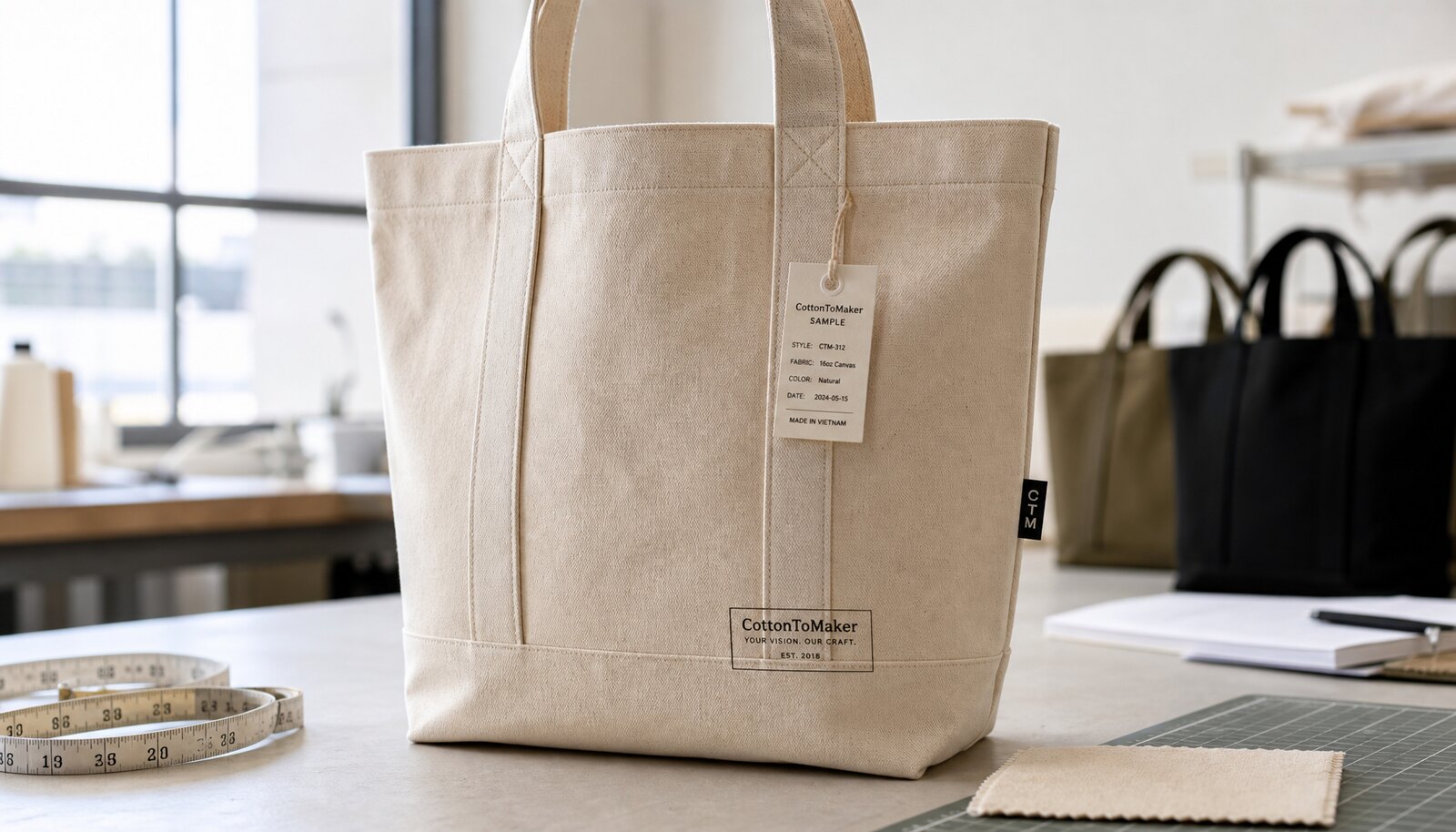
1. Start with the buying problem, not the bag name
A heavy canvas tote sounds simple until quotes arrive with different fabric weights, handle constructions, print methods, and packing assumptions. For a startup brand, that gap can turn a first launch order into a slow approval loop. The real buying problem is not finding any tote supplier. It is defining a production specification tight enough that three factories are quoting the same product.
Before requesting prices, decide what job the tote must do. A resale tote needs better structure, cleaner stitching, and more controlled print placement than a giveaway bag. A launch-kit tote may need safe packing to protect shape and print surface. A distributor stock tote needs repeatable sizing and carton efficiency. These use cases may look similar in photos, but they lead to different material and inspection choices.
- For retail resale, prioritize fabric handfeel, seam finish, print durability, and barcode or hangtag requirements.
- For brand launch gifting, prioritize appearance consistency, packing cleanliness, and delivery schedule control.
- For wholesale distribution, prioritize standard size, carton quantity, repeat-order fabric availability, and cost stability.
- For ecommerce packaging, prioritize flat packing, lower carton volume, and scuff-resistant print.
2. Define heavy canvas by GSM, oz, and finished condition
Heavy canvas tote buyers often describe fabric as 12 oz, 14 oz, 16 oz, or 18 oz. Factories may also quote GSM. As a practical reference, 12 oz canvas is often around 400 GSM, 14 oz around 475 GSM, 16 oz around 540 GSM, and 18 oz around 610 GSM, but these are approximate because weaving density, yarn count, finishing, and shrinkage change the result. A good RFQ should include both oz and GSM range, then ask the supplier to confirm their actual finished fabric.
The most common mistake is comparing a 16 oz finished canvas quote against another supplier's 16 oz greige fabric quote. Greige fabric is unfinished fabric before dyeing, washing, softening, or other treatment. Finished fabric can shrink, gain body, lose weight, or change handfeel depending on processing. If your approved sample is made from one fabric condition and bulk production uses another, the tote may not stand the same way or print the same way.
- 12 oz canvas: useful when cost and freight are tight, but may feel less premium for resale.
- 14 oz canvas: common middle option for branded totes with reasonable structure.
- 16 oz canvas: strong choice for startup brands wanting a heavy retail feel without extreme bulk.
- 18 oz canvas and above: premium and rigid, but higher sewing difficulty, freight weight, and needle mark risk.
- Always ask if the quoted GSM is before washing, after washing, or measured on the finished roll used for sewing.
3. Lock size, gusset, and handle details before comparing quotes
A heavy canvas tote price changes quickly with small size changes because fabric consumption is the main cost driver. A bag that is 38 x 42 cm flat uses less fabric and sewing time than a 40 x 35 x 12 cm boxed-bottom tote. Startup buyers sometimes send only a front-view drawing, then receive quotes that look cheaper because one supplier assumed no gusset, shorter handles, or a smaller hem allowance.
Handle specification is equally important. A shoulder tote usually needs a handle drop of about 25 to 30 cm, while a hand-carry tote can use a shorter drop. Handle width, fabric thickness, folding method, and reinforcement stitches affect comfort and strength. If you want self-fabric handles, specify that. Otherwise a quote may use cotton webbing because it is faster to sew and easier to standardize.
- State finished dimensions as width x height x gusset, for example 38 x 42 x 10 cm.
- Specify handle length or handle drop, not just total strap length from a photo.
- Require cross-stitch or box-stitch reinforcement at the handle attachment for heavier loads.
- Define top hem depth, for example 2.5 cm folded hem with lockstitch.
- If you need the bag to stand better, request a boxed bottom instead of only a side gusset.
4. Match print method to canvas texture and artwork risk
Screen printing is still the practical default for most heavy canvas tote production. It works well for one to three solid colors, bold logos, and simple brand graphics. On coarse canvas, however, very fine lines, small reversed text, and heavy solid ink blocks need review. The weave texture can break fine artwork, and thick ink may crack or feel stiff if curing is not controlled.
Heat transfer, digital print, embroidery, woven labels, leather patches, and sewn patches all have valid uses, but each changes cost and inspection. Heat transfer can help with gradients or complex small-quantity artwork, but buyers should test adhesion and handfeel. Embroidery gives a premium look, but it can distort the canvas if the logo is dense and the backing is not suitable. A sewn woven label is often the safest branding option when the front print must remain clean or when repeat orders may use different bag colors.
- For a startup logo in one color, request screen print with Pantone reference and a cured ink rub test.
- For artwork with gradients or photo detail, ask for a print sample before approving bulk.
- For small premium branding, compare woven side label, front patch, and embroidery instead of forcing a complex print.
- For dark dyed canvas, confirm ink opacity and whether an underbase is needed.
- Specify print size and placement from bag edges, not only centered position.
5. Understand MOQ logic so you do not negotiate the wrong number
MOQ for heavy canvas totes is not one number. There may be separate minimums for fabric procurement, custom dyeing, printing setup, label production, and efficient sewing-line arrangement. A supplier may accept 300 pieces using in-stock natural canvas, but require 1,000 or more pieces for custom dyed canvas because the dye lot and fabric mill minimum drive the cost. The same applies to custom webbing, special zipper pockets, and branded packing materials.
For startup brands, the smartest approach is to separate launch MOQ from repeat-order MOQ. If you are still validating demand, choose natural canvas, one print color, standard construction, and simple packing. If you need a fully custom dyed tote with inside pocket, printed lining, woven labels, retail tags, and individual cartons, accept that the MOQ and lead time will rise. Trying to push a complex custom build into a very small MOQ often leads to hidden compromises.
- Ask for MOQ by fabric color, print design, print color count, and total order quantity.
- Request a price ladder such as 300, 500, 1,000, 3,000, and 5,000 pieces if your forecast is uncertain.
- Use stock natural canvas for first launch when speed and budget matter more than exact brand color.
- Avoid custom dyed fabric unless the order quantity supports dye lot control and lab dip approval.
- Check whether the sample fee and print setup fee are refundable or separate production costs.
6. Build a quote sheet that exposes real cost drivers
A useful heavy canvas tote quote should show more than unit price. Procurement teams need enough detail to understand why one quote is higher or lower. Fabric weight, cutting method, seam finish, print technique, packing, carton quantity, and export terms can all change the final landed cost. A cheap unit price with heavier cartons, unclear packing, or missing label work is not always cheaper after rework and freight.
Ask suppliers to quote the same specification in a structured format. If one factory includes individual polybags and another quotes bulk packed, compare both ways. If one supplier includes barcode labeling and another treats it as an add-on, the purchasing decision should reflect that. For startup brands, quote clarity is also a test of supplier discipline. A factory that cannot confirm basic fabric and packing data during quotation may also struggle during production control.
- Product: size, gusset, fabric weight, fabric color, handle style, and construction.
- Decoration: print method, print size, color count, Pantone references, setup fee, and sample fee.
- Accessories: labels, hangtags, barcode stickers, care labels, and country of origin labels.
- Packing: individual packing, pieces per carton, carton size, gross weight, and net weight.
- Commercial terms: MOQ, price ladder, sample lead time, bulk lead time, payment terms, and Incoterms.
- Validity: quote expiration date and assumptions for raw cotton price or exchange rate changes.
7. Sampling should prove production, not just appearance
Many first samples are made to show the concept, but a pre-production sample should prove that the factory can make the bulk order correctly. It should use the final canvas weight, final color, final handle construction, final print method, final label placement, and final packing if time allows. If the sample is made from substitute fabric or hand-cut panels, mark it clearly as a reference sample rather than a production approval sample.
Heavy canvas sampling also needs measurement and strength checks. Because thick fabric has spring-back and shrinkage, finished dimensions can vary. A sample may look good in photos but fail when loaded, folded, or rubbed. Ask the supplier to send close-up photos of handle reinforcement, top hem, bottom corners, inside seams, print edges, and carton packing. If the order is important, keep one approved sample with your team and one sealed sample with the factory for bulk comparison.
- Check finished size with a tape measure on a flat surface, without stretching the bag.
- Load test the tote with a realistic weight for your use case and inspect handle attachment.
- Rub the printed area with a dry cloth and slightly damp cloth after curing.
- Review seam allowance and loose threads inside the bag, not only the front panel.
- Approve a physical pre-production sample before bulk when using custom dye, complex print, or retail packing.
8. Set acceptance criteria for heavy canvas defects
Heavy canvas is a natural textile, so buyers should distinguish acceptable character from rejectable defects. Small slubs or minor yarn variations may be normal on natural canvas. Oil stains, dark contamination, needle damage, severe weaving flaws, crooked panels, skipped stitches, and visible print smears are not normal. If your brand sells at retail, your acceptance criteria should be tighter than a basic promotional goods order.
Measurement tolerance should be realistic. Heavy cotton fabric can shrink and move during cutting and sewing. A common tolerance range may be around plus or minus 1 cm for main dimensions, depending on size and construction, but you should agree it before production. Print placement tolerance should also be defined, for example plus or minus 0.5 cm or 1 cm from approved artwork position. Without a written tolerance, disputes become subjective.
- Reject visible oil marks, rust marks, mold odor, and stains on the front print area.
- Reject broken stitches, skipped stitches at handles, open seams, and weak top hem closure.
- Define acceptable natural fabric slub level if using unbleached canvas.
- Set measurement tolerance for width, height, gusset, handle drop, and print placement.
- Require carton-level inspection for mixed logo versions, mixed colors, or wrong packing counts.
- For dark colors, check rubbing fastness because dye transfer can damage customer clothing or other goods.
9. Packing decisions affect freight, presentation, and claims
Packing is often treated as an afterthought, but it can create real cost and quality problems. Individual polybags protect each tote from dust and rubbing, but they add material cost, labor, and volume. Paper bands or kraft sleeves can improve retail presentation but need accurate placement and may crush during export if cartons are too full. Bulk packing is efficient, but front print panels can rub if the ink is not fully cured or if the bags move during transit.
For export cartons, ask for carton size, gross weight, net weight, and pieces per carton before confirming the order. Heavy canvas becomes heavy quickly, and cartons that are too large may be difficult for warehouse teams to handle. Moisture protection is important, especially for natural cotton canvas. A simple inner poly liner or moisture-control plan may prevent odor, mildew risk, or water marks during long transit.
- Use individual polybags when bags are retail-ready, light-colored, or have high-value printed panels.
- Use bulk packing when cost and warehouse efficiency matter more than individual presentation.
- Confirm whether bags are folded, flat packed, or rolled, because fold marks affect display.
- Request carton marks with item code, color, quantity, PO number, carton number, and country of origin if required.
- Check carton weight limits against your warehouse or retailer receiving requirements.
10. Plan lead time around approvals, not only sewing days
A factory lead time estimate usually starts after sample approval, deposit, artwork confirmation, and material availability. Startup teams often count from the day they send the first inquiry, which is not realistic. The real schedule includes quote clarification, artwork adjustment, sample making, sample shipping, buyer review, revision if needed, material booking, cutting, printing, sewing, trimming, final inspection, packing, and export handover.
For a simple natural canvas tote with one-color screen print, the process is much faster than a custom dyed 16 oz tote with multiple labels and retail packing. To protect your launch date, build a backward schedule from the required warehouse arrival date. Include time for international freight, customs, local trucking, and possible inspection correction. If the launch cannot move, reduce specification complexity rather than assuming production can safely compress every step.
- Confirm when lead time starts: after deposit, after sample approval, or after material arrival.
- Reserve extra time for lab dips if using custom dyed canvas.
- Approve artwork size and Pantone references before screen setup.
- Ask when fabric cutting begins and whether changes are still possible after that point.
- Schedule final inspection before balance payment or shipment release when order value justifies it.
Specification comparison for buyers
| Spec decision | Recommended option | When it fits | Buyer risk to check |
|---|---|---|---|
| Main body fabric | 14 oz to 16 oz cotton canvas, approx. 475 to 540 GSM before washing | Startup retail tote, merch bag, subscription gift, or premium launch kit needing structure without excessive freight weight | Confirm whether the quoted weight is greige, finished, or washed fabric; finished GSM can shift after dyeing or washing |
| Bag construction | Flat tote with boxed bottom and side gusset, 2.5 cm to 3 cm folded seams | Good balance of shelf presence, usable capacity, and stable printing area | Check gusset depth tolerance and whether bottom corners are cleanly squared or loosely folded |
| Handle style | Self-fabric canvas handles, cross-stitch reinforced at top hem | Retail brands that want a matched heavy look and comfortable shoulder carry | Low-cost quotes may use thinner webbing or fewer reinforcement stitches unless specified |
| Print method | Screen print for 1 to 3 solid colors; heat transfer only for artwork with gradients or small MOQ color complexity | Most startup logos, slogans, and launch graphics on natural or dyed canvas | Ink coverage on coarse canvas can look uneven if artwork has fine lines below practical print limits |
| Inside finishing | Turned top hem with lockstitch; optional internal pocket only if needed | Keeps the tote clean and durable while controlling cost | Extra pockets increase labor time and inspection points; specify pocket size, placement, and stitch type |
| Packing | Individual polybag or paper band only when required; export carton with moisture protection | DTC brand launches, retail distribution, and warehouse receiving | Overpacking increases cost and volume; underpacking risks staining, compression marks, or mixed colors |
Buyer checklist before sampling
- Define the tote purpose: retail resale, launch gift, event merchandise, ecommerce packaging, or distributor stock.
- State finished bag size as width x height x gusset, plus acceptable tolerance in centimeters.
- Specify fabric weight in oz and GSM, and clarify whether it refers to finished fabric before sewing.
- Confirm natural, dyed, washed, or bleached canvas, because shrinkage, handfeel, and color control are different.
- Choose handle length and width based on hand carry or shoulder carry, not just sample appearance.
- Provide artwork files with Pantone references, print size, print position, and maximum allowed print deviation.
- List required labels, hangtags, barcode stickers, country of origin marking, and carton marks before quotation.
- Request one pre-production sample in final fabric, final print, final stitch construction, and final packing if schedule allows.
- Ask the factory to separate tooling, sampling, printing setup, packing, inland freight, and export carton costs in the quote.
- Set inspection criteria for fabric stains, print registration, seam strength, handle reinforcement, measurement tolerance, and packing accuracy.
Factory quote questions to send
- What is the exact canvas weight in oz and GSM, and is that before or after dyeing, washing, or finishing?
- Is the quoted fabric 100 percent cotton canvas, recycled cotton blend, or cotton-poly blend?
- What finished bag size tolerance do you propose for heavy canvas production?
- Can you quote the same design in 12 oz, 14 oz, and 16 oz canvas so we can compare cost and freight impact?
- Which print method do you recommend for our artwork and why: screen print, pigment print, heat transfer, embroidery, woven label, or patch?
- What is the MOQ for fabric color, print color, and total order quantity, and which MOQ is the real constraint?
- How many production days are required after sample approval and deposit, excluding international transit?
- Will the bulk order use the same fabric lot as the approved pre-production sample?
- What packing method is included in the quote, and how many pieces per export carton?
- What quality inspection standard do you use for stains, loose threads, print defects, and measurement deviation?
Quality-control points to confirm
- Check finished fabric weight and handfeel against approved sample, not only against the written GSM.
- Measure width, height, gusset, handle drop, handle width, and print position on pulled samples from bulk cartons.
- Inspect top hem and handle reinforcement because most heavy tote failures occur at load points, not in the center fabric panel.
- Rub-test printed areas after curing, especially on dark dyed canvas and thick ink coverage.
- Open several cartons to confirm no mixed colors, no wrong logo version, no missing labels, and no incorrect packing count.
- Review export cartons for moisture protection, carton strength, readable marks, and realistic weight for warehouse handling.