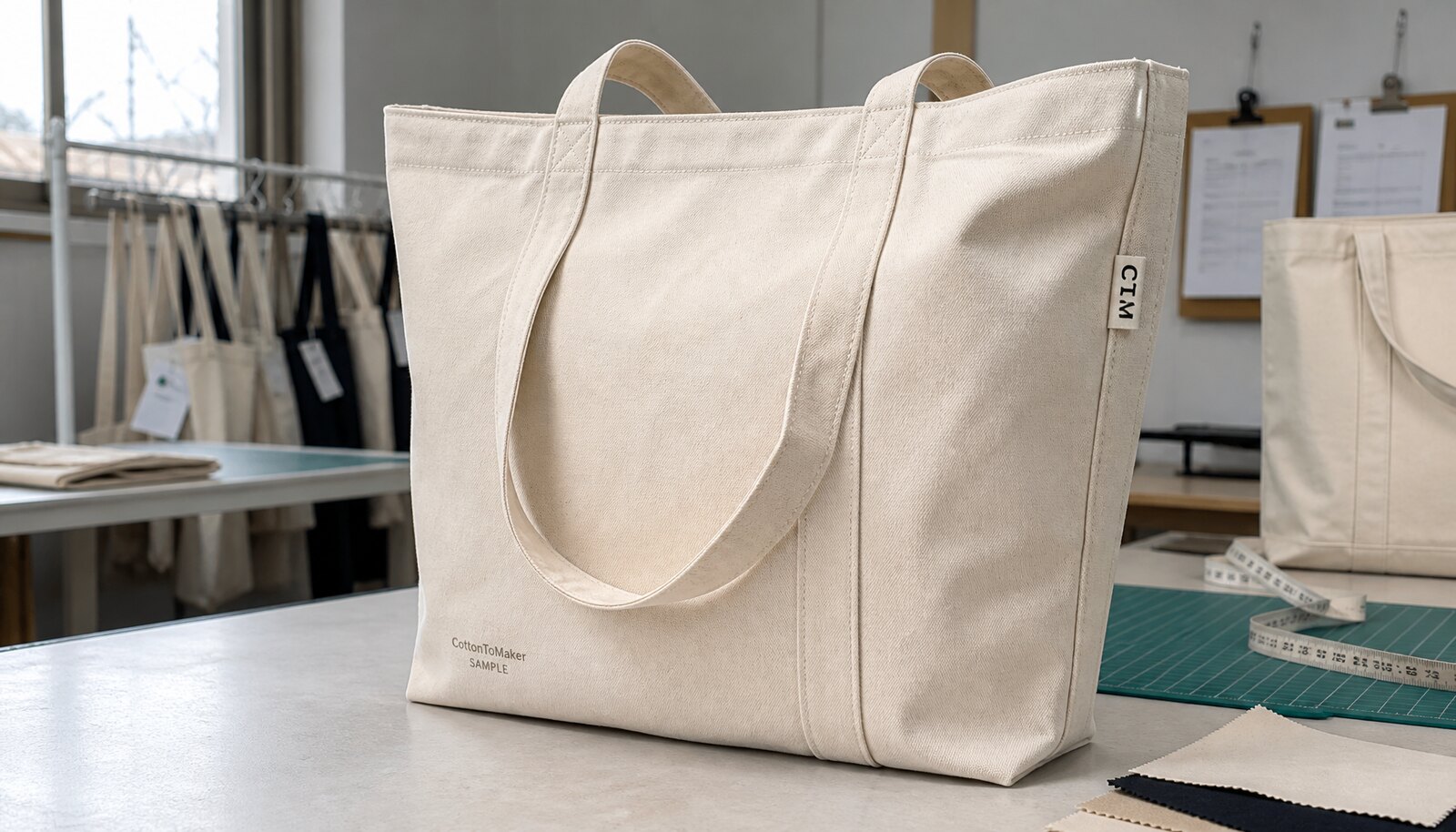
1. Start With The Retail Job The Tote Must Perform
A heavy canvas tote for retail buyers is not one product. It may be a bookstore bag built to carry hardcovers, a museum shop item sold as branded merchandise, a grocery add-on, a premium gift-with-purchase, or a private-label reusable bag. Each use case has a different price ceiling, durability expectation, and shelf standard. Before you ask for MOQ pricing, decide what the tote must do in the store and what it will be compared against at the point of sale.
A tote that looks strong but fails at the handle after a few uses hurts the retailer’s brand. A tote that is overbuilt may be durable but can miss the margin target because fabric, sewing, and freight are too expensive. Procurement should treat the bag as a retail product, not as a generic giveaway. The best brief explains expected contents, selling price target, display method, print importance, sustainability needs, and replenishment plan.
For example, a flat 12 oz natural canvas tote with one-color front print may suit a mid-price lifestyle program. A 14 oz or 16 oz boxed-bottom tote with reinforced webbing handles, inside label, and retail hangtag may be better for heavier contents or premium merchandising. Neither is automatically right. The right spec is the one that supports the retail promise and can be made repeatedly at a landed cost your margin model can carry.
- Define the tote’s purpose: resale item, shopping carrier, staff bag, membership gift, or gift-with-purchase.
- Estimate the real load: apparel, books, groceries, bottles, boxed gifts, or mixed retail goods.
- Set the presentation requirement: folded shelf stack, peg hook, counter display, flat packed, or shipped to e-commerce customers.
- Separate must-have features from nice-to-have features before asking suppliers for price.
- Work backward from the expected retail price and target margin to an acceptable landed cost.
2. Build A Spec Sheet That Factories Can Price Without Guessing
The phrase “heavy canvas tote” is too vague for procurement. One factory may interpret it as 10 oz cotton canvas with basic handles; another may price 14 oz canvas with reinforced self-fabric handles and a larger print area. Both may be acting in good faith, but the quotes will not be comparable. A strong RFQ gives suppliers fewer assumptions to make and makes it easier to spot where a vendor has drifted from your target.
Your spec sheet should include finished dimensions, not only flat artwork mockups. Width, height, gusset, bottom construction, handle drop, handle width, handle material, seam type, stitch color, fabric color, fabric weight, decoration method, print size, print placement, label requirements, packing, and carton requirements all affect cost. If the tote will be sold at retail, include barcode, hangtag, insert card, country-of-origin marking, and care or composition label instructions if required by your market.
Keep the spec sheet practical. A factory does not need a long brand story to price accurately, but it does need hard production data. If you have an approved reference sample, ship it or provide detailed photos and measurements. If you do not have one, ask for supplier recommendations, but require them to state their assumptions in the quote. The goal is to avoid a spreadsheet where one price includes premium stitching and another includes the cheapest construction available.
- List finished bag size as W x H x D, with the measurement method clearly defined.
- Specify whether dimensions are before wash, after wash, or finished production size.
- Include handle drop measured from the top edge of the bag to the top of the handle arc.
- Mark artwork placement using distances from top edge, side seam, or bottom seam, not only visual mockups.
- State whether natural canvas shade variation, seed specks, and slubs are acceptable.
- Attach artwork as editable vector files when possible, plus a PDF showing final placement.
- Ask every supplier to identify assumptions and substitutions in a separate line of the quote.
3. Choose Fabric Weight With Cost, Structure, And Freight In Mind
Fabric weight is one of the fastest ways to understand why heavy canvas tote pricing varies. A 10 oz, 12 oz, 14 oz, and 16 oz tote may all look sturdy in a photo, but the hand feel, shelf structure, sewing difficulty, and carton weight are different. Heavier fabric consumes more cotton, can take more time to cut and sew, and can reduce carton efficiency. It may also require more careful needle selection and thread tension to prevent puckering or skipped stitches.
For many retail buyers, 12 oz to 14 oz canvas is the most practical range. It usually gives enough body for resale without pushing cost and freight too aggressively. A 10 oz to 12 oz range can work when the tote is a lighter merch item or a price-sensitive program. A 14 oz to 16 oz range is better when the tote must carry books, groceries, bottles, or boxed merchandise, but only if handle reinforcement and seam construction are upgraded to match the body fabric.
Do not evaluate fabric weight only by the quoted number. Ask for GSM as well as ounce weight and request a fabric swatch from the actual source. Canvas can vary in weave density, stiffness, finishing, and shrinkage. A chemically stiffened fabric may feel heavy at sampling but soften after handling. A loosely woven canvas may weigh enough on paper but still distort at the seams. Procurement should approve the hand feel, weave, and shade range, not just the weight.
- 10 oz to 12 oz: useful for cost-aware retail programs, lighter merchandise, and folded shelf packs.
- 12 oz to 14 oz: common middle ground for heavy canvas tote retail programs.
- 14 oz to 16 oz: stronger structure, better for heavier contents, but higher sewing and freight impact.
- Natural canvas: popular and cost-effective, but shade and speck variation should be approved.
- Dyed canvas: stronger brand color control, but may require higher fabric MOQ and longer lead time.
- Recycled or certified materials: confirm certificate scope, available weight, shade consistency, and minimum order before committing.
4. Read MOQ Pricing As A Cost Structure, Not A Negotiation Game
MOQ is not just a number a supplier uses to protect itself. It reflects setup time, fabric purchasing, cutting efficiency, print preparation, sewing line balance, packing labor, and admin handling. A factory may be able to make 200 pieces, but the cost per piece can rise sharply because the same screens, cutting setup, sample communication, and packing instructions are spread over fewer units. At the other end, a very high volume may not reduce the price much if the tote construction is slow to sew or uses custom materials with fixed cost.
Retail buyers should request price breaks at realistic tiers. If your launch order could be 500 pieces and replenishment could be 2,000 pieces, quote both. If 10,000 pieces is not realistic, do not use it as the main decision point. The important question is where the next meaningful break occurs and why. If the price drops materially from 500 to 1,000 pieces, the supplier may be spreading setup cost more efficiently. If the price barely changes from 1,000 to 3,000 pieces, fabric cost may dominate the quote or the sewing operation may already be near its efficient point.
Also ask what changes the MOQ. Custom-dyed fabric, custom-color webbing, woven labels, special trims, multi-color print, individual retail packing, or certified cotton can create separate minimums. A supplier may quote 500 pieces for the bag but require 1,000 labels or a larger fabric lot. If those minimums are not visible in the quote, you may end up paying for unused material or accepting a revised price after approval.
- Quote identical tiers across suppliers: for example 300, 500, 1,000, 3,000, and 5,000 pieces.
- Ask which MOQ is driven by the factory and which is driven by the fabric mill, trim supplier, or printer.
- Calculate total program cost, including setup and samples, not only unit price.
- Watch for price breaks that disappear when retail packing or two-sided printing is added.
- Ask whether reorders can use a lower MOQ if fabric, labels, or screens are already available.
- For replenishment programs, discuss blanket orders, staged deliveries, and material reservation only when demand is reasonably predictable.
5. Compare Decoration Methods By Risk, Not Only By Price
Decoration can move the final cost more than buyers expect. One-color screen printing on a flat panel is usually efficient for simple logos and bold retail graphics. As soon as artwork becomes multi-color, oversized, tightly registered, metallic, photographic, or printed on both sides, the quote changes. Heavy canvas has texture, so ink coverage, edge sharpness, and opacity must be tested on the actual fabric rather than judged from a digital mockup.
Screen print is often the best starting point for retail totes when the design is simple and repeatable. It can give strong coverage and a durable look, but each color typically adds setup and registration risk. Digital transfer or heat transfer may support more complex graphics, but it can feel less integrated with a rugged canvas product if not selected carefully. Embroidery can look premium, but dense stitching may distort lighter fabric or create puckering. Woven labels and sewn patches can elevate perceived value with less ink coverage, but they add sewing time and require placement control.
Ask for a strike-off or decoration sample before bulk production. The strike-off should be made on the same canvas weight and color as production. For natural canvas, ink color can look different than it does on white paper. For dyed canvas, opacity becomes more important. For large prints, folding and carton compression can create cracks, transfer, or shine marks if ink curing is not controlled. Approving decoration only from a digital proof is risky for retail goods.
- For screen print, confirm number of colors, print size, mesh suitability, ink type, curing process, and registration tolerance.
- For large artwork, check whether print crosses seams, gussets, folds, or heavy texture areas.
- For two-sided printing, confirm whether both sides are included in the quoted unit price and sample.
- For embroidery, confirm stitch count, backing, thread color, and whether the fabric puckers.
- For woven labels or patches, confirm label MOQ, edge finish, sewing placement, and colorfastness.
- For retail presentation, test how the decorated panel looks after folding, stacking, and unpacking.
6. Use A Sample Sequence That Approves The Right Thing At The Right Time
Sampling should not be treated as a single yes-or-no event. Different sample stages answer different questions. A fabric swatch confirms material weight, color, hand feel, and weave. A print strike-off confirms artwork behavior on that fabric. A proto or fit sample confirms size, handle drop, and construction. A pre-production sample confirms the full approved specification before bulk production. A sealed sample becomes the reference used for inspection and dispute resolution.
Small retail orders sometimes skip stages to save time, but every skipped stage transfers risk into production. If the tote is simple, a swatch and pre-production sample may be enough. If the tote includes custom dyed fabric, complex artwork, special handles, sewn labels, and retail packing, a fuller sample sequence is worth the time. The sample plan should be discussed before purchase order placement so the production calendar is realistic.
When reviewing samples, write comments in measurable language. “Make handle better” is not useful. “Increase handle drop from 22 cm to 25 cm,” “move print 2 cm upward,” or “change bar-tack thread to matching natural color” gives the factory a production instruction. Keep one approved sealed sample with procurement or QA, and ask the factory to keep one. Bulk inspection should compare against that sample plus the written spec sheet.
- Reference sample: shows target market feel but may not match final construction.
- Fabric swatch: approves weight, shade, weave, and finishing before cutting.
- Decoration strike-off: approves ink, color, opacity, registration, and print hand feel.
- Proto sample: approves dimensions, handle drop, gusset, and construction logic.
- Pre-production sample: approves the full production-ready tote before bulk manufacturing.
- Sealed sample: becomes the inspection reference for bulk goods and should not include unresolved comments.
7. Set Measurable QC Criteria Before Bulk Production Starts
Quality control for heavy canvas totes must be specific enough for a factory floor and an inspector to use. High-level instructions such as “good stitching” or “nice print” do not protect a retail order. Define measurable tolerances for dimensions, print placement, handle drop, stitch density, shade range, carton count, and acceptable defect levels. The more retail-facing the item is, the more important visual consistency becomes.
A practical inspection plan separates critical, major, and minor defects. Critical defects are issues that make the product unsafe, illegal, or brand-damaging, such as wrong logo, sharp contamination, mold, or severe chemical odor. Major defects are issues likely to cause customer return or store rejection, such as broken handles, open seams, wrong size outside tolerance, missing labels, severe print misplacement, or heavy staining. Minor defects may include trimable threads, small removable marks, or slight shade variation within the approved range.
Use functional tests that match the product. A load test can reveal weak handle attachment, seam slippage, or fabric tearing. A dry rub test can catch under-cured ink. A fold test can show whether a printed panel cracks in the packing format. Measurement checks should be taken from multiple cartons, not just the top of one carton. If using an AQL inspection plan, define the standard, inspection level, and acceptable quality limits before production, not after a problem appears.
- Suggested dimension tolerance: agree in writing, often around plus or minus 0.5 cm for smaller measurements and plus or minus 1 cm for larger panels.
- Suggested print placement tolerance: set a measurable range, such as plus or minus 0.5 cm to 1 cm depending on artwork size and construction.
- Stitching failures to reject: skipped stitches at stress points, open seams, broken threads, loose bar-tacks, and handle tearing.
- Print failures to reject: wrong color, severe misregistration, smearing, poor opacity, cracking, sticky ink, and visible transfer after rubbing.
- Material failures to reject: holes, heavy stains, oil marks, mold, extreme shade mismatch, fabric runs, or unacceptable slubs outside the approved standard.
- Packing failures to reject: wrong carton quantity, missing barcodes, crushed retail packs, wet cartons, incorrect carton marks, or fold lines damaging the artwork.
8. Finalize Packing, Cartons, And Warehouse Receipt Before You Approve The Price
Packing is often finalized late, but it affects cost, retail condition, freight cube, and warehouse receiving. Heavy canvas takes up more space than thin cotton, and a thick tote folded aggressively can develop permanent creases. If the logo crosses the fold, the tote may arrive looking used even when it is new. Retail buyers should decide the fold direction and presentation format before approving the pre-production sample.
Bulk folded packing is efficient for warehouse handling but may not be shelf-ready. Individual polybags protect the product but may conflict with plastic reduction goals. Belly bands, insert cards, hangtags, and barcode stickers improve retail presentation but add labor and require placement control. If a retailer has strict receiving rules, carton labels, carton weight, carton dimensions, and barcode scannability need to be included in the purchase order.
Carton count is a trade-off. More pieces per carton can reduce handling cost but may crush the bottom bags, distort handles, or mark prints. Fewer pieces per carton may protect presentation but increase shipping cube and landed cost. Ask for a packing trial or at least carton dimensions and gross weight before final price approval. For larger orders, the carton specification should be checked during final inspection.
- Approve the exact fold method on a sample, especially when artwork is large or ink coverage is heavy.
- Confirm whether individual bags require polybags, paper bands, tissue, insert cards, hangtags, or barcode labels.
- Set maximum carton gross weight if your warehouse or retailer has handling limits.
- Request carton dimensions and pieces per carton before comparing freight quotes.
- Check that carton marks match purchase order, SKU, color, quantity, country of origin, and routing requirements.
- For e-commerce or store replenishment, decide whether bags need to arrive flat, folded, or individually sellable.
9. Compare Suppliers By Capability, Region, And Landed Cost
A lower factory unit price is not automatically the best supplier choice. Heavy canvas totes depend on fabric access, sewing capability, print control, packing discipline, and export reliability. Some factories are strong in simple natural canvas bags with screen printing. Others are better at dyed canvas, retail packaging, embroidery, labels, or higher-volume replenishment. Procurement should match the supplier to the order complexity rather than asking every factory to behave like the same type of vendor.
Regional sourcing differences matter. A supplier close to cotton canvas mills may have better access to standard natural canvas and faster replenishment. A factory with strong printing partners may manage multi-color artwork more reliably. A region with higher labor cost may be less competitive on complex sewing but stronger on smaller batches or shorter transit to your market. Import duties, port congestion, inland freight, and consolidation options can all change the true landed cost. Avoid broad assumptions; ask for the data that affects your route.
Use the same Incoterm when comparing quotes. EXW can look cheap but leaves inland transport, export handling, freight, insurance, duties, customs clearance, and delivery to you. FOB is common for ocean freight comparisons because the supplier delivers goods to the port or vessel terms as agreed. CIF includes cost, insurance, and freight to the destination port, but not necessarily import clearance and inland delivery. DDP can simplify budgeting but may hide cost details. The right term depends on your logistics setup, but all suppliers must be compared on the same basis.
- Ask where fabric is sourced and whether the supplier controls cutting, sewing, printing, and packing in-house or through subcontractors.
- Compare lead time by stage, not just total days. Material booking and sample revisions often create the real delay.
- Request carton dimensions and gross weight so freight forwarders can calculate realistic air, sea, courier, or truck cost.
- Clarify Incoterms and named place, such as FOB Shanghai, FCA factory, CIF Los Angeles, or DDP warehouse.
- Check whether the supplier can support documentation needs: commercial invoice, packing list, certificate of origin, test reports, or material certificates if required.
- Evaluate communication quality. A supplier who states assumptions clearly is usually safer than one who quotes fast but leaves gaps.
10. Read The Quote Like A Cost Map, Not A Single Number
A useful quote tells you what is included, what is excluded, and what changes the price. For heavy canvas totes, the quote should identify fabric weight, fiber content, color, size, gusset, handle type, reinforcement, decoration method, number of print colors, label details, packing, MOQ, lead time, sample charges, setup charges, and Incoterm. If a quote only lists a unit price and a quantity, treat it as incomplete.
Build a comparison sheet that normalizes all supplier offers. Put fabric weight, finished size, handle construction, print size, packing, Incoterm, carton details, and price breaks in separate columns. Then add adjustment lines for setup, sample, freight, duties, inspection, and packaging. This often shows that the cheapest unit price is not the lowest landed cost, especially if it excludes screens, retail packing, or freight-sensitive carton dimensions.
Also look at how suppliers answer questions. Strong suppliers will tell you when your spec creates cost or production risk. They may suggest reducing print size to avoid fold creasing, changing handle material to hit a target price, or moving from custom dyed canvas to stock natural canvas for a smaller MOQ. A vague quote may look attractive at first, but if the supplier cannot explain the cost drivers, the risk usually returns during sampling or bulk production.
- Separate base unit price from one-time setup charges and recurring production charges.
- Check whether artwork, screens, labels, hangtags, barcodes, and cartons are included.
- Compare all prices under the same Incoterm and currency.
- Calculate cost per sellable unit after expected inspection, freight, duty, and receiving costs.
- Ask suppliers to price acceptable alternatives, such as 12 oz versus 14 oz or bulk pack versus retail pack.
- Document all final assumptions in the purchase order before deposit payment.
Specification comparison for buyers
| Procurement decision | Common options to compare | Buyer-side price or MOQ logic | Acceptance or risk check |
|---|---|---|---|
| Fabric weight and hand feel | 10 oz, 12 oz, 14 oz, 16 oz cotton canvas; natural, bleached, dyed, recycled blends | Heavier canvas raises fabric cost, cutting load, sewing time, and carton weight. Dyed or custom-color canvas can also push MOQ up because mills may require separate dye lots. | Verify oz or GSM against the approved sample. Use a written tolerance and reject fabric that feels noticeably lighter, looser, or softer than the agreed reference. |
| Finished size and gusset | Flat tote, bottom gusset, side gusset, boxed bottom, portrait or landscape format | Larger panels increase fabric yield loss. Boxed bottoms and gussets add labor, so the cheapest quote is not always the best value if construction is slow. | Measure width, height, gusset, and bottom shape on random bulk pieces. Use defined tolerances instead of visual acceptance only. |
| Handle construction | Self-fabric handles, cotton webbing, contrast webbing, folded handles, cross-stitch reinforcement, bar-tack reinforcement | Self-fabric handles look clean but add cutting and folding labor. Webbing may be efficient if stock is available, but custom color webbing often adds a separate minimum. | Check handle drop, width, symmetry, attachment strength, and stitch quality. Stress points should hold under a practical load test. |
| Decoration method | One-color screen print, multi-color screen print, digital transfer, embroidery, woven label, sewn patch | Screen setup is spread across the order quantity, so unit cost improves with scale. Multi-color artwork, large coverage, and double-sided branding raise setup and labor costs. | Approve a strike-off or pre-production sample for color, placement, opacity, registration, and rub resistance before bulk production. |
| MOQ and price breaks | Trial run, 300 to 500 pieces, 1,000 pieces, 3,000 pieces, replenishment order | Low quantities carry more setup cost per piece. A low-MOQ quote may exclude screens, labels, or retail packing, which makes it look cheaper than it is. | Ask every supplier to quote the same tiers and list exactly what is included. Compare the price curve, not only the lowest tier. |
| Sample hierarchy | Reference sample, swatch, strike-off, proto sample, pre-production sample, sealed sample | More sample stages add time and cost, but they reduce bulk risk. Skipping the pre-production sample can be expensive when the tote includes print, labels, or retail packing. | Define what each sample approves: fabric, size, handle, print, packing, label, or carton. Do not approve bulk cutting from a sample with unresolved notes. |
| Packing and retail receipt | Bulk folded, individual polybag, belly band, insert card, hangtag, barcode label, master carton only | Retail-ready packing adds labor and materials. Heavy canvas also increases carton weight and may reduce pieces per carton. | Confirm fold direction, pieces per carton, carton dimensions, gross weight, barcode placement, and whether cartons fit warehouse limits. |
| Freight and landed cost | EXW, FOB, FCA, CIF, DDP; air, sea, courier, consolidated freight | Unit price is only part of total cost. Fabric weight, carton cube, duties, inland trucking, and urgent air freight can change the real landed cost. | Quote the same Incoterm and shipping assumptions. Request carton dimensions and gross weight before final supplier comparison. |
| Lead time and capacity | Sample lead time, material booking, bulk production, inspection window, packing, vessel or air booking | A lower unit price can hide slower material lead times or limited sewing capacity. Custom dyed canvas and special webbing can delay production before sewing starts. | Ask for a stage-by-stage timeline and identify the longest lead item. Build approval buffers for artwork, strike-off, pre-production sample, and inspection. |
Buyer checklist before sampling
- Define the retail use case first: grocery, bookstore, museum shop, gift-with-purchase, lifestyle merch, or reusable shopping bag. The carrying load and shelf presentation should drive the spec.
- Lock finished width, height, gusset depth, bottom shape, handle drop, handle width, and seam construction before asking for pricing.
- Specify fabric in oz and/or GSM, fiber content, weave, finish, and whether natural specks, recycled slubs, or shade variation are acceptable.
- Ask whether the quoted fabric is stock fabric, greige fabric to be dyed, or a special mill order, because that changes MOQ, shade risk, and lead time.
- State the decoration method, artwork size, placement distance from seams, color count, Pantone references if needed, and whether the design is one side or both sides.
- Request price breaks at identical quantities from all suppliers, such as 300, 500, 1,000, 3,000, and 5,000 pieces, only if those volumes are realistic for your program.
- Ask suppliers to separate unit price, print setup, screen charges, sample charges, custom label charges, packing materials, inspection cost, and freight assumptions.
- Require a sample plan: material swatch, print strike-off, proto sample, pre-production sample, sealed sample, and what each stage is meant to approve.
- Set written QC tolerances for size, handle drop, print placement, color, stitch density, carton count, and acceptable defect categories.
- Define retail packing early: fold method, individual polybag or plastic-free pack, insert card, hangtag, barcode label, carton markings, carton dimensions, and max gross weight.
Factory quote questions to send
- What exact canvas weight are you pricing in oz and GSM, and what tolerance do you allow on fabric weight in bulk production?
- Is the fabric stock, made-to-order, dyed-to-order, organic, recycled, or blended, and what MOQ or lead-time constraint comes from that material choice?
- What is the finished size tolerance for width, height, gusset, and handle drop, and how do you measure those dimensions during QC?
- What handle construction are you quoting: self-fabric, webbing, folded, reinforced, cross-stitched, bar-tacked, or another method?
- What is the MOQ for this exact construction, and does it change if we alter fabric color, print color count, handle material, label type, or packing format?
- Please quote the same specification at our requested tiers and identify the point where the next meaningful price break occurs.
- Which costs are included in the unit price, and which are separate charges for screens, sampling, custom labels, barcodes, insert cards, inner packing, cartons, inspection, or export handling?
- What decoration method do you recommend for this artwork on heavy canvas, and what are the risks for opacity, registration, ink cracking, bleeding, or rub-off?
- Can you provide a print strike-off on the actual production fabric before bulk printing, and how long will that take after artwork approval?
- What sample stages do you recommend for this order, what does each sample approve, what does each sample cost, and are sample charges refundable against bulk order?
Quality-control points to confirm
- Check bulk fabric weight against the approved specification using a cut swatch or agreed test method, not only by visual feel. Record the result and compare it with the stated tolerance.
- Measure finished width, height, gusset, handle drop, handle width, and print placement on a random sample set from bulk goods. Use the same measurement points defined on the tech pack.
- Inspect handle attachment on every sampled piece for skipped stitches, loose ends, weak bar-tacks, uneven cross-stitching, broken thread, twisting, and fabric tearing at the stress point.
- Run a practical load check using the intended retail load range or an agreed test weight. Look for seam opening, handle elongation, stitch popping, or distortion after lifting and holding.
- Verify stitch density and seam allowance at side seams, bottom seams, and handle reinforcements. Inconsistent stitch spacing is often an early sign of rushed sewing or wrong machine setup.
- Check print opacity, edge sharpness, registration, placement, color consistency, ink hand feel, and coverage over canvas texture. Heavy weave can create pinholes if ink deposit is too light.
- Perform a dry rub check on printed areas with a clean white cloth and an agreed number of strokes. Flag visible transfer, smearing, surface dusting, or tackiness.
- Fold the tote exactly as it will be packed, then reopen it and inspect whether the print cracks, sticks to itself, transfers ink, or forms a permanent crease across the artwork.
- Review fabric shade, natural speck level, slubs, stains, oil marks, weaving defects, and dye lot variation against the approved sample. Natural canvas can vary, but the approved range should be defined.
- Classify defects before inspection: critical defects such as unsafe contamination or wrong branding; major defects such as broken seams, wrong size, severe print shift, or missing labels; minor defects such as loose threads that can be trimmed.