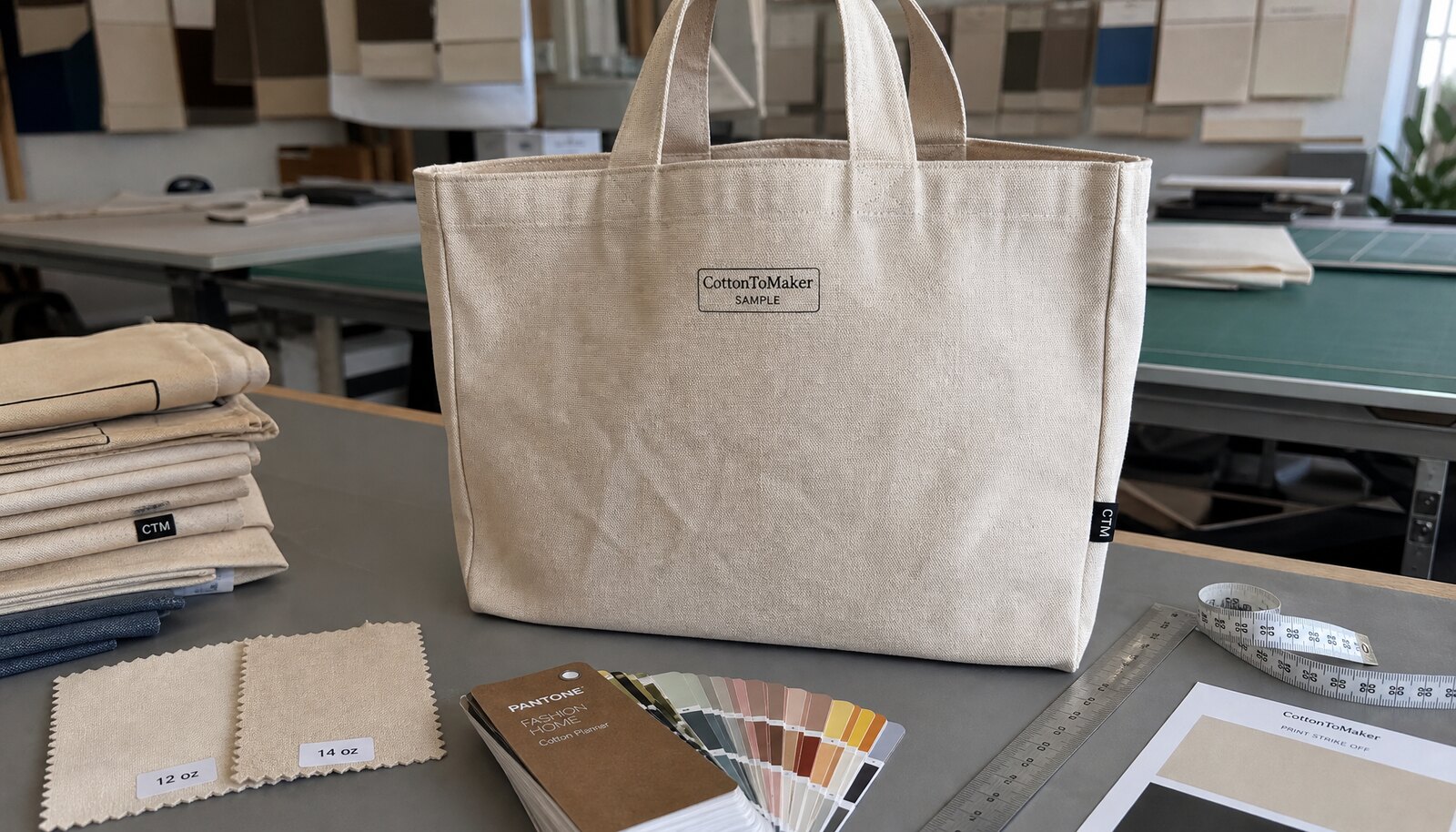
1. Start with a tighter product brief, not a vague tote request
A heavy canvas tote looks simple until three suppliers quote three different products from the same email. One may quote 10 oz natural canvas, another 14 oz dyed canvas, and another a flat promotional tote with short handles. All can be described as a heavy tote with logo printing, but they will not feel, carry, pack, or cost the same. For startup brands, this is where margin and launch timing often get lost: the first RFQ is too loose, so the quote comparison is not real.
A useful heavy canvas tote for startup brands logo printing checklist begins with the tote's commercial role. Is it a paid retail SKU, a launch-kit bag, a gift-with-purchase, a trade show giveaway, or packaging for another product? A paid SKU needs stronger consistency and finishing than a one-day event bag. A launch-kit tote may need to hold bottles, catalogs, garments, or boxed items without sagging. A gift bag may need clean logo visibility and good folding more than maximum load capacity.
Before discussing price, write a one-page brief that fixes the visible and functional decisions: size, fabric weight, color, handle drop, gusset, logo method, quantity, packing, and delivery market. This gives the factory enough information to challenge weak assumptions. A capable supplier should be able to say, for example, that a large front print is too close to a side gusset, that a light ink on navy canvas needs an underbase, or that individual polybags will increase carton volume. Those comments are not delays; they are signs the supplier is reading the job properly.
- Define the tote's purpose: resale, merch, event distribution, ecommerce insert, retail gift, or product packaging.
- Fix the target load: light daily carry, books, bottles, apparel, boxed products, or mixed promotional items.
- State whether the bag must stand up, fold flat, look premium on shelf, or ship as compactly as possible.
- Ask suppliers to quote against the same written specification, not against a mood board or photo alone.
2. Choose canvas weight by use, size, and finishing route
Canvas weight is the first spec buyers notice, but it is also one of the easiest to misunderstand. Suppliers may use ounces, GSM, or informal labels such as heavy, thick, premium, or durable. For procurement, ask for both oz and GSM. A 12 oz canvas is roughly 407 GSM, while 14 oz is roughly 475 GSM. These are practical choices for many startup brand totes because they feel more substantial than common lightweight cotton bags without becoming as bulky and expensive as very heavy utility canvas.
The same GSM can feel different depending on yarn, weave density, finishing, and washing. Natural unwashed canvas usually looks crisp and structured. Washed canvas feels softer but may shrink and wrinkle more. Dyed canvas adds color control issues and may require different print preparation. Coated canvas can resist moisture better but may change ink adhesion and handfeel. If the brand image depends on a particular shade of natural cotton, do not assume every batch of natural canvas will look identical; cotton tone can shift from cream to beige.
For startup brands, the best approach is usually to sample two weights rather than debate descriptions. Compare a 12 oz and 14 oz tote in the actual size, then load each with a realistic product mix. If the bag collapses, twists, or makes the logo wrinkle, move up in weight or improve construction. If the bag becomes too stiff, expensive, or bulky in cartons, a lighter fabric with better gusset and handle reinforcement may be a better decision.
- 10 oz / about 339 GSM: can work for cost-sensitive merch, but may not feel premium in a large size.
- 12 oz / about 407 GSM: balanced option for many logo totes, launch kits, and retail-friendly bags.
- 14 oz / about 475 GSM: stronger handfeel and better structure, often suitable for paid merch or premium gifting.
- 16 oz / about 542 GSM and above: very sturdy but heavier to sew, pack, ship, and fold; sample before committing.
- Ask whether quoted GSM is greige, finished, dyed, washed, or coated because the number may change after processing.
3. Construction details decide whether the tote feels premium or cheap
Two totes made from the same canvas can perform very differently. Construction controls shape, strength, comfort, and perceived value. A flat tote is economical and packs efficiently, but it can look strained when filled with bulky products. A bottom gusset or boxed bottom gives the bag depth and makes it more useful for retail purchases, bottles, notebooks, cosmetics, or apparel bundles. If your brand photography shows the tote standing with products inside, specify the gusset instead of hoping a flat bag will behave that way.
Handles deserve more attention than many first-time buyers give them. Handle drop determines whether the tote can be worn on the shoulder. Handle width affects comfort when the bag is loaded. Self-fabric handles create a cohesive look but may feel thicker; cotton webbing can be consistent and strong but changes the visual style. For heavy canvas totes, handle reinforcement is not decorative. A single stitch line may be enough for a light giveaway, but a box-stitch, cross-stitch, or bartack gives better confidence at stress points.
Internal finishing also matters. Raw internal seams can fray or look unfinished if the tote is sold as a brand product. Overlocked, folded, bound, or French-style seams each carry different cost and appearance implications. If the tote includes an inner pocket, zipper, snap, magnetic closure, woven label, or side tab, put these into the first RFQ. Adding them after sampling can change the sewing sequence, production time, and unit price.
- Specify finished size as width x height x bottom gusset; add side gusset if relevant.
- Define handle width and handle drop, not only total handle length.
- Choose handle material: self-fabric canvas, cotton webbing, contrast webbing, or another agreed trim.
- State reinforcement method: box-stitch, cross-stitch, bartack, double-row stitch, or approved equivalent.
- Request measurement tolerances for bag size and handle drop; avoid unrealistic zero-tolerance language.
- Ask for seam-finish photos from similar past production if the supplier has not made your exact sample yet.
4. Match logo printing to artwork, fabric color, and order size
Logo printing is where a good tote becomes a brand asset or a visible quality problem. Screen printing is usually the most practical method for bold one-to-three-color logos on heavy canvas. It can give a clean, durable result when the artwork is properly separated, the screen mesh suits the detail, and the ink is cured correctly. On natural canvas, black or dark ink is normally straightforward. On dark canvas, light colors often need an underbase layer to keep the logo from looking dull, which can increase cost and make the print feel thicker.
Heat transfer can be useful when the design has gradients, many colors, photographic detail, or a small test quantity that does not justify several screens. It should be sampled on the exact canvas because heavy texture can show through the film or create edge-lift risk. Embroidery works well for small marks, monograms, and patches, but large filled embroidery can pucker canvas and become expensive. Woven labels, cotton labels, and side tabs are good when the brand wants subtle identity rather than a large front logo.
The supplier should explain limitations before taking the order. Fine lines can fill in during printing. Small reversed text can disappear on textured fabric. Large prints near a seam, gusset, or handle attachment can distort. If the front panel is printed after sewing, the frame and platen may limit the printable area. If panels are printed before sewing, the cutting and sewing tolerance must still keep the logo centered in the finished bag. Ask the factory which route they will use.
- Use screen print for solid brand marks, repeat orders, and clean one-to-three-color artwork.
- Use heat transfer only after checking edge feel, adhesion, flexibility, and cracking on the actual canvas.
- Use embroidery for smaller logos where texture and premium effect matter more than large coverage.
- Use woven or cotton labels for minimal branding or when direct printing may not suit the artwork.
- Confirm whether printing happens on cut panels before sewing or on finished bags after sewing.
5. Set real print tolerances before the strike-off
A digital mockup is not production approval. It shows intent, not what ink will do on cotton texture. Give the factory vector artwork in AI, EPS, or PDF format with fonts outlined and colors separated. Include Pantone references if brand color matters, but remember that ink on cotton canvas will not always look exactly like ink on coated paper. Natural cotton tone, fabric absorbency, and ink film thickness can shift the final appearance. For practical procurement, define acceptable tolerance instead of expecting an impossible perfect match.
For many straightforward front-panel prints, buyers use a logo placement tolerance around ±3-5 mm, depending on bag size, fabric movement, and whether the tote is printed before or after sewing. Multi-color registration may need its own tolerance, such as visible misregistration not exceeding an agreed small range and not affecting readability or logo shape. If the logo has fine text, set a minimum line thickness and ask the supplier to confirm it can hold on canvas before making screens.
A print strike-off should answer four questions: is the color acceptable, is the opacity acceptable, is the handfeel acceptable, and does the print survive simple handling tests? Ask the supplier to record ink type and curing conditions where possible. During sample review, rub the print with a dry white cloth and then, if relevant, a slightly damp cloth. Bend the printed area over itself to check cracking. Stack printed bags or panels to see if ink blocks or transfers. These simple checks do not replace formal lab testing, but they catch many avoidable failures before bulk production.
- Provide vector files with outlined fonts and separated colors.
- State print size, for example 180 mm wide, rather than only saying large, centered, or like the mockup.
- Give placement from fixed points: top edge, side seam, centerline, bottom seam, or handle reference.
- Agree placement tolerance before approval; ±3-5 mm is often more realistic than exact visual centering.
- For dark fabrics, ask if an underbase is required and whether it changes handfeel or cost.
- For multi-color logos, define registration expectations and reject limits for visible misalignment.
- Ask for a strike-off on the actual fabric color, not only on a random cotton swatch.
6. Use samples to remove risk in stages
Sampling should be structured around what you need to learn. A stock blank sample helps you judge a supplier's general sewing level, canvas handfeel, and scale, but it does not confirm your custom tote. A custom blank sample confirms construction, dimensions, handles, gusset, closures, and seam finish. A print strike-off confirms ink color, opacity, cure, and artwork detail. A complete pre-production sample brings those elements together and becomes the control reference for bulk production.
For a first order with a new supplier, do not skip straight from mockup to bulk. The cost of one proper sample is usually smaller than the cost of receiving hundreds or thousands of bags with the wrong handle drop or weak logo opacity. When reviewing a sample, measure it. Check width, height, gusset depth, handle drop, logo size, logo placement, stitch density, reinforcement shape, inside seam finish, label position, and packing fold. Photograph details and mark comments clearly. Words like improve stitching or make logo higher are too vague unless paired with measurements or reference images.
If the sample is approved with comments, require written confirmation before bulk cutting or printing. For example: approved if handle drop changes from 240 mm to 280 mm, logo moves 20 mm lower, and thread changes to natural color. If those changes are material, ask whether a revised photo sample or physical sample is needed. Keep one approved sample in your office and ask the factory to keep one matching sample on the production floor.
- Use a stock sample only to screen supplier capability, not to approve your final product.
- Use a blank custom sample when tote structure, size, or handle comfort is uncertain.
- Use a print strike-off when color, opacity, detail, or curing risk matters.
- Use a full pre-production sample for first production or whenever multiple specs changed.
- Sign, label, or photograph the approved sample so it becomes a practical QC reference.
- Do not approve bulk production from retouched photos or mockups for a first custom logo order.
7. Understand MOQ and price breaks without losing control of quality
MOQ is a production reality, not only a negotiation number. Natural canvas in a common weight can often support lower MOQs because fabric may be available from stock. Custom dyed canvas, washed finishing, special webbing, zippers, colored snaps, multiple logo versions, and individual retail packaging all add setup and purchasing constraints. A supplier who accepts an unusually low MOQ may be using available stock, simplifying construction, charging more per unit, or limiting color and packing options.
For startup brands, the right quantity depends on the commercial test. If the tote is part of a launch campaign, a lower first run may be sensible even at a higher unit cost. If the tote is a wholesale SKU or retail item, a more standard MOQ may reduce cost and give the supplier room to run proper material purchasing, printing setup, and inspection. The mistake is pushing quantity down while expecting every custom feature to remain unchanged.
Ask for price breaks that reflect real decisions, such as 300, 500, 1,000, and 2,000 pieces. Also ask whether MOQ applies per bag color, per print colorway, per artwork, and per packing method. A 1,000-piece order split across four colors and five logo versions may behave like several small orders in production. Keep the quote transparent: bag cost, print cost, setup cost, sample cost, packing cost, and carton data should be visible.
- Ask MOQ per fabric color and per logo artwork, not only total order quantity.
- Request price breaks at realistic levels rather than asking only for best price.
- Clarify whether screens can be reused for repeat orders and how long the supplier keeps them.
- Separate setup charges from unit cost so repeat-order economics are clear.
- If using custom dyed fabric, confirm lab dip approval, dye lot tolerance, and minimum dye quantity.
- Avoid approving a low-MOQ quote if it depends on substitute fabric you have not sampled.
8. Build quality control around likely tote failures
Quality control for canvas totes should focus on the failures buyers actually see: wrong fabric weight, visible stains, crooked logos, weak handles, poor curing, loose threads, skipped stitches, and incorrect carton counts. A general final inspection is useful, but the checklist must reflect the product. If the logo is the brand-facing feature, print defects should not be buried as minor issues. If the bag is marketed as heavy duty, handle failure should be treated seriously.
Before production, classify defects. Critical defects may include wrong artwork, wrong brand name, unsafe sharp parts, severe mold or contamination, and handle attachment that fails under a reasonable load test. Major defects may include logo color clearly outside approved sample, placement outside agreed tolerance, broken stitches at stress points, open seams, large stains, holes, or ink cracking. Minor defects may include small loose threads, slight internal seam irregularity, or small natural slubs within an agreed limit. The exact AQL plan depends on order size and buyer requirements, but the defect definitions should be agreed early.
Simple supplier-side tests add discipline. For fabric weight, cut a known area and weigh it to calculate GSM. For print, conduct dry rub, damp rub if relevant, bend/fold, and tape-pull style checks where appropriate for the ink system. For handles, load the bag with a realistic weight for a set period or repeated lifts, then inspect stitch holes, seam stress, and broken threads. For dimensions, measure finished goods after pressing and packing setup, not only first-off pieces. The goal is not to overcomplicate the order; it is to remove arguments after goods are finished.
- Fabric: verify GSM, shade, weave, slubs, stains, odor, holes, and unwanted coating marks.
- Dimensions: measure width, height, gusset, handle drop, handle width, and logo position on random pieces.
- Printing: check color against approved sample, opacity, registration, curing, rub resistance, cracking, and scuffing.
- Sewing: inspect seam strength, stitch density, skipped stitches, loose threads, reinforcement shape, and back-tacking.
- Load: test handles with realistic intended weight and inspect stress points after lifting or hanging.
- Packing: confirm pieces per carton, carton marks, barcode labels, polybag or banding, moisture protection, and carton condition.
- Reorder control: keep approved sample and shipment sample to prevent specification drift on future lots.
9. Packing, carton data, and logistics affect landed cost
Heavy canvas totes occupy more carton space than thin cotton bags. Packing therefore affects landed cost, warehouse handling, and presentation. Bulk packing is efficient for event distribution, wholesale, or internal fulfillment. Individual polybags keep units cleaner and easier to count, but they add material, labor, volume, and sometimes crease marks. Paper bands or belly bands reduce plastic use and can look retail-friendly, but they need testing because they can scuff prints or slide during transport.
Ask for carton data before placing the purchase order: pieces per carton, carton dimensions, gross weight, net weight, and carton marking layout. Without this, your freight estimate is not reliable. If goods go to a retailer, distributor, marketplace warehouse, or third-party logistics center, packing instructions must be part of the production order. Barcode labels, SKU stickers, country-of-origin marking, inner carton labels, and master carton marks should not be improvised after goods are packed.
Cotton canvas also needs basic moisture awareness. Long sea shipments, humid routes, or warehouse storage can create odor, mildew risk, and carton softening if packing is poor. Depending on route and season, ask about dry cartons, inner liners, desiccants, and container loading condition. Do not overpack bags so tightly that print surfaces block, crease, or transfer. If the tote is sold as a premium brand item, request a packed sample or packing photo before full carton sealing.
- Bulk pack 25-50 pcs per carton when cost and efficiency matter more than retail presentation.
- Use individual polybags for ecommerce, retail handling, or clean unit picking, but confirm added volume.
- Consider paper bands only after checking print scuffing, band movement, and carton compression.
- Confirm carton marks: PO number, SKU, color, quantity, carton number, gross weight, and destination requirements.
- Ask whether export cartons are suitable for stacking and whether inner moisture protection is needed.
- Request packed-carton dimensions early enough to estimate freight and warehouse receiving costs.
10. Compare suppliers by assumptions, not just unit price
A low unit price is useful only when the assumptions match. Put every supplier quote into the same comparison sheet: canvas weight, fabric state, tote size, gusset, handles, reinforcement, logo method, print colors, print size, underbase, sample route, MOQ, packing, carton data, lead time, and exclusions. If one quote is much lower, identify the reason. It may be lighter fabric, smaller logo, no underbase, simpler stitching, bulk packing, stock fabric only, or no pre-production sample.
A stronger supplier response often includes practical warnings. For example, they may say that a fine-line logo should be enlarged, that the print should move away from the bottom fold, that dyed canvas needs a lab dip, or that the handle drop in your reference photo is too short for shoulder carry. These comments help you avoid avoidable defects. The best factory for a startup brand is not always the cheapest; it is the one that can turn an early product idea into repeatable production with clear samples, tolerances, and communication.
Once you choose a supplier, put the final specification into the purchase order or tech pack. Attach the approved artwork, sample photos, tolerance notes, packing instructions, carton marks, and inspection expectations. This prevents the common problem where sales discussions say one thing, the invoice says another, and the production floor follows a third version. A clean first order also makes reorders faster because the approved sample, screens, fabric notes, and carton data are already controlled.
- Compare only quotes based on the same GSM, dimensions, construction, logo size, and packing.
- Check whether the quote includes one-sided or two-sided printing and whether underbase is included.
- Separate product cost, print cost, setup cost, sample cost, packing upgrades, testing, and freight assumptions.
- Ask each supplier what they would change to improve quality or reduce cost without weakening the tote.
- Confirm lead time triggers: deposit, final artwork, lab dip approval, sample approval, or material arrival.
- Write final specifications into the PO so sample approval and mass production follow the same document.
Specification comparison for buyers
| Spec decision | Recommended option | When it fits | Buyer risk to check |
|---|---|---|---|
| Canvas weight | 12 oz / about 407 GSM or 14 oz / about 475 GSM cotton canvas | Startup retail totes, merch drops, launch kits, gift-with-purchase, premium event bags | Confirm if GSM is measured before or after dyeing, washing, coating, or finishing; request a cut-and-weigh check for material-sensitive orders |
| Tote structure | Boxed bottom or bottom gusset with reinforced handle stitching | Bags expected to carry bottles, books, apparel, samples, or retail products | Flat totes may quote cheaper but look weak when loaded; check gusset depth, handle drop, and stress-point stitching |
| Logo print method | Screen print for solid 1-3 color logos; heat transfer for gradients or very small runs | Most startup brand marks, slogans, and simple front-panel artwork | Confirm print size, ink type, underbase on dark fabric, curing method, registration tolerance, and rub/crack test expectations |
| Print placement | Measured from fixed edges, not only centered by eye | Brand-facing bags where logo position must be consistent across cartons | Ask for placement tolerance, commonly ±3-5 mm for straightforward front prints depending on bag size and sewing variation |
| Sample approval | Blank structure sample plus print strike-off or complete pre-production sample | First order, new artwork, new fabric color, or new supplier | Do not approve only a digital mockup; check real canvas texture, ink opacity, handle reinforcement, shrinkage, and packing fold marks |
| MOQ setup | 300-500 pcs for standard natural canvas and simple screen print; higher for dyed fabric, special trims, or multi-version artwork | Startup brands testing launch quantities without overbuying | Very low MOQ may limit fabric choice, increase unit cost, skip proper strike-offs, or use substitute stock material |
| QC inspection | AQL-style final inspection plus agreed critical checks for print, seams, stains, and packing | Orders going to retail, ecommerce, distributors, or paid merch customers | Define failure thresholds before production: severe stains, wrong artwork, weak handle stitching, uncured ink, or wrong carton count should not be treated as minor issues |
| Packing | Bulk pack 25-50 pcs per carton or individual polybag/paper band when retail handling requires it | Wholesale, ecommerce prep, distributor shipments, event allocation | Confirm carton dimensions, gross weight, carton bursting strength if needed, barcode labels, moisture protection, and creasing risk |
Buyer checklist before sampling
- Define the finished tote size as width x height x bottom gusset, and state whether dimensions are measured flat, filled, or after pressing.
- Specify canvas weight in both oz and GSM, plus fabric state: natural, bleached, dyed, washed, coated, recycled cotton blend, or organic cotton if required.
- Confirm whether GSM is measured before or after finishing, and ask the supplier how they verify fabric weight during incoming material inspection.
- Choose the tote body: flat, bottom gusset, boxed bottom, side gusset, open top, zipper top, snap closure, inner pocket, or label placement.
- Define handle width, handle drop, handle material, and reinforcement method such as box-stitch, cross-stitch, bartack, or double-row stitching.
- Send vector artwork with outlined fonts, Pantone references, print size, placement measurements, and acceptable color tolerance on cotton canvas.
- Ask the factory to recommend the print process based on artwork, fabric color, quantity, and expected use, not only on the lowest print price.
- Set print tolerances before sampling: placement tolerance, color tolerance, registration tolerance for multi-color logos, and acceptable ink handfeel.
- Request the right sample path: blank sample for construction, print strike-off for color/ink, and pre-production sample for final approval.
- Separate bag cost, print cost, screen/setup cost, sample cost, packing cost, inspection cost if applicable, and freight-ready carton data.
Factory quote questions to send
- What is the exact canvas weight in oz and GSM, and is it measured before or after dyeing, washing, coating, or other finishing?
- Can you provide a fabric swatch or cut panel for GSM verification before bulk cutting?
- Is the canvas in stock natural fabric, greige fabric, bleached fabric, dyed-to-order fabric, washed fabric, or a special blend?
- What finished bag dimensions, gusset depth, handle width, and handle drop are included in this quote?
- What dimensional tolerance will you apply to finished bags after sewing and pressing?
- What handle reinforcement is included: box-stitch, cross-stitch, bartack, double stitch, or another method?
- Which logo method do you recommend for our artwork and quantity, and what are the limitations on detail, opacity, and handfeel?
- For screen printing, what ink type, curing process, underbase requirement, and maximum print area do you propose?
- What placement tolerance and color tolerance can you hold in bulk production?
- Are screen charges, Pantone matching, artwork separation, strike-offs, reprint work, and sample freight included or separate?
Quality-control points to confirm
- Verify fabric weight by cutting and weighing a measured panel when the order depends on true GSM; document the result against the approved specification.
- Check canvas shade, weave consistency, slubs, oil marks, stains, holes, and excessive creasing before printing or sewing.
- Measure finished bag width, height, gusset depth, and handle drop on random pieces after sewing and pressing, not only on the top sample.
- Inspect logo placement from fixed points such as top edge, side seam, or bag centerline with a ruler; do not rely on visual centering alone.
- For multi-color printing, check registration between colors and reject obvious misalignment that changes logo shape or readability.
- Rub-test cured print with a dry white cloth and, where relevant, a slightly damp cloth; visible color transfer should trigger review before shipment.
- Bend and fold the printed area to check cracking, flaking, or poor adhesion, especially for thick ink layers or heat transfer graphics.
- Check ink curing by confirming the supplier's curing time/temperature controls and inspecting for tacky handfeel, blocking, or ink sticking between packed bags.
- Load test handles with a realistic weight based on intended use, then inspect stitch holes, broken threads, handle elongation, and seam stress points.
- Review stitch density, skipped stitches, loose threads, thread color, seam finish, back-tacking, bartacks, and reinforcement symmetry.