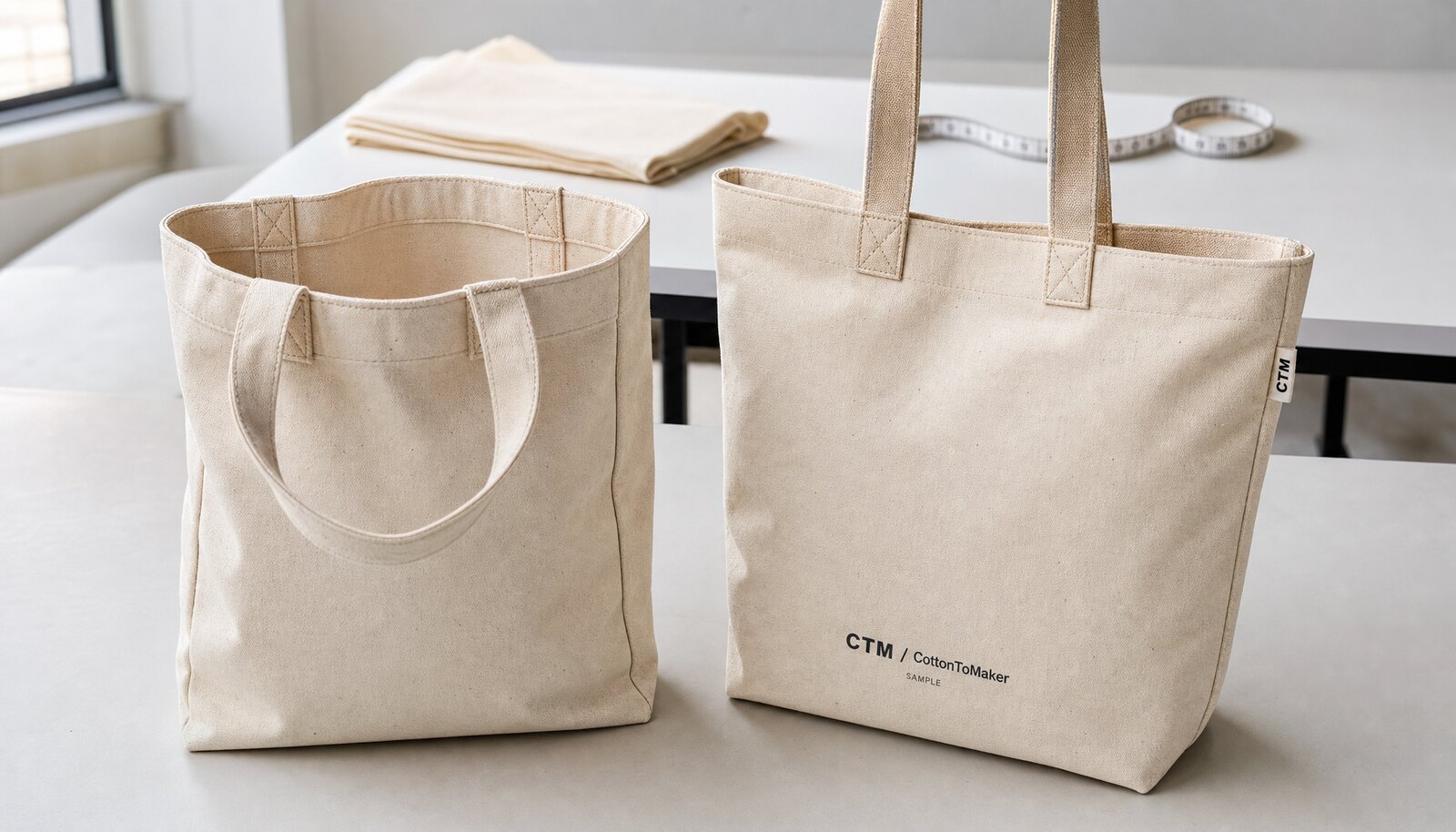
1. What the Cost Review Memo Must Decide
A heavy canvas tote for procurement teams cost review memo should answer one central question: which supplier offers the best controlled cost for the same approved product? It should not simply rank quotes from low to high. The phrase 'heavy canvas tote' is not a specification. One supplier may quote 12 oz canvas, box-X handles, screen print with underbase, and individual barcode packing. Another may quote lighter fabric, simple overlock seams, straight handle stitching, and bulk packing. Both quotes can look similar in a price table, but the cost and risk are not equal.
The memo should connect price to product decisions. Procurement should show the required use, the comparable specification, the quote basis, and the open assumptions that still need approval. This is especially important when merchandising, marketing, finance, and quality teams all influence the final decision. A low unit price can become expensive if samples fail, carton data changes the freight budget, retail packing is added late, or inspection finds defects that could have been prevented with clearer specifications.
A strong memo is concise but evidence-based. It gives management enough information to approve, renegotiate, revise the specification, or request another sample. It should also identify which risks are acceptable and which risks must be closed before purchase order release.
- Decision to make: approve the best total-value quote, not only the lowest FOB or EXW unit price.
- Evidence needed: comparable specification, factory answers, sample data, finished bag weight, packing data, Incoterm, lead time, and QC plan.
- Main risk: approving a quote before confirming GSM, seam construction, logo assumptions, packing method, and shipment basis.
- Best output: a one-page recommendation supported by a specification sheet, quote comparison, and approval checklist.
2. Build a Comparable Heavy Canvas Specification First
Heavy canvas tote pricing starts with the product specification. Procurement should use both ounce weight and GSM, because factories and buyers may use different terms. As a practical reference, 12 oz canvas is commonly around 407 GSM, 14 oz is around 475 GSM, and 16 oz is around 542 GSM. Exact feel still depends on weave, finishing, moisture content, and whether the fabric is natural, dyed, or washed. The memo should therefore ask the supplier to confirm the measured GSM, tolerance, and whether the number applies before or after finishing.
Finished size is the second major cost driver. A 38 x 42 cm flat tote is not cost-equivalent to a 38 x 42 x 10 cm gusseted tote. A gusset improves capacity and shelf presentation, but it increases fabric consumption, cutting time, sewing length, and carton volume. Handle drop must also be stated separately from total handle length. A shoulder tote usually needs a different handle drop than a hand-carry event bag.
The most useful specification sheet is simple but complete. It should include dimensions, fabric weight, handle construction, seam type, logo size and position, label details, packing method, carton requirements, and tolerances. If the team cannot define these items before requesting quotes, it should expect quote gaps and price changes later.
- Write size as width x height x gusset, and state whether width is measured at the top opening or base.
- Specify handle drop, handle width, and handle material, such as 3 cm folded self-fabric or 3.8 cm cotton webbing.
- State internal seam construction, reinforcement pattern, and top opening finish.
- Ask for finished bag weight and keep it with the sample record.
- Include practical tolerances, such as finished size +/-1 cm and logo placement +/-0.5 cm, or project-specific standards agreed before production.
3. Fabric Weight, Finish, and Color Are Cost Levers
Fabric weight should be selected for the use case, not for a marketing label. A 10 oz canvas tote may be acceptable for light promotional use, but it may not satisfy a retail buyer expecting a firmer structure or repeated load use. A 12 oz tote is often a balanced heavy option for corporate gifting, retail merchandise, grocery programs, and reusable packaging. A 14 oz or 16 oz tote can feel more premium and structured, but it increases material cost, sewing difficulty, carton weight, and freight exposure.
Finishing also changes cost and risk. Natural canvas is usually more cost-efficient and easier to source. Dyed canvas adds lab dip or shade approval, dye lot control, and possible colorfastness checks. Washed or enzyme-washed canvas can create a softer, premium handfeel, but washing may shrink fabric and change final dimensions. If the approved sample uses stock washed fabric while bulk uses newly processed fabric, the approval should clearly state that bulk must match the final processed sample, not only the original artwork.
Color affects both MOQ and quality control. Multiple dyed colors split the order into smaller lots, add shade management, and complicate carton separation. Dark colors may require logo underbase for print opacity. Natural canvas may show cotton seed specks, slubs, and shade variation that are part of the material character, but buyers should define what is acceptable before inspection.
- Use 10 oz only when the buyer accepts lighter structure and lower perceived weight.
- Use 12 oz when cost, durability, and handfeel need to be balanced.
- Use 14 oz when retail presentation or load expectation requires stronger structure.
- Use 16 oz when premium firmness matters, while reviewing sewing feasibility, needle marks, and freight weight.
- For dyed or washed canvas, require shade approval, shrinkage expectations, and final-size tolerance after processing.
4. Construction Details That Often Explain Price Gaps
Sewing construction is where many low quotes hide differences. A basic tote may use simple overlock seams inside. A better retail tote may use overlock plus top-stitch, bound seams, reinforced bottom corners, or a cleaner internal finish. These details increase labor time, thread use, and handling, but they can reduce seam failure and improve perceived quality. Procurement should decide which construction level is required for the product channel instead of allowing each factory to choose its own version.
Handle attachment deserves special attention because it is a common failure point. A straight stitch may be cheaper, but box-X stitching, cross-stitching, or bartack reinforcement distributes stress better. Handle width, folded layers, fabric direction, stitch density, and thread quality all matter. A self-fabric handle gives a clean look but consumes the same canvas as the body. Cotton webbing can be strong and consistent, but it introduces separate material sourcing and color matching.
The cost memo should include photos of the approved handle reinforcement and inside seams. Written terms are helpful, but factory descriptions are not always used consistently. A photo-backed specification reduces disputes during sample review and final inspection.
- Confirm whether handles are self-fabric, cotton webbing, or another material.
- Define handle drop, total handle length, width, folded layers, and reinforcement pattern.
- Check whether the top opening is single folded, double folded, or reinforced with an extra panel.
- Request inside seam photos in the sample report, not only front-view product images.
- If the tote carries books, bottles, or boxed goods, define a practical load test instead of relying on the word 'strong.'
5. Logo and Branding Costs Need Their Own Review
Logo decoration can change the real cost of a heavy canvas tote more than buyers expect. Screen printing is usually practical for one-color to three-color solid artwork. It can be efficient in bulk, but each color may require setup, registration, and curing control. On dark canvas, a white underbase may be required to make the logo color visible and accurate. If the underbase is excluded from one quote and included in another, the price comparison is not valid.
Heat transfer can work for gradients, photo effects, or smaller production runs, but the buyer should approve handfeel, edge durability, and folding performance. Embroidery can create a premium look, but high stitch counts may pucker canvas or add backing requirements. Woven labels, side labels, patches, and leather-like badges may reduce repeat print setup or support multi-color bag programs, but they add label MOQ, sewing alignment, and inventory control.
Procurement should ask the factory to quote the logo method separately when artwork is still changing. This prevents a bag price from being approved based on an early one-color logo when the final artwork becomes larger, multi-color, or placed in a more difficult position.
- For simple flat artwork, ask for screen print cost by color count, print size, and print position.
- For dark fabric, confirm whether the quote includes underbase and acceptable opacity.
- For retail resale, check rub resistance, curing, print edge sharpness, and registration.
- For multiple bag colors, consider a woven label or sewn patch if one print color cannot work across all shades.
- For large prints, confirm equipment can handle the print area without distortion or uneven curing.
6. MOQ, SKU Splits, and Quote Comparability
MOQ should be reviewed by production setup, not only by total order quantity. A 3,000-piece order in one natural canvas color with one logo is very different from 3,000 pieces split across six colors, three sizes, and five artworks. Each split affects fabric procurement, dyeing, cutting, printing setup, sewing line management, packing labels, carton marks, and inspection. A supplier may accept the order, but unit cost can rise because fixed setup costs are spread across smaller lots.
The cost review memo should show the SKU structure clearly. If the program is for distributor stock, limiting the number of colors and sizes may protect price. If the program is for retail launch, SKU variety may be commercially necessary, but procurement should explain the cost premium caused by color splits, labels, individual packing, and carton assortment rules.
This section is also where procurement can identify negotiation options. Instead of asking for a general price reduction, ask whether cost improves if the team uses one fabric color, reduces print colors, combines artwork positions, changes individual polybags to bulk pack, or increases the quantity per SKU.
- Lowest-complexity structure: one natural fabric color, one size, one artwork, bulk packing.
- Medium-complexity structure: two or three fabric colors, one artwork, same size, same packing.
- Higher-complexity structure: multiple sizes, different artworks, dyed canvas, individual barcode packing.
- Ask whether the factory can combine cutting, sewing, or inspection for similar SKUs.
- Do not approve mixed-SKU orders without confirming carton separation, barcode labels, and inspection batch rules.
7. Sampling and Approval Workflow Before Bulk Cutting
A heavy canvas tote sample is not only an appearance check. It is a production control tool. Procurement should verify that the sample reflects the quoted material and method. If the sample is made from available stock fabric but bulk will use new fabric, the approval record must say so. If the sample print is hand-positioned but bulk will use a jig or production printing line, placement tolerance should be confirmed before bulk cutting.
Sample review should be structured. Measure finished width, height, gusset, handle drop, handle width, seam allowance, and logo placement. Weigh the complete bag and record the weight. Turn the tote inside out to inspect seam finish, corner strength, loose threads, and reinforcement. Fold and rub the printed area to catch obvious curing or adhesion problems. Smell the bag, especially if it is dyed, washed, or heavily printed. None of this replaces lab testing when required, but it catches common sourcing issues early.
The approval workflow should also name the decision owner. Procurement may collect samples, but merchandising may approve appearance, quality may approve construction, and finance may approve cost. The memo should state whether the order is approved, approved with changes, or held for resample. Ambiguous sample comments often create later disputes.
- Keep one approved sample with the buyer and one sealed reference sample with the factory.
- Photograph ruler measurements for size, gusset, handle drop, and logo placement.
- Record finished bag weight, fabric shade reference, print color reference, and packing method.
- Approve a print strike-off or decoration sample when artwork color and opacity matter.
- Do not release bulk cutting if fabric, seam construction, logo position, or packing differs from the approved cost basis.
8. Quality Control Plan: Inspection Level, Defects, and Release Rules
Quality control should be built into the memo, not treated as a separate afterthought. Heavy canvas totes are simple products, but defects are visible and brand-sensitive. Common issues include wrong fabric weight, inconsistent shade, stains, skewed panels, weak handle stitching, open seams, poor print adhesion, misaligned logos, barcode mistakes, and dirty packing. The supplier should know the acceptance standard before production starts.
For bulk inspection, the buyer and factory should agree on a sampling approach. Many importers use an AQL-based final random inspection, with the inspection level and acceptable defect limits selected according to order value, customer risk, and brand requirements. The memo does not need to overcomplicate the standard, but it should state that cartons are randomly selected, samples are checked against the approved pre-production sample and specification sheet, and defects are classified before inspection.
Defect classification prevents subjective arguments. Critical defects may include unsafe contamination, mold, wrong product, or mixed SKUs that could create shipment rejection. Major defects may include broken handles, open seams, wrong fabric weight, wrong logo, severe stains, or unreadable barcodes. Minor defects may include small loose threads, slight wrinkles, or tiny print imperfections within agreed tolerance. Shipment release should depend on inspection result, corrective action, and final approval authority.
- Set inspection level and sampling plan before production is finished.
- Classify critical, major, and minor defects in writing.
- Compare production to the approved sample, signed spec sheet, and packing instruction.
- Inspect cartons for SKU, color, quantity, PO number, carton number, and destination marks.
- Allow shipment only after final inspection is passed or corrective action is approved by the named buyer contact.
9. Packing, Freight, Incoterms, and Landed-Cost Assumptions
Heavy canvas totes can be bulky even when unit price looks low. Fabric thickness, gusset depth, folding method, individual polybags, carton strength, and pieces per carton all affect CBM. A tote that is individually packed may look cleaner for retail but can increase labor, plastic use, carton count, and freight cost. A bulk-packed tote may reduce cost and volume, but it may not satisfy barcode, cleanliness, or presentation requirements.
Procurement should ask for carton dimensions, pieces per carton, net weight, gross weight, and estimated CBM before approving the quote. If cartons are too heavy, warehouse handling and carton damage may become issues. If bags are folded too tightly, heavy canvas may develop strong creases, and printed areas can transfer if curing is not complete. Packing approval should therefore include both cost and quality considerations.
The memo must also state the Incoterm used for comparison. EXW, FOB, CIF, DAP, and DDP prices include different responsibilities and costs. A low EXW quote may exclude inland freight, export handling, customs documents, and port charges. A DDP quote may include duty and final delivery but depends heavily on tariff classification, destination, and the supplier's logistics assumptions. For a fair review, procurement should compare quotes on the same landed-cost basis or clearly show what is missing.
- Request pieces per carton, carton size, net weight, gross weight, and total CBM.
- Show freight assumptions separately for sea, air, courier, or truck delivery if timing is uncertain.
- List duty, tariff, customs clearance, destination charges, and local delivery assumptions where applicable.
- Confirm whether quote basis is EXW, FOB, CIF, DAP, or DDP.
- Include packing cost changes when moving from bulk pack to individual polybag, paper band, barcode label, or retail carton.
10. Payment Terms, Lead Time, and Cost Memo Decision Framework
Payment terms affect risk and cash flow. A common export structure may require a deposit before production and balance before shipment, but terms vary by supplier, order value, credit history, and inspection arrangement. Procurement should record deposit percentage, balance timing, sample fee, screen or tooling charge, refund policy, bank fees, and whether final inspection can occur before balance payment. If the buyer requires payment after inspection or against copy documents, that should be negotiated before purchase order release, not after goods are finished.
Lead time should be broken into steps. Natural canvas with standard screen print and bulk packing can move faster than dyed, washed, multi-color, individually packed goods. The schedule should include sample lead time, fabric preparation, lab dip or shade approval, print strike-off, bulk cutting, printing, sewing, inspection, packing, and shipment readiness. Buyer-side approval dates matter as much as factory production dates. Late barcode files, artwork changes, or shade approvals can delay the order even when sewing capacity is available.
The final memo should present the recommendation in a decision-ready format. Start with the required use and specification. Then compare supplier price, quote basis, sample status, MOQ fit, packing data, freight assumptions, QC risk, payment terms, and lead time. End with one clear action: approve, renegotiate, resample, revise specification, or reject. This keeps the review short enough for management while still protecting the buyer from hidden cost.
- Cost memo structure: product use, approved specification, supplier comparison, landed-cost assumptions, QC plan, lead time, risks, and recommendation.
- Calculation logic: unit product cost + decoration + packing + testing + inland/export costs + international freight + duty/tariff + customs/clearance + destination delivery.
- Decision example: choose a higher unit price if it includes verified 12 oz canvas, stronger handles, correct packing, lower CBM, and clearer inspection control.
- Negotiation option: reduce cost by simplifying fabric color, print colors, packing, SKU splits, or gusset size before pressuring the supplier on margin.
- Final action should be explicit: approve PO, request revised quote, approve sample with changes, require resample, or reopen supplier comparison.
Specification comparison for buyers
| Spec decision | Recommended option | When it fits | Buyer risk to check |
|---|---|---|---|
| Fabric weight | 12 oz / about 407 GSM canvas for standard heavy retail totes; 14–16 oz for premium or higher-load programs | Retail merchandise, book bags, grocery promotions, corporate gifting, reusable packaging, and distributor stock where structure matters | Factories may quote lighter 10 oz fabric as 'heavy canvas'; require GSM tolerance, fabric swatch, and finished bag weight for confirmation |
| Fabric finish | Natural greige, washed natural, dyed canvas, or enzyme-washed canvas depending on handfeel, color, and shrinkage tolerance | Natural finish works for cost control; dyed or washed finish fits premium retail, fashion, or branded campaigns | Washed or dyed fabric can shrink, change handfeel, and shift GSM; confirm finished size tolerance after processing |
| Handle construction | Self-fabric handles with cross-stitch or box-X reinforcement; cotton webbing for higher load capacity and consistency | Self-fabric handles fit clean retail aesthetics; webbing works for heavier contents, repeat programs, and distributor stock | Handle width, folded layers, stitch density, and reinforcement pattern affect cost and failure rate; do not compare only handle length |
| Logo method | Screen print for most 1–3 color flat artwork; heat transfer for gradients; embroidery, woven label, or patch for premium minimal branding | Screen print is cost-efficient for bulk solid graphics; woven labels fit reorders, multi-color bag programs, and smaller branding areas | Print price depends on color count, print size, ink type, print position, setup, and curing; ask if underbase is included on dark fabric |
| Internal seams | Overlock plus top-stitch or bound seams for premium bags; simple overlock for cost-sensitive programs | Bound seams suit retail resale and heavier use; overlock is acceptable for giveaways if neat and strong | Low-cost quotes often hide seam simplification; request inside seam photos and approve seam type in the pre-production sample |
| Bottom design | Flat bottom with gusset for shopping and packaging use; no gusset for documents, event handouts, or low-CBM programs | Gusseted totes stand better and hold boxed items; flat totes reduce fabric consumption, sewing time, and carton volume | Gusset width changes fabric yield and carton CBM; confirm finished bottom measurement, not only bag width and height |
| Packing method | Bulk pack for cost control; individual polybag only when retail presentation, barcode control, or cleanliness requirements justify it | Retail buyers need SKU labels, barcodes, and clean folding; distributors may prefer bulk pack by 50 or 100 pieces | Individual packing adds labor, material, carton volume, plastic, and lead time; include it in the landed-cost comparison |
| MOQ logic | Review MOQ by fabric color, print artwork, bag size, and packing type, not only total order quantity | One natural fabric with one logo has lower MOQ; multiple colors, sizes, and designs require separate production setup | A supplier may accept low total MOQ but raise unit cost because dyeing, printing setup, cutting loss, and packing control are spread across fewer pieces |
| Landed-cost basis | Compare FOB product cost with freight, duty, tariff assumptions, customs clearance, local delivery, and testing where applicable | Important when the tote is bulky, individually packed, urgent, or imported under a specific Incoterm | A low FOB price may lose advantage after higher CBM, heavier cartons, air freight, additional duties, or repacking |
Buyer checklist before sampling
- Confirm target fabric weight in oz and GSM, with tolerance, and ask whether GSM is measured before dyeing, after dyeing, or after washing.
- Define finished size, gusset, handle drop, handle width, seam type, reinforcement method, logo size, logo position, labels, and packing in one specification sheet.
- Request finished bag weight for each size because it helps identify fabric substitution, hidden construction changes, or excessive tolerance drift.
- Separate quote lines for fabric, sewing, printing, labels, packing, testing, export carton, inland freight, and tooling or setup fees when the order value justifies a detailed review.
- Check whether the logo price includes screen setup, color count, underbase, PMS matching, test print, print position, curing, and wash or rub resistance expectations.
- Ask the factory to show sample photos of inside seams, handle reinforcement, bottom corners, print edge quality, folded packing, and carton marks before sample shipment.
- Confirm MOQ by fabric color, artwork, size, and packing type instead of relying on one total MOQ number.
- Review carton dimensions, pieces per carton, gross weight, net weight, and estimated CBM before approving the packing plan or freight budget.
- State the Incoterm used for comparison, such as EXW, FOB, CIF, DAP, or DDP, and list what costs are excluded from each supplier quote.
- Include payment terms, deposit percentage, balance timing, sample fee, refund policy, and any tooling or screen charges in the memo.
Factory quote questions to send
- What is the exact canvas weight in oz and GSM, and is this measured before dyeing, after dyeing, or after washing?
- What GSM tolerance can you commit to, and can you provide a fabric swatch from the same material source planned for bulk production?
- What is the finished bag weight for the quoted specification, including handles, seams, labels, and print?
- Is the fabric yarn count, weave density, or fabric construction available for comparison against another supplier quote?
- Which seam construction is included: simple overlock, overlock plus top-stitch, bound seam, French seam, or another method?
- What handle material, width, drop, total length, folded layers, and reinforcement stitch pattern are included in the unit price?
- Which logo method is quoted, how many colors are included, what is the maximum print size, and what print position is assumed?
- Does the print quotation include screen charges, PMS matching, test print, underbase for dark fabric, curing requirements, and rub or wash-resistance expectations?
- What is the MOQ by fabric color, bag size, artwork, label, and packing method?
- What are the sample cost, sample lead time, courier cost, and whether the sample fee is refundable or deductible from the bulk order value?
Quality-control points to confirm
- Measure finished size at top width, height, gusset, handle drop, handle width, and logo placement against approved tolerance.
- Check fabric handfeel, thickness, shade, weave consistency, stains, slubs, broken yarns, obvious skewing, and color variation within cartons.
- Verify finished bag weight against the approved sample to detect fabric downgrading, hidden seam changes, or handle construction changes.
- Inspect handle reinforcement for stitch pattern, skipped stitches, loose threads, bartack or box-X consistency, and stress points at the bag opening.
- Check internal seams for overlock coverage, seam allowance, top-stitch accuracy, loose edges, corner strength, and exposed raw edges where not approved.
- Test print adhesion with rubbing, tape pull, light scratch, and folding at print areas where suitable for the ink system and artwork.
- Verify logo position, print size, color matching, edge sharpness, registration for multi-color artwork, and opacity on dark fabric.
- Review packing cleanliness, folding method, barcode label accuracy, SKU separation, carton marking, carton strength, and moisture protection.
- Perform a practical load test according to intended use, such as books, grocery items, boxed merchandise, or event materials.
- Classify defects before inspection, for example critical defects for unsafe contamination or wrong SKU, major defects for broken handles or wrong print, and minor defects for small loose threads.