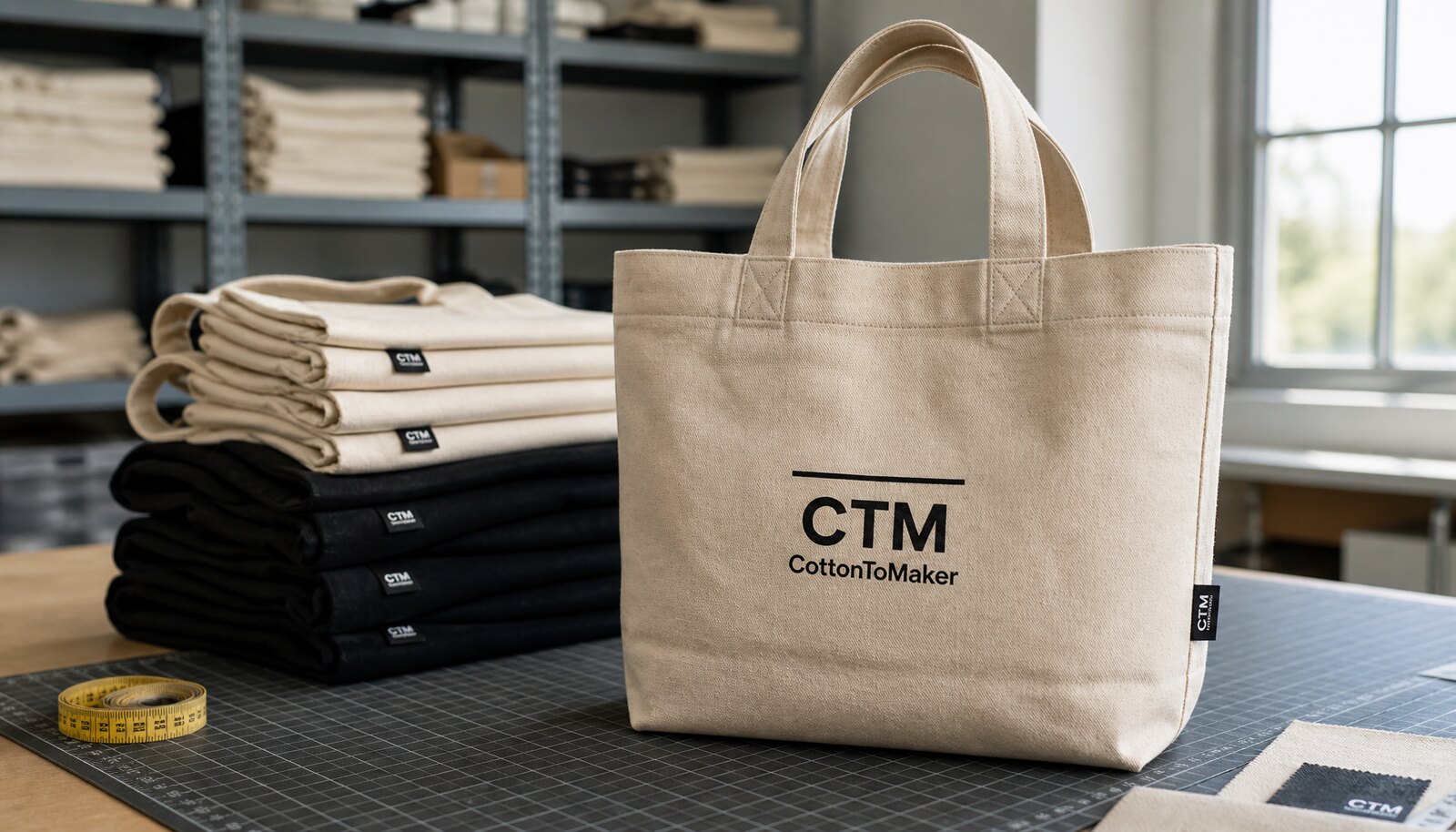
What buyers mean by heavy canvas in ecommerce
For ecommerce brands, a heavy canvas tote is more than a reusable shopping bag. It is a visible product that has to photograph well, survive shipping, and still feel substantial when the customer opens the parcel. In procurement terms, the useful range is often around 10 oz to 14 oz canvas depending on the hand feel and structure the brand wants, but the right number depends on the weave, finishing, and bag construction. Two bags can share a similar weight on paper and still feel very different in hand.
That is why buyers should treat fabric weight as one input, not the entire spec. A heavier cloth with a loose weave may still sag. A slightly lighter cloth with tighter construction may look cleaner and hold its shape better. If your tote is a retail SKU, the customer is likely judging appearance first, then durability. If the bag is a promotional insert or bundle item, you may care more about cost, packability, and clean fulfillment than about premium hand feel.
The practical sourcing lesson is simple: do not write the RFQ as if “heavy canvas” were self-explanatory. Ask the supplier to define the cloth, finishing, and construction in measurable terms. If the factory cannot explain what makes the canvas heavy, stable, and repeatable, the quote is not yet ready for comparison.
- Use both oz and GSM in the RFQ so mills and factories cannot interpret the requirement loosely.
- Ask whether the canvas is woven, dyed, pre-shrunk, washed, or calendered, because those finishing steps change hand feel and sizing.
- If the tote must carry heavier retail items, prioritize denser weave and reinforced handle attachment over decorative extras.
- If the tote is mainly for brand merchandising or lifestyle resale, prioritize shape retention, print clarity, and clean presentation.
Match the spec to the use case before you compare price
A tote sold as an ecommerce product needs a different spec from a tote that is only used for gifting or order inserts. The retail SKU usually needs cleaner sewing, more predictable dimensions, and better print quality because the customer will see it as part of your brand. A tote used inside a kit or subscription box can be simpler if it packs efficiently and still arrives presentable. If you price both versions the same way, the order will almost certainly drift.
This is where sourcing teams often overcorrect. They start with a simple tote, then add lining, a zipper, a custom label, thicker handles, and a second print placement because each request seems small. In practice, those changes move the bag into a different cost and production bracket. It is better to decide the commercial role first. Is this a low-friction merch item, a higher-margin retail accessory, a premium gift-with-purchase, or a hard-working shipping insert?
A useful buyer test is to picture the bag at three moments: on the factory table, in the parcel, and in the customer’s hands. A spec that works in only one of those moments is usually incomplete. The best tote spec balances production ease, carton efficiency, and customer perception without overengineering the product.
- Retail SKU: prioritize structure, visual consistency, and accurate print registration.
- Bundle insert: prioritize low pack cost, stable carton yield, and low defect rate.
- Gift item: prioritize hand feel and logo clarity over features that slow production.
- Promotional carry bag: keep the spec simple so the supplier can hold price and lead time.
Fabric, weave, and finishing choices that affect cost and repeatability
Canvas cost is not driven by weight alone. Yarn quality, weave density, shrink control, and finishing method all influence how the bag behaves after cutting and sewing. For example, a cloth that feels heavy but is not well stabilized can twist at the seams or drift in measurement after pressing. If you want a reorderable SKU, ask the factory what fabric lot they are quoting from and whether the same mill can repeat that construction later.
The phrase “pre-shrunk” deserves follow-up. Some suppliers use it loosely, and the effect can vary by mill or finishing line. If the tote will be sold in a market where dimensional consistency matters, ask how shrinkage was measured, what the test condition was, and what the acceptable post-process change is. The same caution applies to washed, enzyme-treated, or calendered fabric. Those finishes can improve appearance, but they also change feel, size, and print behavior.
Lighter-weight canvas may be the better choice when cost, folding, or freight is the priority. Heavier canvas makes sense when the bag should stand up in photos, hold bulkier merchandise, or feel more premium in the hand. There is no universal “best” range. The right answer depends on the bag’s selling role, expected carry load, and whether the customer will reuse it often enough to justify the added cost.
- Ask for the mill or fabric source, not just the factory’s internal description.
- Check whether the quote assumes stock natural canvas, stock dyed fabric, or custom dyed fabric.
- Treat pre-shrink and finish claims cautiously unless the supplier can explain how they were tested.
- If the bag needs a crisp silhouette, look for tighter weave and stable finishing rather than only heavier cloth.
Size, handle, and load-bearing details that buyers should not leave vague
Dimensions on a tote are often written too loosely. A bag that is supposed to be 15 x 16 inches can arrive slightly smaller or larger and still be called acceptable if the RFQ does not define tolerances. That may not matter for a casual merch giveaway, but it matters when the tote has to fit products, sit inside a shipping carton, or match a planned product photo. Define the body width, height, gusset depth, handle length, and handle drop in the same document, and make the reference points clear.
Handle design deserves the same attention. A short handle can make the bag uncomfortable on the shoulder, while a long handle can make the bag flop awkwardly when carried by hand. Wider handles spread load better and can look more premium, but they also use more material and can change the visual proportions of the tote. If your bag is carrying books, apparel, or heavier purchased goods, reinforcement at the attachment point matters more than decorative stitching.
The load profile should be part of the spec, not a hidden assumption. Some tote buyers only describe appearance, then discover later that the handle or seam cannot handle the real use case. If you expect the bag to carry heavier daily items, ask for reinforcement that matches the use, such as bartacks, X-box stitching, or double-needle seams at stress points.
- Set a tolerance for every dimension that affects fit or presentation.
- Specify handle drop as well as handle length so the bag carries the way you expect.
- If the tote will carry heavier goods, require reinforcement at the top edge and handle joins.
- Ask for a sample loaded with the approximate customer carry weight before final approval.
Print method selection: what works on heavy canvas and what tends to disappoint
Heavy canvas can look excellent with the right print method, but it also exposes weak artwork choices quickly. Screen printing remains the most dependable route for simple branding on bulk orders because it is durable, cost-efficient, and relatively predictable on rougher fabric. It is usually the first method to evaluate when the design is one to four solid colors and the order size is large enough to justify setup.
Digital methods and transfers have their place, especially when artwork is detailed or the order is small. The tradeoff is that they can be more sensitive to canvas texture, surface finish, and curing conditions. Fine text may not survive well on coarse weave. Gradients can appear softer than expected. A print that looks clean in a product render can still feel less premium in hand than a simple screen-printed logo. That is why a strike-off or sample is worth the time whenever the art is intricate.
Print durability matters as much as visual appearance. Ask how the ink is cured, how the factory checks rub resistance, and whether the print can crack along fold lines after packing. If the bag uses large ink coverage, the approval sample should be folded and handled the same way the bulk order will be packed. That small test can reveal transfer, offset, or surface tackiness before the order ships.
- Screen print: best for simple logos, durable branding, and bulk runs.
- Heat transfer: useful for short runs or detailed graphics, but watch for edge lift and surface feel.
- Embroidery: premium-looking on smaller logo placements, but it can distort lighter canvas and add stitch bulk.
- Woven label: useful when the tote itself should stay visually minimal while still carrying brand identity.
MOQ, custom options, and where the real cost jumps usually happen
MOQ is not just a sales number. It is the factory’s way of telling you how much setup complexity the order requires. A standard natural canvas tote with a single print location may have a low MOQ because the cloth, sewing pattern, and print process are already familiar. A custom-dyed bag with lining, zipper closure, and two labels can push the order into a much higher production class because it adds cutting, sourcing, and assembly steps.
For new ecommerce launches, the safest route is often the most standard one: stock canvas, one logo location, a simple handle, and existing trims. That keeps sampling short and gives you a cleaner view of demand. Once the SKU proves itself, you can decide whether a higher-spec version deserves the added complexity. This staged approach is often more useful than trying to build the “ideal” bag in the first round.
The key is to separate feature demand from commercial demand. A pouch pocket or lining may be attractive in theory, but if it pushes the tote beyond your target price or slows replenishment, it may not be the right version for the first order. Ask the supplier which items change MOQ, which are truly standard, and which features are likely to trigger new tooling or longer lead time.
- Lowest-risk MOQ route: stock natural canvas, one print color, standard size, standard handles.
- Higher MOQ triggers: custom dye, heavy lining, metal accessories, multiple print areas.
- Ask whether MOQ applies per color, per artwork, per size, or per shipment.
- If the supplier says a feature is “free,” ask what it changes in sewing time, packing, or lead time.
How to compare supplier quotes without comparing the wrong bag
A unit price only becomes useful when you know exactly what it covers. Two suppliers can quote the same tote model and still be pricing different cloth, different sewing methods, different packing, or different assumptions about artwork. Before you compare numbers, make sure the quote states fabric weight, weave style, print method, number of print colors, reinforcement details, packing format, and whether sample charges or tooling are included.
Low quotes deserve scrutiny, but not because they are automatically false. They may simply be based on a lighter cloth, a simpler construction, or a different packing plan. The issue is that many quote sheets do not make the tradeoff visible. If your buyer team only sees the total unit price, you can accidentally choose a cheaper bag that performs worse in the customer’s hands or costs more to receive and repack.
It is worth asking the supplier to break the quote into the parts that drive cost: fabric, cutting, sewing, printing, label attachment, packing, and carton preparation. That split helps you see whether a supplier is cutting price by reducing material quality or by operating efficiently. It also makes renegotiation cleaner on the next order because you know which elements actually moved.
- Compare quotes only after aligning fabric weight, finish, and print method.
- Separate sample cost, tooling cost, and freight from the factory price.
- Confirm whether the quote includes woven label, hangtag, polybag, barcode label, or master carton marking.
- Ask for any exclusions in writing so landed cost is not guessed later.
Sample approval: the step that should stop most expensive mistakes
A pre-production sample is the point where procurement should slow down, not speed up. It should use the final or near-final fabric, the final print method, the intended handle construction, and the real packing format. A photo or paper sample can help with artwork approval, but it does not validate fabric hand, stitch quality, fit, or the way the bag behaves when folded and packed.
A good sample review should be written like an internal inspection record. Measure the body, gusset, and handles. Check print position against a ruler, not by eye. Load the bag with the approximate item weight it is expected to carry and see whether the seams pull, the handles twist, or the bag collapses. If the tote is meant for retail resale, also judge whether it stands neatly enough for product photography and shelf display.
This is also the time to resolve future arguments. If the brand team likes the visual look but the ops team sees a packing issue, document both positions in one approval note. Record what may change and what must not change. That makes the sample a production reference, not just a design milestone.
- Approve final fabric, not just artwork placement.
- Measure body width, height, gusset depth, and handle drop on the physical sample.
- Test one sample with the likely customer use weight.
- Confirm print edges, ink cure, and rub resistance before bulk release.
- Verify that the fold and pack method used on the sample matches the final order.
QC tolerances, defect examples, and what should count as a fail
QC for tote bags works best when it is written as a simple, measurable system. Use defined tolerances, classify defects as critical, major, or minor, and tell the supplier what will be checked before shipment. For ecommerce totes, the most useful targets are usually body dimensions, handle length, handle drop, stitch quality, print placement, and packaging count. If those are not stated clearly, inspection becomes subjective and disputes become more likely.
A practical tolerance approach is to allow small variation on dimensions while being stricter on stress points and print placement. For example, if the bag is approved at a certain size, a small dimensional variation may be acceptable only if it does not affect fit, print placement, or carton loading. But a handle that is visibly off-center, a stitch line with repeated skipped stitches, or a print that sits too close to the seam should be treated as a real defect, not cosmetic noise.
Defect examples matter because factories and brand teams often use different language. A buyer may say a bag is “messy,” while the factory may not know whether the issue is loose threads, crooked top hem, inconsistent stitch density, or print misalignment. Put real examples into your QC note: broken yarns, seam puckering, loose bartacks, print offset, smudged ink, misfolded pack, missing barcode, or dirty cartons. The more concrete the defect language, the easier it is to prevent repeat errors.
It is also worth separating product QC from pack-out QC. A tote can be structurally fine but still fail receiving because carton counts are wrong or labels are unreadable. If your warehouse or 3PL depends on barcode placement and count accuracy, those are not small details; they are part of acceptance.
- Use an AQL-style inspection plan with written critical, major, and minor defect categories.
- Set tolerances for body dimensions, handle length, handle drop, and gusset depth.
- Require a defined stitch standard at handle joins and top hems.
- Test print adhesion and rub resistance before shipment.
- Check packaging counts, barcode legibility, and carton condition as part of final acceptance.
Packing, cartonization, and warehouse handling
Packing choices affect not only the unit cost but also receiving speed and damage risk. Heavy canvas bags are usually bulky enough that poor folding or an oversized carton can create avoidable freight waste. Bulk packing is the leaner option, but it depends on disciplined fold standards, count verification, and clean carton labeling. Individual polybags improve presentation and cleanliness, yet they add labor and material cost. For an ecommerce brand, the correct answer depends on whether the bag is being sold as a visible retail item or used as an internal fulfillment component.
Carton size should be selected around the packed bag, not guessed from the flat dimensions alone. The same tote can occupy more or less space depending on print thickness, handle bulk, and whether the handles are folded inside or outside the body. Ask for carton dimensions, gross weight, and units per carton as a single packing plan. That gives your logistics team a real basis for freight estimates and receiving planning.
If your warehouse has labeling rules, carton orientation requirements, or moisture concerns, include those in the RFQ. It is cheaper to approve the pack format before production than to sort pallets at destination. In many cases the packing spec is where a “good” tote order becomes a “smooth” operations order.
- State whether each tote needs a polybag, tissue, desiccant, or no inner pack at all.
- Require carton count, gross weight, and carton dimensions before production.
- Make barcode, shipping mark, and SKU label placement part of the approved packing spec.
- Confirm whether cartons need drop protection or moisture protection for transit.
Specification comparison for buyers
| Spec decision | Option 1 | Option 2 | Practical tradeoff for ecommerce buyers |
|---|---|---|---|
| Fabric weight | 10–11 oz canvas | 12–14 oz canvas | 10–11 oz is lighter, usually cheaper to sew and ship, and may work for merch or gift inserts. 12–14 oz gives a more substantial hand feel, better shape retention, and a stronger print surface, but it adds fabric cost, sewing effort, and carton weight. |
| Fabric composition | 100% cotton canvas | Cotton-poly blend canvas | 100% cotton usually feels more natural and can suit premium retail positioning. A cotton-poly blend may reduce wrinkling, help with dimensional stability, and lower some shrink risk, but it can change the hand feel and how ink sits on the surface. |
| Weave/finish | Standard woven canvas with light finishing | Tighter weave, pre-shrunk, washed, or calendered finish | A more controlled finish can improve repeatability and print appearance. It often costs more and can change the final hand feel. Ask how the mill measures the cloth, because mills and factories may not quote identically. |
| Print method | Screen print | Heat transfer / DTG / other digital methods | Screen print is usually the safest choice for simple branding at volume. Digital methods can help with small orders or detailed art, but they are more sensitive to fabric texture, curing, edge lift, and perceived premium feel. |
| Handle construction | Self-fabric handle or narrow webbing with basic stitch reinforcement | Wider handle with bartack or X-box reinforcement | Basic handle construction is cheaper and faster. Reinforced handles are better when the tote will carry books, apparel, or heavier inserts, but they add labor and should be reflected in the quote. |
| Bag structure | Flat tote | Gusseted or box-bottom tote | Flat totes are simpler and lower risk to source. Gusseted or box-bottom versions improve volume and presentation, but they require tighter dimensional control and can complicate carton fit. |
| Branding complexity | One logo, one location, one or two colors | Multiple print locations, woven labels, hangtags, or embroidery | Simple branding keeps MOQ and setup costs lower. More branding elements can make the bag look more retail-ready, but each addition adds another inspection point and more chances for variation. |
| Packing format | Bulk packed, folded, count-checked | Individual polybag or retail-ready packout | Bulk packing is usually cheaper and faster. Retail-ready packing improves presentation and cleanliness, but it raises unit cost and makes carton planning more important. |
| Supplier route | Direct factory | Trading company / sourcing agent | Direct sourcing usually improves visibility into fabric, sewing, and QC. Trading support can help if you need mixed-category buying or one point of contact, but it can also add margin and slow root-cause resolution. |
Buyer checklist before sampling
- Confirm the target fabric weight in both oz and GSM, and ask the supplier to state the measurement method, weave style, and whether the fabric is pre-shrunk, enzyme-washed, or calender-finished.
- Lock the full bag dimensions with tolerance, including body width, height, gusset depth, handle width, handle length, and handle drop.
- Define the load profile: what the tote must carry, how much weight it should tolerate in normal use, and whether the bag is meant for daily resale, gift bundling, or fulfillment inserts.
- Specify the print method, print area, number of colors, and artwork complexity, including whether the design contains fine text, thin linework, halftones, or gradients.
- State the seam standard, handle reinforcement, and stress-point construction required for your use case, rather than assuming the factory will choose the heavier version.
- Decide whether the tote needs lining, an inner pocket, zipper closure, snap closure, or key loop; every add-on should have a business reason and a measured cost impact.
- Request fabric swatches, a pre-production sample, and a side-by-side comparison photo against your reference bag if you already have one.
- Require a carton pack plan showing units per carton, inner pack format, gross weight, carton dimensions, carton label position, and whether individual polybags, tissue, or silica gel are included.
- Ask the supplier to identify the material source, print process, sewing line controls, and in-line QC checkpoints used before bulk production starts.
- Set an acceptance standard in writing for fabric weight variance, measurements, print placement, stitch quality, and packaging quality so inspection decisions are not subjective.
Factory quote questions to send
- What exact fabric weight, weave type, and finishing method are you quoting, and can you confirm the measurement standard in oz and GSM?
- Is the quoted price based on ready stock canvas, greige fabric that will be finished later, or custom dyed canvas?
- What is the fabric width, and how many bags can you cut from that width at the quoted size?
- How many print colors are included, what print method is assumed, and is the quote for one side, both sides, or a wrap print?
- What is the tolerance you can hold on body dimensions, handle length, and handle drop, and how do you measure those points?
- What stitching construction is included at the handle joins, top edge, gusset corners, and bottom seams: single stitch, double stitch, bartack, or X-box?
- What is the minimum acceptable fabric weight at shipment if the approved sample is 12 oz, 14 oz, or another spec?
- What is the shrinkage expectation after finishing, if the tote will be washed or steam-pressed, and can you share prior test data or mill records?
- What print adhesion or rub-resistance testing do you perform before shipment, and what standard do you use for acceptance?
- What sample cost, sample lead time, and sample contents are included, and will the approval sample use the final fabric, final print method, and final packing format?
Quality-control points to confirm
- Fabric weight should stay within an agreed tolerance band at the approved width and construction. If the tote arrives visibly lighter than the approved sample or fails your stated GSM/oz target, it should be treated as a nonconformance, not a minor variation.
- Check fabric width, weave consistency, and panel cut accuracy before sewing. Loose weave, broken yarns, shade variation, or skewed cut panels can turn into crooked seams and poor bag shape later.
- Measure body width, height, gusset depth, handle length, handle drop, and opening width on a sample plan with clear reference points. Use the same measurement method for factory checks and final inspection.
- Inspect stitching at handle joins, top hem, bottom seams, gusset corners, and any label attachment points. Look for skipped stitches, loose threads, uneven stitch density, and short backtacks or bartacks.
- Ask for stitch density to be stated in stitches per inch or stitches per 3 cm where relevant, and compare it against the approved sample or an agreed internal standard.
- Check print placement against a measured window, not just by eye. The logo should be centered or positioned exactly where approved, with consistent distance from seams, hems, and side edges.
- Test print adhesion with a rub check, especially on dark inks or large solid areas. Watch for fading, powdery residue, cracking at fold lines, offset, or sticky ink that transfers during packing.
- If the tote uses multiple colors, verify registration between colors and confirm that small text does not fill in or blur on the canvas texture.
- Review handle reinforcement by pulling and flexing at the stress points on a sample unit. Handles should not twist excessively, separate from the seam, or show bar-tack failure under normal loading.
- Check shape retention and corner alignment on a filled sample. If the bag collapses, tilts, or loses its intended profile when loaded, the structure may be too weak for the intended use case.