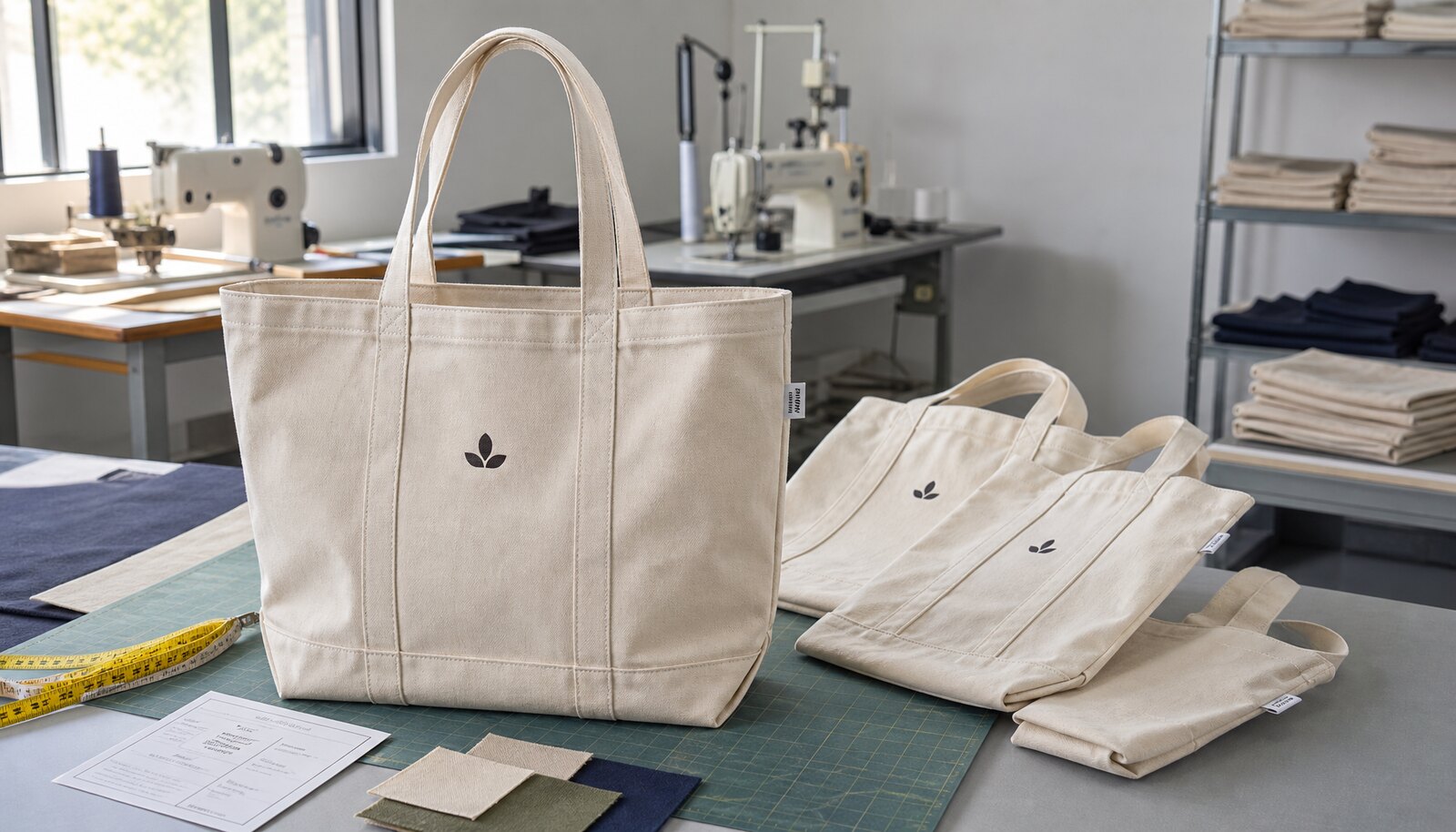
Why subscription box buyers need a different tote spec
A tote bag for a subscription box is not the same sourcing problem as a retail shopping tote. In a subscription program, the bag is usually folded, packed with other items, handled by a fulfillment center, and opened after a customer has already formed an opinion about the box. That means the tote has to work as packaging first and branded merch second. The spec needs to protect carton efficiency, prevent damage in transit, and still deliver enough perceived value that the customer keeps the bag.
The main procurement mistake is approving a sample that only looks good in isolation. A tote that feels strong in hand can still be the wrong choice if it takes too much cube, pops open awkwardly when unpacked, or creates a crease pattern that will not recover. For subscription box buyers, the relevant question is not just whether the tote is durable. It is whether the tote survives the full chain from sewing floor to carton close to final customer use without forcing hidden cost elsewhere.
- Write the tote specification around the subscription box dimensions and insert sequence, not a generic retail display use case.
- Decide whether the tote must arrive flat, lightly folded, or inserted with tissue or a card; each option changes pack-out and cost.
- Treat print durability, handle strength, and recovery from folding as part of the packaging requirement, not as an optional aesthetic detail.
Start with the carton, not the logo
For subscription box programs, the carton usually defines the bag more than the brand team expects. If the tote has to sit inside a set kit with skincare, apparel, books, or promotional items, the folded size and thickness become critical. A bag that is only slightly larger on paper can push the whole kit into a higher shipping dimension, which creates a recurring cost increase that will not appear in the bag quote itself.
The practical first step is to map the tote to the kit. Confirm the shipping carton size, the planned inner arrangement, and the maximum allowed pack height before you ask suppliers for prices. If the bag is going into a rigid insert, measure the usable cavity. If it is going into a loose-fill carton, define the fold pattern and make sure the handles do not create pressure points. This is where many programs lose money: the tote is approved as an isolated item, then the fulfillment team discovers it does not fit cleanly into the intended box build.
- Approve the tote only after you know the exact insert sequence and available cavity inside the final subscription carton.
- Ask the supplier for both finished bag size and folded size, because the second number often drives freight and pick-pack efficiency.
- If the bag is meant to be removed after opening, make sure the fold opens cleanly and does not trap the handles inside a hard crease.
Choose canvas weight with landed cost in mind
For most subscription box programs, 12 oz to 14 oz cotton canvas is the practical range. A 12 oz bag is usually enough for a reusable premium insert without making the carton unnecessarily heavy. A 14 oz bag gives a more substantial hand feel, better structure, and a more premium impression, but it also adds fabric cost, sewing time, and shipping weight. The wrong choice is often made when teams focus on hand feel alone and ignore the effect on carton count and freight.
The quote should state the finished fabric weight and how that weight was measured. Suppliers sometimes describe fabric using nominal or greige figures that do not match the finished bag. Ask for the canvas composition, finished GSM or ounce weight, and any shrinkage assumption after printing or pressing. If the supplier cannot explain how the number was derived, the spec is not ready for award. For procurement, the real issue is not whether the sample feels heavy. It is whether the fabric is repeatable enough that reorders stay inside the same cost and performance band.
- Use 12 oz when the tote is a branded insert and not a heavy-load carry bag.
- Use 14 oz when the tote is expected to behave like a daily-use reusable bag and the premium feel justifies the added freight.
- Require the supplier to state whether the quoted weight is finished fabric weight or a pre-finish reference, and keep that language in the PO.
Construction details that decide whether the bag feels premium or flimsy
A flat tote with hemmed edges and reinforced side seams is usually the best default for subscription packaging. It folds predictably, packs efficiently, and keeps the quote easier to compare across suppliers. A gusset can be useful if the bag needs capacity or a more retail-like shape, but it adds bulk, increases sewing complexity, and can create a less stable fold. Pockets, linings, zips, and other extras should only be added when they serve a clear use case, because each addition creates more production points to inspect and more room for variation.
Handle construction deserves separate attention because it affects both use and defect risk. Self-fabric handles are economical and simple to source, while cotton webbing handles usually feel better in hand and resist wear more effectively. What matters is the attachment method. Ask for bar-tacks, X-box reinforcement, or an equivalent reinforcement pattern, and make sure the stitch path is visible in the sample. A handle that is cosmetically neat but structurally weak is a poor trade for a subscription box item that is supposed to outlast the first use.
- Flat constructions usually win on carton efficiency and ease of receiving.
- Add gussets only when the tote must hold more than a flat insert and the extra cube is acceptable.
- Specify the reinforcement pattern at the handle join and check it on the first sample, not only on production photos.
Decoration choice should match artwork complexity and reorder frequency
Heavy canvas is forgiving in appearance but unforgiving when decoration is mis-specified. For most subscription box programs, one-color screen print is the safest default because it is repeatable, durable, and cost-effective at scale. It works especially well for clean logos and short brand messages. If the artwork is more detailed, a woven label or sewn patch often gives a more controlled result than forcing fine illustration through a screen process that is not built for it.
Heat transfer can be appropriate for short runs or frequently changing campaigns, but buyers should not treat it as a universal shortcut. It may save setup time, yet it introduces a different surface feel and can be more vulnerable to cracking or scuffing after folding and warehouse handling. When comparing decoration options, ask the factory to show the actual print size, placement tolerance, and cure method. A PDF proof is not enough. The approval should be based on a decorated pre-production sample with the final material stack, because canvas texture changes how edges, small text, and solid fills behave in production.
- Use screen print for simple, repeatable branding and predictable unit economics.
- Use woven labels or sewn patches when the art direction is subtle and the brand wants a premium, understated finish.
- Use heat transfer only if the artwork, run size, and timeline justify the tradeoff, and test it after folding and rubbing.
MOQ and supplier route change the real buying decision
MOQ is not just a number on a quote. It is the result of fabric booking, cutting efficiency, decoration setup, and packing requirements. A supplier quoting stock blank totes with local decoration can often offer a lower entry quantity, but the buyer gives up control over exact dimensions, handle color, seam details, and sometimes even the consistency of the base fabric. A fully custom cut-and-sew program gives more control, but it usually requires a larger commitment because the supplier has to book material and production time specifically for your design.
This is why comparing supplier types without normalizing the scope is misleading. A direct factory that owns sewing and printing usually gives the clearest path to repeatability and reorder control. A trading company can still be workable if the factory identity, process ownership, and inspection scope are transparent, but the buyer should not accept a vague middleman quote and assume it carries the same accountability. For subscription box programs, the question is not which quote is lowest on paper. It is which supplier can repeat the same bag, same fold, and same carton plan on the next order without re-learning the job.
- Use stock blank plus decoration when you are testing demand or need a lower-cost pilot batch.
- Use custom cut-and-sew when exact fit, color, or structural details matter more than the lowest opening MOQ.
- Ask each supplier to separate fabric, sewing, print, packing, and export carton costs so you can compare like for like.
How to write sample approval so production cannot drift
Sample approval should be tied to the actual production stack, not a showroom version of the tote. If the PO calls for 12 oz natural canvas with one-color screen print and cotton webbing handles, the sample must use those exact materials and methods. A blank sample can confirm shape, but it cannot tell you whether the print will align cleanly, whether the handle stitch will pucker, or whether the bag will still fold neatly after curing. Approval based on an incomplete sample is one of the fastest ways to create avoidable disputes later.
The approval checklist should include measured dimensions, handle drop, seam appearance, print placement, and fold performance. Measure more than one sample from the same batch because single-piece approval hides variation. Then fold the bag using the production method and confirm that it fits the planned carton without forcing the handles into a kinked position. If the tote is going into a kit insert, check it in that exact context. Good procurement does not just approve the product. It approves the product in the environment where it will actually be used.
- Require a decorated pre-production sample before bulk release, not only a digital proof.
- Measure at least three samples from the same batch to reveal variation before production is locked.
- Check opening behavior after the tote has sat folded, because memory and crease behavior matter in subscription packaging.
Packing specification is a cost item, not a finishing detail
Packing often decides whether a tote program stays inside budget. Bulk flat packing is usually the best default for subscription boxes because it saves material, keeps carton efficiency high, and fits the reality of fulfillment-center assembly. Individual polybags can make sense when print scuffing, moisture, or retail display demands extra protection, but they add cost and cube. If the tote needs interleaving, moisture protection, or a specific fold sequence, that should be spelled out in the RFQ so the supplier prices the real job instead of assuming a generic method.
Carton details matter more than many teams expect. Too-tight cartons crease panels and distort handles. Too-loose cartons let the bags slide and create count errors or corner wear. Ask for carton dimensions, piece count per carton, gross weight, and packing marks before you compare landed cost. If the tote is moving through a long transit lane or a humid warehouse environment, ask the supplier to propose a carton protection plan and confirm whether the outer carton should be tested with a basic drop sequence or compression check before shipment. Even a simple agreed protocol is better than a vague promise that the carton is strong enough.
- Use flat bulk packing unless you have a clear reason to pay for individual protection.
- Lock the fold pattern and carton count before production so the warehouse can receive and pick without repacking.
- If transit is rough or humid, require a carton protection method and define how it will be checked before shipment.
Set quality controls that can actually stop bad product from shipping
A useful QC plan needs thresholds, not just intentions. For heavy canvas totes, start with the fabric weight and finished dimensions, then define the acceptable tolerance band. Many buyers use a tighter band on handle drop than on bag body size because handle inconsistency is immediately visible in use. If the supplier cannot hold the agreed band, the receiving team should know whether the bag is acceptable, reworkable, or rejectable. That decision should be written before production, not made under pressure at destination.
Testing should reflect the actual use case. A tote that will hold light promotional items does not need the same test load as a reusable shopping bag. Ask the supplier what static load or pull test they recommend, then define the target yourself in the PO or QC sheet. The same logic applies to print and carton integrity. Agree a rub or scuff check for decoration, and agree a carton drop or compression protocol for the packed goods. If you do not specify the test, the factory will apply its own standard, which may be too lenient for your program.
The most common defect types are straightforward: loose threads, off-center print, uneven handles, seam puckering, stains, odor, and count mismatch. The point of inspection is not to find every tiny cosmetic issue. It is to stop issues that will turn into warehouse friction or customer complaints. If the tote is part of a premium subscription box, write the acceptance criteria tightly enough that the receiving team can say yes or no without interpretation.
- Set tolerance bands for finished size, handle drop, and print placement before the PO is issued.
- Use a defined static load or pull test that matches the tote's intended use, not a generic factory habit.
- Agree a carton drop or compression check for packed goods if the route is long, humid, or handled multiple times.
- Define the defect classes in advance so receiving can reject or rework product without debate.
Compare quotes on landed cost, not just unit price
A tote quote is only useful when it can be translated into landed cost per usable unit. The ex-factory number is only one part of the decision. Fabric weight, print setup, trim, packing, and carton dimensions all influence the final cost to put the tote into the subscription box. A supplier with a slightly higher unit price may still be cheaper overall if their packing is more efficient, their carton size is smaller, or their quality control prevents rework and claims.
The best way to compare quotes is to force every supplier to show the same inputs: fabric spec, decoration method, piece count per carton, gross weight, carton dimensions, setup charges, and lead time. Once those are normalized, you can see whether a low quote is real or just a stripped-down offer that will grow during sampling or production. For procurement buyers, the goal is not to find the cheapest tote on paper. It is to find the version that lands in the box at the lowest total cost with the least operational risk.
- Normalize every quote by fabric weight, print method, packing method, and carton data before comparison.
- Ask whether screens, labels, or setup charges are one-time or repeated on every reorder.
- Include freight cube, receiving labor, and likely rework risk in the final award decision.
Specification comparison for buyers
| Spec decision | Recommended option | When it fits | Buyer risk to check |
|---|---|---|---|
| Canvas weight | 12 oz to 14 oz cotton canvas, usually about 340 to 475 GSM; use 12 oz for cost control and 14 oz when the tote is a premium keep item | Subscription boxes that need a reusable bag with enough body to look intentional after folding and unpacking | Each step up in weight increases fabric cost, sewing effort, carton weight, and often reduces pieces per carton; ask the supplier for finished GSM, not just nominal fabric weight |
| Bag structure | Flat tote with hemmed top, reinforced side seams, and a simple gusset only if capacity really matters | Programs where the tote ships folded inside the box and is not meant to carry bulky goods immediately | Gussets and pockets increase fold bulk and can lower carton count by 10 to 20 percent depending on size; unreinforced seams can fail when the customer overfills the bag |
| Handle construction | Cotton webbing handles or self-fabric handles with bar-tack or X-box reinforcement at the stress points | Retail-oriented subscriptions and repeat-use gifts where handle comfort and durability affect perceived quality | Short stitch length, weak reinforcement, or uneven handle attachment usually shows up as pull failure or customer complaints; ask for the stitch pattern and target pull test |
| Print method | 1-color screen print for most programs; woven label or sewn patch for understated branding; heat transfer only when the artwork or run size justifies it | Simple logos, short runs, or brand marks that need a clean result on heavy canvas without fine detail | Heat transfer can lower setup cost on small runs but can crack or scuff faster after folding; fine text and gradients often blur on canvas if the mesh, ink, or cure is wrong |
| MOQ route | Stock blank tote plus decoration at origin for pilot launches; custom cut-and-sew for exact size, color, and placement control | Buyers testing demand, churn, or new subscriber kits before committing to scale | Stock routes can cut MOQ by 30 to 60 percent but limit size, color, and seam details; custom routes usually carry higher minimums and longer lead times |
| Packing method | Flat-packed in bulk with moisture protection, clear carton marks, and a defined fold pattern | Boxes that need efficient cube use and fast warehouse picking | Polybagging adds cost and cube; loose bulk packing can create scuffing, corner crush, or count disputes if the fold spec is not defined |
| Sample approval level | Pre-production sample made from actual fabric, actual decoration, and final trim details | Any new supplier, new artwork, new size, or first order after a redesign | Mockup-only approval misses shrinkage, print alignment, handle symmetry, and the real hand feel; require a physical sample before PO release |
| Carton strategy | Master carton sized to protect panel edges and prevent handle distortion, with a carton count that matches the receiving plan | Long transit lanes, humid routes, or fulfillment centers that re-kit contents into subscription boxes | Cartons that are too tight crease the tote; cartons that are too loose allow shifting and can create receiving damage or count discrepancies |
| Supplier route | Direct factory with in-house sewing and printing preferred; trading route only if factory identity, process ownership, and QC are fully visible | Programs that need repeatability, an audit trail, and stable reorders | Hidden subcontracting makes sample-to-mass-production drift harder to control and can obscure who is responsible for print, sewing, or packing defects |
Buyer checklist before sampling
- Confirm final bag size, gusset depth, handle drop, folded size, and the maximum carton gross weight the fulfillment team can receive without repacking.
- Specify fabric composition, finished GSM or ounce weight, acceptable weight tolerance, color target, and any shrinkage limit after pressing or steam exposure.
- Send vector artwork only, define print size and location in millimeters, and include Pantone references or a clear visual standard for acceptable color.
- Request a physical pre-production sample built from the actual fabric, actual print method, and final trim before you approve the PO.
- Agree the fold method, carton count, carton dimensions, barcode or label placement, and pallet or master carton marks before production starts.
- Write inspection checkpoints for stitching, thread trimming, print adhesion, stains, odor, measurement tolerance, and carton count accuracy.
- Set the acceptance standard for defects, including what counts as a major defect, a minor defect, and a reject for rework or replacement.
Factory quote questions to send
- What is the exact fabric specification you are quoting, including composition, finished GSM or ounce weight, weave, and any wash or shrinkage allowance?
- Is the price based on stock canvas or custom woven fabric, and what changes in unit cost and lead time if we move from 12 oz to 14 oz?
- What is the exact decoration method, how many colors are included, and which setup or screen fees are one-time versus recurring on reorders?
- What is the MOQ for this exact size, handle type, print method, and packing method, and what is the price break at the next tier?
- Can you provide a pre-production sample made with actual materials, and will it include final stitching, print placement, and packing method?
- What packing method is included in the quote, and can you confirm carton size, piece count per carton, gross weight, and any polybag or moisture protection?
- What is the production lead time after sample approval, and which steps depend on fabric booking, print approval, or external subcontractors?
- What QC standard do you use for stitch quality, measurement tolerance, print registration, defect classification, and AQL level?
- Do you handle sewing and printing in-house, and if not, who owns each process step and who signs off on final inspection?
- Can you share a landed-cost data sheet with carton dimensions, gross weight, pieces per carton, and any palletization assumptions?
Quality-control points to confirm
- Verify fabric weight against the agreed finished spec, not just nominal supplier description; write a tolerance band into the PO so roll variation does not become a dispute later.
- Measure finished dimensions on multiple pieces from the same batch and require the supplier to stay within a defined tolerance, such as plus or minus 1 cm on body dimensions and a tighter band on handle drop if fit matters.
- Check seam integrity at the handle joins and side seams with a documented pull test or static load test that reflects the intended use case; agree the test method before production, not after failure.
- Confirm stitch density, seam allowance consistency, and reinforcement pattern on the first production pieces, because loose stitch control on canvas usually shows up as uneven top edges or handle twist.
- Inspect print placement against a centerline and top-edge reference, and set an allowable registration drift so a slightly off-center logo does not become a receiving dispute.
- Run a rub or scuff check on the cured print and fold the sample several times to simulate warehouse handling; a design that looks good flat can fail after repeated folding.
- Check for loose threads, needle marks, oil spots, odor, and fabric contamination before packing; these are cheap to catch and expensive to sort later.
- Confirm carton count, carton marks, and item labeling against the packing list, because count errors are a common cause of receiving delays and chargebacks.
- If the tote is packed for long-distance transit, ask for a carton drop and compression plan; a simple agreed protocol is better than relying on a generic factory promise.
- Define your defect threshold in the PO or QC sheet, including what is a major defect, what is cosmetic only, and what can be reworked before shipment.