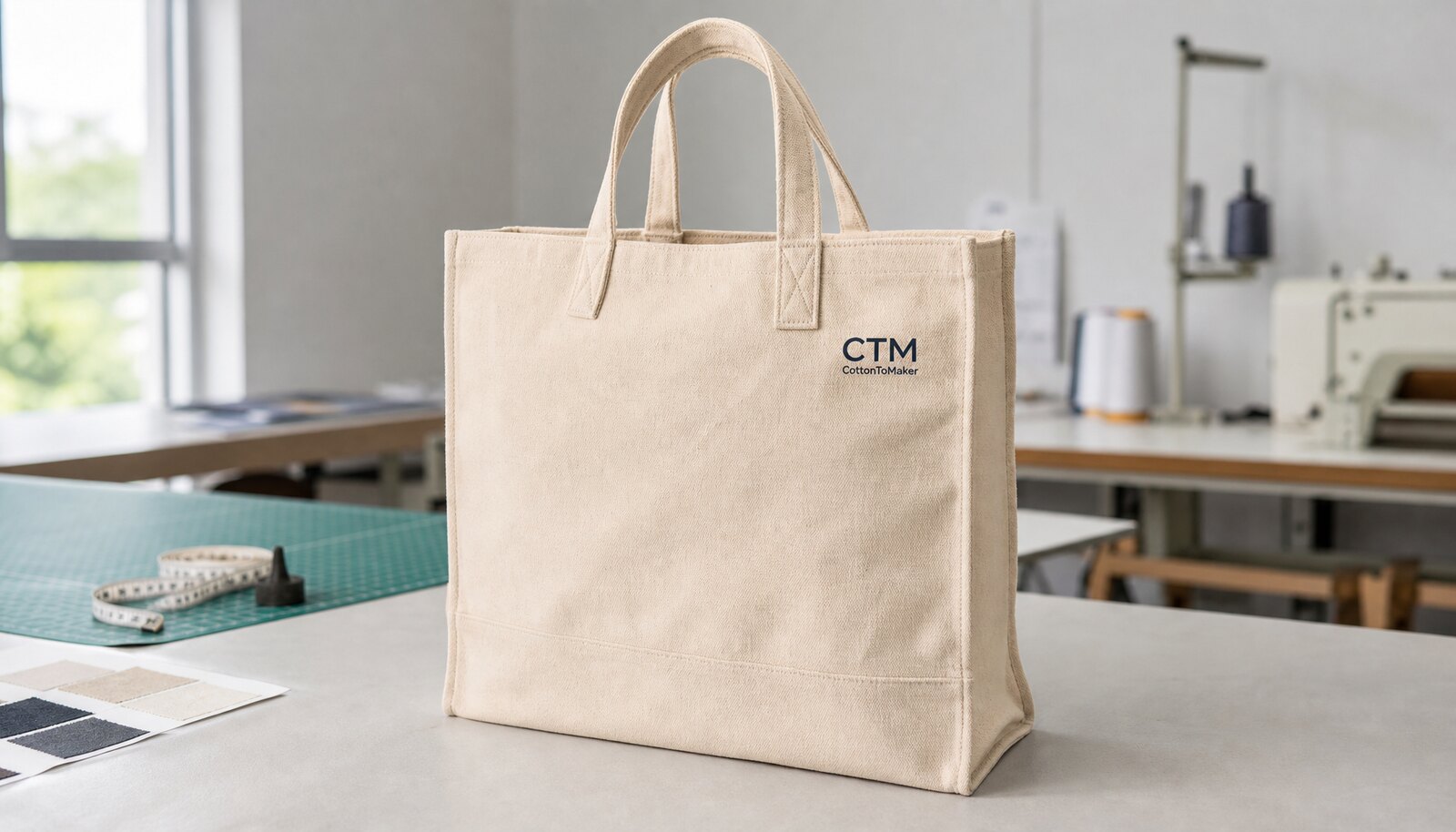
Why wineries need a different tote spec than general retail
A winery tote is not a generic shopping bag with a wine logo on it. It usually has to carry glass bottles, survive repeated handling at tasting rooms, and still look acceptable as a gift item. That changes the sourcing brief. The bag needs enough structure to stand up on a counter, enough seam strength to handle a full bottle load, and enough print clarity to hold brand value at retail distance.
Most buying mistakes start when the buyer treats the tote as a simple promotional item. If you are selling through a cellar door, club program, distributor channel, or gift shop, the bag becomes part of the product experience. That means the fabric weight, handle construction, and finish level must match the price tier of the wine brand, not just the lowest quote.
- For entry-level wine retail, a sturdy natural canvas tote with simple one-color branding is often enough.
- For premium clubs or gifting, buyers usually need heavier fabric, cleaner stitching, and better carton presentation.
- If the tote is meant to carry two bottles, the gusset and handle reinforcement matter more than decoration.
Choose the canvas weight before you compare suppliers
For heavy canvas tote bags for wineries, the practical range is usually 14 oz to 16 oz finished canvas, with 16 oz used when the bag needs a more premium hand feel or better standing structure. If the supplier only quotes fabric in raw ounce weight or yarn count, push for finished fabric data. Two quotes can look similar on paper and still produce very different stiffness, shrinkage, and drape after sewing and washing.
A lighter 10 oz or 12 oz canvas can work for flat merch bags, but it is usually a weak choice for wine bottles unless the design includes a generous gusset and reinforced handles. On the other end, very heavy canvas can drive up sewing difficulty, crease marks, and freight weight without giving you a proportionate retail benefit. The right spec is the one that survives bottle loading and still looks clean on shelf.
- Ask whether the fabric is bleached, natural, dyed, or washed, because each finish changes the look and lead time.
- If the bag will carry two bottles, treat handle reinforcement as part of the fabric spec, not an optional add-on.
- For club mailing programs, consider whether a lighter weight bag plus a carton insert is cheaper than overbuilding the tote.
Private label routes: direct factory, trading company, or hybrid sourcing
The best sourcing route depends on how often you will reorder. A direct factory is usually the cleanest route for a private label wine tote because the fabric, sewing, print, and packing decisions can be managed in one place. That reduces the chance of color mismatch, label drift, and delayed approval loops. It also gives you a better view of what is actually being made, not just what appears in a polished sales deck.
A trading company can help when you need multiple bag formats, mixed accessories, or coordinated packaging across several SKUs. But for a heavy canvas tote bag program, that extra layer often creates margin stacking and slows down corrective action if the handle placement or print placement is off. A hybrid route can work when the factory makes the tote and a second vendor supplies hangtags or inserts, but keep the number of touchpoints low.
- Direct factory route: best for repeat orders, lower hidden cost, and tighter QC control.
- Trading company route: useful for one-stop buying, but verify who actually owns the pattern, print, and carton work.
- Hybrid route: acceptable if the bag itself is made in one factory and the branding inserts are simple and standardized.
What drives quote differences for winery totes
Price variation usually comes from four places: fabric weight, print complexity, labor content, and packing. A quote that looks cheap may be based on thinner canvas, a smaller print area, no individual bag packing, or a lower stitch standard. If the quote does not state these items clearly, you are not comparing the same product.
For a realistic buying comparison, ask for a cost split. Even if the supplier does not want to disclose full factory math, you can still get useful data by requesting price tiers at 500, 1,000, and 3,000 pcs; separate setup charges for screens or plates; and the packing cost per unit. That is usually enough to identify where the quote is lean and where it is hiding risk.
- Fabric cost rises sharply when you move from standard canvas to heavier, cleaner, or washed canvas.
- Screen print cost increases with each color, each placement change, and each extra proof cycle.
- Individual polybags, hangtags, and retail-ready belly bands can add more than buyers expect if they are not included in the quote.
Use the right comparison table before you shortlist suppliers
Wineries often need bags for retail shelf display, tasting-room sales, club shipments, or event gifting. Those use cases can point to different sourcing routes even if the outer bag looks similar. The comparison below helps separate cheap quotes from commercially sensible ones.
The main buyer mistake is comparing only the unit price. A factory that gives a lower FOB quote but requires more revisions, more hidden packaging charges, or a longer sample cycle may cost more by the time the goods land and pass inspection.
- Compare suppliers on exact fabric basis, not only on bag style photos.
- Use the same print artwork, same size, same packing request, and same incoterm across all quotes.
- Reject any quote that leaves fabric weight, print method, or carton packing undefined.
Sample approval: what to inspect before bulk production
A pre-production sample is the point where most sourcing errors can still be fixed at low cost. For winery totes, the sample has to prove more than visual appeal. It should show how the bag sits when empty, how it behaves with a bottle inside, whether the print lands in the correct position, and whether the handles feel secure when lifted. A sample that looks nice but collapses under load is not an approval sample.
When reviewing the sample, measure the actual body width, gusset depth, and handle drop. Check the stitch line at the top seam and the handle joint. Put a bottle in the bag and stand it upright. If the bag twists, leans heavily, or the seams pull, the design needs adjustment before production starts.
- Compare sample dimensions against the approved spec sheet, not against the seller’s verbal description.
- Rub the print by hand and fold the bag once to see whether the ink cracks or transfers.
- If the bag will be retail-sold, inspect edge trimming, loose threads, and stain control under bright light.
Print method choices for winery branding
For most winery private label programs, screen print is the most practical method. It gives clean brand blocks, good opacity on natural canvas, and predictable cost on repeat runs. A one- or two-color print is usually enough for a strong winery identity. If the logo has fine lines or small text, ask the factory for minimum line thickness and minimum font size. Otherwise the art may look fine on screen and poor on fabric.
Embroidery can work on smaller logo zones or premium gift bags, but it adds cost, needle-hole risk, and a more limited area for branding. Woven labels are useful when you want a refined side mark or care label that does not dominate the bag face. Heat transfer is usually less attractive for a heavy canvas tote because long-term durability and crack resistance can be weaker than direct print. If the brand depends on a clean, rustic look, keep the decoration simple and direct.
- Screen print: best for bold logos, repeat orders, and clear cost control.
- Embroidery: good for small premium marks, but not ideal for large filled graphics.
- Woven label: useful as a side mark, inside brand label, or secondary identity element.
MOQ logic and how to structure a sensible first order
The right MOQ depends on color count, artwork complexity, and whether the supplier is running standard or custom fabric. For a private label winery tote, a common starting zone is 500 to 3,000 pcs per color and artwork. That range gives the factory enough volume to stabilize cutting, printing, and packing without forcing the buyer into an oversized launch inventory.
If you push too low on MOQ, the quote may look possible but become inefficient once setup costs are spread over too few pieces. On the other hand, a first order that is too large can trap you with the wrong handle length, the wrong print tone, or a bag size that does not work with your bottles. The safest first buy is usually a controlled test run with a clear reorder trigger.
- Start with one core size and one core print placement rather than multiple variations.
- If you need multiple wine colors or club tiers, separate them into standardized SKUs only after the first run proves demand.
- Tie reorder quantity to sell-through speed, not to supplier pressure for a larger run.
Packing, shipping, and landed-cost control
Packing affects both cost and receiving efficiency. For a heavy canvas tote bag, bulk packing with inner polybags and export cartons is usually the most cost-effective route unless the bag is intended for immediate retail display. If you need retail-ready packaging, decide early whether you want a belly band, hangtag, barcode sticker, or separate insert card. Each item adds labor and can change carton volume.
The landed cost of a winery tote is not just the FOB unit price. Freight weight, carton dimensions, and pack count can shift the real cost more than a small price difference at the factory. A heavy bag with oversized cartons can look cheap on paper and become expensive when shipping is booked. Ask for carton data early and calculate whether a tighter fold or adjusted pack count saves space without damaging the bag shape.
- Bulk pack is usually best for wholesale, club fulfillment, and warehouse distribution.
- Retail-ready packing is worth it only when shelf presentation or direct gifting requires it.
- Request carton dimensions, gross weight, and units per carton before final quote acceptance.
Lead time risk: where schedules usually slip
The lead time for a custom winery tote depends on how fast the sample is approved, whether the fabric is in stock, and how many revisions are needed on print placement or packing. A standard timeline often includes sampling, artwork confirmation, bulk production, and carton consolidation. The problem is not usually sewing speed. Delays often come from waiting on logo approval, changing the handle length after sampling, or adding pack instructions late in the process.
A buyer who wants a reliable ship date should lock the spec before the factory cuts bulk fabric. Once cutting starts, small changes become expensive and slow. If the project is tied to a vintage release, harvest season, club shipment, or holiday retail window, build a buffer for sample revisions and freight booking.
- Freeze artwork early so screen preparation and sample output do not restart.
- Approve carton labels and barcodes at the same time as the pre-production sample.
- Leave schedule buffer if your order depends on a seasonal winery event or campaign launch.
Specification comparison for buyers
| Supplier option | What to verify | Commercial advantage | Buyer risk to control |
|---|---|---|---|
| Direct sewing factory | fit-test photos with reference bottle, bottom reinforcement close-up, handle load proof, and final carton photo set | Better sample-to-bulk control and faster production feedback | May be weaker on export paperwork or branded packing unless checked early |
| Trading company | Factory name, production photos, trim-source proof, and who owns QC decisions | Can coordinate small mixed orders and extra services | Markup can hide real factory capability and slow defect decisions |
| Specialized bag workshop | bottle fit, bottom reinforcement, handle or cord strength, divider option, seam allowance, and upright stability | More practical for detailed construction, trims, and repeat programs | Capacity may be limited during peak seasons |
| Low-price general supplier | cotton canvas, jute, felt, nonwoven, or laminated paper sized to bottle diameter, weight, and condensation risk | Useful for simple promotional runs with loose specs | Material downgrades, weak packing, and vague inspection scope can erase savings |
| Retail-ready supplier | upright or flat packing, bottle-protection insert, carton count, moisture control, and retail display orientation | Can handle labels, SKU separation, carton marks, and receiving rules | Higher unit cost must be compared against reduced warehouse work |
| Compliance-focused supplier | Fabric records, labeling review, test plan, and production traceability | Safer for retail programs and repeat brand orders | Documentation claims need evidence, not only sales language |
| Local sample room plus bulk factory | Signed sample, bulk factory handoff, first-piece photos, and deviation owner | Good for complex branding before large production | Sample room quality may not match bulk line unless handoff is controlled |
Buyer checklist before sampling
- Finalize bottle count, bottle diameter, and whether the tote must hold one or two bottles without seam strain.
- Lock fabric weight in finished GSM or ounce weight, and state whether you want natural, bleached, dyed, or washed canvas.
- Define logo method, print colors, print area, and acceptable registration tolerance before sampling starts.
- Set handle length, reinforcement style, and target loaded weight, not just a general tote style.
- Confirm packaging format for cellar door retail, e-commerce, or wholesale case packs.
- Request a pre-production sample, a photo approval on print placement, and a carton drop test if the bags will ship internationally.
Factory quote questions to send
- What is the finished fabric weight, and is it measured after washing or only in raw fabric form?
- What is the exact MOQ per color and per artwork, and how does the unit price change at 500, 1,000, and 3,000 pcs?
- Which print method is included in the quote, and what are the setup charges for additional colors or placement changes?
- What is the handle reinforcement structure, and can you share a seam specification or stitch count at the stress points?
- What packing method is included: individual polybag, bulk pack, belly band, hangtag, or export carton only?
- What is the sample lead time, bulk lead time, and the point at which artwork approval becomes binding?
- Can you quote both FOB and a rough landed-cost estimate to my destination port or warehouse?
- What inspection standard do you use for print alignment, stains, stitching defects, and dimensional tolerance?
Quality-control points to confirm
- Finished fabric weight matches the agreed spec within the acceptable tolerance; do not approve based only on seller description.
- Bag opening, body width, gusset depth, and handle drop are measured on a packed sample, not just a flat cutting sample.
- Print registration stays within the agreed tolerance and does not crack or blur on the first fold line.
- Handle attachment must withstand a loaded lift test without stitch popping, seam puckering, or slippage at the joint.
- Fabric must be clean and even in color, with no oil stains, needle marks, or shade variation between panels.
- Carton pack count, master carton dimensions, and gross weight must match the booking data to avoid freight surprises.
- Labels, barcodes, and country-of-origin markings must be readable and placed where your receiving team expects them.
- If the bag is designed for bottles, the seam and gusset should not distort when the bag is loaded and set upright.