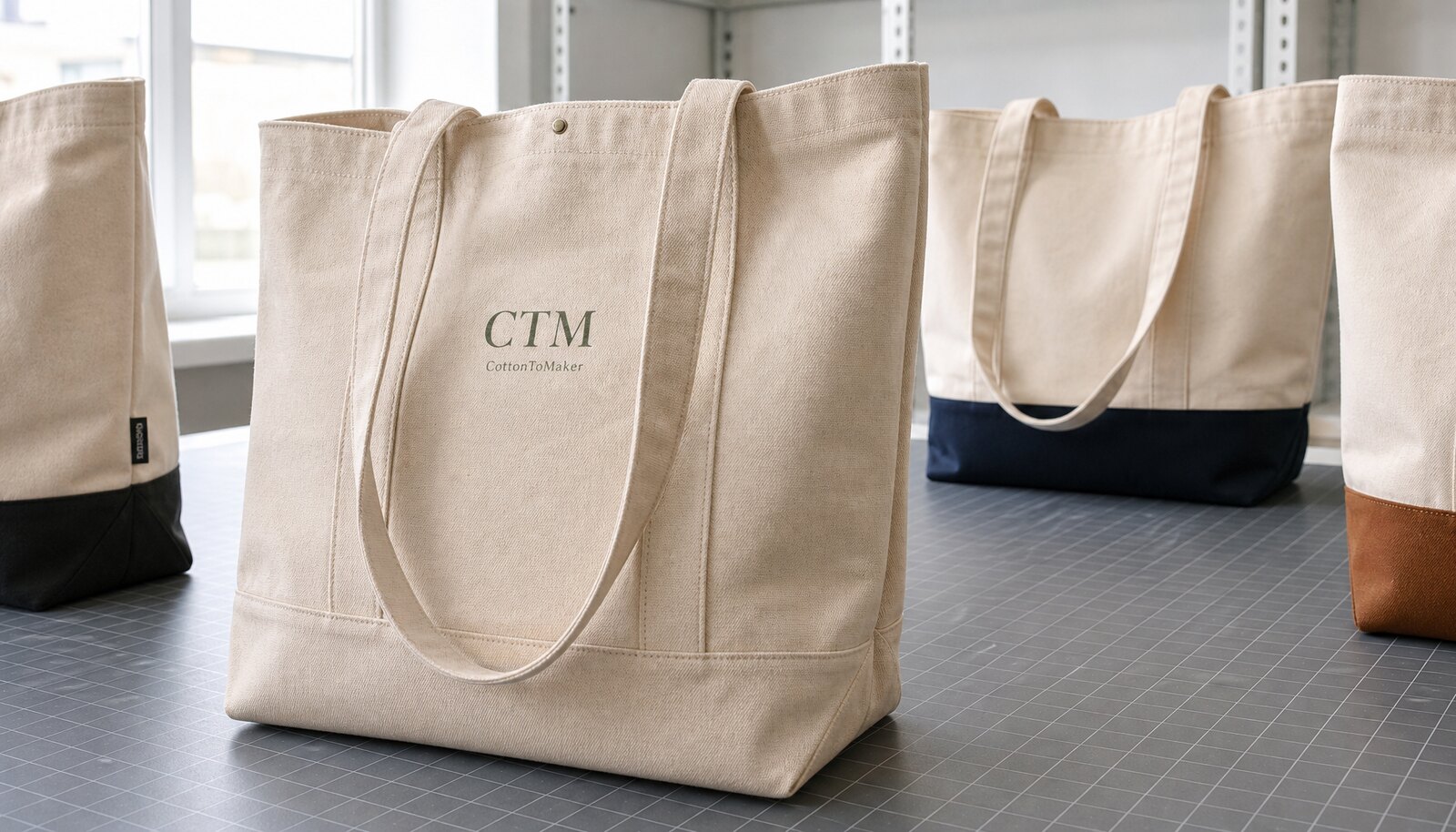
Why wineries buy heavy canvas tote bags differently from other retail buyers
Wineries usually buy tote bags for a specific commercial job: moving bottles, supporting cellar-door retail, increasing gift-set value, or creating a premium add-on for club shipments. That means the spec is less about fashion and more about load bearing, shelf presentation, and how quickly the program can be replenished when a vintage or event sells through. A tote that looks good on a website but fails a two-bottle carry test will create returns, complaints, and replacement cost that were not visible in the first quote.
For procurement teams, the first mistake is treating 'heavy canvas' as a single spec. In practice, 12 oz canvas, 14 oz canvas, and 16 oz canvas behave very differently once handles are filled, seams are stressed, and a logo is printed across a coarse weave. You need a clear usage scenario before comparing suppliers, because MOQ and lead time change depending on whether the bag is a stock item with print added later or a fully cut-and-sewn custom order.
- Cellar-door retail: needs strong visual appeal, fast replenishment, and simple packing.
- Gift sets: needs accurate sizing for bottle necks, inserts, and bundled collateral.
- Wine club shipping add-ons: needs better protection and more consistent carton packing.
- Event merchandise: needs short lead time and a print method that can handle smaller runs.
Fabric weight, structure, and finish: what actually changes the buying decision
Heavy canvas is often quoted in ounces per square yard or GSM. For wineries, 12 oz canvas is usually the lowest sensible starting point for a retail tote that carries a bottle or two, while 16 oz is a better fit when the bag needs a more premium hand feel, improved standing structure, or a stronger perception of value. GSM can help compare suppliers, but only if the same weave density and finishing are used. Two fabrics with similar GSM can still behave differently if one is tightly woven and the other is loose or heavily washed.
Finish matters just as much as weight. Bleached canvas gives a brighter print surface but can look more promotional. Natural unbleached canvas feels more rustic and is often a better match for winery branding. Dyed canvas can strengthen shelf identity, but it usually adds color consistency risk and may extend lead time if the supplier must source or dye fabric to order. Buyers should decide whether the tote is a functional carrier or a branded retail item first; that decision determines the fabric tolerance you should accept.
- 12 oz: suitable for standard single-bottle or light two-bottle use when handles are reinforced.
- 14 oz: balanced option for general winery retail with better drape and durability.
- 16 oz: better for premium positioning, bottle weight, and stronger structure on shelves.
- Unbleached canvas: lower visual contrast, more natural look, usually easier to source.
- Dyed canvas: stronger brand color match, but more shade variation risk between lots.
Print method choices and why the logo can change MOQ
Most winery tote programs start with one-color screen print because it is cost-effective, repeatable, and works well on coarse canvas. If the artwork has a simple mark, winery name, or short slogan, screen print usually gives the cleanest unit economics at volume. The catch is setup. Each color and each print position adds screens, registration work, and approval time, so the MOQ often rises when the artwork becomes more complex than the bag itself.
For premium brand programs, woven label, embroidery, or a sewn side label may be better than a large full-panel print. These options can improve perceived quality, but they also change sewing time and can slow lead time if the factory has to coordinate multiple processes. A buyer comparing quotes should not accept 'logo included' as a finished answer. The quote should say what method, what size, what position, how many colors, and whether artwork touch-ups or screen setup are included.
- Screen print: best for simple logos, repeat orders, and clear unit cost control.
- Embroidery: better for premium cues, but usually slower and more expensive on thick canvas.
- Woven label: useful for small brand marks or side branding with a more retail-ready look.
- Sewn side label: good for understated branding, but requires an extra sewing step.
MOQ logic: what drives minimums for winery tote programs
MOQ is rarely a random number. In a factory quote, it usually comes from one or more of four things: fabric sourcing, dyeing or color matching, print setup, and sewing efficiency. If the bag uses a stock natural canvas with one-color print, MOQ can be relatively low because the factory is mostly cutting, sewing, and printing against an existing material plan. If the bag needs a custom dyed fabric, special handle length, inside pocket, or custom label, the MOQ can rise quickly because each added variable reduces production efficiency.
Buyers should also distinguish between order MOQ and color MOQ. A supplier may accept a total run of 3,000 bags, but require 1,000 per color if the canvas is dyed. A winery planning three SKUs for red, white, and rosé promotions may be better off ordering one neutral body color and using different print variants rather than splitting the run into three low-volume fabric colors. That approach often shortens lead time and reduces leftover inventory when a campaign changes.
- Lowest MOQ usually comes from stock fabric, one print color, and standard dimensions.
- Higher MOQ often appears when the fabric must be dyed, laminated, lined, or washed.
- Multiple artwork versions can create separate screens and separate minimums.
- Custom zippers, snaps, or reinforced bottoms usually increase both MOQ and sewing time.
A practical supplier comparison for wineries: stock route vs cut-and-sew vs trading route
Not every buyer needs the same sourcing route. A cellar-door chain launching a seasonal gift bag may be better served by stock canvas with local printing, while a brand owner planning a year-round retail line often needs a cut-and-sew factory that can hold the spec steady across reorders. Trading companies can help when the bag is part of a mixed procurement basket, but they may not give you the clearest visibility on fabric source, sewing control, or packing accuracy.
The point is not to pick the cheapest quote. The point is to choose the route that matches your reorder pattern, artwork complexity, and target margin. For wineries, the ideal supplier is often the one that can hold a stable fabric lot, repeat the same logo position, and pack bags in a way your warehouse can receive without repacking.
- Stock route: faster start, lower customization, best for test orders and events.
- Cut-and-sew factory: better control over size, handle, and branding consistency.
- Trading route: helpful for mixed baskets, but verify the real factory and inspection process.
- Local printing partner: useful when speed matters more than exact fabric control.
Comparison table: sourcing options for winery heavy canvas tote bags
Use the table below to compare sourcing routes on a commercial basis, not just on headline price. The cheapest quote can become the most expensive if fabric weight is inconsistent, print setup is unclear, or packing adds warehouse labor at destination.
For each route, compare the same delivered specification: fabric weight, print method, packing format, and acceptable defect rate. That is the only way to make an apples-to-apples MOQ and lead time review.
- Write decisions in measurable language, not only descriptive wording.
- Ask for sample photos plus one physical approval sample for important orders.
- Keep quotation, sample approval, and inspection notes tied to the same spec version.
Sample approval: the checks that prevent bulk mistakes
A sample is not just for visual approval. For heavy canvas tote bags, it is the only reliable point to test handle feel, bottle fit, print readability, and whether the bag still looks clean once loaded. If the approved sample is too soft, too narrow, or too short, the bulk order will reproduce those problems exactly. A buyer should treat the sample as the master reference for every dimension and finish detail that matters in warehouse receiving and retail use.
Pre-production samples are especially important when the winery program includes branded packaging or gift bundles. The sample should show the final print method, final label placement, and final packing style. If the factory sends a blank bag or a one-off version with different stitching, it is not a real approval basis. Ask for a sample photo with measurement notes, then compare the physical sample against your receiving criteria before releasing the bulk PO.
- Measure finished width, height, and gusset if the bag must hold bottles upright.
- Load test the handles with actual bottle weight or equivalent weight.
- Inspect print edges under normal retail lighting, not just in photos.
- Check seam alignment and corner shape so the bag does not twist when filled.
Packing decisions affect damage rate, carton efficiency, and warehouse labor
Packing is one of the most underestimated cost drivers in tote bag buying. A flat-packed canvas bag may be cheap to ship, but if it arrives creased, dusty, or with misaligned handles, your warehouse may spend time re-folding or rebagging before distribution. For wineries with direct-to-store or distributor receiving, the packing standard should be written into the quote: bundle count, inner polybag use, barcode label placement, master carton count, and whether cartons are pallet-ready.
If the bag is printed on one face, make sure the factory knows which way the print should face in the carton. That sounds minor, but it affects opening presentation for retail or gifting. Also, ask whether the factory will use inserts to keep the bag shape during transport. Inserts can protect appearance, but they increase packing time and carton volume. Buyers should only pay for them if the product is sensitive to creasing or the delivery channel is strict about shelf-ready appearance.
- Flat pack is usually best for lower freight cost and easier palletization.
- Bundle by color or SKU to simplify warehouse receiving.
- Use inner labels if the same bag will be sold through multiple channels.
- Confirm master carton dimensions before booking freight so container loading is predictable.
Lead time review: where the schedule usually slips
Lead time for heavy canvas tote bags is usually a chain of smaller steps: artwork confirmation, fabric booking, sample approval, cutting, sewing, printing, packing, and carton consolidation. Buyers often focus only on the sewing days, but the real schedule risk is usually before production starts. If the artwork is not final or the fabric is not in stock, the factory can lose days waiting for approval or raw material receipt.
A realistic lead-time review should separate sample time from bulk time. For standard stock-fabric programs, sample turnaround may be quick, but bulk still depends on print queue and sewing line capacity. For custom dyed canvas, the color approval step can add extra time. Procurement teams should build a buffer if the bags are tied to a winery launch, event calendar, or wine club mailing date. The safest move is to freeze the bag spec before the final sales forecast, not after.
- Artwork approval delays often add more time than sewing itself.
- Fabric dyeing or custom color matching can extend the schedule significantly.
- Small changes after sample approval can reset screens, labels, or packing details.
- Peak seasons can lengthen queue time even when the quoted sewing lead time looks short.
Quote breakdown: how to compare real landed cost instead of unit price
A reliable quote should let you see where the money goes: fabric, cutting, sewing, printing, labels, packing, and carton cost. For winery tote bags, a low unit price can hide weaker canvas, fewer stitches, or a vague packing plan that creates extra receiving cost at destination. If you are comparing two suppliers, ask both to quote the same finished size, same fabric weight, same print method, and same carton configuration. Without that discipline, the lower quote may simply be missing a line item.
A practical landed-cost review should also include freight assumptions and defect risk. A bag that is 8% cheaper but has a higher rework rate or inconsistent print registration may cost more after inspection, relabeling, and replacement. The goal is not the cheapest ex-factory price; the goal is the lowest acceptable total cost for a bag that can be sold or handed out without embarrassment.
- Compare fabric spec line by line, not just 'canvas tote' naming.
- Separate setup fees from unit price so reorders are easier to forecast.
- Ask whether packaging, barcode labels, and inner polybags are included.
- Use the same freight assumption when comparing landed cost across suppliers.
Specification comparison for buyers
| Spec decision | Recommended option | When it fits | Buyer risk to check |
|---|---|---|---|
| Fabric weight | 12 oz canvas for general retail; 16 oz for premium bottle carrying | Cellar-door retail, gift sets, and repeated consumer use | Too-light fabric can show handle pull and corner sag after bottle load testing |
| Handle construction | Same-fabric self-fabric handles with bar-tack reinforcement | Premium presentation and lower sewing complexity | Short handles or weak bar-tacks can fail when shoppers carry 2 bottles plus collateral |
| Print method | 1-color screen print for volume; woven label or embroidery for premium brand cues | Simple winery logo and repeat orders | Fine serif text and small details may fill in or lose edge on coarse canvas |
| MOQ route | Blank stock plus local print for very small runs; custom cut-and-sew for larger runs | Pilot launch, seasonal event, or club member gift program | Stock color and print placement limits can distort brand spec or reduce shelf appeal |
| Closure style | Open-top for retail use; zipper or snap-top only when shipment protection matters | Store resale and tasting-room carry-out | Added closure hardware increases cost, sewing time, and defect points |
| Lining choice | Unlined for cost and structure; light lining only if bottle abrasion or dust control matters | Everyday retail tote programs | Lining can add lead time and cause a mismatch between outer fabric and bag shape |
| Packing method | Flat-packed with size-separated cartons and barcode labels on inner bundles | Distributor and warehouse receiving | Over-compressed packing can crease printed panels and increase relabeling work at destination |
| Supplier route | Factory direct for repeat volume; trading route only when you need mixed product consolidation | Ongoing winery merchandise programs | A middleman quote may hide the actual fabric GSM, print setup, or carton count |
| Lead-time structure | Standardize fabric, print, and packing before PO; keep sample sign-off separate from bulk approval | New program with a fixed launch date | Late artwork changes are the fastest way to lose 1–2 weeks |
Buyer checklist before sampling
- Confirm the bottle load target: one bottle, two bottles, or mixed gift pack, then set handle and base reinforcement accordingly.
- Lock fabric weight in ounces or GSM, not just 'heavy canvas,' and request the finished bag weight if appearance matters.
- Specify print size, number of colors, and print location on a dieline or clear photo reference.
- State whether the bag must fit 750 ml bottles, magnums, or wine club inserts, because internal width changes the sewing pattern.
- Define packing requirements: flat pack, inserted tissue, polybag, barcode sticker, master carton count, and pallet preference.
- Request sample photos or pre-production samples before bulk approval, especially when using new colors or special labels.
Factory quote questions to send
- What is the exact fabric spec, including GSM or oz, warp/weft construction, and whether the canvas is bleached, dyed, or greige?
- Is the MOQ driven by fabric dyeing, print setup, cut pattern efficiency, or carton packing, and can any part be split across colors?
- What is the quoted lead time for sample approval, bulk production, and packing separately?
- Which print method is included in the quote, what is the setup charge, and what is the tolerance for logo position and color match?
- What carton size, carton quantity, and packing ratio are included, and are inner polybags or barcode labels extra?
- What inspection standard will you use for stitch density, handle pull strength, and print defect acceptance?
Quality-control points to confirm
- Fabric weight tolerance should be agreed in advance; for heavy canvas, buyers should allow a small manufacturing tolerance but reject bags that feel visibly underweight or loose-woven.
- Handle attachment must use bar-tacks or equivalent reinforcement at both ends; loose stitching or skipped stitches should be treated as a major defect.
- Print registration should stay within a pre-agreed tolerance; blurred edges, uneven ink coverage, and off-center placement are the most common retail complaints.
- Bag opening, width, and height must match the approved sample within practical sewing tolerance so bottles fit without stretching the side seams.
- Carton count and bundle count must be verified against the packing list to avoid receiving shortages masked by overfilled cartons.
- If the bag uses dark canvas with light print, rub resistance should be checked before bulk release to reduce scuffing during transit.