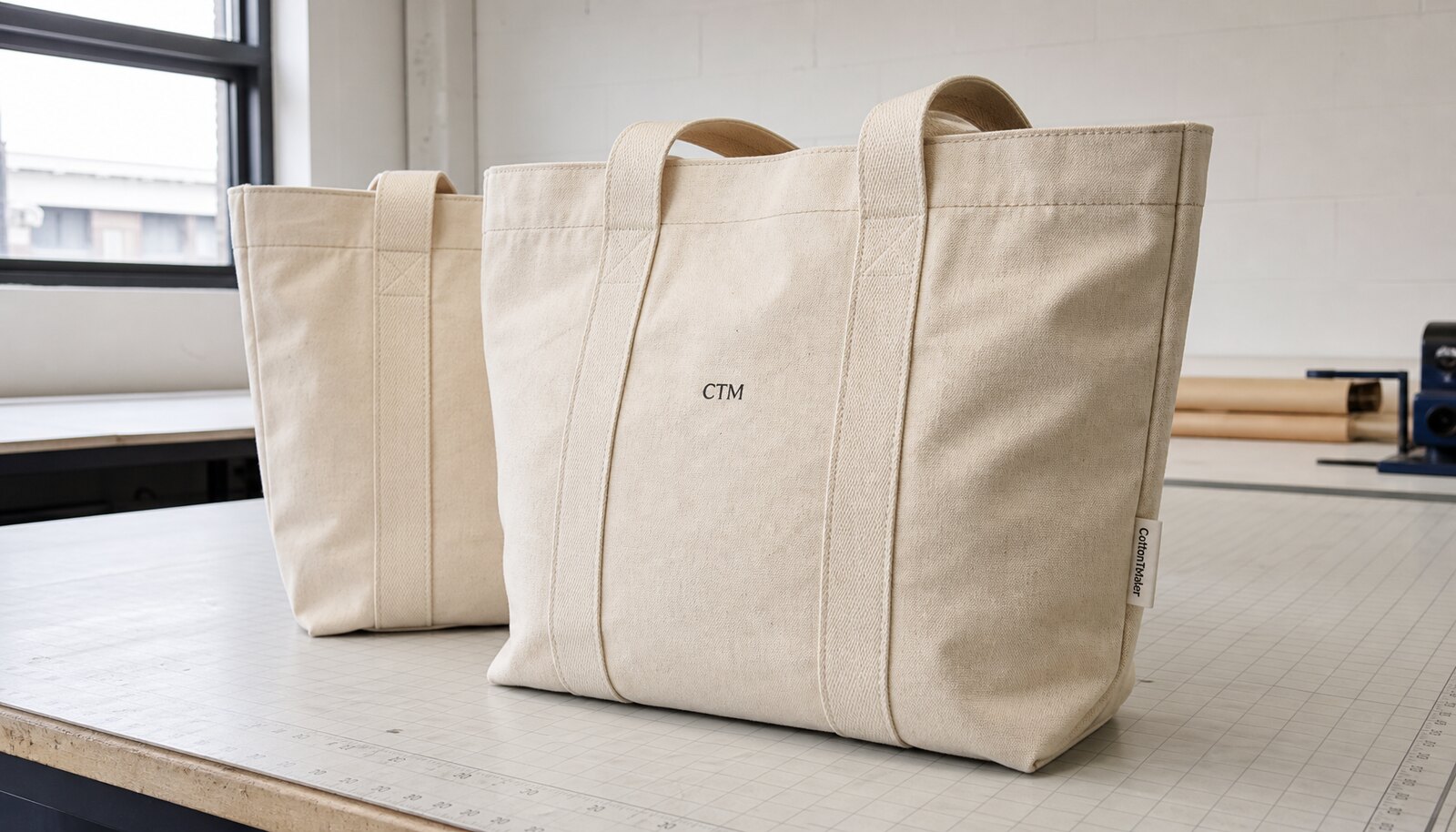
Why wellness brands buy heavy canvas tote bags as packaging, not just merchandise
For wellness brands, a heavy canvas tote has to do more than carry products. It often replaces a paper bag, protects glass jars or bottles, and stays in use long after the first purchase. That makes the tote part of packaging strategy, not just a branded accessory. Buyers usually run into trouble when they spec the bag like a simple giveaway and then discover the load, print, and finish are too weak for retail use.
The buying problem is usually balance: the bag needs to look premium enough for a clean wellness brand, but still stay practical for mass packing and repeat orders. If the tote is too light, it loses structure and feels cheap. If it is too heavy or over-built, your landed cost rises and your packing cube gets worse. The right specification depends on whether the bag is acting as sustainable secondary packaging, a paid retail item, or a bundled campaign insert.
- Sustainable packaging use case: prioritize structure, repeatability, and low defect risk.
- Retail use case: prioritize print quality, handfeel, and shelf presentation.
- Campaign or subscription use case: prioritize speed, stackability, and carton efficiency.
Fabric weight choices that change cost, handfeel, and durability
Heavy canvas tote bags for wellness brands are commonly built from 12oz, 14oz, or 16oz canvas. In buyer terms, 14oz to 16oz, roughly 475 to 540 GSM, is the sweet spot when the bag must support reusable packaging and still feel substantial at first touch. Below that range, the tote often feels too soft for premium kits and can sag when loaded with glass or boxed sets. Above that range, the bag starts to behave more like a structured utility tote, which may be unnecessary if the brand only needs a reusable carrier.
Be careful with quoted fabric descriptions. Some suppliers quote greige weight before finishing, while others quote finished fabric after washing or calendering. That difference changes real performance and cost. A buyer should also define whether the fabric is plain weave canvas, enzyme-washed canvas, or brushed canvas, because the finish changes shrinkage, print behavior, and color consistency.
- 12oz canvas: lower cost, lighter handfeel, suitable for simple packaging but not ideal for heavier kits.
- 14oz canvas: practical middle ground for most wellness brands using the tote as reusable packaging.
- 16oz canvas: premium structure, better shelf presence, higher sewing load and higher unit cost.
- Natural color is usually the safest route for sustainability messaging and avoids dye batch variance.
Print method comparison: what works on canvas and what causes complaints
For wellness branding, the safest print route is usually one or two-color screen print on natural canvas. It gives solid logo coverage, predictable repeatability, and better unit economics than complex decoration. Water-based inks can feel softer and more aligned with eco positioning, but the factory still needs proper curing control so the print does not crack or transfer during packing. If the artwork has fine lines or small text, ask for a test strike on the exact canvas weight you plan to buy, not on a different sample fabric.
Full-color digital print can work for short runs, but it is not always the best commercial choice for heavy canvas tote bags. The ink laydown can sit differently on coarse canvas, and small details may lose clarity. Embroidery looks premium, but it adds labor and can distort the bag face if the design is large or the stitch density is too high. For most wellness brands, a restrained print plus a woven label or small sewn patch gives the cleanest value-to-cost ratio.
- Screen print: best for stable logo use, repeat orders, and tighter cost control.
- Water-based print: better brand fit for eco messaging, but requires curing verification.
- Embroidery: premium effect, but higher labor cost and more risk of panel puckering.
- Woven label: useful for secondary branding, especially on side seam or handle area.
Comparison of supplier routes for sustainable packaging projects
The quote you get depends heavily on the sourcing route. A factory-direct supplier usually gives better visibility on fabric weight, cut size, trim, and print process, which matters when the tote is part of a packaging system. A trading company may be useful if you need mixed categories or very small quantities, but the buyer has to work harder to verify the real spec behind the quote. For a wellness brand scaling from pilot launch to repeat purchase, that hidden layer can create inconsistency between reorder lots.
If your use case is sustainable packaging, the right supplier is not the cheapest one on paper. The right supplier is the one who can hold a repeatable spec, explain the cost drivers, and protect your packing standard. The table below compares practical sourcing routes, not just product fields, so procurement teams can judge which option fits a launch, a replenishment program, or a retail rollout.
How to compare quotes without missing the real cost drivers
A useful quote should separate fabric, cutting, sewing, print, trim, packing, and export carton cost. If the supplier only gives one lump sum, compare with caution. The cheapest quote often hides a lighter fabric, a lower stitch count, or a weaker print standard. Those shortcuts are expensive later because they create sample rejections, carton damage, or retail complaints.
Procurement teams should compare landed cost, not just factory price. For heavy canvas tote bags for wellness brands, the shipping cube matters because the tote is bulky relative to its value. A flat-packed 14oz tote in a tight carton may beat a slightly cheaper 16oz tote that ships in a larger carton. Also consider whether the supplier can hold the same standard on reorders without a new dye or print variance review.
- Ask for a line-item quote so you can see where cost changes with fabric, trim, and packing.
- Compare carton dimensions and bag fold method because those affect freight and warehouse handling.
- Watch for hidden costs such as artwork setup, print plates, label sourcing, and extra sample rounds.
MOQ logic: what drives minimums on canvas tote orders
MOQ is not just a factory preference. It reflects how the plant sets up cutting, printing, and sewing lines. A stock-size natural canvas tote with a simple one-color print can often start at a lower MOQ than a fully custom size with gusset, snap closure, and multiple decorations. Once you add custom dimensions, custom color, or nonstandard trim, the supplier needs more material planning and more setup time, so the minimum rises.
For wellness brands testing sustainable packaging, there are two practical paths. The first is a stock base bag with custom print and possibly a woven label. The second is a fully custom tote for a larger launch where the bag becomes part of the brand’s core presentation. The stock path reduces risk and gets a product into market faster. The custom path improves fit and branding, but only makes sense if the volume can absorb the development effort.
- Lower MOQ: stock size, natural color, one-color print, flat packing.
- Mid MOQ: stock size, custom print, woven label, limited packing changes.
- Higher MOQ: custom size, custom handle length, snaps, gusset, or specialty wash.
Sample approval: what a serious buyer should inspect before bulk
A sample should prove construction, not just appearance. Hold the bag by the handles, load it with product weight similar to your real use case, and inspect the seams after handling. For wellness brands, a tote that looks good empty but sags with jars or glass bottles is a poor packaging solution. The sample also needs to show how the print sits on the canvas after pressing and after a basic rub test.
If the supplier sends only a photo sample or artwork render, treat it as an early reference, not approval for bulk. A proper pre-production sample should use the final fabric weight, final print method, final label, and final packing format. Small differences in handle width, seam fold, or ink density become much more visible once the tote is used as retail packaging.
- Measure body width, height, and gusset against the approved tech pack.
- Load-test the handles and bottom seam with a realistic product fill.
- Rub the print, flex the fabric, and inspect for transfer, cracking, or puckering.
- Confirm label placement and stitching if the tote includes a woven brand label.
Packing format and warehouse handling: small decisions that affect landed cost
Packing is where many buyer teams lose money without noticing. A bag folded in a controlled way and packed in efficient export cartons can lower freight cost and simplify warehouse receiving. A loosely packed tote or overstuffed retail presentation fold may look better at first glance, but it can increase carton volume, labor, and carton damage risk. For wholesale or DTC fulfillment, consistency in pack count matters as much as the bag itself.
For sustainable packaging programs, flat packing is usually the practical choice. It keeps the carton count manageable and reduces the risk of crushed corners or distorted print during transit. If the brand wants a premium unboxing appearance, the supplier can pack with a neat insert card or controlled fold, but the buyer should quantify the labor cost and the effect on carton density before approving it.
- Flat-packed bulk cartons are usually the best balance for import and storage.
- Polybagging every bag adds cost and plastic; only use it if retail presentation requires it.
- Mark cartons with SKU, size, color, and quantity so receiving teams can count quickly.
Lead time planning and where schedules usually slip
Lead time for heavy canvas tote bags depends more on sample approval and printing setup than on cutting alone. A simple stock-base order can move quickly after artwork sign-off, while a new custom size or new trim item may need extra pattern work and a second sample round. Buyers should build buffer time around print approval because that is where delayed decisions often push the whole shipment.
The usual schedule risks are artwork revisions, label sourcing, and late changes to packing instructions. If the factory is waiting on label approval or a corrected logo file, the sewing line may be ready but unable to finish the order. The cleanest way to protect the schedule is to lock all decoration and pack details before PP sample approval. For repeat orders, keep the same spec code and revise only what truly needs changing.
- Typical sequence: tech pack review, sample, sample approval, bulk material booking, production, packing, shipment.
- Avoid changing print size after sample approval unless you want a cost and time reset.
- Keep artwork in vector format and specify Pantone targets only where color matching truly matters.
Practical acceptance criteria for wellness brand tote programs
When the tote is part of a wellness brand’s sustainable packaging system, acceptance criteria should focus on function and repeatability. The bag does not need luxury-level detailing, but it does need controlled fabric weight, stable print, and enough structure to carry the intended products without early failure. Buyers should define the acceptable range before production so the factory understands where the line is between normal natural variation and a real defect.
A strong acceptance standard keeps the order honest. It protects both sides: the buyer knows what will ship, and the supplier knows what needs to be corrected before bulk release. If you buy on vague language like “premium quality” or “nice finish,” you will spend too much time sorting out avoidable disputes. If you buy on measurable tolerances and visible defect limits, reorders become much easier to manage.
- Fabric weight: define target GSM and acceptable variance.
- Stitching: define seam appearance, reinforcement points, and no-skip threshold.
- Print: define placement tolerance, coverage, and rub resistance.
- Packing: define fold style, carton count, and outer carton marking standard.
Specification comparison for buyers
| Spec decision | Recommended option | When it fits | Buyer risk to check |
|---|---|---|---|
| Fabric weight / GSM | 14oz to 16oz cotton canvas, roughly 475 to 540 GSM | Best for wellness brands using the tote as reusable retail packaging, gift-with-purchase, or premium event carry | Too light will collapse under bottles, journals, or sample kits; too heavy raises cost and slows sewing |
| Surface finish | Unbleached natural canvas or garment-washed natural canvas | Fits clean, eco-oriented branding and reduces dependency on aggressive dye matching | Natural slubs, seed specks, and shade variation need to be accepted in the spec |
| Print method | 1 to 2-color screen print or water-based print | Works for logo-led wellness branding and stable repeat orders | Fine gradients, small text, or full coverage art can blur or crack if the mesh count and curing are weak |
| Decoration route | Woven label or small sewn patch plus restrained print | Good for premium positioning when the tote is part of a retail packaging system | Extra trim components add approval steps and can delay bulk if label shades or stitch density are loose |
| Handle construction | Cross-stitched self-fabric or cotton webbing handles with reinforced X-box | Suitable for heavier fill weights and repeated customer reuse | Short handle drop or weak bar-tacks can fail in field use and create complaints after packing |
| Closure option | Open top for speed, or top snap button for premium kits | Open top fits checkout packaging and event handout; snap suits curated wellness sets | Snaps add assembly labor and can create line defects if placement tolerance is not controlled |
| MOQ route | Stock base bag with custom print versus fully custom dimensions | Stock base bag suits smaller launch tests and faster replenishment | Fully custom needs higher MOQ and longer lead time because cutting, markers, and fit approval change |
| Packing format | Flat-packed in bulk with size-label carton marks and moisture protection | Best for importers optimizing cube and warehousing cost | Loose stuffing or retail folding may improve presentation but increases labor and carton volume |
| Sourcing route | Factory-direct from a canvas bag manufacturer rather than a trading layer | Best when the buyer needs spec control, sampling discipline, and better quote visibility | A trading route may hide the true fabric weight, print method, or packing spec unless paperwork is explicit |
Buyer checklist before sampling
- Confirm target fabric weight in GSM or oz, plus whether the quoted weight is finished fabric or greige fabric before shrinking and washing.
- State the tote purpose clearly: sustainable packaging, retail resale, event kit, or subscription insert, because load requirement changes handle and seam spec.
- Approve one decoration method only, or define hierarchy if combining print, woven label, and sewing patch.
- Request construction details: seam allowance, handle width, stitch count, reinforcement points, and whether side gusset or bottom gusset is required.
- Lock packing format, carton count, and whether each bag must be folded, polybagged, or carton-packed by size/color.
- Ask for sample photos of actual production fabric, not only a design render, before PO release.
Factory quote questions to send
- What is the finished fabric weight in GSM after washing or finishing, and what tolerance do you hold per lot?
- Is the quoted price based on stock dimensions or a new cutting pattern, and what extra charges apply for custom size, gusset, or closure?
- What print method is included, how many colors are priced, and what mesh count or curing standard do you use for canvas?
- What is your MOQ for blank bags, printed bags, and bags with added labels or snaps, and how does MOQ change by fabric weight?
- What sample will you send for approval: pre-production sample, size sample, or photo sample, and what defects are fixed before bulk?
- How are bags packed for export, what carton size is used, and what carton drop or compression test can you support if needed?
- What is the standard production lead time after sample approval, and what part of the schedule usually becomes the bottleneck?
- Can you separate the quote into fabric, cutting, sewing, print, trim, packing, and export carton cost so landed-cost comparison is possible?
Quality-control points to confirm
- Fabric GSM within the agreed tolerance and no hidden light-weight substitution between handfeel and measured weight.
- Cut size within tolerance on body width, height, gusset, and handle drop; inspect both first article and packed random pieces.
- Print registration, color density, and curing quality with no tackiness, cracking, or ink transfer during rub test.
- Stitching density consistent at load points, especially handle joins, bottom seams, and gusset corners.
- No broken threads, skipped stitches, oil stains, loose lint, or visible needle damage on the face panel.
- Carton labeling matches SKU, size, color, quantity, and country of origin details required by the buyer.
- Fold standard and packing count are consistent so warehouse receiving does not need manual recounting.