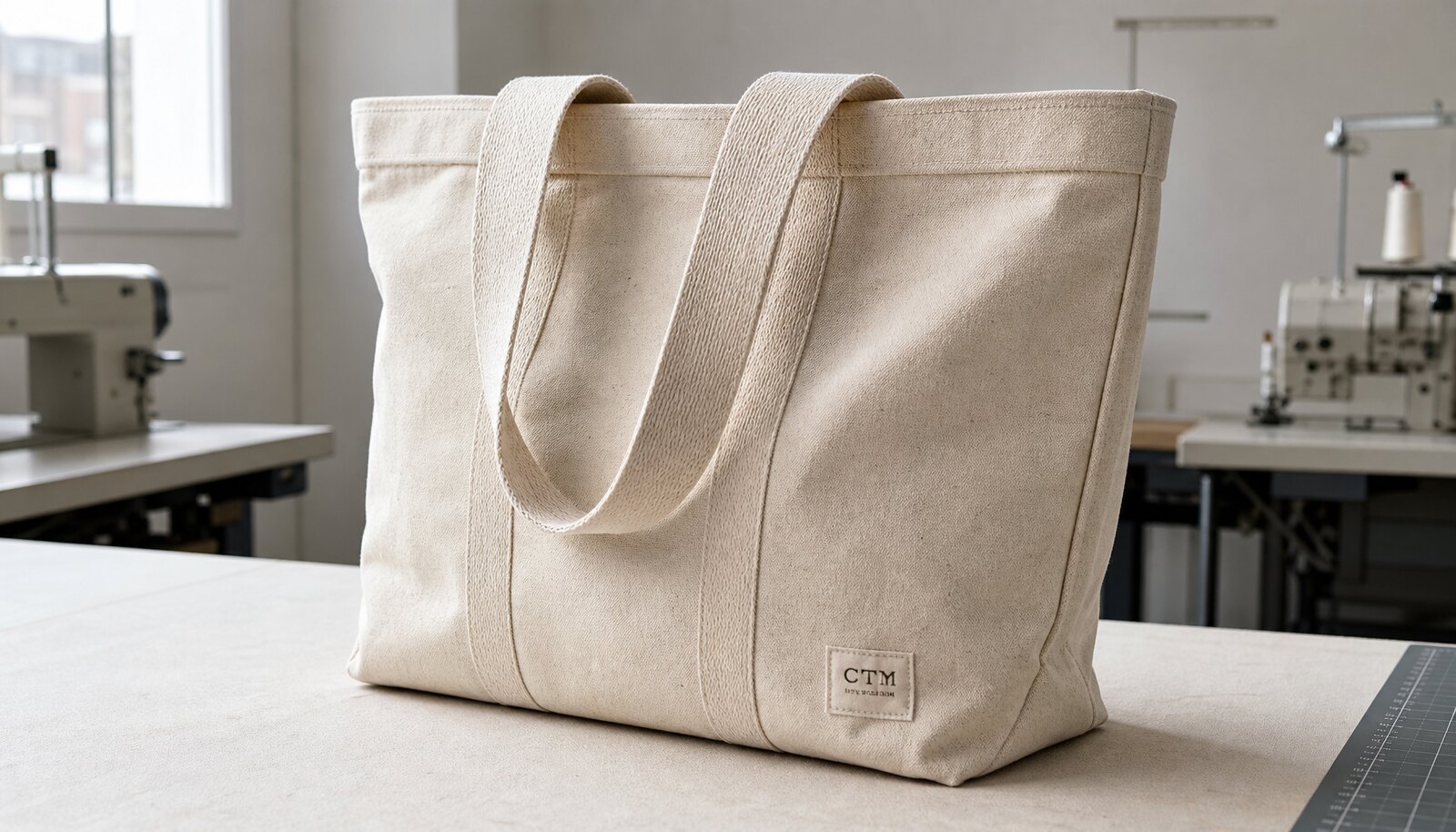
Why Wellness Brands Need A Different Tote Spec
Heavy canvas tote bags for wellness brands do more than carry a logo. They often act as reusable packaging for a launch kit, a membership welcome bundle, a spa retail purchase, or a gift-with-purchase that customers keep using long after the first delivery. That changes the buying standard. The bag has to feel calm, premium, and intentional, but it also has to survive daily use with bottles, jars, towels, supplements, journals, or folded apparel inside. A tote that photographs well and fails in real use is a brand liability, not a marketing asset.
The first procurement mistake is to write the RFQ around appearance alone. A better brief starts with the channel and the contents: what will be packed, how heavy the load is, whether the tote is sold empty or filled, and whether it needs to live on a retail shelf or in a fulfillment carton. That answer determines the fabric weight, handle build, reinforcement, and packing spec. For wellness brands, the bag is part of the customer experience, so the spec should reflect both the physical load and the emotional impression the brand wants to create.
- Define the tote as packaging, merchandise, or both before you ask for a price.
- Match the construction to the actual load, not the visual style board.
- Treat presentation details such as folding and labeling as part of the product, not as an afterthought.
Build The Spec Around The Product That Goes Inside
The right tote size depends on what is going in it. A wellness kit with a towel, a bottle, and two small jars needs different dimensions from a flat promotional insert pack or a retail tote intended for books and grocery items. Finished width, height, gusset depth, and handle drop should be specified in the RFQ, but the more useful input is the actual pack list. If the tote must stand upright on a counter or hold rigid boxes, the gusset matters more than a generic bag name. If the contents are fragile or small, the opening width and internal volume matter more than the headline dimensions.
Fabric weight should be expressed in both oz and GSM so suppliers cannot quietly quote different material bases under the same description. For most wellness programs, 12 oz to 14 oz canvas is the practical baseline because it gives enough structure without becoming overly stiff or expensive. Move to 16 oz when the bag is part of a premium resale item, needs a heavier hand feel, or regularly carries dense contents such as glass bottles. If the brand wants a softer drape, specify whether the canvas is pre-shrunk, washed, or finished, because those details affect both shrinkage and texture. The goal is not the heaviest bag possible. The goal is the lightest construction that still protects the product and feels credible for the brand.
- Write the spec from the pack-out list, not from a generic tote size chart.
- State the fabric in both oz and GSM, plus whether the number is before or after finishing.
- Call out handle drop, gusset depth, and opening width so the tote fits the real contents.
Supplier Comparison: Which Sourcing Route Fits The Program
The sourcing route changes the quote, the risk profile, and the amount of control you actually have. A direct cut-and-sew factory is usually the strongest choice when the order is recurring, the construction is simple, and the buyer wants one factory accountable for fabric, sewing, and reinforcement quality. A trading company or sourcing agent can help when the wellness brand is bundling several product categories or needs one contact across more than one factory, but it also adds a margin layer that can hide the real production cost. A local converter or print shop can be useful for short runs and urgent launches, yet it may have limited heavy-canvas capacity and fewer options for structural details.
For procurement teams, the key question is not which supplier type is cheapest in isolation. It is which route produces the lowest risk at the required service level. A direct factory may have the best unit economics at scale, but only if it runs the print or label process in a controlled way and can show you the actual sample path. A packaging-integrated supplier can simplify kitting for wellness bundles, but the buyer still has to check who owns QC for the tote body, the labels, and the carton build. Ask each supplier to quote the same specification and to identify every process they outsource. The answer tells you far more than a headline price.
- Direct factory is best when the spec is stable and the order will repeat.
- Trading company is useful for multi-SKU programs, but check the real factory and margin layer.
- Local converter works for speed, but confirm heavy-canvas capability and sewing quality before relying on it.
- Packaging-integrated supplier is convenient for kits, but verify who owns QC across every component.
Print, Label, And Finish Decisions That Hold Up In Use
Wellness branding usually performs best when the finish is restrained. Heavy canvas can carry simple screen print, a woven patch, an embroidered mark, or a side label, but the wrong decoration can make the tote feel busy or cheap. Screen print is still the most controllable method for simple logos and repeatable runs because it gives stable color and lower setup complexity. Embroidery adds texture and a more premium tactile feel, but only when the logo is small enough that stitch density will not distort the fabric. Woven labels and side labels are often the cleanest choice when the brand wants a quieter look and a more retail-ready finish.
The practical mistake is to approve artwork on a flat mockup and assume the sewn bag will match it. On a real tote, seam allowance, fold lines, and handle placement change the visual balance. A logo that sits comfortably on screen can end up too close to a seam, too low after folding, or too large for the panel once the bag is sewn. The RFQ should define the print method, artwork size, Pantone target, and placement reference points measured from the top edge and side seam. If the wellness brand is making sustainability claims such as organic cotton, recycled content, or azo-free dye use, the supplier should be asked for documentation before the claim is printed anywhere on pack. If a claim cannot be documented, it should not be part of the approved artwork.
- Use screen print for simple, repeatable logos with stable color control.
- Use embroidery only when the logo is small enough to avoid fabric distortion.
- Measure artwork placement from fixed tote points, not from the center of a flat mockup.
- Do not approve sustainability claims unless the supplier can support them with documentation.
Commercial Quote Template And Landed-Cost Example
A useful quote is not one unit price. It is a clear breakdown of how the bag is built and what is excluded. Procurement teams should ask each supplier to quote the same basis: style code or revision, fabric weight and finish, finished size, handle dimensions, reinforcement, print method and color count, label type, packaging method, MOQ, sample charges, and incoterm. Without that structure, two prices that look similar may describe different products. The buyer then ends up comparing a lighter fabric, fewer print colors, or weaker packing against the bag that was actually requested.
Hidden charges usually sit in the parts that seem small. For a heavy canvas tote, common adders include print screens or embroidery digitizing, handle upgrades, bar-tack reinforcement, woven label setup, hangtags, polybags, barcode labels, carton marks, pre-production samples, internal or third-party inspection, inland freight to port or warehouse, and destination handling. A simple landed-cost example makes the difference visible: if 1,000 units are quoted at $3.20 ex-factory, plus $0.18 for print setup amortization, $0.12 for woven labels, $0.10 for individual polybag and barcode, $0.14 for cartons and carton labels, $0.22 for inland freight, $0.48 for ocean and destination charges, and $0.09 for inspection, the landed cost is $4.53 before duty or tax. That example is not a universal price; it is a comparison method. The point is that a lower ex-factory price can still be more expensive once packaging, freight, and handling are included.
- Ask every supplier to quote the same spec basis, not just a unit price.
- Separate fabric, sewing, print, labels, packaging, freight, and inspection into visible cost lines.
- Use landed cost, not ex-factory price, for the final sourcing decision.
Sampling And Approval Workflow
A sample process that actually protects the launch should have three distinct steps: artwork proof, sewn sample, and pre-production sample. The artwork proof checks layout and copy only. It does not prove that the bag will sew correctly or that the logo will sit in the right place on the sewn panel. The sewn sample is the first real proof of seam quality, handle balance, print placement, and how the tote behaves when it is filled. The pre-production sample is the final gate before bulk starts and should match the approved construction, material, and packing method exactly. If the wellness brand is building a launch kit, the sample should be checked with the actual contents inside the bag, not with an empty shell.
The buyer should also keep version control tight. Every round of comments should be dated, and the supplier should confirm which revision is now authoritative. Keep one signed golden sample on the buyer side and one on the factory side so there is no argument about what was approved. If the project is high risk or the delivery window is tight, a small pilot run can be useful before the full order is released, but only if it is built to the same specification as the bulk order. A beautiful sample that is different from the production bag is not a useful approval tool. It creates false confidence.
- Use artwork proof for layout, sewn sample for construction, and pre-production sample for final signoff.
- Inspect the tote with the real product load when the bag will be used as packaging.
- Keep a signed golden sample and a revision log so the approved spec is unambiguous.
QC Plan, Acceptance Sampling, And Bulk Inspection
QC needs to be more specific than a list of things to look at. For bulk approval, a common buyer starting point is zero tolerance for critical defects, AQL 2.5 for major defects, and AQL 4.0 for minor defects, but the final target should be set by the brand's own QA standard and the risk of the program. Critical defects are the failures that make the tote unusable or unsafe, such as missing handles, open seams, holes, or the wrong construction that changes the load-bearing function. Major defects are issues that would likely trigger rejection by the brand buyer, such as a failed print placement, a large stain, or a visible handle imbalance. Minor defects are cosmetic issues that do not stop use but still count against the lot if they appear too often.
The inspection workflow should be written before production starts. First, the factory checks the first article and confirms the approved sample is being followed. Second, an inline check catches drift while production is running, not after the cartons are full. Third, a final random inspection samples cartons by the agreed AQL plan and checks workmanship, dimensions, print, packing, and carton labeling. For a heavy canvas tote, the buyer should include a basic load test, such as holding the agreed weight for 24 hours without seam failure or handle stretch, and a carton check that confirms fold direction, unit count, barcode position, and master carton markings. If the lot fails, it should be quarantined, reworked, and re-inspected before release. Do not rely on visual approval alone.
- Set the defect standard in writing: critical zero, with common starting points of AQL 2.5 major and 4.0 minor.
- Use first article, inline, and final random inspection rather than one end-of-line look.
- Require a load test and a packing check before the lot is released.
- Quarantine any failed cartons until rework and re-inspection are complete.
Packing, Cartonization, And Logistics
Packing changes both the presentation and the freight math. If the tote is going into e-commerce fulfillment or warehouse storage, an individual polybag may be worth the added material cost because it protects the canvas from dust, moisture, and handling marks. If the bag is part of a spa kit or retail presentation, tissue wrap or a clean fold may look better, but the factory still needs exact instructions for fold direction, inner protection, and carton count. Heavy canvas is not fragile, but it does crease and pick up dirt easily, so packing is part of the product specification, not a side note.
Carton spec matters because it affects landed cost and warehouse handling. Ask for carton dimensions, gross weight, units per carton, and whether the carton is master-only or retail-ready. If the tote is packed with other wellness products, the factory may need dividers, inserts, or a kitting sequence to protect adjacent items. Barcodes, country-of-origin labels, fiber-content labels where required, and carton marks should be confirmed before production starts. Freight is often driven by volumetric weight as much as actual weight, so a bulky fold can cost more than a denser pack. A quote that ignores carton volume is not complete.
- Specify the fold method, inner wrap, and barcode position in the packing sheet.
- Confirm carton dimensions and units per carton before freight is booked.
- Align the packing method with the channel: retail presentation, warehouse storage, or kit assembly.
Lead Time Risk And Repeat-Order Control
Lead time for heavy canvas tote bags is rarely just sewing time. The schedule usually includes fabric booking, cutting, printing or embroidery, sewing, inspection, packing, and any rework from sample comments. Each extra construction detail adds time because heavy canvas is slower to sew and less forgiving at stress points. A zipper, lining, pocket, or patch can turn a straightforward tote into a longer production cycle. Buyers should ask the supplier to show the critical path and identify the step most likely to delay shipment. That makes the schedule realistic instead of optimistic.
For repeat orders, the biggest risk is drift. Canvas shade, stitch tension, print placement, and packing consistency can all move over time if the factory does not have a locked master spec. Keep the approved artwork file, final size sheet, signed golden sample, and packing method attached to the purchase order. If the brand wants a reorder to match the first batch, do not change the bag and the artwork in the same PO. If a new colorway or new label is needed, treat it as a new revision with its own approval path. That discipline matters most for wellness brands because the bag often sits inside a broader launch system. A small production change can make the whole kit feel off-brand.
- Separate sample time from bulk lead time in the launch calendar.
- Freeze the master spec before the first bulk order ships.
- Treat any change to color, label, or packing as a revision, not a casual tweak.
Final RFQ Checklist For Procurement Teams
The cleanest RFQ is the one that leaves the supplier no room to guess. A buyer-ready brief for heavy canvas tote bags should include the end use, contents, finished dimensions, fabric weight, handle build, print method, label type, packaging method, quote quantity tiers, sample stages, incoterm, and inspection standard. If the tote is part of a wellness launch, it is also worth stating the shelf or shipment environment, because a bag packed for retail display is not necessarily the same bag packed for warehouse efficiency. The more the supplier can see the actual use case, the fewer quote revisions and the lower the risk of a mismatch between sample and bulk.
Before you award the order, make sure the quoted price is tied to the exact revision you approved, not to a generic tote description. Ask the supplier to acknowledge the spec in writing and to confirm which items are included and excluded. Then compare suppliers on landed cost, inspection risk, and repeatability, not just on ex-factory price. That is the difference between buying a tote that merely looks right and buying one that actually works for a wellness brand's channel, contents, and budget.
- Attach the spec sheet, artwork file, packing sheet, and sample approval to the PO.
- Make the supplier confirm inclusions and exclusions in writing before production starts.
- Compare landed cost, QC risk, and repeatability before deciding on the supplier.
Specification comparison for buyers
| Sourcing option | Typical pricing structure | Best fit | Buyer tradeoff |
|---|---|---|---|
| Direct cut-and-sew factory | Lower ex-factory price once setup is spread across volume; extras such as print, labels, and packing are usually itemized | Stable repeat orders, custom construction, and buyers who want one factory accountable for sewing quality | Higher MOQ and more buyer-side coordination, especially if the factory does not run print in house |
| Trading company or sourcing agent | Bundled quote with a margin on top of the factory cost, sometimes with separate handling fees | Smaller teams, multi-product wellness bundles, or programs that need one contact across several suppliers | Less visibility into the real factory cost and more risk of markup hidden inside the quote |
| Local converter or print shop | Higher unit cost, but lower freight exposure and faster proofing for short runs | Domestic launches, fast reorders, and programs that need speed more than deep customization | Limited heavy-canvas sewing capacity and fewer options for structural upgrades such as lining or gussets |
| Packaging-integrated supplier | Components may be priced separately for tote body, label, insert, carton, and kitting labor | Wellness kits that include multiple items and need a coordinated packout process | Convenient for one-stop buying, but the buyer must verify who owns QC across each subcontracted step |
| Material | 8-12 oz cotton canvas, 120-220 gsm cotton, recycled cotton, or blended fabric selected by use case and target price | Before price comparison | Different cloth weights, backing, or certification claims make quotes hard to compare |
| Construction | bag size, gusset, handle drop, seam allowance, stitch density, reinforcement patch, and loading expectation | Before sampling | Weak stress points create returns and failed inspections |
| Decoration | screen print, heat transfer, embroidery, woven label, or hangtag matched to fabric texture and brand durability needs | Before artwork approval | The wrong method can crack, bleed, pucker, or fail on the chosen fabric |
| MOQ | Base MOQ plus change drivers | During quote review | Custom colors, trims, and packing can change minimums |
Buyer checklist before sampling
- Define the exact use case before the RFQ: retail tote, welcome kit, membership gift, event giveaway, or resale product.
- List the real contents the bag must carry so the supplier can size the tote for the load, not just the logo.
- Lock the finished size, gusset depth, handle drop, and expected weight range in both oz and GSM.
- Send vector artwork, Pantone references, and exact placement measurements from the top edge and side seam.
- State whether the tote will ship empty, folded, polybagged, tissue-wrapped, or packed inside another kit.
- Request tiered pricing at 500, 1,000, and 3,000 pieces so setup cost and volume breaks are visible.
- Require a sewn pre-production sample and keep a signed golden sample for bulk comparison.
- Ask the supplier to quote on the same incoterm, carton spec, and packaging method so landed cost is comparable.
- Ask for the QC standard in writing, including the AQL target and how critical, major, and minor defects are handled.
- Confirm whether any sustainability claims, such as organic cotton or recycled content, will be documented by the supplier.
Factory quote questions to send
- What is the actual fabric weight in oz and GSM, and is that measurement before or after finishing?
- Is the canvas raw, pre-shrunk, washed, bleached, or otherwise treated, and how does that affect shrinkage and hand feel?
- Please itemize the tote body, handles, reinforcement, print, labels, packaging, and cartonization as separate cost lines.
- How many print colors, embroidery stitches, or patch placements are included in the base price, and what is the add-on cost for each extra element?
- What is the MOQ by size, color, artwork version, and packaging variant, and does a zipper, lining, or pocket change that MOQ?
- What sample stages are available, what does each one prove, and what is the cost of artwork proof, sewn sample, and pre-production sample?
- Which packaging method is included in the unit price, including polybag type, barcode label, fold method, and master carton count?
- What costs are excluded from the quote, such as artwork setup, screen charges, embroidery digitizing, hangtags, inspection, freight, and destination handling?
- What is the expected lead time for sampling and bulk production, and which steps are most likely to delay shipment?
- How does the factory handle rework or replacement if the bulk order fails visual or load-based inspection?
Quality-control points to confirm
- Set the defect policy before production starts: critical defects at zero tolerance, with a common starting point of AQL 2.5 for major defects and 4.0 for minor defects unless your brand standard is stricter.
- Lock the inspection lot size before the final check begins so the AQL sampling plan is based on the actual shipment quantity, not an estimate.
- Finished body width, height, and gusset stay within the approved tolerance, and handle length remains symmetrical side to side so the tote hangs evenly.
- Seam lines are straight, thread tension is consistent, and no skipped stitches appear at handle anchors, bottom corners, or other stress points.
- Bar-tacks, X-box reinforcement, or equivalent reinforcement fully catch all required layers and are centered on the load-bearing points.
- Print placement matches the approved golden sample, with no obvious skew, cracking, ink bleed, or visible registration drift across repeated units.
- Rub resistance, fold resistance, and light abrasion checks are passed on the decorated area so the logo does not fail during packing or retail handling.
- Static load testing uses the buyer's agreed weight, such as the actual product load or a defined test weight, held for 24 hours without seam failure, handle deformation, or tearing.
- Packaging, fold direction, barcode position, carton marks, and carton counts are checked against the packing spec before cartons are released.
- Inspection workflow should include a first article check, an inline production check, and a final random inspection, with failed lots quarantined and reworked before shipment.