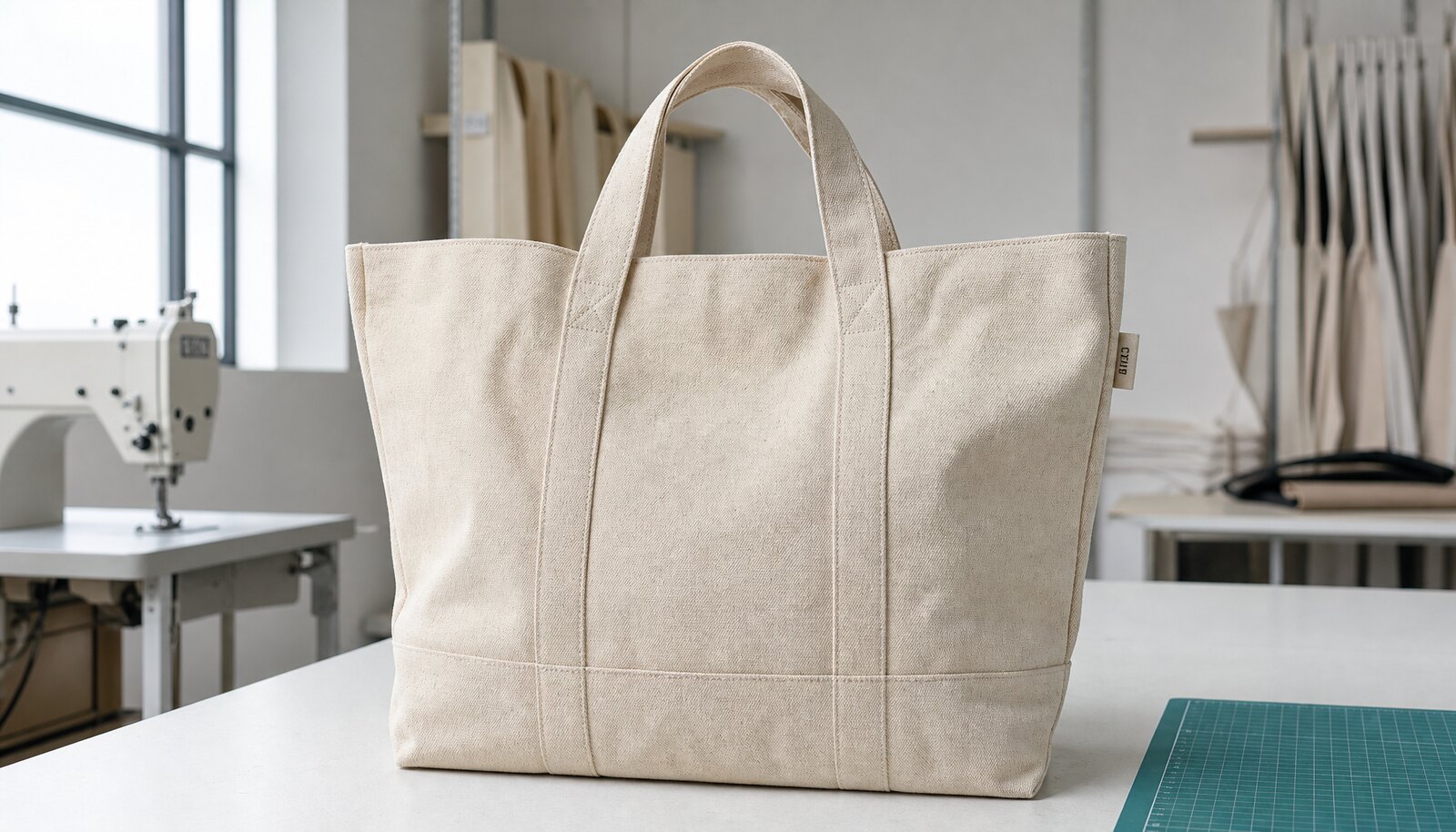
What wellness brands actually need from a heavy canvas tote
If the contents are light and the tote is only meant for short-term distribution, a 12oz canvas bag may be enough. If the bag must support repeated carry or a more premium unboxing moment, 14oz is usually the safer baseline. If the brief includes heavy bottles, multi-item wellness kits, or a retail price above promo level, 16oz canvas or a reinforced build may be worth the extra cost. The key is to match the material to the contents and the expected customer behavior, not to the cheapest available spec.
- Map the tote to one primary use: event giveaway, retail resale, subscription insert, or paid bundle item.
- Define whether the tote must stand upright when empty, because that changes fabric weight and bottom construction.
- Treat the tote as part of brand presentation, not only as packaging.
Choose canvas weight based on load, not just look
Canvas weight affects feel, drape, print stability, sewing difficulty, freight, and price. Buyers often use ounces per square yard or GSM, and both are acceptable if the supplier states them clearly. A 12oz canvas tote is a common entry point for branded programs. A 14oz canvas bag is often the best middle ground for wellness brands because it still feels substantial while keeping the quote manageable. A 16oz bag creates a stronger, more structured impression but costs more in fabric and handling.
Procurement teams should ask how the quoted weight was measured. Some suppliers quote the fabric before washing, coating, or finishing, while others quote the final processed cloth. That difference matters because a raw fabric may shrink, soften, or change shape after finishing. If your brand cares about the final dimensions, ask for the weight basis and whether the fabric is pre-shrunk or stabilized before cutting.
Bag performance also depends on weave quality, not only weight. A tightly woven plain weave will generally print more cleanly and resist distortion better than a loose weave at the same GSM. For wellness-brand work, that can matter more than an extra ounce on paper. The brand image tends to suffer when a tote looks thick but irregular, especially on the logo panel.
- 12oz / about 340 GSM: good for lighter wellness kits, flyer packs, and promotional distribution.
- 14oz / about 475 GSM: balanced option for retail, subscription add-ons, and repeat-use carry.
- 16oz / about 545 GSM: better for premium bundles, structured appearance, and heavier loads.
- Ask whether the canvas is pre-shrunk, washed, or raw before you compare quotes.
Set the bag size and handle dimensions before asking for a price
A surprising number of tote quotes fail because the buyer did not specify the finished size clearly. Heavy canvas tote bags for wellness brands bulk pricing plan decisions should always begin with finished width, finished height, and gusset depth. A tote with a 4-inch gusset behaves very differently from one with a 6-inch gusset, even if the body fabric weight is identical. The gusset affects capacity, carton fold, and how neatly the bag carries bottles or boxed items.
For wellness brands, a practical finished size is often in the range of 14 to 16 inches wide, 15 to 17 inches high, and 4 to 6 inches deep. That is not a rule, but it is a useful starting band for procurement. Smaller bags can work for light kits or premium event gifting. Larger bags can improve perceived value but also increase fabric use, print area, and carton cube. If the tote must fit into an existing retail shelf or kitting line, size should be locked before the supplier quotes.
Handle geometry matters almost as much as body size. A total handle length around 22 to 26 inches often gives enough room for shoulder carry, while a handle drop around 9 to 11 inches is comfortable for many users. Handle width is usually stronger when it is at least 1 inch for self-fabric or as specified by the factory for webbing. Short handles may save material, but they can make a wellness tote feel cramped or low value. Weak handle geometry often becomes a complaint only after the product is in use, which is the worst time to discover it.
- Write all dimensions as finished measurements after sewing, not pattern estimates.
- If the bag needs to fit into a shelf display or reusable shipping carton, test that dimension early.
- Ask the supplier to show the pattern size and expected shrinkage so the finished bag is not smaller than intended.
Bulk pricing plan: the real cost drivers and realistic price bands
A landed-cost view should also include duty, inland freight, carton handling, and any charge from the destination warehouse for receiving or relabeling. In some programs, the factory price may only be 60 to 75 percent of the final delivered cost, depending on shipping lane and packing complexity. That is why a procurement team should compare the same bag in two or three pack-out formats before finalizing the order.
If a brand is planning repeat orders, the supplier should be asked for tiered pricing and reorder pricing separately. The first order often includes pattern setup, screen charges, and sample approval cost. A reorder may be cheaper if the spec stays fixed. If the supplier cannot show the change in price by volume tier, the buyer does not yet have a real pricing plan.
Choose the right sourcing route: factory, verified trader, or stockholder
The sourcing route changes transparency, speed, and control. A direct factory is usually the best route when the brand needs a custom tote with a stable spec, a repeatable QC standard, and access to production photos or inspection. A verified trader can be useful when the order includes mixed SKUs, a tight export schedule, or more than one product category in the same shipment. A local stockholder can help with urgent campaigns, but stock cloth and stock bag construction limit customization.
The phrase ‘verified trader’ should mean something more than a salesperson saying so. Buyers should ask for the business license, export registration where relevant, factory authorization letter, and recent shipment references for similar goods. If the trader is truly controlling production, ask who owns the fabric booking, who approves the sample, and who signs off on final inspection. If those answers are vague, the commercial risk goes up even if the price looks competitive.
For wellness brands, the best supplier route is usually the one that can prove control over the exact bag build. That means the supplier should be able to show the cloth source, the cutting and sewing process, the print method, and the packing workflow. A buyer does not need a perfect factory story; the buyer needs a supplier who can document the actual process and remain accountable if the production batch drifts from the approved sample.
- Ask each supplier to identify the actual production site, not only the sales office.
- Request at least three photos: fabric stock, sewing line, and packed carton stage.
- Use the same spec sheet when comparing routes so the quote does not disguise different builds.
Print method, branding position, and durability tradeoffs
If the supplier offers print at a very low price, ask whether the price includes one screen per color, squeegee cleanup, and alignment checks. Ask what the reject tolerance is for misprint, smudge, color shift, and off-center placement. A cheap quote that tolerates obvious print defects can cost more later if the bags are used in a paid program or retail channel.
- Screen print: best for flat logos, solid colors, and predictable bulk pricing.
- Embroidery: good for premium branding, but check fabric pull and stitch density.
- Heat transfer: useful for short runs or detailed art, but test rub resistance before approval.
- Woven or sewn label: useful for minimal branding when the bag face should stay quiet.
Sample approval: what to inspect before you approve the bulk run
A sample should prove the actual build, not just the general style. The sample must use the same or equivalent canvas weight, the same handle material, the same thread color, and the same print method planned for the bulk order. If the supplier sends a display sample made from a different cloth, that sample is useful for concept review only and should not be used as production approval. This distinction matters because a good-looking sample can hide shrinkage, print spread, or weak stitch behavior that appears only in the final build.
The approval sample should be inspected like a buyer would inspect a finished retail item. Measure the finished width, height, gusset, and handle drop after pressing or folding the bag in the same way it will be packed. Check whether the logo sits where it should on a full bag, not only on an empty flat panel. For wellness kits, fill the bag with the intended contents: bottles, jars, brochures, pouches, or folded apparel. Then confirm that the tote still closes neatly, stands reasonably well, and does not distort badly under weight.
If the order is important enough for a custom spec, it is worth asking for two samples: one to approve appearance and one to test use. The use sample should be filled, carried, and checked for seam stress, handle stretch, and print rub. That small extra step often reveals more than another round of emails. It is also a cleaner way to align procurement, brand, and operations before the full run starts.
- Measure the finished bag after pressing or folding, not before finishing.
- Inspect seam symmetry, stitch consistency, and handle attachment points.
- Rub the print with dry cloth and light moisture to see whether it smears.
- Load-test with an actual kit, not only empty-hand carry.
- Keep a photographed approval record with the date and spec revision number.
Set realistic QC standards before production begins
Quality control is easier to manage when the acceptance criteria are written in plain language. Textile bags have natural variation, so the buyer should define what is acceptable and what is not. The goal is not to demand machine-like perfection from a sewn product. The goal is to prevent visible problems that hurt the brand: crooked handles, weak seams, bad print registration, obvious stains, and carton count errors.
A workable QC plan should define measurement tolerances, stitching standards, print standards, and packing standards. For example, the buyer may allow a small size variance but still reject a tote if both handles are not symmetrical or if the logo drifts too close to the seam. The buyer may allow some canvas texture variation, but not panel-to-panel shade mismatch within one carton. The more valuable the tote in the wellness brand’s channel, the tighter the QC language should be.
Inspection should also consider the end use. If the tote is going to a retailer, packaging and barcode accuracy matter. If it is going directly to consumers, polybag seal quality and label placement matter more. If it is a kit component, carton count and pack consistency matter most. One QC checklist does not fit every channel, so the supplier should know the intended route before sewing starts.
- Define measurement tolerance, print position tolerance, and thread color standard before bulk starts.
- Reject major stains, broken stitching, loose bartacks, and obvious asymmetry.
- Add carton-count accuracy and barcode readability if the bags go into fulfillment.
- If the bag is premium retail stock, tighten the acceptance range on print and fabric shade.
Packing and carton design affect warehouse cost more than buyers expect
Ask the supplier to state whether the bag will be folded flat, folded once, or folded with a board insert. That detail can change carton density and the final freight quote. Also ask whether the carton is export-standard, double-walled, or reinforced, especially if the bags are heavy or the shipment will move through a rough logistics route. If the carton spec is weak, the product can arrive with crushed edges, bent cartons, or damaged polybags even if the bags themselves are fine.
Every open item in the buyer guide should have an owner: buyer to approve, supplier to confirm, or QC to verify. This keeps heavy for wellness brands bulk pricing plan from becoming a vague note buried in an email thread.
- Write decisions in measurable language, not only descriptive wording.
- Ask for sample photos plus one physical approval sample for important orders.
- Keep quotation, sample approval, and inspection notes tied to the same spec version.
How to compare quotes without missing landed cost
For bulk tote sourcing, landed cost is the number that matters. The factory quote is only one part of the total. Freight, duty, inland delivery, warehouse receiving, and any relabeling or repacking all change the final cost per bag. A heavier canvas tote may seem expensive at the factory level, but if it reduces damage, improves brand value, and lowers complaint risk, the finished program can still be more cost-effective. Buyers should compare not only price but also cost to receive and cost to use.
The cleanest way to compare quotes is to normalize the spec first. Every supplier should be asked to quote the same canvas weight, same finished dimensions, same handle build, same print method, same color count, and same packing plan. If one supplier quotes a 12oz bag with bulk packing and another quotes a 14oz bag with retail bagging, the quotes are not equivalent. Procurement teams should reject any comparison that is not spec-matched.
Once the spec is aligned, review the price at multiple quantities. A strong supplier should show how the unit price changes at 500, 1,000, 3,000, and 5,000 units. If your brand has a reorder plan, ask for repeat-order pricing separately. Setup costs often fall on reorder, but only if the artwork, fabric, and packing remain stable. A buyer who does not ask for price breakpoints may overpay on the first order or miss a better scale tier.
Specification comparison for buyers
| Spec decision | Recommended option | When it fits | Buyer risk to check |
|---|---|---|---|
| Fabric weight | 12oz to 16oz canvas, usually 340–545 GSM | Wellness kits, retail resale, premium event bags, and repeat-use tote programs | Too-light fabric collapses with bottles, journals, and sample jars; too-heavy fabric raises freight and sewing cost |
| Bag size | Typical finished size: 14–16 in W × 15–17 in H with 4–6 in gusset | Most wellness bundles, boutique retail, and conference gift sets | If the bag is too shallow, taller items tip; if too wide, the print area can distort across the front panel |
| Canvas construction | Plain weave, tightly woven, pre-shrunk if possible | Brands that need a clean print surface and predictable panel size | Untreated or loosely woven canvas can skew after finishing or shrink after first use |
| Handle build | Self-fabric or webbing handles with bartack reinforcement; 22–26 in total handle length and 9–11 in handle drop | Daily-carry bags and heavier wellness packs | Short handle drop makes the bag awkward on the shoulder; weak bartacks create field failures |
| Load expectation | State a target load of 8–12 lb for promo use or 12–20 lb for retail/repeat carry programs | When the tote will carry glass bottles, boxed supplements, books, or bundled samples | If no load target is stated, the factory may build for appearance only |
| Print method | Screen print for simple logos; heat transfer only for short runs; embroidery or woven label for premium look | When the artwork is limited to one or two colors and the logo area is flat | Fine lines, gradients, and small text can blur on rough canvas or at curved seams |
| MOQ route | Standard bulk MOQ for one fabric/color/print setup, or mixed-color MOQ if supplier has stock cloth | Brands testing a new collection or ordering multiple wellness SKUs | Low MOQ often means higher unit cost, limited color choice, or higher setup fees |
| Sample stage | Pre-production sample based on final fabric, print, and trim | When the bag carries retail branding or a paid wellness kit | Sales samples made from different fabric than bulk hide shrinkage, color, or stitch issues |
| Packing method | Bulk inner polybag with carton count, or retail-ready individual polybag with barcode label | Wholesale distribution, e-commerce fulfillment, and subscription add-ons | Wrong packing changes labor cost, carton volume, and warehouse receiving time |
Buyer checklist before sampling
- Define the tote’s actual job first: retail resale, wellness kit insert, event giveaway, or paid bundle item. The load expectation changes the right fabric weight, handle length, and packing method.
- Write the bag size in finished dimensions, not just an estimated concept size. Include width, height, and gusset depth in inches or centimeters so quotes are comparable.
- Lock the canvas weight in GSM or oz and state whether pre-shrunk, washed, coated, or raw fabric is acceptable.
- Set a target load in pounds or kilograms and list what the tote must carry during normal use. A tote for brochures is not the same as a tote for glass bottles or supplement jars.
- Confirm exact print area, number of colors, and whether the print may cross seams, side gussets, or bottom panels.
- Specify handle length, handle width, handle drop, reinforcement method, and whether the handle material should match the body fabric or use webbing.
- Request stitch details: seam allowance, bartack placement, and whether the bottom is single-stitched, double-stitched, or boxed.
- Set the packing format early: bulk packed, folded with insert, or individually polybagged with barcode label and hangtag.
- Ask for a pre-production sample from the same fabric batch or equivalent base cloth, not only a visual mockup or render.
- Request carton count, carton dimensions, gross weight, and carton packing method so landed cost and warehouse receiving can be estimated before the PO is issued.
Factory quote questions to send
- What canvas weight do you recommend for this use case, and is that measured before or after washing, coating, or finishing?
- Is the quoted price based on finished bag size, cut size, or the cut-and-sewn blank before printing?
- What exact print method is included, how many colors are covered, and what is the setup fee per color, screen, or artwork change?
- What is the MOQ for this fabric, this color, and this print combination separately?
- Are the handles self-fabric, webbing, or blended, and what bartack or seam reinforcement is included in the base quote?
- What is the seam allowance and the stitch density used on the side seams, bottom seam, and handle attach points?
- What packing is included in the unit price, and what is the surcharge for individual polybagging, barcode stickers, inserts, or hangtags?
- Can you quote the same bag in two pack-out options: bulk packed and retail-ready packed, so we can compare true cost impact?
- How many days are needed for fabric booking, sample approval, bulk production, and final inspection before shipment?
- Can you provide carton dimensions, units per carton, gross weight, and estimated CBM for the quoted packing plan?
Quality-control points to confirm
- Fabric weight tolerance should stay within the agreed range, typically ±5% unless a stricter spec is needed for retail consistency.
- Canvas surface should be free from major slubs, oil marks, dye streaks, and panel-to-panel shade mismatch within the same order.
- Stitching at handles, side seams, and bottom corners should show even stitch length and no skipped stitches, broken thread, loose ends, or seam puckering.
- Bartack reinforcement should cover the handle stress points with dense, clean stitching and no thread bunching or loose thread tails.
- Handle width and handle drop should match the approved spec, and both handles should be symmetrical when the bag is laid flat and when it is filled.
- Print should match the approved artwork placement, with acceptable color deviation defined before production; small text must remain legible at normal viewing distance.
- Artwork near seams, gussets, and the bottom fold should be checked for distortion, because a centered print on a flat pattern can shift on a finished bag.
- Bag dimensions should be measured after finishing and folding, with allowance for natural textile variance but no obvious asymmetry or panel twist.
- Load-test a finished sample with the intended contents or an equivalent weight for at least 15 minutes; check for handle stretch, seam opening, and bottom sag.
- Packing count should match the carton list exactly, and each carton should carry the agreed product ID, size, and quantity label.