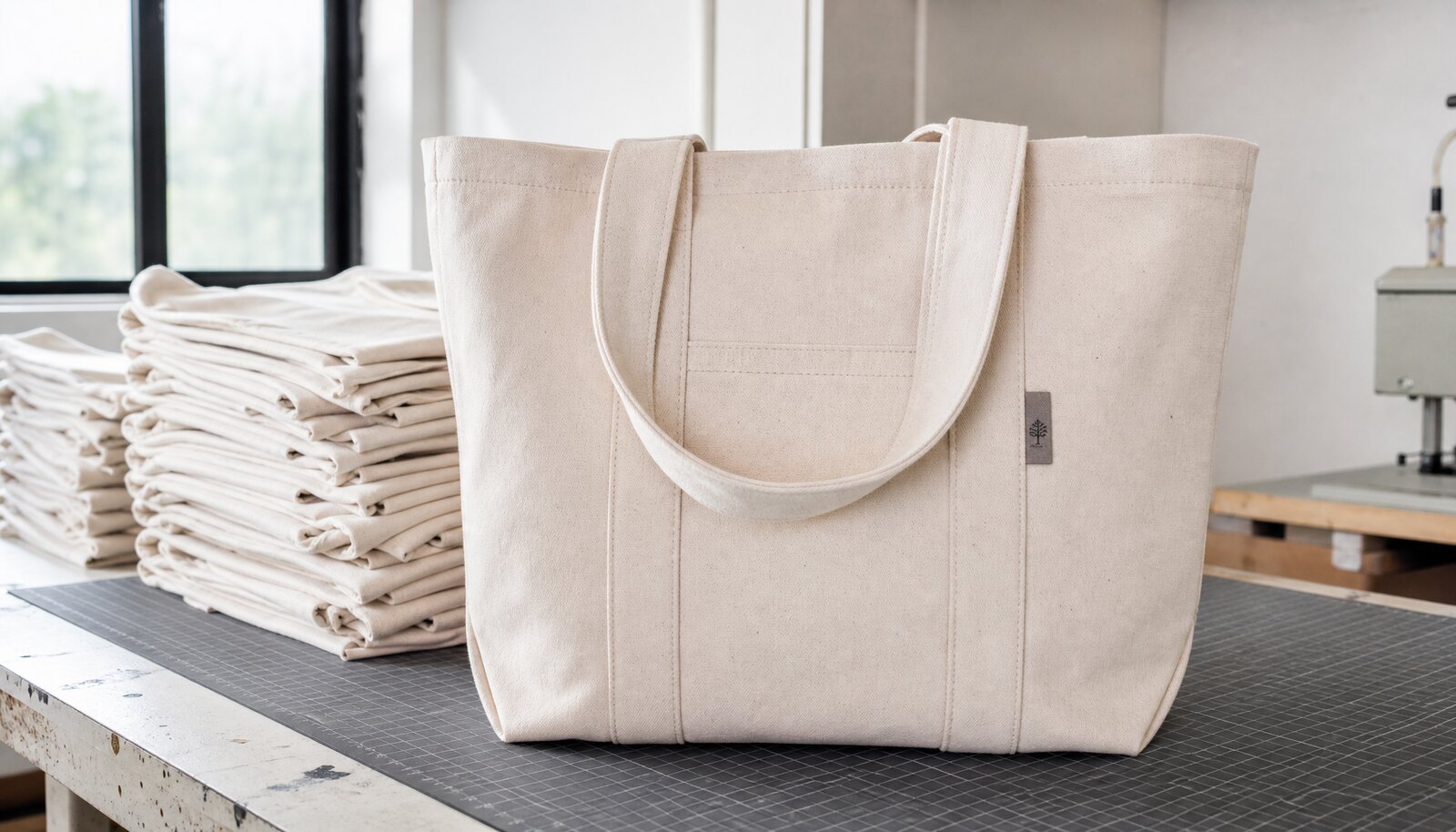
1. Why this reorder memo matters for trade show tote buying
Heavy canvas tote bags for trade shows are not a one-off creative buy. They are a repeatable event item with a practical job: carry brochures, sample kits, notebooks, and sponsor materials without looking flimsy on the show floor. Because they are replenished season after season, the procurement challenge is less about design inspiration and more about controlling the variables that make a reorder drift from the original approval.
When a tote reorder goes wrong, the failure usually appears in ordinary places rather than dramatic ones. Fabric weight was described loosely, so the bag feels lighter than expected. The print method was not fixed, so the quote assumes a cheaper or less durable process than the first run. Packing was left open, so the factory chooses a format that saves labor but changes cube, protection, or distribution convenience.
The purpose of a reorder memo is to stop that drift before the RFQ goes out. It should make it easy for the supplier to quote the same bag, not a similar bag. That distinction matters because trade show tote bags are often judged in a matter of seconds by booth staff, buyers, and attendees. If the bag looks weak, twists when loaded, or arrives late, the item that was supposed to support the brand becomes a source of friction.
This guide is written for procurement, merchandising, sourcing, and event operations teams that already know the basic product category and need a cleaner buying framework. The emphasis is on spec discipline, inspection discipline, and quote discipline.
- Treat the tote as a repeatable operational item, not a concept development project.
- Write the RFQ so the supplier can quote the same bag again without assumptions.
- Anchor the reorder to the approved sample, not to a catalog image or a memory of the first run.
2. Start with the use case before you choose fabric weight
A trade show tote should be specified around what it will carry and how it will be used. A bag handed out empty at registration has different requirements from a tote that holds a catalog set, bottle, notebook, and promotional samples. That sounds obvious, but many buyers still begin with fabric weight and only later discover that the carry load, print area, and packaging format determine the real cost and failure points.
For heavy canvas totes, the practical range is usually 12oz to 16oz. A 10oz tote can work for lighter giveaways, but it tends to feel softer, collapse more easily, and show wrinkles more readily once packed. A much heavier canvas can feel premium and stand better on a table, yet it also increases raw material cost, sewing difficulty, carton weight, and freight cube. In other words, heavier is not automatically better; it is only better when the use case needs it.
A 14oz canvas is often a sensible starting point for many event programs, but it should be treated as a starting point rather than a default. If the tote must stand upright for display, use a gusset and reinforced bottom. If the tote is mainly for brochures and small handouts, print clarity and handle comfort may matter more than maximum fabric mass. If the bag will be reused after the show, durability and seam reinforcement deserve more attention than decorative detail.
A procurement team should define the bag around a few practical questions: what will go inside, whether the bag must stand on its own, whether attendees are expected to keep and reuse it, and whether the look needs to feel retail-grade or simply functional. Those answers influence the fabric decision more reliably than a generic “heavy canvas” label.
- State the intended contents: brochures, sample kits, bottles, notebooks, or mixed load.
- Decide whether the tote must stand upright when empty, partially filled, or fully loaded.
- Choose fabric weight after the use case is clear; do not let the supplier choose it for you by default.
- Define whether the program needs a retail-like appearance or a durable giveaway look.
3. Translate the fabric spec into something the factory can actually hold
A quote for heavy canvas tote bags for trade shows is only useful if the supplier is pricing the same material you think you are buying. The most common sourcing mistake is leaving the fabric description at “heavy canvas” and assuming everyone means the same thing. They do not. One supplier may quote on a fabric that feels dense but is still relatively soft; another may quote a stiffer cloth with a similar name but different finished weight and hand feel.
The RFQ should specify finished weight in both ounces and GSM, with a note on whether the value refers to raw fabric or finished fabric. That distinction matters because some mills and factories reference different measurement points. If the tote is meant to be reusable and structured, also ask whether the canvas is pre-shrunk, washed, or finished in a way that changes final dimensions. Buyers often care about bag size, but the supplier may be controlling a fabric process that changes the size after cutting and sewing.
Structure details should be written into the spec, not just implied. For example, if the bag needs to stand upright, the bottom panel should be reinforced and the gusset depth stated. If the side seams must stay clean and square, ask for a defined seam allowance. If the handles will carry heavier loads, ask for the tape width, reinforcement stitch pattern, and whether the handle join uses box stitching, cross stitching, or both. Those details are not decorative; they are the difference between a tote that looks fine in a photo and a tote that performs under load.
A good fabric spec also helps with price comparison. If one supplier quotes a lower price because they are using a lighter cloth or a looser tolerance, the quote is not truly comparable. Procurement teams should compare apples to apples by locking the approved sample, the weight range, and the construction details before asking for revised pricing.
- Define finished fabric weight in oz and GSM.
- Ask whether the quoted weight is raw, greige, or finished fabric.
- Specify whether the bag must stand upright, and if so, under what loading condition.
- Write handle construction and reinforcement into the spec, not into a later note.
4. Print method decisions that change cost, durability, and reorder stability
Print choice is not only a design issue. It changes setup cost, repeatability, production speed, and the risk of variation across reorders. For most heavy canvas tote bags used at trade shows, one- or two-color screen printing remains the most practical option when the logo is large, clean, and repeatable. It usually produces strong opacity on canvas, is easier to repeat on later orders, and keeps unit economics predictable once the screens are made.
That said, screen print is not always the right answer. If the artwork uses gradients, fine text, multiple colors, or a photographic look, transfer printing may be the more workable route. The tradeoff is that transfer methods can be less forgiving on textured canvas and may have different durability characteristics depending on the adhesive, curing process, and the way the tote is folded or handled after printing. Embroidery can also be used on canvas, but it usually makes more sense for a premium presentation program than for a high-volume booth giveaway.
The sourcing memo should ask the supplier to quote the exact print method, not just “logo printing.” Request ink type, color count, registration tolerance, cure method, and any durability testing they use. If the bag will be reused many times, ask specifically about rub resistance, adhesion, and whether the print has been tested after folding or abrasion. A logo that looks perfect on day one can still fail in use if the ink sits too heavily on a textured surface or if the curing process was rushed.
The best way to avoid dispute is to tie print approval to a physical sample made on the final canvas weight with the final print method. A sample on smoother cloth or a digitally altered proof does not tell you how the ink will behave on the real bag.
- Use screen print for simple, repeatable logos and large brand marks.
- Use transfer methods only when the art complexity justifies the tradeoff.
- Ask for rub resistance and cure details if the tote will be reused.
- Approve print on the exact fabric weight, not on a substitute fabric.
5. Supplier comparison: how to think about sourcing routes instead of just unit price
Procurement teams often ask for the lowest tote quote first and only later compare the operational burden. That usually leads to a false saving. A cheaper quote can become more expensive once you add sample revisions, artwork delays, packing changes, or a freight bill that grows because the cartons are inefficient. With canvas totes, the real comparison is not just sewing price; it is the whole sourcing route.
Direct factory sourcing is usually the cleanest route when the spec is stable and repeat orders matter. It offers better visibility into cutting, printing, sewing, and final packing, and it often improves price control if the factory truly manages the critical steps in-house. Trading routes can be useful when the buyer needs consolidation across multiple products or a faster commercial response, but the additional handoffs can make color matching, packing, and schedule control less predictable. Local stock or decorator routes can work for urgent events, but they are usually less suitable when the buyer needs exact repeatability across a campaign.
A useful decision rule is simple: if the order is a repeat of an approved tote and the event date is fixed, favor the sourcing route that minimizes process variation. If the tote is part of a broader promotional bundle or the artwork is still changing, a trading route may be easier to manage even if the unit price is not the lowest. The right answer depends on speed, control, and how much variance the buyer can tolerate, not on headline cost alone.
Before award, ask the supplier to explain where each step happens, who controls the print setup, who buys the fabric, and who owns final QC. If the answer is vague, the buyer does not yet have a real comparison basis.
- Compare sourcing routes by control, not only by price.
- Direct factory is usually best for repeatability and stable artwork.
- Trading or consolidation routes can help when the program includes multiple items or changing design requirements.
- Ask who controls fabric purchase, print setup, sewing, and packing before award.
6. MOQ logic: what the factory is pricing into the reorder
MOQ is rarely arbitrary. On canvas totes, the minimum is usually shaped by setup work and material planning rather than by sewing time alone. A factory may need to open a fabric lot, cut new panels, make or remake screens, calibrate print registration, set handle lengths, prepare cartons, and assign packing labor. If any of those steps are new, the factory needs more volume to amortize the setup cost.
This is why a “simple” tote can still carry a surprisingly high MOQ. Simplicity at the final product level does not eliminate the work behind the scenes. It only means the buyer is less likely to see the work. For procurement, the practical goal is to reduce variables so that the factory can reuse prior records and keep the setup cost from spreading across too few units.
The easiest way to improve MOQ economics is to hold the spec steady. Keep the same fabric weight, body size, handle length, print area, and packing format if the reorder is meant to match a prior run. If the order changes multiple elements at once, the factory cannot reuse production data as easily, and the MOQ or price is likely to rise. Buyers should also ask whether MOQ is driven by fabric availability or by print setup; those are different constraints and should be priced differently.
If the event volume is smaller than the supplier’s standard minimum, it is still worth asking for a price on a simplified spec, but the buyer should expect tradeoffs. Lower MOQ often means higher unit cost, a narrower choice of fabric, or less flexibility on custom packing. The key is to know which concession is being made before the PO is released.
- Hold the spec steady to improve reorder economics.
- Ask whether the MOQ is driven by fabric lot, print setup, or packing labor.
- Do not change size, fabric, and artwork on the same reorder unless the budget allows it.
- Expect a higher unit cost if the order is smaller than the factory’s standard production run.
7. Sampling and approval: what a real pre-production check should cover
A reorder should not move into mass production on the basis of a photo approval alone. For heavy canvas totes, the pre-production sample should be made from bulk fabric with the final thread, final print method, final trim, and final packing style. If the sample is softer than expected, the logo is flatter, or the handle sits differently than the approved reference, the factory is not yet matching the production standard. That is not a minor detail; it is a warning that the bulk run may not match the ordered spec.
The sample also needs to be tested in use, not only inspected visually. Put the exact contents into the bag that it will carry at the show. For many buyers, that means brochure packs, a notebook, a water bottle, and perhaps a small gift box or sample pouch. Then look at handle comfort, shoulder drop, bag opening width, bottom sag, seam pull, and logo visibility under load. A tote that passes only an empty visual check may still fail the real use case.
Procurement teams should also keep the sample process disciplined. One physical sample should be signed and dated as the reference standard, and a second sealed sample should be retained as a control if possible. The supplier should confirm that the production line will work from the same approved sample, not from memory or from an older version of the artwork. If there are later disputes about shade, print shift, or seam quality, the sealed sample and dated spec sheet become the baseline for resolution.
If the supplier wants to approve by email only, the buyer should ask for photos plus the actual bulk sample. The cost of one more sample cycle is usually much lower than the cost of rework or event-day failure.
- Approve a physical sample made from bulk fabric and final process steps.
- Test the bag with the real event contents, not just as an empty tote.
- Keep one sealed reference sample with a dated spec sheet and artwork file.
- Use photo approval only as a supplement, not as the production standard.
8. QC thresholds that make the buying memo actionable
Quality control should tell the factory what counts as acceptable, what counts as repairable, and what counts as rejectable. Without that structure, the inspection becomes subjective. On heavy canvas tote bags, the most common problems are not dramatic manufacturing disasters; they are small but visible deviations that make the bag feel less reliable: a logo is slightly off-center, one handle is longer than the other, the bottom seam twists, or the stitching at the handle join is inconsistent.
A serious inspection plan needs measurable standards. For example, the buyer can define a tolerance band for bag dimensions, a maximum acceptable logo shift, and a stitch standard for stress points. If you do not want to argue about “close enough,” define it. The same approach should be used for stains, thread tails, and seam puckering. Cosmetic marks may be acceptable for some promo programs, but if the tote is being used for a premium event or distributor channel, the defect threshold should be tighter.
A practical inspection approach is to sample from multiple cartons rather than taking all checks from the top of one case. Review print placement, seam quality, handle reinforcement, and dimension consistency. If the order is large enough, separate defects into categories: major, minor, and packing-related. Major defects are the ones that affect function or brand presentation, such as open seams, severe print misplacement, wrong size, or visible contamination. Minor defects might include a few loose threads if your brand allows them, but those allowances should be written into the order before production starts.
The QC language in the PO should also specify what happens when a lot falls outside the agreed threshold: rework, sorting, replacement, or shipment hold. The factory should know this in advance. That is what turns QC from a generic promise into a usable procurement control.
- Define major vs. minor defects before production begins.
- Check multiple cartons, not only one top carton sample.
- Set measurable limits for dimension, print placement, stitch quality, and contamination.
- State the corrective action if the lot fails inspection.
9. Packing, cube, and event readiness: the hidden cost drivers
Packing decisions can change landed cost more than many buyers expect. Individual polybags add materials and labor, but they protect the print surface and can make distribution easier when totes are inserted into delegate kits or bundled with other show items. Bulk packing reduces unit cost and is usually adequate for event giveaways, but it raises the risk of scuffing, moisture retention, and handling marks if the ink is not fully cured or the canvas has a soft finish.
The carton plan matters just as much as the bag spec. Heavy canvas can be bulky, so a poor carton layout can create unnecessary freight cost. Ask the supplier for carton dimensions, gross weight, carton count, and whether the cartons are optimized for palletization or loose shipment. If the event is on a tight timeline, ask whether the bags will be packed in a way that allows faster on-site access and easier distribution. The cheapest carton count is not always the best operational answer if the receiving team then has to re-sort everything on arrival.
A buyer should also confirm carton markings, barcode needs, and whether the shipment requires any special handling for humid lanes or long storage. If the totes are printed and packed soon after curing, ventilation may matter. If the bags are moving into a warehouse before the event, humidity control and carton strength become more important. These are small details, but they affect whether the shipment arrives ready to use or needs extra handling on arrival.
For procurement teams managing multiple event dates, packing should be written into the decision memo as a logistics choice, not a late-stage ops note.
- Use bulk packing for giveaways unless presentation or hygiene requires individual polybags.
- Request carton dimensions and gross weight before freight booking.
- Confirm whether cartons are designed for palletization or loose shipment.
- Ask how the supplier protects printed surfaces during packing and storage.
10. Lead time, reorder planning, and the questions that prevent schedule slips
The biggest reorder risk is often not sewing time. It is decision time. Artwork approval, screen preparation, fabric confirmation, sample sign-off, and packing sign-off can each add days. If the order is placed near a major exhibition season, suppliers may also be balancing competing promotional runs, which can slow the fabric or printing stage even when the sewing line itself is available. That is why a stable spec is so valuable: it shortens the approval cycle and reduces the chance of last-minute changes.
A useful lead time request should separate sample time from mass production time and shipping time. If the supplier quotes only a single total number, ask for a breakdown. Buyers need to know where the bottleneck sits: sourcing the canvas, preparing the print setup, sewing the bag, curing the ink, packing the cases, or booking freight. If the supplier cannot identify the bottleneck, the schedule estimate is likely too optimistic.
Trade show buyers should also build a reorder buffer. That buffer is not just extra time; it includes a small allowance for artwork corrections, fabric lot differences, and carton procurement. If you are reordering from a prior approved bag, the goal is to preserve what already worked rather than optimize every element again. A clean reorder is usually the result of disciplined continuity, not of redesigning the product at the same time as trying to save money.
For a procurement memo, the final decision should answer three questions plainly: can the factory repeat the approved spec, can they do it inside the event window, and can they provide proof through sample and QC records? If the answer to any of those is unclear, the order is not yet ready for release.
- Ask for a lead time breakdown: sample, production, curing, packing, and shipping.
- Build buffer time before major trade show dates and seasonal peaks.
- Avoid spec changes during reorder unless they are essential.
- Require proof of repeatability through sample records and QC documentation.
Specification comparison for buyers
| Sourcing or spec choice | Best-fit option for a reorder | When it is the right call | What to verify before award | Cost / risk tradeoff |
|---|---|---|---|---|
| Direct factory vs. trader | Direct factory with sewing, printing, and packing control in one location | The spec is already approved and the buyer wants fewer handoffs | Confirm whether fabric purchase, printing, sewing, and carton packing are actually in-house or split across subcontractors | Usually better unit economics and tighter schedule control; less flexibility if the factory is busy or less responsive |
| Fabric weight | 12oz–16oz heavy canvas, with 14oz as a practical midrange starting point rather than an automatic default | The tote must feel substantial, stand up on a table, and survive repeated event use | Ask for finished fabric weight in oz and GSM, plus whether the measurement is raw or finished cloth | Heavier fabric improves structure but raises material cost, seam stress, and freight cube |
| Body structure | Gusseted body with reinforced bottom panel and clean edge finishing | The bag will carry catalogs, swag kits, notebooks, or retail purchases | Check bottom seam width, corner reinforcement, and whether the gusset distorts when loaded | Adds sewing steps and cost, but materially improves load stability and display value |
| Print method | 1–2 color screen print for simple logo programs; transfer print only for detailed artwork or short runs | The artwork is repeatable and the buyer wants stable reorder pricing | Confirm ink opacity, registration tolerance, rub resistance, and curing method | Screen print is usually best for repeat orders; transfers may cost more and age less predictably |
| Handle construction | Cross-stitch plus box stitch with a handle drop sized for the intended carry method | The tote will be carried across a venue or loaded with brochure packs | Request stitch pattern, stitch density, handle tape width, and thread type | Strong reinforcement reduces failure risk and customer complaints; poor handle construction is a common reject reason |
| MOQ strategy | Keep size, fabric, handle length, and print area consistent with the last approved order | The buyer wants reorder continuity and better pricing leverage | Ask which element of MOQ is driven by fabric lot, screen setup, or packing labor | Lower variation usually lowers risk and helps pricing, but limits design changes |
| Packing format | Bulk packing into master cartons for giveaways; individual polybags only when presentation or hygiene requires it | The bags are going straight to event distribution or delegate kits | Confirm polybag gauge, carton count, carton markings, and whether insert cards are included | Bulk packing lowers cost and cube; individual packing adds labor, materials, and handling time |
| Sampling route | Pre-production sample made from bulk fabric with the final print method and final packing style | The buyer is locking a repeat PO and needs proof of production match | Do not approve from a photo alone; require a physical sample and one sealed reference sample | Better control, slower start; the sample cycle catches color, stitching, and fit issues before mass production |
| Inspection path | Factory QC photo report plus buyer or third-party final inspection on a measurable checklist | The order is time-sensitive and the brand cannot tolerate visible defects | Use clear acceptance criteria for stitch skips, print shift, stains, and dimension tolerance | Adds inspection cost, but reduces chargebacks and event-day failures |
Buyer checklist before sampling
- State finished fabric weight in both oz and GSM, and define the acceptable tolerance band in the RFQ.
- Lock artwork size, color count, placement, and print method before requesting final quotes.
- Specify handle length, handle drop, reinforcement pattern, and intended load use case, such as brochures, sample kits, or retail carry.
- Request a pre-production sample made from bulk fabric with the exact sewing and printing method planned for mass production.
- Define packing format, carton count, master carton size, label format, and whether each bag needs an individual polybag.
- Ask the factory how they manage peak-season capacity, fabric buying, and printing bottlenecks before you award the PO.
- Build a reorder buffer for color matching, screen remake, carton supply, and shipping delays before major trade show dates.
- Keep one sealed approved sample and one photo record of the same sample for later inspection comparisons.
Factory quote questions to send
- What is the finished fabric weight in oz and GSM, and is it measured on raw cloth or finished fabric after processing?
- Are sewing, printing, inspection, and carton packing all done in-house, or will any step be subcontracted?
- What is the MOQ for this exact spec, and how does it change if we reduce print colors, change the body size, or alter handle length?
- Will the pre-production sample be made from bulk fabric, bulk thread, and the same print screens or transfer film used in production?
- What is the handle reinforcement construction, including stitch pattern, stitch density, thread type, and any load test method?
- What acceptance standard do you use for print misregistration, seam skips, loose threads, stains, and uneven bag dimensions?
- What packing is included in the unit price, and what are the carton dimensions, gross weight, and cartons per pallet or carton count per case?
- What lead time applies after sample approval, and where are the main schedule risks: fabric purchase, print setup, sewing line capacity, or packing?
- Can you provide a photo QC report, a packed carton sample, and a sealed approval sample from the same bulk run?
- If we keep the same spec for the next reorder, what records do you retain so the order can be repeated without re-approval of basic details?
Quality-control points to confirm
- Fabric weight: set an acceptance band in the order confirmation, not just a single target. For a heavy canvas tote, a practical buyer band is often around ±5% of the approved finished sample, unless your brand or retail program requires tighter control.
- Fabric consistency: inspect body panel, gusset, and handle tape for visible shade shift, weave irregularity, slubs, contamination, or uneven finishing. A bag can look acceptable flat and still read uneven when stacked or loaded.
- Stitch quality: check for skipped stitches, broken thread tails, back-tacking failures, seam puckering, and loose reinforcement at the handle joins and bottom corners. These are high-risk points because they carry load.
- Print quality: verify placement against the approved art window, registration between colors, ink coverage, edge definition, and cure quality. Reject obvious shift, blur, ink cracking, or patchy coverage on the logo area.
- Dimensions: measure body width, height, gusset depth, handle length, and handle drop on a representative sample from the production lot. Define a tolerance in advance so a nominal dimension does not become a dispute.
- Load behavior: test the bag with the real contents it will carry at the show. Watch for handle stretch, bag twist, bottom sag, and opening collapse. A tote that looks fine empty may fail in use.
- Packing condition: cartons should protect the bag shape and printed surface, and polybags should not trap moisture, smear ink, or create odor issues. If the route is humid, ask whether drying time or ventilation is included before packing.
- Inspection sample size: for bulk inspection, use a practical lot-based review rather than a single-piece spot check. Document the number of cartons opened, pieces checked per carton, and defect counts by category.
- Acceptance criteria: separate major defects from minor cosmetic issues. For example, major defects can include open seams, severe print misplacement, wrong size, or dirt that cannot be removed; minor defects can include a few loose threads that do not affect function if your brand allows them.
- Reference control: keep one sealed signed sample from the approved bulk standard, plus a dated spec sheet and artwork file. If later shipments drift, this reference makes the dispute easier to resolve.