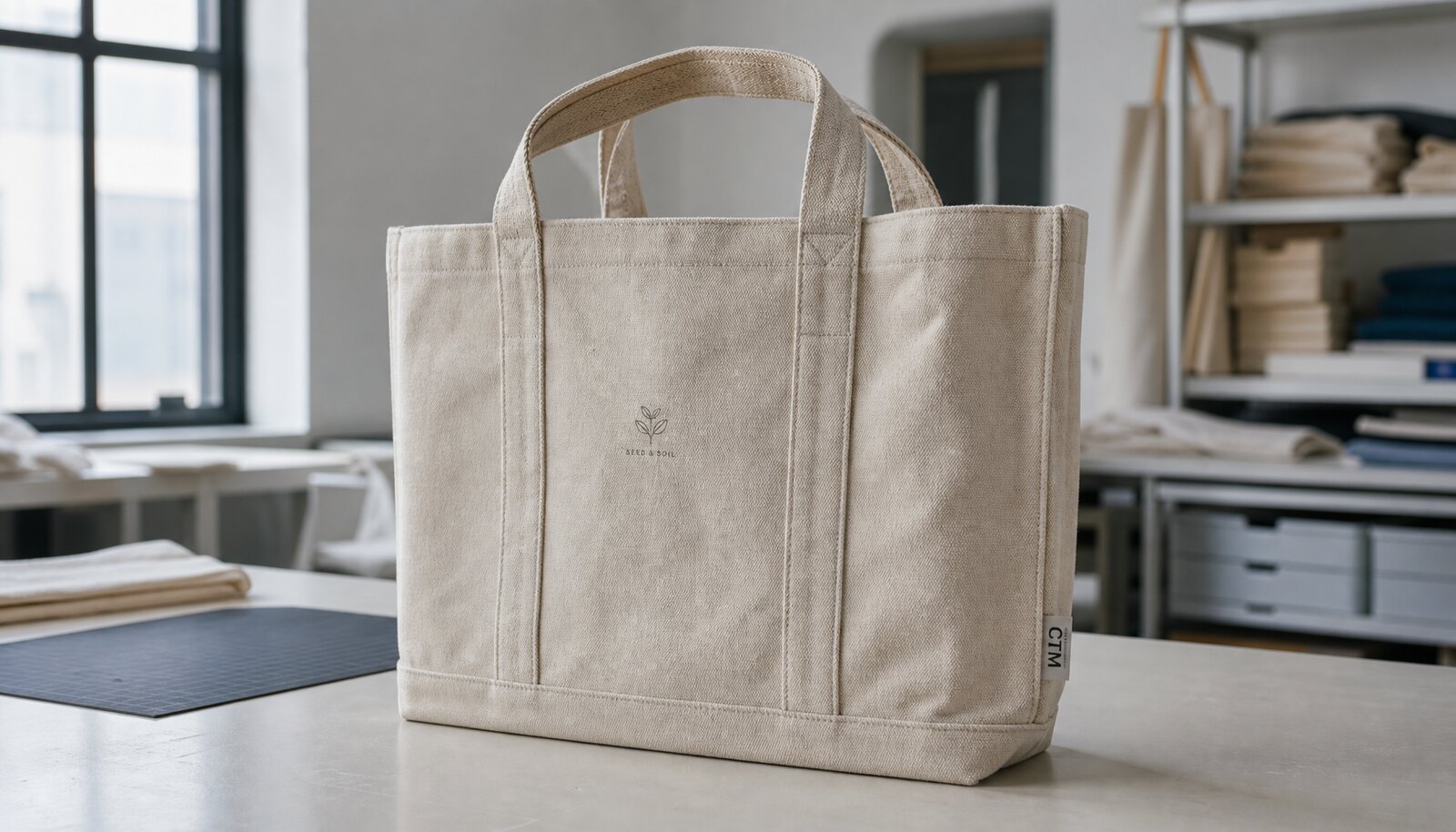
Why heavy canvas is the right starting point for trade-show totes
A trade-show tote is not just a freebie. It is a walking container for catalogs, sample packs, brochures, notebooks, and sometimes a laptop or bottle. If the fabric feels flimsy, the bag looks cheap before the first booth visit ends. That is why heavy canvas is the default choice for serious event programs: it carries weight better, holds shape, and gives the print a more premium base than thin cotton sheeting.
For buyers, the main decision is not simply “canvas or not.” It is whether the bag must survive one event day, multiple reuses, or retail resale after the show. A one-day handout can tolerate a lower-cost spec if the print is simple and the loading requirement is modest. A bag that will be reused in offices or sold through a brand shop needs stronger fabric, cleaner construction, and tighter QC on all visible details.
- Best use case: expo handouts, dealer meetings, product launches, and conference kits.
- A heavier bag improves perceived value, but only if the seams and print quality match the fabric weight.
- The bag should be sized to real contents, not to a marketing brief that assumes everyone carries only paper brochures.
Material selection: GSM, weave, finish, and how they change cost
For heavy canvas tote bags for trade shows material selection guide decisions, the first number that matters is fabric weight. In practice, buyers usually compare 12 oz, 13 oz, and 14 oz canvas, roughly 407 to 475 GSM depending on weave and finishing. At the lower end, 12 oz can work for standard expo distribution. At 13 oz, the bag starts to feel materially stronger and more structured. At 14 oz and above, the bag feels closer to a retail-grade reusable tote, but sewing cost and material cost rise quickly.
GSM alone does not tell the full story. Two fabrics with the same weight can behave differently if the weave is loose, the yarn count is inconsistent, or the finishing is too soft. A dense weave improves print crispness and bag body, while a softer finish can make the tote nicer to touch but also more prone to wrinkling. For brand buyers, the practical spec is not only GSM; it is the combination of GSM, weave density, finish, and the final hand feel on a filled sample.
- 12 oz / about 407 GSM: workable for standard show giveaways and light-to-medium content loads.
- 13 oz / about 440 GSM: a balanced choice for strong hand feel without excessive cost increase.
- 14 oz / about 475 GSM: better for heavier inserts, retail positioning, or repeated reuse.
- Natural unbleached canvas often looks more premium for eco-friendly branding, but shade variation must be managed.
- Bleached or dyed canvas can improve brand color matching, but may add lead time and shade-control risk.
Build the tote around the load, not around the print file
A common sourcing mistake is approving the artwork before the bag structure is fixed. The correct order is the opposite: define the load, then define the fabric, then define the print area. If the bag must hold product samples or thick catalogs, the gusset and handle reinforcement matter more than a larger logo. A wider gusset improves usable volume, while stronger handle joins reduce seam stress when the tote is carried on one shoulder for long periods.
For trade-show programs, the most workable standard size is often around 38 x 42 cm with an 8 to 12 cm gusset, but that should be tested against the actual contents. A flat bag may look elegant in a quote sheet, but a gusseted bag usually performs better on a show floor because it stands upright, swallows more material, and avoids distortion at the bottom seam. Buyers should request a filled sample with the real pack-out inside, not just an empty sample on a table.
- Check handle drop against shoulder use, not only hand-carry use.
- Use box X stitching or equivalent reinforcement at handle ends for heavier loads.
- Confirm bottom seam construction if the tote will carry angular sample boxes or bottles.
- If the bag is meant to stand at a booth, specify a heavier base and a stable gusset shape.
Print method choice: what looks good on canvas and what fails in production
Heavy canvas is forgiving, but not all print methods behave the same way on it. For most trade-show orders, screen printing remains the safest option because it gives solid color coverage, reasonable unit cost, and repeatability at volume. One to three colors is the sweet spot. If the logo uses large solid shapes, screen print is usually the cleanest route. For complex gradients, photo detail, or short runs, buyers sometimes choose heat transfer, but the feel can be less premium and durability depends heavily on film quality and application control.
The print decision should be tied to artwork tolerance. Fine lines, tiny legal text, and pale logos on natural canvas are common failure points. On rougher canvas, small type can fill in or break apart at the edges. Buyers should ask the factory for a printed strike-off on the actual fabric, not only a PDF proof. If the event bag must look clean in booth lighting and in customer photos, the print must be checked under both daylight and indoor lighting before approval.
- Screen print: best for repeat orders and simple branding.
- Heat transfer: useful for lower quantities or more detailed designs, but confirm wash and rub resistance.
- Embroidery: can work for a premium retail-style tote, but it increases labor and may distort lighter canvas.
- Avoid overcomplicated art if the bag is meant for fast event distribution.
Supplier comparison: direct factory, trading company, or local decorator
The best sourcing route depends on order size, brand control, and how much technical ownership your team wants. A direct factory is usually the strongest option for recurring trade-show programs because it allows tighter control over fabric, stitching, and packing. A trading company can be useful when you need mixed products, faster communication, or smaller administrative effort, but pricing may include hidden margin layers and the real production site may be harder to audit. A local decorator can be convenient for urgent domestic jobs, yet material options and cost efficiency are usually weaker once volumes rise.
For procurement teams, the right comparison is not just unit price. It is quote transparency, sample control, lead-time reliability, and whether the supplier can keep the same fabric lot or close equivalent across repeat orders. If the trade-show program will be reordered quarterly, supplier consistency matters more than shaving a small amount off the first order. If the program is a one-time event with a short deadline, a local route may win on speed even if unit cost is higher.
- Direct factory: best for repeatability, spec control, and full cost breakdown.
- Trading company: best when consolidating mixed SKUs or when sourcing team bandwidth is limited.
- Local decorator: best for urgent domestic deadlines or very small last-minute quantities.
- For multi-show programs, request the same fabric mill reference or a written substitute policy.
Comparison table: sourcing route tradeoffs for heavy canvas event totes
The table below is the practical comparison most buyers need before they send an RFQ. It focuses on where each route is strongest and where hidden risk usually appears. Use it to decide whether you are buying a simple event handout, a premium brand tote, or a repeatable program that needs consistent reorders.
Define the measurable checks around fabric weight, size tolerance, handle pull, seam strength, logo rub, stains, loose threads, and carton count verification. Add tolerance ranges only where the buyer truly cares, and ask for photos that show the measurement point, not just a finished product overview.
- Write decisions in measurable language, not only descriptive wording.
- Ask for sample photos plus one physical approval sample for important orders.
- Keep quotation, sample approval, and inspection notes tied to the same spec version.
Quote structure: what should appear in a usable factory offer
A good quote is not just a unit price. It should separate fabric, printing, sewing, packaging, and any extra setup cost so your team can compare suppliers line by line. When those items are bundled together, a low quote may simply hide thinner fabric, weaker stitching, or cheaper packing. For trade-show totes, the quote should also show whether the price changes with print colors, handle length, gusset depth, or packing requirements.
The best quote format also clarifies MOQ logic. Some factories quote a minimum by total quantity, while others set a minimum by fabric color, print color, or each design version. That matters if your marketing team wants multiple event themes or regional language versions. If the supplier cannot explain how MOQ changes across variants, the final order can become more expensive than planned.
- Separate material, printing, sewing, packaging, and inland logistics.
- Show price breaks by quantity tier, not just one headline number.
- Clarify whether tooling or plate charges are one-time or repeatable.
- State whether sample cost is refundable against production.
Sample approval: what to inspect before mass production
For heavy canvas tote bags for trade shows material selection guide work, sample approval should happen in stages. A blank material sample tells you the fabric feel, weave density, and base color. A pre-production sample shows the real size, print position, and stitching. The final sealed sample becomes the reference for mass production. Without this sequence, teams often approve a nice-looking artwork proof but later receive a bag that feels too soft, prints too dark, or folds differently from the approved sample.
When reviewing samples, use the actual packed contents if possible. Put in the brochure set, sample product, notebook, or bottle that the tote is expected to carry. Then test strap comfort, bottom sag, and print distortion under load. Also inspect the inside of the bag. A good event tote should not have loose thread chains, skipped stitches, or messy seam finishes that create an unprofessional impression when the customer opens it.
- Check size after sewing, not only cut size before sewing.
- Verify print placement from seam to logo edge, especially on centered front prints.
- Rub test the print with a dry cloth to catch weak curing or poor ink adhesion.
- Load test the handles with realistic contents before approving the golden sample.
Packing, carton loading, and why event programs often fail in logistics
Packing decisions affect landed cost more than many buyers expect. A tote that is folded loosely in a large carton consumes volume, raises freight, and arrives with hard creases that affect presentation. A tote packed too tightly can deform the print area or create permanent fold lines. For trade-show orders, consistent folding and carton counts matter because event teams often need fast distribution at the venue without opening and recounting every bag.
If the bags will be shipped to multiple regions, carton marks and outer labels should be standardized early. Ask for carton counts by size, gross/net weight, carton dimensions, and whether the supplier can apply barcode labels or destination stickers. If the order goes to a distributor or retail buyer, the outer pack must also protect the print from scuffing during transit. A simple polybag is not always necessary, but it can be useful for premium retail presentation or when the bags need to stay clean in long transit.
- Agree on folding method to avoid mixed appearance across cartons.
- Specify carton count to match event kit assembly speed.
- Use outer carton labels for SKU, quantity, and destination if multiple show sites are involved.
- Protect printed surfaces from rub damage if cartons will be re-handled by 3PLs.
Lead time and schedule risk: where the calendar usually slips
Most delays in canvas tote programs happen before sewing starts. The usual bottlenecks are fabric booking, color approval, print strike-off approval, and packaging instruction changes. If your event date is fixed, work backward from the shipment method and leave enough room for sample approval and correction. A realistic schedule depends on fabric availability, print complexity, and whether the order needs custom-dyed canvas. For a straightforward one-color tote using ready fabric, production can move faster than a dyed or heavily finished item.
The safest buyer behavior is to separate the critical path from the nice-to-have details. For example, if the tote must be ready for an expo launch, lock the body spec and print method early, then finalize packing details once the sample is approved. Small changes late in the cycle can force a reprint or delay carton prep. Suppliers usually move faster when they receive one complete, stable spec instead of several partial revisions spread across a short window.
- Fastest path: stock fabric, simple artwork, standard packing.
- Slower path: custom color canvas, multi-color print, retail polybagging, multiple SKU versions.
- Late artwork changes often trigger plate changes, rework, or schedule slip.
- Build a buffer for sample mail time and internal approval time.
Specification comparison for buyers
| Spec decision | Recommended option | When it fits | Buyer risk to check |
|---|---|---|---|
| Fabric weight | 12 oz to 14 oz heavy canvas, usually around 407 to 475 GSM | For trade-show giveaways where the bag must feel substantial and hold catalogs, samples, and a laptop sleeve | Too light and the bag collapses; too heavy raises cost and can shrink print area after washing or finishing |
| Fabric construction | 100% cotton canvas with tightly controlled weave density | When brand feel and print quality matter more than lowest cost | Loose weave can skew printing, show gaps at seams, and create inconsistent body shape |
| Handle build | Self-fabric handles with reinforced box X stitching or cross stitching | For carrying catalogs, water bottles, and product samples over a full expo day | Short handles or weak stitch density lead to shoulder discomfort and seam failure |
| Print method | Screen print for 1 to 3 colors; heat transfer or DTG only for small runs or complex art | When the design is simple and repeatable across large quantities | Fine gradients, tiny text, and low-contrast logos can lose definition on rough canvas |
| Bag sizing | Approx. 38 x 42 cm with 8 to 12 cm gusset for trade-show use | For standard brochures, samples, and mid-size retail inserts | Oversized bags increase freight and fabric cost; undersized bags create complaints on-site |
| Closure option | Open top for speed, or zip/top snap only if product security matters | For quick handout flow at booth counters | Closures add labor and hardware cost, and can slow packing and bag filling during the event |
| Supplier route | Direct factory sourcing for repeat programs; trading company for low-volume multi-item consolidation | When you need stable specs, better tooling control, and predictable replenishment | Intermediary sourcing can hide the real factory, weaken QC ownership, or blur lead-time accountability |
| Packing method | Bulk-packed with consistent folding and carton inner count, or polybagged only if retail presentation is needed | For event logistics where carton efficiency matters | Over-packaging increases carton volume, labor, and warehouse handling time |
Buyer checklist before sampling
- Confirm target GSM, weave density, and whether the canvas is bleached, natural, dyed, or washed for the final hand feel.
- Lock the finished size, gusset depth, and handle drop using a filled sample, not a flat drawing only.
- Specify logo size, print colors, Pantone references, and acceptable print placement tolerance.
- Define stitching reinforcement at handle joins, side seams, and stress points with a photo or sample reference.
- State carton pack count, folding direction, polybag requirement, and whether cartons need barcodes or outer labels.
- Agree on sample approval stages: blank material sample, pre-production sample, and sealed golden sample.
- Ask the supplier to separate material cost, printing cost, sewing labor, packaging, and inland freight in the quote.
- Request shrinkage, colorfastness, and seam-strength expectations if the bags will be washed, reused, or sold at retail.
Factory quote questions to send
- What is the exact fabric weight in oz and GSM, and what is the weave count or yarn count used?
- Is the canvas reactive dyed, piece dyed, or natural unbleached, and how much shade variation should we expect between lots?
- How much does each print method change the unit price at 1 color, 2 colors, and 3 colors?
- What is the MOQ by fabric color, print color, and total order, and can you mix sizes within one order?
- What are the dimensions after sewing, not just the cut size, and what tolerance do you hold on width, height, and gusset?
- How are handle reinforcement and seam stress tested in production, and what is your acceptance threshold?
- What is the lead time for blank material, printed production, and final packing, and where is the longest bottleneck?
- What packing configuration is quoted: bulk fold, individual polybag, carton count, and master carton size?
- Can you provide a pre-production sample photo, a sealed sample, and a simple QC report before shipment?
Quality-control points to confirm
- Fabric weight tolerance should stay within an agreed range, commonly around plus or minus 5% if no stricter spec is defined.
- Print registration must stay aligned within the approved sample, with no obvious ghosting, bleeding, or color shift.
- Seam stitching at handles and side seams should be even, with no skipped stitches, loose threads longer than the agreed trim standard, or broken bartacks.
- Finished size should match the approved spec after sewing, with clear tolerance on width, height, and gusset depth.
- Handle attachment points must hold a loaded sample without tearing, seam popping, or visible distortion.
- Carton packing should keep bags folded consistently so logo placement and fabric creasing do not differ from carton to carton.
- Random carton inspection should verify barcode, count, label accuracy, and the absence of mixed shades or mixed print versions.