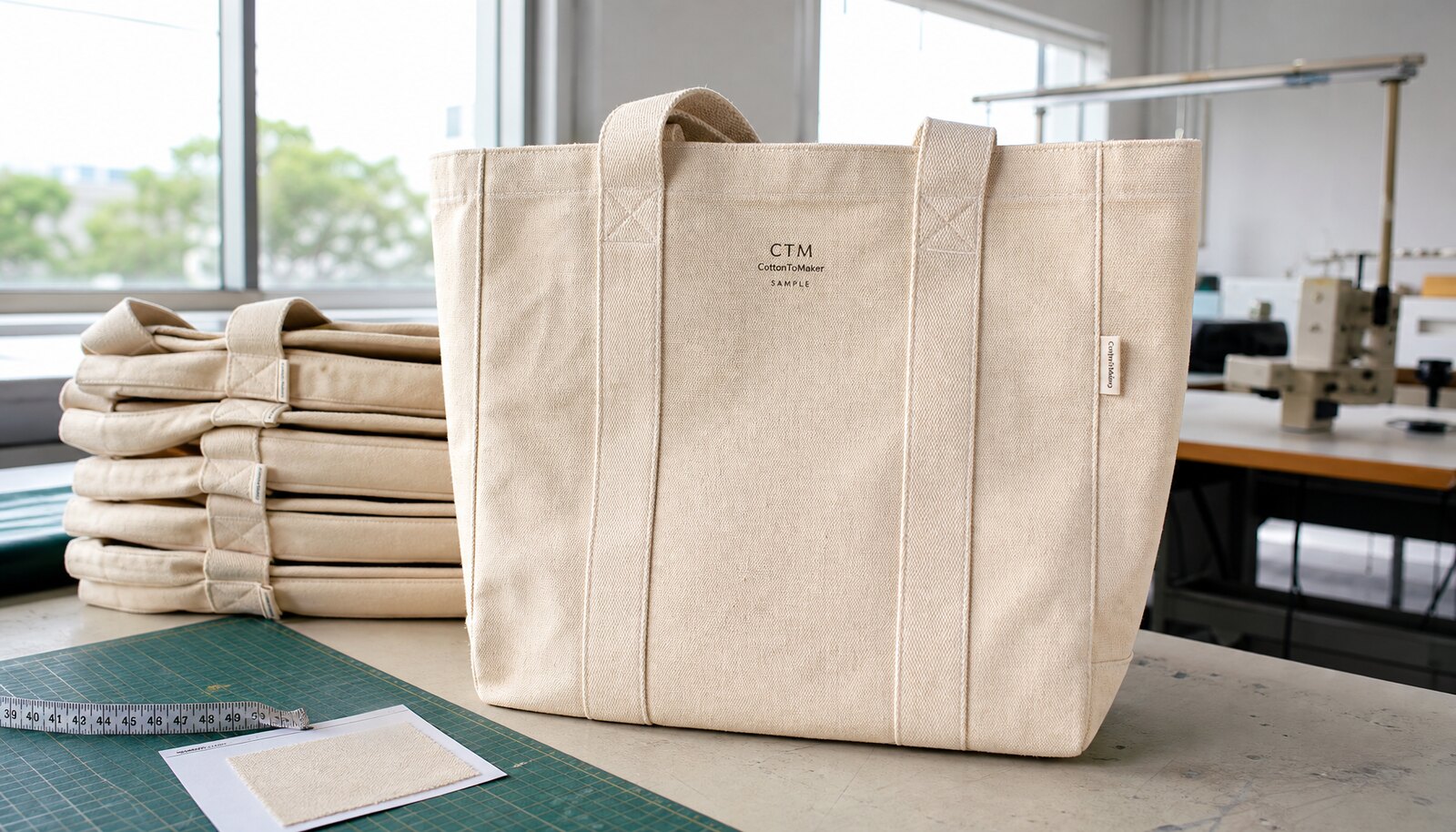
What makes a trade show tote worth quoting as “heavy canvas”
A trade show tote is not purchased like a fashion tote. It is judged on the booth floor, where buyers, attendees, and exhibitors pick it up, load it, fold it, drop it into another bag, and sometimes carry it for hours. That use case is why procurement teams need a tighter spec than “nice canvas bag” or “premium promotional tote.” The factory should understand the event load, the desired look, and the failure point you want to avoid. If the bag needs to hold catalogs, sample kits, water bottles, and brochures all day, the quotation should start from load and construction, not from print artwork.
For most event programs, the practical starting point is 10–12 oz canvas, roughly 340–420 GSM. That range usually gives enough body for a premium hand feel while staying flexible enough to fold, pack, and print cleanly. If the tote will hold heavier inserts or needs to stay upright on a tabletop display, 14 oz can be the better choice. The tradeoff is not just price. Heavier fabric also affects stitch speed, handle build, carton weight, and freight cost. That is why “heavy” should never appear alone in the RFQ. It should be paired with a measurable weight, a defined fabric source, and a use case.
Buyers should also separate visual premium from performance premium. A tote can look substantial because of color, print placement, or a flat body shape, yet still fail if the fabric is thin or the handle anchors are weak. On the other hand, an overbuilt bag may survive easily but become stiff, expensive, and awkward to carry. The right quote sits in the middle: enough fabric to avoid collapse, enough structure to carry real event contents, and enough control to keep the bag flat, clean, and repeatable at volume. That balance is what the factory needs to quote accurately.
- Write the spec in GSM or oz, not “thick,” “heavy,” or “premium.”
- State the expected contents: brochures only, sample products, bottles, or mixed event materials.
- Say whether the bag must stand upright, fold flat, or survive repeated reuse after the show.
- If the tote is only for a single giveaway event, avoid over-specifying fabric and hardware that add cost without adding value.
Start with the bag structure, not the print
Many RFQs put the logo first and leave the construction vague. That is the fastest way to get quotes that cannot be compared. A supplier can reproduce a logo and still deliver a tote that feels cheap because the body droops, the handles twist, or the bottom seam opens after a few lifts. For trade show use, the body shape, gusset depth, seam build, and handle anchor points should be fixed before the artwork is discussed. The factory needs to know what it is sewing, not just what it is printing.
A useful structure for most trade show tote bags is a self-fabric body with a bottom gusset and reinforced seams. Self-fabric means the body and handles use the same canvas, which keeps the appearance cohesive and usually helps with branding. A gusset gives usable volume and a better profile for catalogs or sample boxes. Reinforced side seams and bottom seams reduce the chance of split corners and help the bag keep its shape after repeated filling. If the tote is expected to carry heavier loads, ask for bar-tacks at each handle anchor and, where the factory can support it, a double-stitch or box-X reinforcement pattern.
Do not let the supplier substitute a “standard tote” description for these details. Standard means different things across factories. One factory may mean a basic open-top bag with loose handles. Another may mean a lined and reinforced style with better sewing time built into the price. If the RFQ does not name the construction, the quote may be low, but the bag will not be consistent. A better procurement habit is to attach a simple build drawing or dimensioned sketch with front, back, side, and bottom views. That one page removes ambiguity faster than a paragraph of text.
For larger programs, ask the factory to confirm the body panel layout and stitch path. The buyer does not need a full engineering drawing, but the quote should make clear whether the bag has one-piece side panels, a seamed bottom gusset, bound raw edges, or turned seams. Those choices affect not only quality but also machine time and defect risk. A quote that includes a real construction description is easier to compare and easier to hold accountable after sampling.
- Define finished size: width × height × gusset depth.
- Specify handle length, handle width, and handle drop if shoulder carry matters.
- Call out reinforcement: bar-tack, box-X, double stitch, or bound seam.
- Ask for a build sketch if the factory’s written description is too generic.
Fabric weight, weave density, and finish: how to compare quotes fairly
Two bags can both be labeled 12 oz canvas and still feel different in hand. The difference often comes from yarn quality, weave density, surface finishing, and shrinkage behavior. A tighter weave usually prints more cleanly and resists distortion around seams and handle attachments. A looser weave may feel softer, but it can telegraph weaving inconsistency, absorb ink unevenly, or show more visible texture under a large flat logo. That is why a true fabric spec should not stop at oz or GSM.
Buyers should ask whether the canvas is raw, pre-shrunk, bleached, dyed, or washed. Each finish changes the hand feel, print behavior, and size stability. For many trade show programs, plain natural canvas is the most efficient route because it simplifies shade control and gives strong contrast for logos. If the tote must be black, navy, or another brand color, then the supplier should explain how the dye is applied and how repeat shade consistency is controlled across production lots. Piece-dyed and yarn-dyed fabrics behave differently; the factory should not use one term loosely if the buyer needs a specific repeatable result.
A procurement team comparing quotes should also ask for a swatch or a small cut panel. That sample tells you more than a unit price line ever will. It lets you judge whether the fabric is too loose, too glossy, too stiff, or too uneven for the print method. If the supplier cannot show a swatch, a roll photo, or a sourced fabric reference, the quote should be treated as provisional. The buyer still has no real proof of what will be sewn.
Shrinking is another overlooked issue. If the fabric is not pre-shrunk, the bag dimensions and print alignment can shift after finishing or storage. That matters most when the artwork sits close to seams or when the bag has a sharp rectangular profile. Ask the factory to state expected shrinkage and, if relevant, whether the canvas is washed, steamed, or otherwise stabilized before cutting. A few extra minutes on this question can prevent a lot of correction later.
- Ask for fabric weight before and after finishing if shrinkage matters to the bag size.
- Keep the same fabric source when reordering to reduce shade and hand-feel variation.
- Treat any quote without a swatch, roll reference, or fabric description as preliminary only.
- If color consistency is critical, ask how shade lots are separated and labeled.
Print method choice: what actually works on heavy canvas
Heavy canvas is a forgiving substrate, but the print method still matters. The same logo can look premium with one process and rough with another. For a simple event logo, screen printing is usually the most practical route because it balances unit cost, color opacity, and repeatability. It also tends to sit well on canvas, especially when the artwork is bold and the quantity is large enough to absorb screen setup cost. If the logo is one or two colors and the design is stable, screen print is often the first method a buyer should quote.
Heat transfer has a place, but it is best reserved for short runs, variable text, or event-specific personalization. It is useful when the buyer needs city names, individual names, or many small version changes. The tradeoff is durability. Some transfers do not age well at fold lines or after repeated packing, and the buyer should not assume every transfer behaves the same. Ask for the exact transfer type and the test standard the factory uses if the tote must be reused. If the supplier cannot explain durability in plain terms, the buyer is taking a risk on a bag that may look fine at shipment but fail after first use.
Embroidery gives a premium feel and can be appropriate when the design is small, simple, and meant to signal quality. But on a canvas tote, embroidery adds stitch bulk and can distort lighter panels or create puckering if the digitizing is too dense. It also increases labor time. That means it should be quoted with care, not assumed to be automatically better. A buyer should weigh logo readability, hand feel, and lead time, not just visual preference. On textured canvas, smaller text is often the first thing to lose legibility, so the artwork should be checked against the chosen method before the PO is released.
If the design includes fine type, gradients, thin outlines, or small registration marks, the safest approach is to ask for a production-feasible artwork proof. That proof should reflect the actual print method and should show how the logo sits relative to the seam lines and handle anchors. This is where procurement gets practical: the design that looks clean in a PDF may not survive sew-and-print production unless the line weights and safe areas are adjusted first.
- Use screen print for stable logos and medium-to-high quantities.
- Use heat transfer only when personalization or short-run flexibility matters more than long-term abrasion resistance.
- Use embroidery only when the artwork tolerates stitch build-up and the budget allows the extra labor.
- Avoid tiny text on textured canvas unless the print method has been proven on a pre-production sample.
A comparison of sourcing routes for trade show tote quotes
The cheapest quote is not always the best sourcing route. For heavy canvas tote bags, buyers usually compare direct factory, factory-approved trading partner, and domestic assembler or decorator routes. The sourcing route changes what is actually being controlled. It affects who buys the canvas, who owns the print process, who carries the QC burden, and how easy it is to trace a problem back to its source. If the buyer only compares unit price, the cheapest quote may hide a lot of ambiguity.
Direct factory sourcing is usually the cleanest route when the buyer needs control over fabric weight, sewing standard, and repeatable reorders. The factory that cuts and sews the bag can answer detailed questions about seam type, stitch count, reinforcement, and packing discipline. This route often gives the strongest documentation trail, especially if the buyer wants inspection access or a sealed reference sample. The downside is that it may require better internal coordination from the buyer, because the factory expects the RFQ to be more complete before it quotes confidently.
Factory-approved trading partners can be useful when a buyer wants broader coordination or a faster response across multiple small order versions. The best trading partners do more than pass along an inquiry. They know which factory is actually sewing the bag, how the factory handles prints, and whether the fabric source is stable. The buyer should verify that the trader can name the actual production site, share sample evidence from that site, and explain how quality responsibility is assigned. If the trader cannot show which factory is making the bags, the buyer is comparing a promise rather than a production capability.
Domestic assembly or local decoration can help when speed matters more than fabric variety. It may reduce transit time and simplify late-stage artwork changes. But it often raises unit cost and can limit material options. A local assembler may be printing or finishing imported blanks instead of making the full tote structure from fabric roll. That is not a problem if the buyer understands the route and the material chain, but it should be documented clearly. The important point is to verify what is actually being made in-house and what is being outsourced. Ask for documents, not just assurances: factory name, process map, sample source, and inspection responsibility.
- Direct factory: best when spec control, repeatability, and QC traceability matter most.
- Trading partner: acceptable only if the actual sewing factory, sample chain, and QC ownership are documented.
- Domestic assembler: useful for speed, but verify what is made locally versus imported as blanks or components.
- Ask each supplier to identify the production site, not just the sales office.
How to compare supplier quotes without getting fooled by unit price
A quote for heavy canvas tote bags should never be compared as a single number. The right comparison starts with the same bag size, same fabric weight, same print method, same handle build, same packing format, same incoterm, same currency, and the same sample scope. If one supplier quotes EXW and another quotes FOB, or one includes a pre-production sample while another charges separately, the numbers are not yet comparable. A low unit price can hide a lighter fabric, weaker stitching, smaller print area, or a carton pattern that increases freight cost.
The cleanest method is a landed-cost view. Add together the production unit price, sample cost, artwork setup, carton cost, inland handling, export charges, ocean or air freight, import duty, and destination delivery. For trade show bags, timing risk should be included as a cost factor as well. If the bags arrive after the event opens, the financial value of the order drops sharply, even if the unit price looked strong. Buyers often save a few cents on the bag and lose far more in expediting, air freight, or unusable inventory.
When a quote seems much lower than the others, ask the supplier where the saving comes from. A direct answer is a good sign. A vague answer is not. Common reasons for a low quote include a lighter canvas weight, fewer reinforcement stitches, a cheaper print process, larger cutting waste tolerance, simpler packing, or a looser QC standard. In procurement terms, the goal is not to force every supplier to the same price. The goal is to make every supplier quote the same spec so the differences that remain are meaningful. That is what gives the buyer leverage.
A good quote comparison also includes a quantity ladder. Ask for pricing at 500, 1,000, 3,000, and 5,000 pieces, or whatever range matches the program. This shows the real breakpoints where setup cost is diluted. It also helps the buyer understand whether the factory is giving a true production price or just a placeholder number. If the quantity may change after artwork approval, ask how the price moves if the final PO lands 10–20% above or below the estimate. That question saves money and avoids awkward renegotiation later.
- Compare only after aligning spec, packing, incoterm, currency, and sample scope.
- Break out one-time setup fees from recurring unit cost.
- Request a price ladder to identify the real quantity breakpoints.
- Use landed cost, not ex-works unit price, as the final decision number.
MOQ logic: what drives the minimum and where costs actually change
MOQ on heavy canvas tote bags is driven by cutting efficiency, print setup, and sewing line changeover, not by a single universal rule. If the bag uses standard natural canvas, a single color print, and a basic shape, the MOQ can be more flexible. If the buyer wants custom dyed fabric, multiple print versions, special washing, lining, or extra hardware, the factory usually needs a larger run to recover setup time and material losses. A good buyer does not ask only, “What is your MOQ?” The better question is, “What specifically causes the MOQ to rise?”
The cost curve often changes at discrete points. A 500-piece quote may look acceptable, but a 1,000- or 3,000-piece quote can show a much better unit price because screen setup, cutting layout, and QC time are spread across more units. The buyer should ask the factory to show where those breakpoints are. That is particularly useful when multiple buyers inside one company may reorder later. If the first order is small but repeat orders are likely, it may be worth paying a slightly higher initial unit price to preserve the same fabric, print screens, and production recipe for future runs.
Mixed orders need careful definition. Some factories allow multiple colors or multiple artwork variants under one overall MOQ, while others treat each color, size, or logo version as a separate setup. The buyer should not assume that a 3,000-piece total order can be split across three colors at no extra cost. Each split may create extra cutting waste, new screen setups, or additional QC sorting. Ask for the rule in writing before approving artwork. That one step prevents a very common misunderstanding: the buyer thinks the total order is one run, while the factory prices it as three separate runs.
Low MOQ offers are not automatically bad, but they should be examined closely. Sometimes the factory is using in-stock fabric and wants to fill a production gap. Sometimes the quote is real but the print and packing options are limited. And sometimes the low MOQ hides a quality compromise that will only appear after sample approval. If the buyer values brand presentation, it is usually better to pay for a clean, documented run than to chase the lowest entry volume without understanding the production constraints.
- Clarify MOQ per color, per size, and per artwork version.
- Ask whether mixed versions share one production line setup or require separate runs.
- Request the price breakpoints that improve unit cost without changing the spec.
- Treat unusually low MOQ quotes as a cue to ask more questions, not fewer.
Sample approval: the point where many tote programs go wrong
For heavy canvas tote bags, sample approval is not just a visual sign-off. It is the point where the buyer locks the actual product definition. The approved sample should confirm fabric weight, hand feel, color, stitching, handle length, print placement, and packing method. A blank sample alone is not enough when the final bag will include print or special finishing. Likewise, a digital mockup is not enough when fabric texture, seam placement, and fold lines can shift the final appearance. The sample sequence has to reflect the real production path.
A practical approval flow is: artwork proof, fabric swatch or blank sewn sample, pre-production sample with final print and final construction, then a sealed reference sample retained by both sides. The sealed sample matters because it gives procurement and QC a physical benchmark when production questions arise. It should be marked, dated, and linked to the PO or spec revision. Without a sealed reference, buyers end up arguing from memory instead of from an agreed standard.
The sample should also be tested with real contents. If the bag is for brochures and a bottle, use those items. If it is for sample kits, fill it with a realistic substitute weight. Then check handle comfort, seam pull, gusset shape, print registration near seams, and whether the bag can be folded into the planned carton format without damaging the print. This is not overthinking. It is a simple way to catch the most expensive errors before bulk production. Many tote orders are simple enough that a small missed detail can be fixed early, but costly to fix after sewing has started.
If the supplier sends a sample that differs from the quote in fabric, handle build, or print method, stop and ask for correction before approval. A sample that is “close enough” is often the first step toward a production dispute. The buyer should mark exactly what is approved and what is not. If multiple colorways are involved, approve each one separately if shade, print contrast, or fabric source differs. That discipline keeps the sample process useful instead of symbolic.
- Keep one approved sample signed or marked by both buyer and supplier.
- Load the sample with real or realistic event contents before signing off.
- Do not approve a sample that differs from the quoted fabric or print method.
- Separate approval for each colorway if shade or contrast matters.
Stitching, load capacity, and load tests: the specs buyers should actually ask for
A quote for a heavy canvas tote should include more than fabric weight. If the bag is meant to carry real event loads, the sewing spec needs to support that use. Ask how the factory handles the side seams, bottom corners, and handle anchors. The goal is to prevent split seams, twist in the handles, and body distortion when the bag is full. This is where simple procurement language helps: define where the bag is expected to fail, then build the quote to avoid that failure.
Handle anchors deserve special attention. A bag may look sturdy from the front but fail at the join where the handle meets the body. Reinforcement can be done with bar-tacks, box stitches, or a combination of extra stitch passes. The buyer does not need to prescribe a sewing textbook, but it should be clear that a single light stitch line is not acceptable for a heavy-load tote. If the bag will be carried by the shoulder, handle drop and width also matter. Wide handles distribute weight better and usually feel more premium during a long event day.
A useful procurement question is whether the supplier can perform a basic load or drop check on a sample. The exact method can vary, but the factory should be able to explain how it verifies that the bag holds expected contents without immediate seam strain, handle elongation, or print cracking after repeated lifts. If the supplier has a standard internal test, ask for the pass/fail criteria. If not, define a practical test together and include it in the sample approval note. The idea is not to create laboratory paperwork; it is to make sure the tote survives the real use case.
For higher-value programs, ask the factory for seam construction photos or a cut sample that shows the reinforcement from the inside. This helps procurement verify that the sewing standard is real, not just described. It is also a useful audit tool when comparing suppliers, because a strong-looking exterior can hide weak internal finishing. If the buyer will reorder the tote later, preserving that sewing recipe is part of protecting future consistency.
- Specify reinforcement at handle anchors, side seams, and bottom corners.
- Ask whether the factory can run a practical load or drop check on the sample.
- Confirm handle width and handle drop for shoulder carry.
- Request internal seam photos or a cut sample if construction risk is important.
Packing, carton marks, and shipping details that protect margin
Packing is often treated as a minor line item, but for heavy canvas tote bags it affects count accuracy, freight volume, and how the bags arrive at the booth or warehouse. Most trade show totes should be folded flat and packed in master cartons with clear marks for PO number, item code, color, and quantity per carton. That sounds basic, but buyers still receive shipments where carton labels do not match the packing list or where the count per carton changes without notice. Those mismatches slow receiving, raise dispute risk, and create unnecessary labor at the destination.
Inner polybags are optional and should be decided based on the channel. If the totes are going direct to a booth or bulk warehouse, a simple flat pack may be enough. If they need dust protection, retail presentation, or extra moisture control, polybags can make sense. They do add material and labor cost, so the buyer should ask for them only when there is a reason. The same logic applies to tissue sheets, moisture barriers, or carton dividers. Extra packing is useful if it protects the print or keeps the bags neat, but it should not be added casually.
Carton dimensions and gross weight matter more than many buyers expect. Heavy canvas is dense enough that freight can become expensive quickly if the pack format is inefficient. Ask the factory for carton size, net weight, gross weight, and cartons per pallet if palletization is used. If the totes are printed, ask how the factory prevents scuffing inside the carton. Sometimes a simple fold direction or a separating sheet is enough. The goal is to keep the print readable and the bag presentable when the carton is opened, not just to get the shipment out the door.
A strong packing instruction should also cover overpack tolerance and count control. If a carton is supposed to contain 25 pieces, say whether 24 or 26 is acceptable. If carton count matters for staging or booth distribution, define that clearly. For procurement, packing is not a housekeeping detail. It is part of the product delivery standard.
- Require carton marks that match the purchase order and packing list.
- Confirm whether polybags, tissue, moisture protection, or dividers are included.
- Ask for carton dimensions, net weight, gross weight, and pallets if relevant.
- Specify acceptable carton count tolerance if the bags will be distributed by the piece.
Specification comparison for buyers
| Spec decision | Recommended option | When it fits | Buyer risk to check | Cost / lead-time effect |
|---|---|---|---|---|
| Canvas weight | 10–12 oz canvas (about 340–420 GSM) for most trade show use; 14 oz if the tote will carry catalogs, samples, or bottles all day | Standard event giveaways, booth handout bags, and premium promo totes that need structure without becoming too stiff | Too light feels flimsy and can distort print; too heavy raises sewing time, freight weight, and folding difficulty | Higher GSM usually increases material cost and can add 3–8% to sewing/labor on the same size bag |
| Weave / fabric quality | Tighter plain weave with confirmed swatch approval and documented shrinkage behavior | When you need cleaner printing, better seam stability, and repeatable reorders | Loose weave can show slub variation, bleed through, or uneven print absorption | Better yarn and weave control can reduce rework risk but may increase fabric price and sampling time |
| Bag construction route | Self-fabric body with bottom gusset, reinforced side seams, and bar-tacks at handle anchors | When the bag must stand on tables, carry samples, and keep a tidy shape | Unreinforced bottoms sag; weak seam allowance can split at the bottom corners | Adds cutting and sewing steps; usually higher labor but lower defect risk |
| Handle build | Wide self-fabric handles or reinforced cotton webbing handles, with bar-tacks or box-X stitching at stress points | Repeated shoulder carry and heavier event loads | Narrow handles cut into the hand and often twist; single-line stitching is weak for heavy use | Wide handles raise material use slightly and may add sewing time, but improve perceived quality |
| Print method | 1–2 color screen print for stable logos; heat transfer only for small runs or variable names; embroidery only when the design tolerates stitch build-up | Simple event logos, stable artwork, and medium-to-high quantity orders | Fine type, gradients, and seam-adjacent artwork can distort on textured canvas | Screen print has setup cost but lower unit cost at scale; transfer lowers setup but can reduce durability |
| Logo placement | Front panel with safe margins from seams, gusset folds, and handle anchors | When the bag needs booth visibility and clean brand presentation | Artwork too close to seams can warp after sewing or become off-center after folding | No major cost change, but poor placement can create costly reprints or rejects |
| MOQ route | One color body / one print design / one size for the best unit price; mixed versions only if the factory confirms line setup logic | When you want predictable pricing and a reorder path | Low MOQ quotes can hide setup fees, weaker QC, or limited fabric availability | Lower MOQ increases unit price because setup and cutting waste are spread over fewer bags |
| Packing method | Flat packed, master cartons labeled by PO/color/item code, with controlled carton count and gross weight | Import orders where count accuracy, freight planning, and booth delivery timing matter | Loose packing creates wrinkling; overcompressed cartons can mark prints or distort shape | Tighter packing improves carton efficiency but may add labor; better for freight and inventory control |
| Supplier route | Direct factory if you need spec control; factory-approved trading partner if you need speed and broader coordination; domestic assembler for urgent local events | When the buyer has different priorities on cost, speed, and control | Trader claims must be verified; domestic assembly may narrow fabric options and raise cost | Direct factory usually offers better unit economics; domestic options may reduce transit time but increase landed cost |
Buyer checklist before sampling
- Approve the exact canvas weight in GSM or oz, not just the word “heavy,” and confirm whether that value is before or after finishing.
- State finished bag size, gusset depth, handle length, handle width, and handle drop so the factory cannot substitute a different silhouette.
- Specify seam build: seam allowance, side seam type, bottom seam type, and whether bar-tacks, box-X stitches, or double stitching are required.
- Fix the print method, number of colors, Pantone references, logo size, and safe margin from seams before quoting.
- Ask for a build drawing or spec sheet that shows front, back, side, and bottom views with dimensions labeled.
- Request a pre-production sample made from the final fabric, final print method, and final packing method; do not approve only a blank sample.
- Confirm carton pack count, folding method, inner polybag use, carton dimensions, gross weight, and pallet pattern if needed.
- Compare unit prices only after aligning the incoterm, currency, freight responsibility, packaging, and sample charge assumptions.
- Ask the supplier to identify the fabric source, mill, or buying channel, and request proof that the quoted fabric weight is available in the stated shade.
- Get a written defect standard for stitch skips, broken thread, measurement tolerance, print misalignment, dirty marks, and packing count errors.
Factory quote questions to send
- What is the exact fabric weight in GSM or oz, and is it measured before or after washing, dyeing, or finishing?
- What is the weave structure, yarn count, and finished width of the canvas, and can you provide a swatch or lab reference?
- Is the canvas carded, combed, ring-spun, recycled-content, or blended, and what consistency controls do you use across rolls?
- What shrinkage percentage should we expect after finishing or washing, and do you pre-shrink the fabric?
- What handle width, handle length, handle drop, and reinforcement stitch pattern are included in the quote?
- What seam allowance, seam construction, and stress-point reinforcement are standard for this bag size?
- Can you provide a simple build drawing with dimensions, panel construction, gusset depth, and handle placement?
- What is the print method, maximum color count, and setup fee for each artwork version?
- What is the ink type, and how do you control opacity, cracking, and wash or rub resistance on textured canvas?
- What is the MOQ per color, per size, and per print design, and how does the unit price change at 1,000 / 3,000 / 5,000 pcs?
Quality-control points to confirm
- Fabric weight tolerance: accept only if the measured GSM or oz stays within the agreed band, typically about ±5–8% for woven canvas, unless the spec sheet states a tighter range.
- Fabric inspection: check roll width, slub frequency, weaving defects, stains, shade variation, and edge fray before cutting; reject or segregate nonconforming rolls.
- Shrinkage control: if the tote will be folded tightly or printed edge-to-edge, confirm shrinkage after finishing so artwork placement does not shift after sewing.
- Seam integrity: side seams, bottom seams, and handle anchor points must show no skipped stitches, broken thread, loose ends, or exposed raw edges beyond the agreed standard.
- Handle strength: bar-tacks or reinforcement stitches must be present at every stress point; handles should not twist excessively or elongate after repeated lifting.
- Load verification: test the finished tote with realistic event contents; the bag should carry expected weight without seam strain, gusset collapse, or handle failure during repeated lifts.
- Print quality: logo edges should be clean, color density even, and placement within the stated center/offset tolerance; inspect for pinholes, ink bleeding, and misregistration.
- Print durability: verify rub resistance and fold-line performance on the actual print method; some transfers look good flat but crack at creases after packing.
- Size control: finished width, height, and gusset should match the approved sample within the manufacturing tolerance shown on the spec sheet.
- Appearance control: no oil marks, fabric stains, loose fibers, adhesive residue, or visible seam damage on any visible panel.