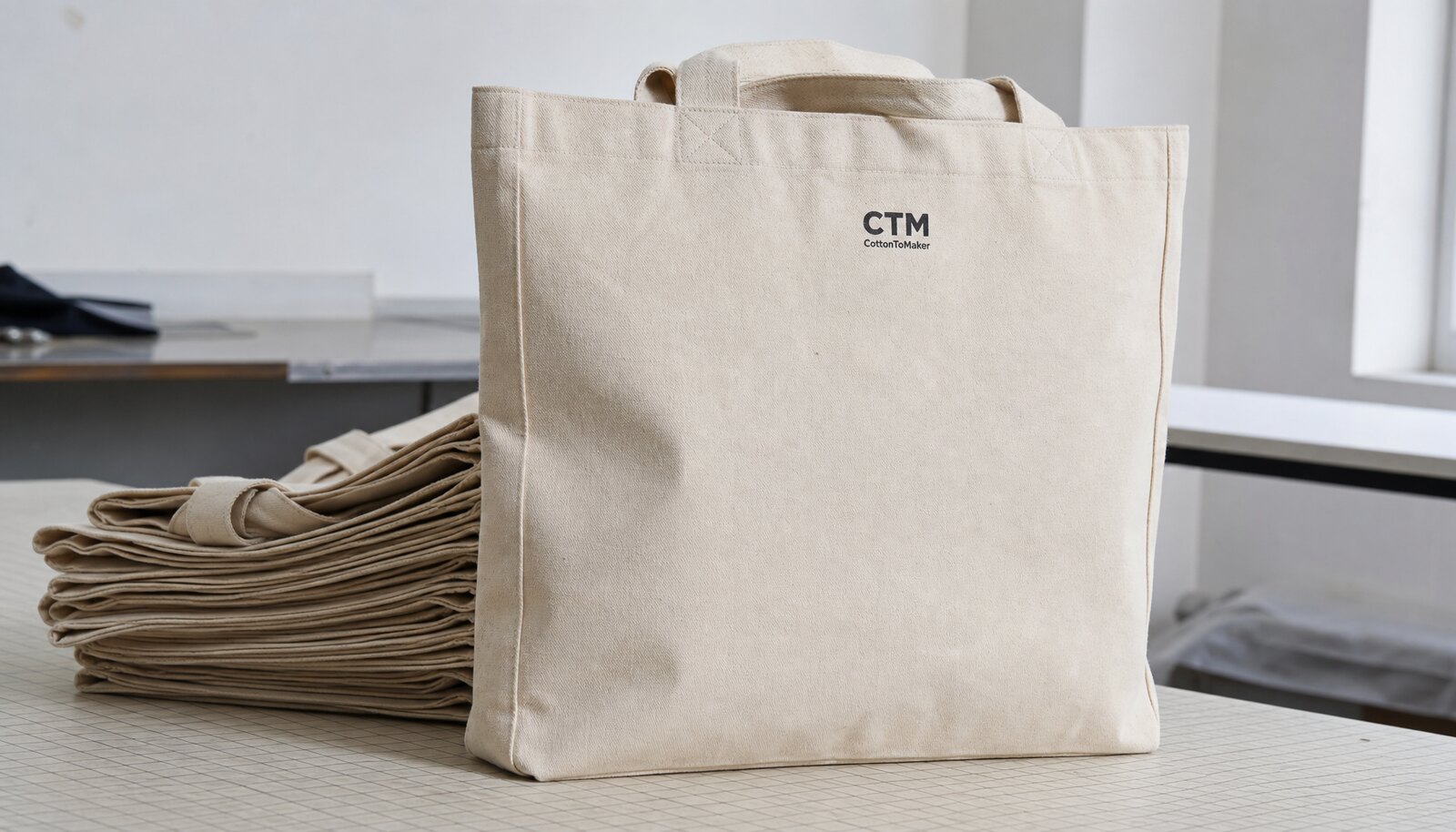
Why heavy canvas is the right spec for trade show totes
Trade show bags are judged in motion. They need to look credible when an attendee picks one up at the booth, walks the floor for hours, and then keeps using it long after the event. A thin tote may save a little money at purchase, but it usually fails the real job: carrying enough material to stay useful and keep the brand visible. Heavy canvas gives the bag body, improves hand feel, and prevents the sagging look that makes many giveaway bags feel disposable before the day is over.
For procurement teams, the useful starting band is usually 12 oz to 16 oz canvas, which is roughly 340 to 450 GSM depending on weave, finishing, and whether the fabric is measured pre- or post-shrink. That range is heavy enough to feel substantial, but still practical for cutting, sewing, and printing in bulk. Once you go much lighter, the bag loses structure and reuse value. Once you go much heavier, the piece can become stiff, harder to sew cleanly, and more expensive than the trade show program can justify.
The other reason heavy canvas is common in event sourcing is that it hides handling better than many lighter fabrics. Bags get folded, stacked, shipped, unpacked, refolded, and carried through crowded halls. Heavier canvas tends to recover shape better, so the bag still looks presentable when it reaches the end user. That matters for brand perception because the bag itself is part of the exhibit experience, not just packaging around it.
- 12 oz: common balance point for cost-sensitive trade show distribution and simple one-color branding.
- 14 oz: better body and a more premium feel without jumping too far in price.
- 16 oz: suitable for heavier sample loads, premium event kits, or resale-oriented programs.
- Below 12 oz: higher risk of collapse, wrinkling, and a less substantial hand feel.
- Above 16 oz: often overbuilt unless the bag is expected to carry weight repeatedly.
How the construction choice changes both cost and use
The bag shape determines how useful the tote is on-site and how expensive it is to make. A flat tote is the simplest version: fewer pattern pieces, less sewing time, and usually a lower quote. It works when the bag is only meant to hold brochures, flyers, or a light promotional pack. But flat bags can feel cramped quickly, especially if the program includes sample bottles, catalogs, or other shaped inserts.
A gusseted tote or boxed-corner tote adds carrying depth and improves the bag’s ability to stand open on a table or registration counter. That makes it easier for attendees to load materials without fighting the bag opening. A bottom gusset of 10 to 15 cm is a practical range for many event programs. It adds usability without creating unnecessary sewing complexity or a bag that becomes too bulky to carry through the show.
Handle design is not a cosmetic detail. Shoulder-length handles generally work better for trade show traffic because people are carrying the bag for long stretches, often alongside a phone, samples, and drinks. Short hand-carry handles can be fine for compact handouts, but they are less comfortable once the bag gets heavier. Reinforced handle attachment is worth specifying whenever the bag is expected to hold more than a few sheets of paper. If the handle tape or seam fails in the venue, the item stops being a marketing tool and becomes an embarrassment.
When comparing construction options, buyers should ask the supplier to quote each spec change separately. A flat tote with one print side is not comparable to a gusseted tote with reinforced handles and a double-sided print. Without a structured comparison, the buyer is likely to choose the cheapest-looking line item rather than the best total-value option.
- Flat tote: lowest sewing cost and best for lightweight inserts.
- Gusseted tote: better capacity and better performance for sample packs.
- Boxed corners: helpful when the bag needs to stand upright and hold shape.
- Reinforced handles: should be treated as standard for heavier event loads.
- Ask suppliers to show the stitch and seam method in their sample photo or tech sheet.
A bulk pricing plan starts with the real cost drivers
A serious bulk pricing plan should begin with a spec sheet, not a target number pulled from a previous campaign. The unit price on a tote is shaped by fabric weight, bag size, handle length, print coverage, construction complexity, and packing method. Fabric is usually the biggest driver, but it is not the only one. A bag with a smaller fabric footprint can still cost more if it has multiple print positions, special reinforcements, or individual retail packing.
There is also a hidden cost in inconsistency. If each supplier is quoting a different spec, the team ends up comparing unrelated products. One supplier may quote 12 oz canvas, single-side print, and bulk carton pack; another may quote 16 oz canvas, double-side print, and individual polybags. Both may be “reasonable” quotes, but they are not like-for-like. The buyer should fix the spec first, then ask for pricing at multiple volumes.
For trade show sourcing, the smartest buying approach is to separate the program into three questions: what is the lowest acceptable spec, what is the target spec, and what is the upgrade that truly changes the user experience. That keeps the conversation focused on tradeoffs. Paying more for stronger handles, better print opacity, or a gusset that actually holds a sample pack may be justified. Paying more just because the supplier bundled in a few unnecessary extras usually is not.
If the team wants a simple way to forecast cost, use a spec ladder. Start with a baseline bag, then add the cost of one upgrade at a time: heavier fabric, longer handles, reinforcement, extra print color, or retail packing. This makes it easier to defend the final buy internally and easier to spot which option produces a meaningful benefit versus a cosmetic one.
- Fabric weight is usually the first cost lever, followed by size and print coverage.
- Two-sided printing is rarely a trivial add-on; it affects setup, alignment, and yield.
- Retail-ready packing adds labor, carton volume, and sometimes more defect handling.
- Compare quotes only after the exact spec, packing, and inspection standard are frozen.
How to compare suppliers without getting trapped by low quotes
Factory versus trading company is not a moral choice; it is a control choice. A direct factory is usually better when the buyer needs visibility into fabric sourcing, stitching quality, and production scheduling. You can often get a clearer answer about machine capacity, line efficiency, and what is or is not possible within the quoted lead time. That matters when the tote is tied to a fixed event date and there is little tolerance for slippage.
A trading company can still make sense when the program includes multiple product categories or when the buyer values one point of contact over factory-level transparency. The risk is that responsibility gets blurred. The trading company may quote the bag, but the actual sewing and printing may happen elsewhere, which means fabric substitution, print variation, or packing differences can be harder to trace. If you use a trading company, ask for explicit factory identity, sample traceability, and a written promise that the bulk order will be produced in the same facility or an approved equivalent.
The most practical procurement control is landed-cost comparison. The unit price matters, but so do freight cube, carton dimensions, destination handling, import duty, local labeling, and rework risk. Heavy canvas bags are bulky, so a quote that looks cheap ex-works can become expensive once the cartons are counted. If two suppliers are close on price, compare carton efficiency and the likelihood of receiving problems. A slightly better-packed carton that ships more efficiently and arrives cleaner can be the lower-cost choice in the end.
For a real supplier comparison, ask for the same evidence from every bidder: base fabric spec, sample photo, sewing method, print method, packing format, carton size, and an explanation of what would change the price. That makes it easier to see whether a quote is strong or just incomplete.
- Direct factory: strongest for control, repeat orders, and traceable QC.
- Trading company: workable for mixed sourcing, but ask for factory identity and sample traceability.
- Local decorator: good for very short runs, but usually too costly for bulk trade show volume.
- Ask every supplier to quote the same spec and same packing format to avoid false price comparisons.
Sample approval should test function, not just appearance
A tote sample should be judged as a working product. Many buyers look only at logo placement and color match, but the sample should also prove that the bag carries properly, folds properly, and survives normal handling. The first check is dimensions: bag width, height, gusset depth, and handle length should match the approved tech pack. The second check is material feel and body. The fabric should be the same approved canvas or a clearly documented equivalent, not a lighter substitute that merely looks similar in a photo.
The sample should also reveal how the print behaves on actual canvas texture. A logo that looks clean on a flat artwork proof can still blur, lose edge detail, or appear too faint on a rough weave. This is especially important for small text, thin lines, and reverse-out logos. If the artwork requires exact placement, inspect it from the distance people will actually see it at a show booth or registration desk. If the logo is meant to be a brand cue from a few meters away, then that is the standard, not a close-up view under perfect lighting.
Functional testing is worth the time. Put a realistic event load into the bag: catalogs, brochures, sample packs, and a water bottle if that is part of the expected use. Then check whether the opening stays usable, whether the handles feel balanced, and whether the bag hangs straight. Pay special attention to the handle joins and bottom corners. Those are the points most likely to open up or distort if the stitching is weak or the bag was cut too close to the seam allowance.
Keep one approved physical sample and one approved photo set. The physical sample is the reference for receiving. The photo set helps when the warehouse or local team needs to check what “good” looks like without waiting for procurement to answer every question.
- Check dimension accuracy before approving print details.
- Compare the print at event-viewing distance, not only in a close-up.
- Load the sample with realistic weight and inspect handle behavior.
- Keep one approved physical reference and one approved image reference.
Print method choices for bulk orders and where rework usually starts
For heavy canvas tote bags, screen printing remains the workhorse choice for bulk because it handles simple logos well, gives solid opacity, and stays economical when quantities rise. It is usually the first method to consider for one-color or two-color brand marks. The reason is simple: it is repeatable and it works well when the artwork is clean. For many trade show programs, that is exactly what the buyer needs.
Where buyers get into trouble is assuming that every logo can be treated the same way. Heavy canvas has texture, and that texture affects fine lines, tiny text, and tight registration. If the design depends on gradients, photographic detail, or delicate line work, the supplier may need heat transfer or digital print. Those methods can be useful, but they tend to increase unit cost and can feel less integrated into the fabric. Buyers should ask for a print method recommendation rather than forcing the wrong method onto the artwork.
Print durability matters because tote bags are folded and compressed during packing. A print that looks sharp when first made can crack, rub off, or offset onto another bag if the curing is incomplete or the ink system is not suited to stacked cartons. Ask the supplier how the print will be cured, whether a rub test is performed, and what the acceptance criteria are for opacity and alignment. If the tote is likely to be reused, a basic wash or wet-rub check is worth requesting as part of pre-shipment review.
The practical rule is this: choose the cheapest method that still protects brand legibility and durability. Do not overpay for an effect if a cleaner screen print will do the job. Do not underbuy a method if the artwork is too detailed for canvas and the event is too important to accept a fuzzy logo.
- Screen print: best default for bulk and simple branding.
- Heat transfer: better for small runs or complex artwork, but inspect feel and durability.
- Digital print: useful for more complex designs, though not always cost-effective on coarse canvas.
- Ask for a curing explanation and a rub-test or adhesion check before bulk approval.
- Reject artwork that requires fine detail beyond what heavy canvas can hold cleanly.
MOQ, price breaks, and how to structure the order around demand
MOQ should be treated as a production reality, not as a negotiation trick. For heavy canvas tote bags, the minimum economic run is usually shaped by fabric purchasing, color setup, cutting efficiency, printing setup, and packing labor. Many factories will show price breaks at specific volumes such as 1,000, 3,000, or 5,000 units, but those thresholds are only useful if the buyer understands the inventory plan behind them. A lower unit price is not a good deal if the extra stock sits unused until the next year.
A better way to buy is to divide the order into pilot, standard, and optimized volumes. The pilot quantity validates the spec, print, and packing. The standard volume covers the main trade show program. The optimized volume should only be used when the forecast is reliable and storage is already planned. This approach helps the procurement team avoid the common mistake of choosing the biggest price break and then carrying excess inventory, storage cost, and obsolescence risk.
When asking suppliers for pricing, request the price at each threshold with all assumptions written down. Ask whether the quote is tied to one print color, one artwork position, one fabric lot, or one pack format. If the supplier offers a lower price at a higher quantity, ask what changes in the line efficiency, carton pack-out, or material purchase that makes the break possible. That answer often reveals whether the break is genuine manufacturing efficiency or just a sales tactic.
If the tote is used at recurring shows, use the volume break to create an annual program rather than a single one-off PO. It is often easier to achieve a better total cost by planning two or three events together than by treating each show as a separate emergency buy.
- Pilot run: validates the product before committing to volume.
- Standard bulk: the real basis for comparing suppliers.
- Optimized bulk: only choose it if forecast and storage are both solid.
- Ask what changes at each price break so you know whether the break is operational or promotional.
Packing details that protect quality and reduce receiving disputes
Packing is one of the most overlooked parts of a tote quote, yet it affects both product condition and receiving speed. Bulk-packed cartons are usually the right choice for trade show distribution because they reduce labor and keep freight cube under control. If the bags are being resold or used in a premium gift program, individual polybags, barcode labels, tissue, or carton inserts may be worth the extra cost. The key is to make the packing standard explicit before production starts.
Carton details should be written into the quote: pack count, carton dimensions, gross weight target, and the fold direction of the bag. The fold direction matters because it determines where creases land, and a crease through the logo can make a clean bag look used on arrival. Carton size also matters because it affects freight cost and warehouse handling. If the cartons are too large, they may create inefficient cube. If they are too small or too tightly packed, the fabric and print can be stressed during transit.
The best procurement language is specific and measurable. Instead of saying “well packed,” define what that means: the bags should arrive folded in the approved direction, cartons should match the stated quantity, the outer marks should show the correct item code and destination, and no print should be scuffed from overcompression. If the order is palletized, specify pallet condition and stacking pattern too. Those details reduce disputes because the supplier knows exactly what is being accepted.
It is also smart to ask for carton photos before shipment. A set of photos showing the fold, count, and label format can catch issues early, especially if the warehouse will receive the goods directly and there is little time to fix problems after arrival.
- Specify pack count and carton dimensions in the PO or spec sheet.
- State fold direction so the logo does not land on a hard crease.
- Choose bulk packing for event distribution; choose retail packing only when the business case supports it.
- Ask for carton photos before balance payment or shipment release.
Lead time, schedule risk, and where the buffer should live
A realistic lead time for heavy canvas tote bags is often 7 to 14 days for sampling and 25 to 40 days for bulk after sample approval and deposit, assuming standard materials and a straightforward print layout. Those ranges are useful as planning anchors, but they are not guarantees. Lead time depends on whether fabric is already in stock or must be ordered, whether the print requires multiple setups, and how quickly the buyer returns comments on the sample. In practice, the schedule slips more often because of decision delay than because of machine time.
The right buffer should sit before the event, not after the purchase order. If the bags are tied to a trade show date, work backward from the show opening and include freight, customs, receiving, and any local labeling or kitting. One late artwork correction can compress the entire downstream chain. A buyer who waits too long to approve a sample often ends up paying for an expedited ship or accepting a weaker QC process to save the schedule.
There are a few triggers that should automatically add buffer: a new fabric not used before, a first-time supplier, a more complex print layout, a tight packaging requirement, or an event date that cannot move. If any of those are true, the buyer should assume additional time for approval and inspection. That is the difference between a calendar that looks acceptable on paper and a delivery plan that actually survives procurement reality.
If the supplier offers a rush timeline, ask what changes in the production process. The answer should be concrete: fewer QC checks, limited material choice, or higher freight cost. If the supplier cannot explain the tradeoff clearly, the rush promise is probably optimistic rather than operationally reliable.
- Artwork delays are usually the most preventable cause of slippage.
- First-time fabric or first-time supplier orders deserve extra buffer.
- Rush orders should be priced separately and reviewed with more caution.
- Plan backward from the event date, not forward from the PO date.
A practical landed-cost model for procurement teams
For bulk tote sourcing, ex-works price is only one piece of the decision. The better metric is landed cost: product cost, packing cost, freight, duty, local handling, and any rework or rejection exposure. Heavy canvas bags are bulky, so freight cube can change the final cost meaningfully. A supplier with a slightly higher unit price may still be the cheaper option if the carton pack-out is tighter, the gross weight is better balanced, and fewer cartons are needed for the same quantity.
The landed-cost view also helps procurement teams compare supplier quality in financial terms. If Supplier A offers a lower price but has weak stitching or vague inspection language, the true cost may be higher once you account for sorting, returns, replacement, or event-day embarrassment. That is especially true for trade shows, where the bag is distributed in public and a failure is visible immediately. A damaged or poorly printed tote can undo the value of a larger branding spend.
A simple comparison sheet should include the same line items for every supplier: fabric weight, construction, print method, packing format, carton size, MOQ, lead time, and destination assumptions. Add a column for risk notes. For example, one supplier may have stronger handle reinforcement but a higher freight cube; another may have lower price but a looser QC standard. The team then makes a procurement decision based on the full picture, not on the lowest starting quote.
If the order is large enough, ask the supplier to provide a pre-shipment inspection photo set or third-party inspection report. That makes the landed-cost calculation more credible because it reduces the chance of receiving goods that need sorting or partial replacement on arrival.
- Compare ex-works price and freight cube together.
- Add duty, handling, and receiving risk before deciding on the winner.
- A slightly higher quoted price can still be lower total cost if QC and packing are stronger.
- Use a single comparison sheet so every supplier is judged on the same assumptions.
Specification comparison for buyers
| Spec decision | Recommended option | Buyer tradeoff / use-case fit | Failure mode to check |
|---|---|---|---|
| Fabric weight | 12 oz to 16 oz heavy canvas, roughly 340 to 450 GSM | 12 oz is often the best cost-to-usefulness point for standard trade show handouts; 14 oz improves body and perceived value; 16 oz suits premium event kits or heavier inserts but raises fabric cost and sewing resistance | Too light collapses under catalogs and looks disposable; too heavy can force price up without adding much practical value |
| Tote construction | Flat tote for simple handouts; gusseted or boxed-corner tote with 10 to 15 cm bottom gusset for sample packs | Flat bags are easier to quote and ship; gusseted bags stand open better and carry more volume, which matters on the show floor and during travel | Deep gussets can distort artwork or make the bag hang awkwardly if the print area was not planned around the seam |
| Handle length | 58 to 65 cm shoulder-carry handles, or 30 to 35 cm hand-carry handles for shorter carry | Shoulder carry is usually better for multi-hour trade show days; hand-carry can feel more compact and cheaper for short giveaways or retail gifting | Handles that are too short create user complaints; handles that are too long can drag, twist, and make the bag look less premium |
| Handle reinforcement | X-box, bar-tack, or equivalent reinforced stitching at stress points | Worth paying for when the bag will hold sample bottles, catalogs, or multiple inserts; the premium is small compared with the reputational cost of a tear at the event | Weak reinforcement often fails first at the handle join, especially when the bag is overstuffed or pulled sideways |
| Print method | 1 to 2 color screen print for bulk; heat transfer or digital only when artwork requires it | Screen print is usually the best balance of cost, opacity, and repeatability on heavy canvas; complex artwork may justify a higher-cost method if brand accuracy matters | Fine text, gradients, and tight registration can break on coarse canvas or crack after folding and transport |
| Supplier route | Direct factory sourcing for repeat volume and spec control; trading company only when the program is mixed or multi-category | Direct factory is usually better for procurement teams that need fabric control, QA visibility, and better landed-cost transparency | Middlemen can obscure fabric substitutions, add handling layers, or blur responsibility when defects appear |
| MOQ logic | Plan around 1,000 to 3,000 pcs per size/color/print combination as a working range, then confirm by spec | This is often the level where setup costs and sewing efficiency become workable for bulk without overcommitting inventory | MOQ is often driven by fabric dye lot, screen setup, carton count, or print color breaks, not just by the bag shape |
| Packaging choice | Bulk packed in cartons for trade show distribution; polybag or retail-ready packing only when needed | Bulk packing lowers cost and carton volume for warehouse handoff; retail packing suits resale or premium gifting but increases labor and freight cube | Overpacking adds cost; underpacking can lead to scuffs, counting disputes, and creased prints |
| Lead time plan | Sample 7 to 14 days, bulk 25 to 40 days after sample approval and deposit | Works for standard materials and straightforward artwork; buyers should add buffer for artwork changes, peak season congestion, and freight | Rush schedules often reduce QC margin and can skip wash tests, curing checks, or carton validation |
Buyer checklist before sampling
- Lock bag size, fabric weight, handle length, gusset depth, and print area before requesting quotes.
- Define the use case clearly: trade show giveaway, resale, sponsor kit, or premium event pack, because the cost target and finish expectations differ.
- Send vector artwork and specify colors by Pantone or another agreed reference; do not rely on a low-resolution image.
- State packing requirements, carton marks, and whether polybags, inserts, or barcode labels are needed.
- Request a pre-production sample or seal sample made to the same fabric, print method, and accessories planned for bulk.
- Confirm carton quantity, gross weight target, and destination port or delivery point so landed cost can be compared on the same basis.
- Ask for the supplier’s inspection standard, measurement tolerance, and response plan if fabric, print, or stitching falls outside spec.
- Keep one approved reference sample and one approved photo set for receiving inspections and claim resolution.
Factory quote questions to send
- What exact canvas weight in GSM or oz will you use, and can you share the base fabric spec before sampling?
- Is the quote direct factory production or a trading company offer, and which steps are included for cutting, stitching, printing, and packing?
- What is the MOQ per size, per color, and per print method, and which setup cost drives that MOQ?
- Will the sample use the same fabric, handle tape, thread, print curing process, and packing method as bulk production?
- What carton pack count, carton size, and gross weight are included in the quote?
- What lead time applies after sample approval, and what events would extend it?
- What QC standard do you follow for print alignment, stitch density, needle damage, seam allowance, and measurement tolerance?
- Can you confirm whether any fabric substitution, thread change, or print ink change requires written buyer approval before bulk starts?
- What is the estimated freight cube per carton and approximate CBM impact at the planned pack count?
- If there is a defect issue, how do you handle replacement, rework, or credit on a time-sensitive event order?
Quality-control points to confirm
- Fabric weight verification against the approved GSM or oz specification, with tolerance stated in the PO or spec sheet.
- Seam allowance check on side seams, bottom seams, and handle joins; common expectations should be documented, not assumed.
- Stitch density and reinforcement check at stress points; buyers should ask for a visible stitching standard, such as consistent stitch density and bar-tack placement.
- Handle pull test on sampled units to ensure stitching does not slip, open, or distort under reasonable event loading.
- Print registration, opacity, and curing check on the approved artwork, including inspection for cracking, smudging, and off-set after stacking.
- Rub test or abrasion check on the print surface, especially for dark ink on light fabric or light ink on dark fabric.
- Wash or wet-rub review when the program needs repeated use, not just one-day event distribution.
- Bag dimensions, gusset depth, and handle length checked against tolerance, with a written accept/reject range.
- Needle damage, broken thread, loose ends, and oil or stain inspection on finished units.
- Carton count accuracy, fold consistency, carton marking accuracy, and pallet condition if palletized shipping is used.