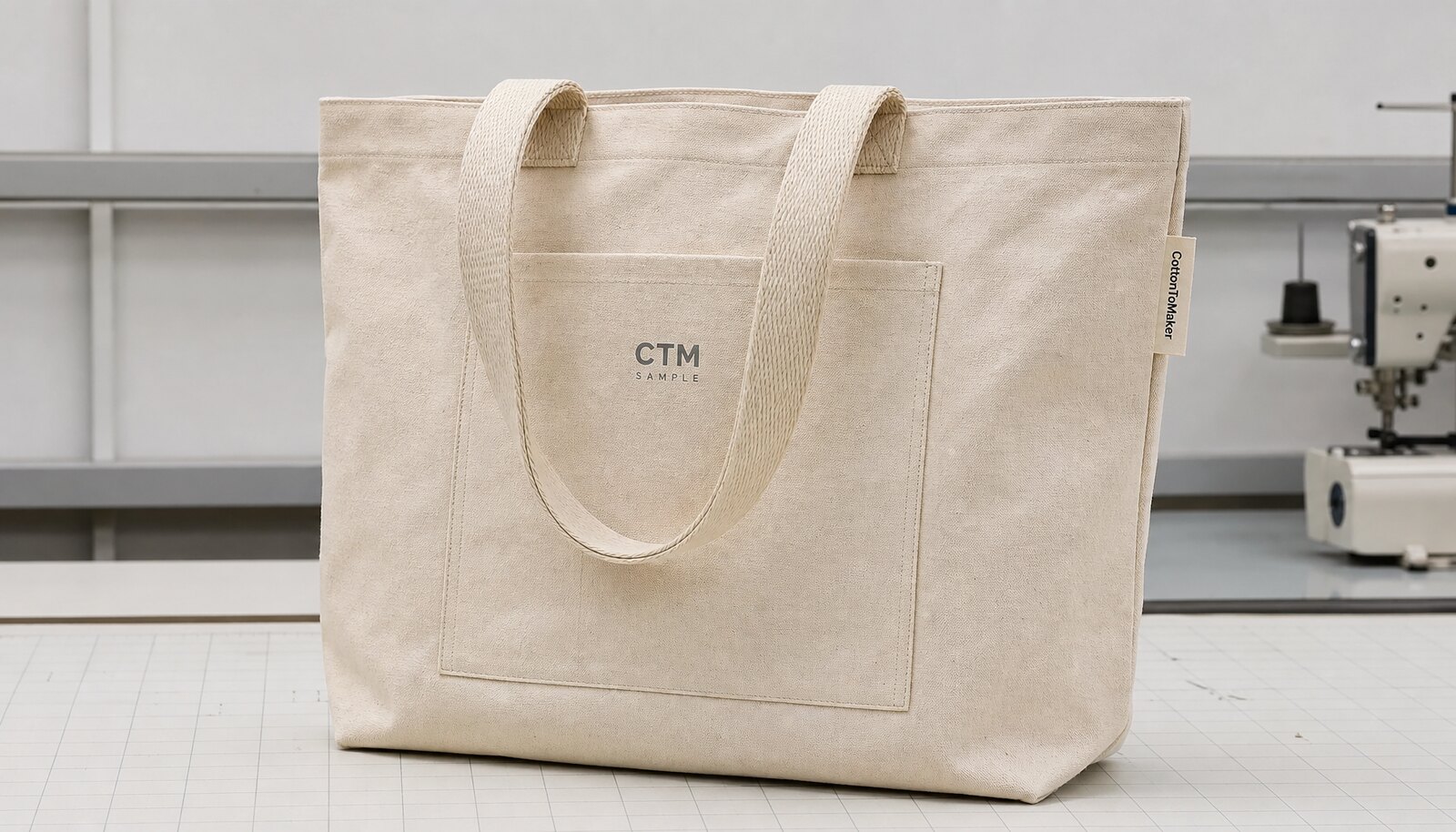
Why heavy canvas tote bags need a different bulk pricing plan for subscription boxes
A subscription box tote is not the same buying problem as a standard retail tote. In a box program, the bag has to survive fulfillment, look intentional when the customer opens the carton, and still land inside a target cost that leaves room for the contents, packing labor, and freight. That is why the pricing plan should be built around total landed cost and not only the factory unit price.
Heavy canvas changes the economics in a very specific way. Once you move from lighter promotional fabric into 12 oz, 14 oz, or 16 oz canvas, the tote starts behaving like a real reusable product rather than an insert. That improves perceived value, but it also increases fabric consumption, sewing time, and carton cube. Buyers who compare quotes without matching GSM, print area, and packing method usually end up with misleading numbers.
- Treat the tote as part of the box experience, not as a generic promo item.
- Compare quotes only after the supplier confirms the same fabric weight, size, and packaging format.
- Think in terms of landed cost per subscribed order, not just FOB unit price.
Fabric weight, handle build, and the look customers notice first
For subscription boxes, 12 oz canvas is often the practical starting point if the tote needs to feel substantial without pushing freight too hard. If the brand wants a sturdier hand and a more retail-ready feel, 14 oz is a common upgrade. Sixteen-ounce canvas can be excellent for premium programs, but it is usually justified only when the tote is a long-life carry bag, not just an insert.
The right handle construction matters as much as fabric weight. A heavy canvas bag with weak handle reinforcement fails the customer test quickly, especially when the box contains multiple items or when the tote is reused for daily errands. A 30–35 cm handle drop works well for most shoulder and hand carry use cases, but the buyer should confirm that the drop still fits the box dimensions and fold pattern.
- 12 oz: good balance of cost, body, and print clarity for most subscription programs.
- 14 oz: better for premium unboxing and repeat use after the box is opened.
- 16 oz: better suited to high-value retail bundles where the tote itself is a keepable item.
Print method choices that affect bulk pricing more than buyers expect
Screen print is usually the cleanest bulk option for simple logos because it keeps setup cost predictable and produces strong opacity on natural canvas. It is the first quote path I would compare when the design is one to three solid colors and the logo size is normal for a tote front panel. The tradeoff is that each added color or print location can raise setup and labor cost quickly.
If the brand wants a softer premium look, a woven label, sewn patch, or embossed side label can reduce the visual risk of print misregistration. Those methods often cost more per unit but can be easier to approve at scale when the artwork is small, detailed, or meant to look understated. For subscription boxes, the safest route is usually a simple one-side screen print plus a small sewn brand label, because that keeps both production and QC straightforward.
- Screen print: best for bold logos, simple typography, and larger runs.
- Woven label: useful when the brand wants a durable premium cue without large ink coverage.
- Sewn patch or embossing: good for understated branding, but sample approval should focus on placement and edge finish.
How MOQ really works when a tote is tied to a subscription program
MOQ is rarely one number. For heavy canvas totes, the factory may have a minimum on fabric color, another minimum on print color, and a third minimum on packaging configuration. A buyer comparing only the headline MOQ can miss the real constraint. For example, a supplier may quote a low total quantity but still require a higher minimum per artwork version or per dyed fabric lot.
The cleanest buying method is to keep the first production run simple. Choose one fabric color, one tote size, one print position, and one packaging method. If the subscription program needs multiple customer tiers, it is usually cheaper to control that difference with printed inserts or outer box graphics than to split the tote into too many SKUs on the first order.
- Simplify the first run to reduce setup cost and approval risk.
- Separate total program volume from MOQ by color or artwork version.
- Use one core tote spec across subscription tiers whenever possible.
Supplier comparison: direct factory, trading company, or local converter
For bulk pricing, the supplier route changes both price and control. A direct factory is usually the most efficient route when the buyer needs one accountable source for fabric cutting, sewing, printing, packing, and carton loading. That matters for subscription boxes because the bag often has to arrive folded a certain way and packed to a specific count per carton or per inner bag.
A trading company can be useful if the buyer needs multi-item consolidation or if the sourcing team lacks time to manage factory details. But the quote should clearly show where the factory is, who controls print setup, and who handles packing. A local converter can shorten communication time, but the unit price is often higher and the canvas specification may be less flexible. The right route depends on whether the program values low cost, speed, or hands-on control.
- Direct factory: best for repeat orders and controlled packing specs.
- Trading company: useful when buying multiple product types together, but responsibility can become blurry.
- Local converter: useful for speed or small test runs, but often less competitive on bulk pricing.
Decision table for sourcing routes and spec choices
The table below is the fastest way to compare practical buying routes for heavy canvas tote bags used in subscription boxes. It is not a spec sheet; it is a cost-and-risk comparison. Use it when you are shortlisting suppliers or reviewing quotes from different regions.
A good quote comparison should line up the same production assumptions. If one supplier prices 12 oz canvas with bulk packing and another prices 14 oz with polybagging and insert cards, the lower quote may not be the better quote. The value is in matching the use case, not in choosing the lowest number on the page.
- Write decisions in measurable language, not only descriptive wording.
- Ask for sample photos plus one physical approval sample for important orders.
- Keep quotation, sample approval, and inspection notes tied to the same spec version.
Bulk pricing drivers that move the quote up or down
The biggest price drivers are fabric weight, size, print coverage, and packing labor. Fabric weight affects raw material cost and the finished feel. Larger tote dimensions increase cloth consumption quickly because canvas is usually priced per yard or per kilogram at the factory level. Print coverage matters because a large solid area uses more ink, more press time, and sometimes more rejects during setup.
Packing is often underestimated. A tote that ships flat in bulk is less expensive to pack than one that needs individual polybags, barcode labels, and retail-ready fold directions. When the tote is inserted into a subscription box, the buyer should decide whether the factory or the fulfillment center handles the final fold. If the factory handles it, the quote should show packing labor separately so the buyer can compare it against in-house fulfillment cost.
- Fabric weight and cut size drive material consumption.
- Multi-color or oversized prints increase setup and reject risk.
- Individual packing can add meaningful labor cost even when the bag itself is simple.
Sample approval: what to inspect before mass production
A pre-production sample should not be judged only by appearance. The sample needs to prove that the fabric, stitch tension, handle length, and print placement all work together. For subscription box use, I would also fold the sample the way the fulfillment center plans to pack it, because some tote shapes look fine open but crease badly when packed flat.
The approval step should include close-up photos of the seam finish, handle reinforcement, print edges, and any label attachment. If the brand is picky about photography or unboxing presentation, compare sample photos under the same light and background. That reduces arguments later about shade, print contrast, or the hand feel of the canvas.
- Review the sample both open and folded to box size.
- Test the bag with the planned fill weight, not with an empty bag only.
- Approve photo evidence of stitching, print, and packing before bulk release.
Packing and carton planning for subscription fulfillment
Packing strategy affects both freight and fulfillment speed. If the tote is going directly into the subscription box, the factory should know the exact fold size and orientation so the bag lands flat and the logo faces the right direction after unboxing. If the bag ships as a separate insert, the buyer may want individual polybags, but only if dust protection or retail shelf presentation requires it.
Carton sizing should be part of the quote review. Too much void space wastes cubic freight and can deform handles and corners. Too tight a carton can crease the bag permanently or scuff the print. A practical approach is to request a packing spec that shows pieces per carton, carton dimensions, gross weight, and any inner bundle count. That makes it easier to compare factories and to plan the receiving labor at the warehouse.
- Define how the tote folds before the supplier quotes packing.
- Keep carton size close to product volume to reduce freight waste.
- Use label and bundle counts that the warehouse can scan and receive quickly.
Lead time risk and how to keep the schedule realistic
Lead time for heavy canvas totes is usually tied to fabric availability and print queue capacity. If the canvas color is standard and the print is simple, production can move faster. If the order needs dyed fabric, multiple print colors, or special packing, the schedule will stretch. Buyers should separate sample time, material prep, production time, and final inspection time instead of accepting one vague delivery promise.
The most common schedule mistake is approving artwork too late. Print changes after sample approval can push the order back more than a week in some factories because the supplier may need to reset screens or adjust label placement. A clean approval chain is faster than chasing an urgent freight plan after the tote is already in production.
- Build time for sample review into the schedule before the PO is released.
- Assume dyed or custom fabric will extend the timeline.
- Freeze artwork and packing details before mass production starts.
Specification comparison for buyers
| Spec decision | Recommended option | When it fits | Buyer risk to check |
|---|---|---|---|
| Fabric weight | 12 oz to 14 oz canvas for premium subscription inserts | When the tote is part of the unboxing experience and must hold 4–8 kg without looking flimsy | Too-light fabric can wrinkle badly and cheapen the box; too-heavy fabric raises freight and carton cube |
| Supplier route | Direct factory with in-house cutting, stitching, printing, and packing | When the buyer needs lower total cost and repeatable bulk pricing across reorder cycles | Outsourced printing or packing creates weak control over shade, alignment, and pack counts |
| Print method | Screen print for simple logos, woven label or sewn patch for premium brand finish | When artwork is one to three solid colors and the brand needs consistency at scale | Fine gradients, tiny text, or low-contrast colors can fail visual approval or wash resistance |
| Handle construction | Cross-stitch or box-x reinforcement with 30–35 cm drop | When the tote is intended for daily retail use after the subscription box is opened | Short handles reduce usability; weak handle reinforcement causes early failure in fill testing |
| MOQ strategy | Start with a print-set-up-friendly MOQ by color and artwork, not by total carton count alone | When the buyer wants one SKU with controlled customization and a test run before scale-up | A low total MOQ can hide high MOQs per size, fabric color, or print color |
| Packing format | Flat packed with bulk insert sheets or single polybag only if retail presentation requires it | When the fulfillment center needs fast carton loading and low cube | Overpacking adds cost and delays; underpacking can create dust, creasing, and print rub risk |
| Color choice | Natural, black, or one house color with proven dye lot control | When the brand wants clean photography and lower shade variance | Special dyed colors may require lab dips and raise minimums and lead time |
| Carton planning | Master carton sized to protect tote corners and reduce void space | When freight cost and warehouse handling matter more than gift-style presentation | Oversized cartons waste cubic freight; under-sized cartons crush seams and handles |
| Sourcing route | Factory-direct with pre-production sample and inline inspection | When the buyer wants one accountable seller for spec, packing, and shipment | Trading layers can obscure responsibility if sewing or print defects appear after approval |
Buyer checklist before sampling
- Confirm canvas weight in oz or GSM, not just the words heavy canvas, and align it with the load and hand feel you want.
- Specify tote dimensions, handle length/drop, seam reinforcement, and whether the bag must stand upright in a subscription box.
- Lock the print method, artwork size, number of colors, and acceptable alignment tolerance before price comparison.
- State packing format, carton count, carton dimensions target, and whether the bag goes into the subscription box or ships as a separate insert.
- Request a pre-production sample, a photo sample of bulk packing, and written QC acceptance criteria for fabric, print, and sewing.
- Compare supplier quotes on the same basis: same fabric weight, same print area, same packing, same incoterm, same carton loading assumptions.
Factory quote questions to send
- What exact canvas weight will you quote in oz and GSM, and is that weight before or after washing or finishing?
- Is the print cost based on one color, one side, and one setup, and what changes the price if artwork has multiple colors or larger coverage?
- What is your MOQ by fabric color, print color, and style, and which part of the MOQ is driven by material sourcing versus machine setup?
- What packing method is included in the quote: bulk, polybag, insert card, barcode sticker, or carton assortment?
- Can you show a sample approval process with seam photos, print close-ups, and carton packing photos before mass production?
- What lead time applies after sample approval, and what typically adds delay: fabric dyeing, printing queue, or external packing?
- How do you handle overrun or shortage tolerance, and how should the buyer expect the final shipped quantity to vary from the PO?
- What defect rate do you use for inspection on stitching, print registration, stains, loose threads, and handle strength?
Quality-control points to confirm
- Fabric weight tolerance should be defined before production, with a practical buyer range such as plus or minus 5 to 8 percent on the finished canvas weight.
- Handle stitching must use even box-x or bar-tack reinforcement, with no skipped stitches and no loose ends at stress points.
- Print placement should stay within a tight visual tolerance relative to the bag centerline and top edge; misaligned logos are easy to spot in box opening.
- Seams should be straight, with no puckering at corners, no exposed raw edges inside the tote, and no seam slippage under hand pull.
- Surface cleanliness matters because subscription box totes are often photographed; reject oil stains, dye marks, and heavy lint on natural canvas.
- Carton packing should protect handles and corners from crush; carton count must match the packing list exactly, with clear bundle labeling.
- Drop test and load test criteria should be agreed in advance for sample approval, especially if the tote will carry a curated box weight plus customer reuse.
- If the tote is folded into the subscription box, the fold line should not distort the print, badge, or side seam after unpacking.