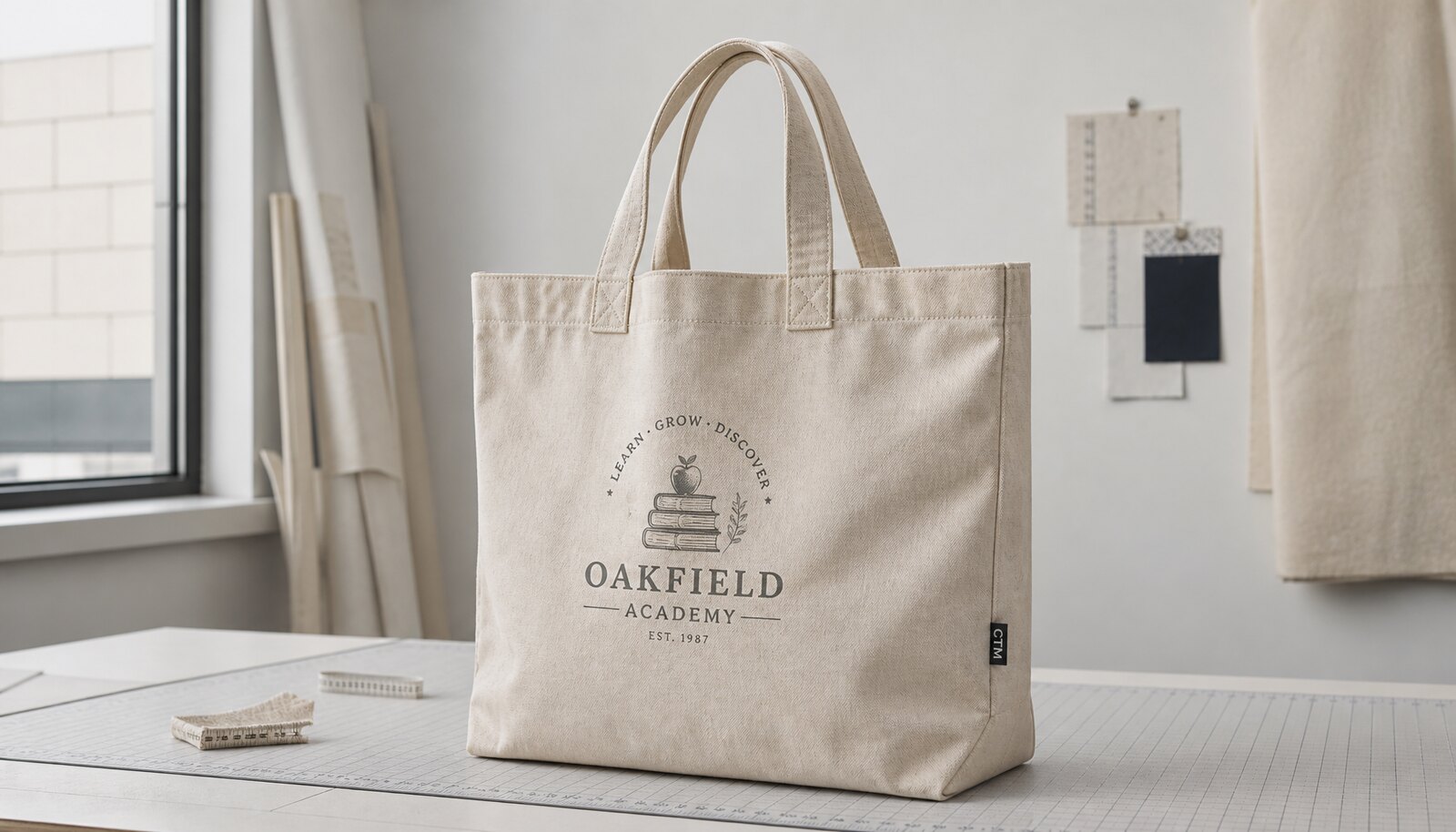
1. Start with the school retail use case, not the tote bag generic spec
Heavy canvas tote bags for school retail should be bought as retail products first and fabric goods second. That sounds obvious, but many sourcing issues start when teams request a generic tote quote and only later decide whether the bag is going to a campus bookstore, school spirit shop, online merch store, or orientation pack. Those channels do not need the same finish, packing, or artwork strategy. A bag sold at a bookstore counter needs to look clean from arm’s length and hold its shape on a shelf. A bag inserted into a welcome pack may prioritize low pack volume and simple branding. An e-commerce item needs stronger packing and more consistent carton labeling.
The buyer brief should name the launch channel and the customer’s expected use. Will students carry books every day, or is the tote more of a merch item for events and gifting? If the answer is daily use, then handle reinforcement, seam strength, and gusset depth matter more than decorative extras. If the product is mostly retail merchandise, front-facing graphics, shelf shape, and barcode-ready packing matter more than extreme load capacity. The wrong assumption leads to the wrong bag, even when the sample looks acceptable in a sample room.
For school programs, it also helps to define the SKU architecture before the first RFQ. A base construction that can support multiple school names or mascots is usually better than creating a new bag style for every campus. That keeps cutting, sewing, and packing consistent, while allowing artwork changes where the market actually needs variety.
- State the exact channel: bookstore shelf, campus retail, e-commerce, event merch, or welcome kit.
- Define the use case: daily carry, light merch, or mixed school items.
- Fix the SKU strategy before quoting: one base bag with artwork variants is usually easier to control.
- Do not let the supplier define the use case for you; the use case should drive the construction.
2. Choose fabric weight by structure, not by habit
For school retail, heavy canvas usually sits in the 12 oz to 16 oz range, but the useful question is not simply whether it is “heavy.” The real question is how the cloth behaves once the bag is cut, sewn, folded, and loaded. A 10 oz canvas can be acceptable for lightweight merchandising, but it often feels too soft for a bag expected to sit upright on shelf or carry books. A 14 oz or 16 oz fabric gives a more substantial handfeel and better body, but it can also slow sewing, change seam bulk, and push costs up if the pattern is not adjusted.
Buyers should ask for the fabric specification in more than one way. Request the oz or GSM, the weave type, yarn count if available, and whether the quoted number is before or after finishing. Washed canvas, dyed canvas, and bleached canvas can all feel different at the same nominal weight. The difference matters because schools often care about appearance consistency across a launch season. If the bag is washed, it may feel softer and look more premium, but the buyer should also check size change after finishing, shade variation, and whether the supplier is quoting pre-wash or post-wash measurements.
A practical benchmark for school retail is to compare the fabric against the load the bag will actually carry. If the tote needs to hold books, bottles, and a notebook, then a lighter cloth may sag too much. If the tote is purely a retail fashion item, a slightly softer body can still be fine. The key is to match structure to use, not to assume heavier is always better.
- 12 oz: a lower-cost entry point for light school merch or small-event runs.
- 14 oz: a useful middle ground for retail launches needing better shape and daily utility.
- 16 oz: suitable when the bag should feel sturdier, hold its form, or carry heavier school loads.
- Always confirm whether the fabric weight is before washing, after washing, or after final finishing.
3. Lock the dimensions and construction details that affect shelf appeal and daily use
The finished size is one of the most under-specified parts of a tote bag quote. For school retail, common launch sizes are around 13 x 15 in, 14 x 16 in, or 15 x 17 in, usually with a 3 to 5 in gusset when the bag needs to carry books or boxed items. Those numbers are not decorative; they influence how the bag opens, how it sits on a shelf, and whether the customer can actually use it. If the opening is too narrow, the tote feels awkward. If the gusset is too shallow, the bag collapses when filled.
Handle size needs equal attention. A handle that is too short can make the tote feel cheap or uncomfortable on the shoulder. A handle that is too narrow can cut into the hand when the bag is loaded. For many school retail bags, self-fabric handles give a tidy premium look, while webbing handles are often more consistent and more comfortable at higher loads. Either can work, but the buyer should specify handle length, handle width, and the reinforcement method instead of leaving those decisions open.
The construction spec should also name the top hem width, side seam type, bottom seam finish, and any internal binding or raw-edge treatment. Those details are important because heavy canvas holds stitch tension differently from lighter cotton. If the factory changes the seam allowance or reinforcement without telling you, the bag can twist, buckle, or wear unevenly at the load points. Good procurement practice is to convert those construction choices into measurable line items in the tech pack.
- Define finished dimensions in inches or centimeters and include tolerance ranges.
- State gusset depth if the bag must hold books, bottles, or boxed stationery.
- Specify handle length, handle width, and handle drop so the carrying comfort is predictable.
- Require a simple technical sketch showing seam allowances and reinforcement points.
- Ask whether the top edge is turned and hemmed, bound, or faced; it affects both appearance and durability.
4. Compare decoration methods by durability, legibility, and cost-to-reorder
School retail buyers often focus on the logo first, but the decoration method should be chosen for the product’s actual life cycle. Screen print is still the most practical option for simple school names, mascots, and bold two-color graphics because it gives strong coverage on canvas and usually scales well for repeat orders. It is also easier to quote consistently when the artwork is stable. For seasonal or multi-school programs, that predictability matters.
Heat transfer can be useful when the artwork includes small type, fine lines, or more colors than screen printing can comfortably handle. But transfer should not be approved on convenience alone. Buyers need to inspect edge sharpness, film handfeel, and whether the decoration survives rub testing and folding. A transfer that looks good in a flat sample may still crack, edge-lift, or feel too plastic after shipping and retail handling.
Embroidery can create a premium impression, but on heavy canvas it adds stitch bulk and cost. It also changes the feel of the panel and may distort the fabric if the design is large. Woven or sewn labels are useful for subtle branding and can elevate a simple bag, but they usually work best as a supporting detail rather than the only visible brand element. For a school retail launch, a common strong combination is front print plus a clean woven side label or sewn label.
The right method is not the one with the most decoration options. It is the one that matches the school’s brand style, the order volume, and the acceptable return risk. A simple, well-placed screen print often outperforms a more ambitious decoration plan that is harder to keep consistent in bulk.
- Screen print: strongest choice for bold logos, simple mascot art, and repeat-order economics.
- Heat transfer: useful for complex artwork, but verify film feel and rub performance.
- Embroidery: premium looking, but higher cost and more bulk on thick canvas.
- Woven label: good for brand identity, but usually not enough as the only front-facing decoration.
5. Use a decision-grade comparison table and stop quoting on broad descriptions
A procurement buyer needs more than a yes/no answer on fabric or print. The supplier comparison should let you evaluate which option is actually safer for launch. That means asking for measurable parameters: fabric weight, size, seam type, reinforcement method, pack format, and the unit cost items behind the quote. A broad statement like “good quality heavy canvas bag” is not decision-grade. It does not tell you whether the bag will survive books, pack cleanly, or hold a sharp retail shape.
The best RFQs behave like mini tech packs. They identify the base construction and allow controlled variation only where it is intentional. For example, one supplier may quote a lower piece price but include a larger setup fee for printing and a higher carton cost because the bag is packed loosely. Another supplier may have a slightly higher sewn cost but lower total landed cost because the bags are folded well, cartonized efficiently, and labeled correctly for the DC. That is why the comparison table matters: it turns vague claims into comparable fields.
When you review supplier quotes, line up every cost element side by side. Fabric, sewing, print setup, label, packing, inland handling, sample charges, and possible overrun/under-run allowances all belong in the same sheet. If you leave out a line item, you are not comparing suppliers; you are comparing incomplete offers.
- Ask for a quote template that separates material, labor, decoration, packing, and logistics.
- Require the supplier to state whether setup fees are one-time or per SKU.
- Compare prices only after normalizing fabric weight, size, and packing format.
- Treat carton efficiency as part of the buying decision, not a warehouse afterthought.
6. Read MOQ, setup fees, and SKU strategy as one commercial problem
In school retail, MOQ is rarely just a factory minimum. It is also a portfolio decision. A buyer may need different school names, mascots, colorways, or event versions, but every variation increases complexity. The cheapest path is usually to keep one base bag construction and vary only the artwork or label where demand justifies it. That keeps production repeatable and reduces the chance of one small variation causing a costly line change.
You should ask for MOQ by color, by artwork version, and by packaging configuration, because those are often different limits. A supplier may be comfortable sewing the same tote in multiple school versions, but charge extra every time a new screen is made or a new barcode sticker is required. Another supplier may give a lower sewing MOQ but require a higher carton pack quantity than your distribution center wants. Those differences change the actual economics more than a few cents on the sewn bag itself.
The procurement goal is not the lowest MOQ at any cost. It is the minimum order that still creates a workable unit price and a clean launch. If the order is too small, setup costs dominate and the bag becomes expensive. If the order is too large, inventory risk rises and you may be stuck with school-specific merchandise that is hard to roll forward. The right balance depends on demand confidence, campus calendar timing, and whether the product can be reused in the next season without artwork changes.
- Keep one core construction and vary artwork only when possible.
- Ask for separate MOQs for color, print, and packing.
- Check whether screen setup, plate charges, or label changes are billed per version.
- Avoid building a launch around too many low-volume variants.
7. Break down landed cost before you compare factories or trading companies
A useful quote for heavy canvas tote bags should show enough detail to calculate landed cost, not just factory price. That means the buyer needs to see material, sewing, decoration, packaging, sample fees, export preparation, and any inland freight or handling that sits before shipment. If a supplier only gives one line price, there is no way to know whether the quote is efficient or simply incomplete. For school retail, that matters because launch timing is often fixed to the start of term, orientation week, or a bookstore reset.
The lowest unit price can be misleading. A cheaper bag may need more receiving labor because it is packed loosely or marked poorly. A slightly more expensive bag may save time because each unit is barcoded, fold-packed correctly, and carton-identified by style and color. Those downstream costs belong in the evaluation. Buyers should also ask how sample fees are treated: are they credited later, and under what conditions? If not, the sample budget should be considered part of launch cost.
To verify claims, ask the supplier for a line-by-line quotation and a photo of the exact packing method they plan to use. If a supplier says the bag will “look premium” or “hold its shape,” ask what construction or packing choice creates that result. Shelf appearance is not a magic feature; it is usually the outcome of fabric weight, gusset depth, fold method, and carton discipline. The more specific the supplier is, the easier it is to validate the claim.
- Compare all quotes on the same basis: fabric, sewing, decoration, packing, and handoff terms.
- Ask whether tax, export packing, and inland freight are included or excluded.
- Request a carton estimate before approval so you can calculate warehouse impact.
- Treat sample fees, plate fees, and artwork changes as part of the launch budget.
- Do not accept a premium-feel claim without asking which material and packing choices create it.
8. Choose the sourcing route that matches your control needs
School retail buyers usually have three practical sourcing routes: direct factory, trading company, or hybrid supplier with outsourced decoration. Direct factory sourcing is often the strongest option when the product needs repeatability and close control over sewing, print, and packing. It reduces handoffs and makes it easier to ask for a pre-production sample from the same line that will run the bulk order. That can matter a lot when the launch has a fixed start date and the store needs a reliable delivery.
Trading companies can still be useful, especially when the buyer is coordinating multiple school versions or does not have the bandwidth to manage several factories. The trade-off is less transparency into where the bag is actually made and how much margin is being added. That does not automatically make the route bad; it just means the buyer should insist on the same technical documentation, sample approval rules, and QC evidence that a factory would provide.
Hybrid models can move quickly, but they require careful ownership mapping. Who is responsible for print quality? Who controls the sewing line? Who signs off on packing? If those roles are blurred, the buyer can end up with one party blaming another when the sample differs from the bulk production. For a retail launch, the simplest structure is usually the safest: one named party owns the bag construction, one party owns decoration, and one person on the buyer side owns final approval.
- Direct factory: best for repeatability and stronger process control.
- Trading company: useful for coordination, but verify the actual production source.
- Hybrid route: workable if responsibilities for sewing, printing, and packing are written down.
- Always request photos or videos from the same production process you are quoting.
9. Approve samples like a launch manager, not like a style shopper
A sample for a school tote should prove that the product can be made repeatedly, packed cleanly, and sold without obvious complaints. That means the review must go beyond “looks good.” Measure the bag, inspect the seams, check the reinforcement, confirm the label placement, and load the bag with actual school-use items. A sample that photographs well but distorts when filled is not ready for production. Likewise, a clean-looking sample with weak handle joins is a future return.
A sound approval process usually has two stages. First, the initial sample confirms the shape, dimensions, and decoration plan. Second, the pre-production sample confirms the final materials and actual production method. The second step is the important one because it reduces the gap between what was approved and what the factory will really build. If the factory makes the sample by hand in the sample room but runs the bulk on a different line or with different finishing, you have not truly approved the production bag yet.
To verify claims, ask for the pre-production sample from the actual line if possible, plus a photo set showing front, back, side seam, handle anchor, inside finish, and packed carton sample. If the supplier cannot show a sample plan clearly, that is a warning sign. A good supplier can explain what changed from sample to bulk and why. A weak one usually avoids details until the shipment is already moving.
- Test the sample with notebooks, a bottle, and a pencil case to simulate real school use.
- Measure handle drop, opening width, and gusset depth against the approved tech pack.
- Inspect print rub after folding, unpacking, and light handling.
- Approve only after the pre-production sample matches the bulk method and not just the appearance.
10. Pack for retail and distribution, not just for shipping
Packing decisions can change the actual retail value of the bag. A heavy canvas tote that arrives with the logo creased, the barcode unreadable, or the SKU sticker in the wrong place creates extra work at receiving and can weaken shelf presentation. For school retail, a clean packing plan should define the fold direction, the inner pack count, the barcode placement, and the master carton marking. The supplier should not decide these details casually at the end of production.
One-per-polybag is common for retail programs, but the buyer should also specify how the tote is folded inside the bag. If the front graphic is folded sharply, the first customer who opens it may see a crease through the brand mark. If the bag is folded too loosely, the carton cube becomes inefficient and freight cost rises. There is a balance between presentation and carton utilization, and the buyer should ask for a sample fold before bulk packing starts.
Master cartons should be easy for the warehouse to identify by style, color, and quantity. This is especially important when a school launch includes multiple versions that look similar but are not interchangeable. Barcode labels should be tested for scan readability. Carton gross weight should remain practical for handling and should not be so heavy that warehouse staff struggle with receiving or shelf replenishment.
- Specify fold direction so the logo faces correctly when unpacked.
- Use one barcode label format across the launch unless the DC requests otherwise.
- Confirm carton quantity, carton dimensions, and gross weight before production.
- Ask the factory for a packed sample so you can check crease position and shelf appearance.
Specification comparison for buyers
| Spec decision | Decision-grade recommendation | When it fits | Buyer risk to check |
|---|---|---|---|
| Fabric weight | 12 oz to 16 oz finished canvas; request the weight in oz or GSM and clarify whether it is measured before or after washing/finishing | School retail launches that need a more structured shelf presence, lower complaint risk on handles, and enough body to hold books or stationery | Weight wording is often loose in quotes; ask for mill test method, finished fabric weight, and roll-to-roll tolerance so a supplier cannot quote one grade and deliver another |
| Finished size | Common school retail formats: 13 x 15 in, 14 x 16 in, or 15 x 17 in; add 3 to 5 in gusset if books or boxed goods must fit | When the tote is sold as a campus store item, bookstore add-on, orientation pack item, or student daily carry bag | If the opening is too narrow or the gusset too shallow, the bag looks good empty but fails in real use; require a measurement tolerance of about +/- 0.25 in on key dimensions |
| Handle construction | Self-fabric handles for a clean premium look, or webbing handles for better comfort and consistency; reinforce with bar-tacks or X-box stitching | When the bag must hold heavier school items and still survive repeated daily use | Short reinforcement or weak stitch density is a common failure point; specify stitch count, bar-tack length, and thread type in the tech pack |
| Print method | Screen print for bold logos and simple school graphics; heat transfer only for complex art or very small type; embroidery only if the budget supports it | When the launch needs a strong front-of-shelf graphic and repeatable seasonal reorder economics | Complex art can lose detail on thick canvas; ask for print rub testing, cure method, and placement tolerance before bulk approval |
| Branding mix | Front print plus woven side label or sewn label; keep decoration simple and recognizable | When the tote must look retail-ready rather than promotional | Too many decoration elements raise cost and create more rejection points; confirm label placement does not distort the bag opening or handle seam |
| MOQ strategy | Keep one base construction and vary artwork or colorway only when demand is proven | Multi-school launches, campus store assortments, or seasonal retail rollouts | Low MOQ on paper can hide setup fees; compare total cost including screen setup, sample charges, packing changes, and carton labeling |
| Packing format | One bag per polybag, barcode label, size/style sticker, and master carton by SKU | Retail stores, distribution centers, and e-commerce fulfillment | Loose packing causes scuffing, counting errors, and delayed receiving; confirm inner pack count, master carton dimensions, and gross weight |
| QC approach | AQL plus functional testing: seam pull, handle load, print rub, size check, and carton audit | Retail launches where returns, store rejects, or online complaints would be expensive | A visual-only inspection misses load-bearing failures; define pass/fail thresholds before production starts |
| Sourcing model | Sample-first production with pre-production approval before bulk cutting | First-time factory relationships or new school retail launches with fixed delivery dates | Skipping pre-production approval makes size, logo placement, and reinforcement mistakes expensive to correct in bulk |
Buyer checklist before sampling
- Lock the base spec: fabric weight, finished size, gusset depth, handle length, handle width, and whether the canvas is natural, dyed, bleached, or washed.
- Define exact tolerances for the critical dimensions; do not accept a quote unless the supplier states the acceptable variation for size, stitching, and print placement.
- Prepare one vector artwork file and specify Pantone references, print size, print location from the top edge and side seam, and any no-print zones near the seams.
- Ask for stitch details in the quote: seam type, stitch density, reinforcement at handle joins, and whether the factory uses bar-tacks, X-box stitching, or both.
- Decide whether the launch needs retail-ready packing: one-per-polybag, barcode sticker, hangtag, desiccant, carton marks, and master carton labeling.
- Request the same quote fields from every supplier: fabric grade, construction, decoration, packing, sample fee, MOQ, lead time, and shipping handoff terms.
- Ask for a pre-production sample or first-piece photo approval before bulk cutting starts.
- Request sample testing on the actual production material, not just a hand-made sample-room version.
- Review landed cost, not just unit price; include setup charges, packing upgrades, inland freight, export handling, and any charge for artwork revisions.
- Plan the launch assortment before quoting: one core SKU, one backup color or artwork version, and a clear rule for what can vary without a new development cycle.
Factory quote questions to send
- What is the exact fabric weight you are quoting, and is it measured before or after washing, dyeing, or finishing?
- What is the weave, yarn count, and finish of the canvas, and can you share the material spec or roll test result?
- What are the finished dimensions, gusset depth, handle length, handle width, and acceptable tolerance range?
- What stitch type do you use at the side seams and handle anchors, and how many bar-tacks or reinforcement points are included?
- What is included in the unit price: print setup, screen charges, label, polybag, barcode sticker, carton packing, and palletizing if needed?
- What is the MOQ by color, by artwork version, and by packaging configuration?
- Can you separate sample lead time, pre-production sample time, bulk production time, and shipping handoff time?
- Which print method do you recommend for this artwork, and what are the setup charges, color-change fees, and reprint charges if the sample is rejected?
- What inspection standard do you use before shipment, and can you share your AQL level plus the internal QC checklist?
- How do you fold and pack the tote, and what are the estimated inner pack count, carton dimensions, and gross weight?
Quality-control points to confirm
- Fabric weight verification: request a measured result from the production roll or batch, not only a catalog claim. If the quote says 12 oz, require an acceptable range in the tech pack and reject material that is visibly underweight or too loose in weave density.
- Finished size: measure at least 10 units from a pilot run for length, height, and gusset depth. A practical launch tolerance is often around +/- 0.25 in for key dimensions, unless your retail program allows a wider range.
- Handle strength: check for consistent reinforcement at both anchor points. Look for symmetrical bar-tacks, no skipped stitches, no loose thread ends, and no puckering that signals uneven tension.
- Stitch quality: inspect seam density, seam straightness, and thread trimming. Define a visible defect threshold in advance; any open seam, skipped stitch line, or split at a load point should fail.
- Load test: fill the bag with a realistic school load such as two notebooks, a water bottle, a pencil case, and a light folder. The bag should hold the load without handle slippage, seam opening, or severe top-edge distortion.
- Print placement: measure print distance from the top edge and side seam. The logo should stay inside the approved print window and should not drift into the seam allowance, gusset fold, or handle anchor area.
- Print durability: run a dry and wet rub check on the sample, then inspect for cracking, smearing, or color transfer. If the bag is supposed to be reusable, the decoration should not shed visibly during normal handling.
- Color consistency: compare fabric body, print ink, and label color under daylight and warehouse light. Reject obvious shade mismatch between sample and bulk lot, especially on natural canvas where dye and ink can vary.
- Packing accuracy: verify inner pack count, SKU label, barcode readability, and carton marks. A receiving team should be able to scan and count the shipment without opening every carton.
- Carton integrity: confirm the master carton can protect shape and print without crushing the handles or creasing the front panel. Define carton gross weight and keep it practical for warehouse handling.