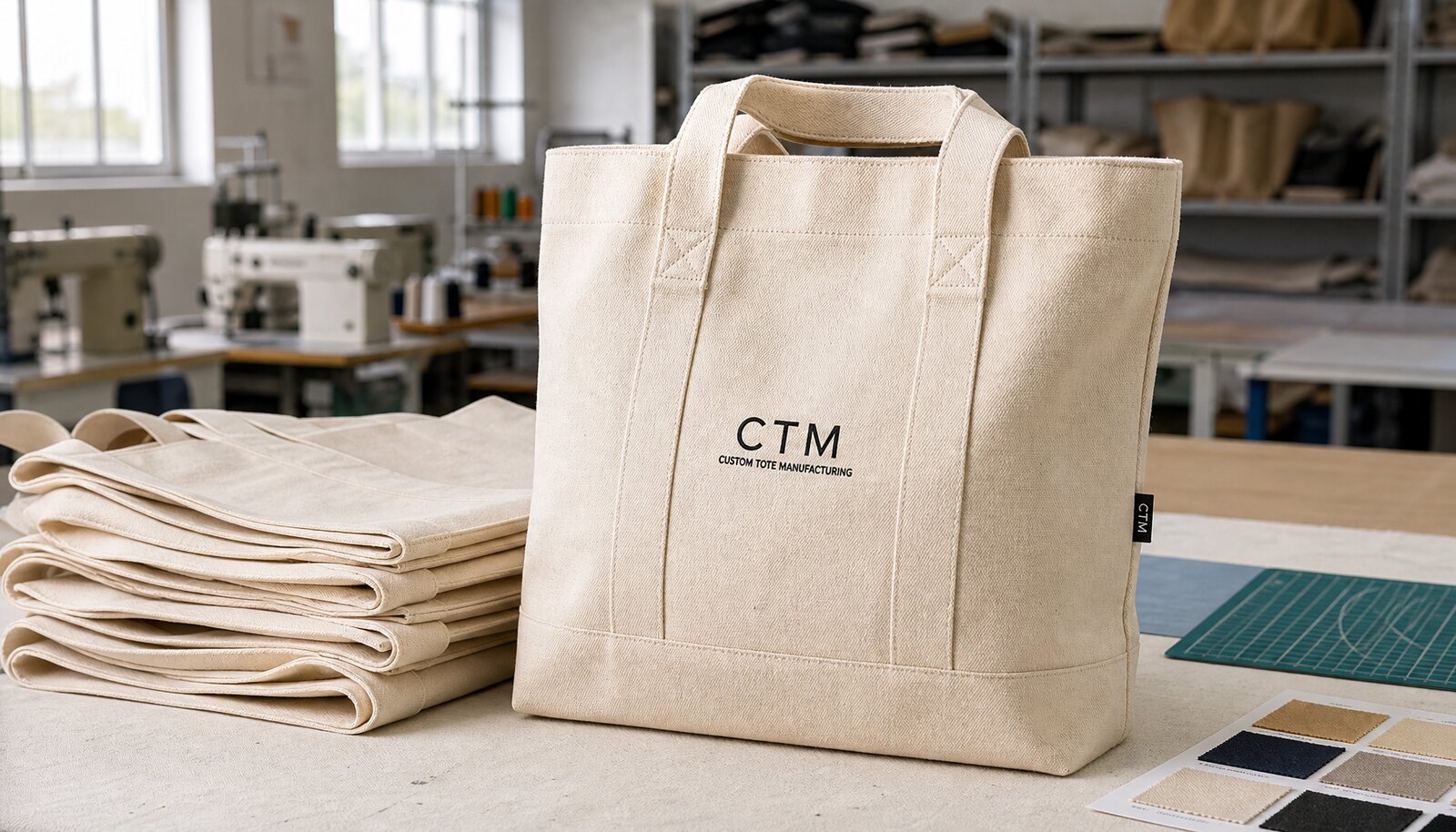
1) Why school totes need a different sourcing plan
A school tote is not a generic canvas bag with a logo on it. It is a utility product that gets loaded, folded, dragged, handed from child to parent, and stored in crowded classroom or home spaces. That means the sourcing brief has to start with the actual use case, not the design file. If the tote is for books and binders, the bag needs body, handle strength, and stable dimensions. If it is for fundraising or parent retail, the same bag also needs a clean finish, dependable branding, and repeatable pack-out.
Private label sourcing gets risky when buyers treat the product like a simple print order. Heavy canvas tote bags for schools involve material sourcing, cut-and-sew quality, label placement, carton control, and freight planning. The commercial mistake is to optimize only for headline unit price. Procurement should instead ask: what is the total landed cost, what quality can we actually hold over repeat orders, and how much control do we need over the bulk production line?
A good sourcing plan also needs to match the school calendar. Orientation packs, open days, fundraising events, and term launches usually have fixed deadlines. If artwork is late or sample approval is not locked early, the cheapest quote can still become the most expensive order because air freight, rework, or launch delays erase the margin. That is why this guide focuses on the spec first, then supplier type, then QC and landed cost. Each step reduces a different risk.
- Use-case first: books, lunch, staff packs, retail, or fundraising each demand different construction and packing.
- Heavy canvas feels simple, but the real risk sits in handles, seams, print durability, and packing discipline.
- For school programs, repeatability matters as much as appearance because the bag may be reordered each term or academic year.
2) Build the spec before you request prices
The RFQ should describe the tote in procurement language, not marketing language. Start with finished dimensions: width, height, and gusset depth. Then define handle length and handle drop, because these dimensions affect comfort and carrying capacity. If the bag must fit A4 folders, exercise books, or a tablet sleeve, say so explicitly. Suppliers price faster and more accurately when they can see the end use.
For heavy canvas tote bags for schools, fabric weight is a key buying decision, but it should not be the only one. A 14 oz bag with weak seams may perform worse than a 12 oz bag with better reinforcement and smarter construction. Buyers should ask for both oz and GSM because suppliers in different markets may quote either system. If the bag will be reordered, ask whether the fabric is pre-shrunk or whether the factory expects natural shrinkage after finishing. That answer affects the final dimensions and the reorder consistency.
Construction details are where many private label programs go vague. Spell out whether the handles are self-fabric or webbing, whether the side seams are single-needle or double-needle, whether the bottom uses a flat seam or boxed corners, and whether reinforcement patches are required at the handle join. These are not optional details; they directly affect durability and the perceived quality of the bag. A buyer who writes them into the RFQ will get cleaner quotes and fewer sample surprises.
The spec should also cover branding placement and packaging. A school logo centered 30 mm higher or lower may look acceptable to a casual eye, but it can be a problem if you are building a retail line with repeat packaging. Likewise, flat-packed bulk cartons are cheaper than retail-ready units, but if the bags are headed to a school shop or distributor shelf, you may need polybags, hangtags, or barcode labels. Put those requirements in the quote request before the supplier starts pricing.
3) Fabric choices: what to buy, what to avoid, and how to compare claims
Heavy canvas can be specified in oz, GSM, weave density, and fiber blend, and suppliers do not always describe these the same way. Procurement should insist on a clear measurement basis. If a supplier says “16 oz,” ask whether that is the greige fabric, finished fabric, or post-wash weight. If they only provide a marketing description, ask for a swatch or a finished sample with the same dye, wash, and print process you plan to order. Otherwise, the unit price may be based on a lighter or less stable cloth than the one you thought you were buying.
For most school-use private label programs, 14 oz / roughly 400 GSM is a practical middle point. It usually has enough body for books and folders without feeling overly stiff. If the tote will carry heavier items or needs a more premium shelf presence, 16 oz / roughly 450 GSM may be a better fit. At the lighter end, 12 oz / roughly 340 GSM can work for event packs, merch, and low-load school use, but it can show sag and seam strain more quickly. These are not universal rules; they are procurement starting points that should be checked against the load case.
Cotton canvas is usually the best default for a school product because it communicates quality and can accept print well. Recycled cotton may fit sustainability programs, but buyers should ask about shade variation and fiber consistency because recycled input can be less uniform. Cotton-poly blends can improve dimensional stability or reduce cost, but they may change print hand-feel and how the tote is perceived by school buyers or parents. If your customer expects a natural premium look, the blend should be approved with a physical sample, not only a spec sheet.
Do not forget fabric finish. Bleached, dyed, washed, and enzyme-finished canvas can behave differently in bulk. A washed finish may soften the hand but also change shrinkage and color depth. If you are comparing two suppliers, ask for the same finish basis and confirm that the fabric seen in the sample is the same as the fabric intended for the bulk order. If one supplier is quoting on stock natural canvas and another is quoting on custom-dyed material, the quotes are not comparable until the fabric basis is aligned.
- 14 oz / about 400 GSM is a common starting point for school-use tote programs.
- Ask for the measurement basis for fabric weight: greige, finished, or post-wash.
- Compare like for like: same fiber blend, same finish, same print method, same size.
- Request a swatch or finished sample if the supplier’s description is vague or unusually favorable.
4) Print, label, and branding choices for private label school bags
For school bags, the branding method should follow the artwork and the usage pattern. Simple one-color school crests, club marks, or brand names usually belong on screen print because it is cost-efficient and durable when properly cured. If the design has fine lines, small text, or multiple colors, ask for a strike-off and print test before bulk approval. Buyers should not assume a digital proof proves the final result; the final result depends on the canvas texture, ink system, and curing process.
Heat transfer can work well for complex art in smaller quantities, but it should be tested for fold lines, abrasion, and edge lift. Heavy canvas has texture, and a transfer that looks perfect on a flat proof may not survive classroom handling or repeated folding. If the brand wants a premium but discreet look, a woven label or sewn side label is often more reliable than overcomplicating the front print. Some programs use a small front print plus a side label, which gives the school or parent buyer both brand visibility and a cleaner aesthetic.
Embroidery can create a premium impression, but on dense canvas it can add cost and introduce distortion if the fabric is too light or the stitch density is too high. If embroidery is considered, ask the supplier to show a stitched sample with the same canvas weight before you commit. In many school tote programs, embroidery is better for small marks or emblems than for large panels. If the logo must remain crisp at distance, screen printing may still be the better choice.
Private label buyers should also think about label hierarchy. A front logo, a side seam label, an inner care label, and a carton barcode each serve different purposes. Do not let the supplier mix them up. The care label should match the market’s legal and retailer requirements, the brand label should be positioned consistently, and carton marking should support receiving. When these elements are written into the PO, suppliers are less likely to improvise during production.
5) MOQ, setup charges, and how to compare real unit economics
MOQ is not a random factory preference; it is usually the point where the factory can buy fabric, allocate cutting time, and absorb printing or label setup without losing money. For a standard school tote made from stock canvas, a direct factory may quote an MOQ in the low hundreds. Once you add custom size, special dyeing, multiple labels, or complex printing, the MOQ can move into the low thousands. Buyers should treat MOQ as a function of material and setup complexity rather than as a fixed industry rule.
To compare quotes properly, split the offer into three layers. First, the one-time setup layer: artwork cleanup, screen or plate charges, sample fees, and label setup. Second, the recurring product layer: fabric, sewing, print, trimming, and unit packing. Third, the logistics layer: carton marks, export packing, freight, and receiving requirements. A quote that looks cheap at the unit level may become expensive when the setup layer is high or when the packing layer is not included.
A practical procurement approach is to ask every supplier for tiered pricing at 500, 1,000, 3,000, and 5,000 pcs. That reveals the real cost curve. If the price drops sharply after a threshold, the factory is signaling where it becomes efficient. If the price barely changes across tiers, the order may be limited by materials or process, which can matter if you intend to reorder. For a school program, the repeat-order price is often more important than the first pilot price because the product may be reordered every term.
Do not accept an MOQ statement without a reason. Ask whether the limit comes from fabric roll minimums, print setup, labor efficiency, or carton packing economics. That question helps you decide whether the supplier can flex on MOQ or whether the order must be redesigned to fit the factory’s normal production flow. Procurement buyers get better outcomes when they know what is causing the MOQ, not just what the number is.
6) How to choose between factory-direct, trading, and specialized bag suppliers
The best supplier type depends on the order profile, not on a blanket idea of “better.” If you need tight control over construction and repeat orders, direct factory sourcing usually makes the most sense. If you need mixed products, low internal sourcing bandwidth, or help coordinating several SKUs, a trading company may be easier to manage. If your bag spec is construction-heavy, such as reinforced handles, custom lining, or unusual packing, a specialized bag workshop may offer more practical feedback than a broad promotional supplier.
The comparison should be based on measurable questions. What is the minimum order? How quickly can they provide a physical sample? Who owns final QC decisions? Can they produce a production photo set before shipment? Can they show a traceable link between the approved sample and the bulk run? If a supplier cannot answer those questions clearly, their commercial usefulness is limited even if the price looks low.
For school programs, the biggest hidden risk is sample-to-bulk drift. A sample room may produce a beautiful prototype that is not how the bulk line actually runs. A trading company may promise flexibility but not control the sewing floor. A direct factory may be slower to quote complex requests, but it often gives the buyer better visibility into fabric source, stitch method, and inspection discipline. The right choice is the one that can prove the product will match the approved sample when the full order is running.
Procurement should also ask about after-sales handling. If there is a print shift, a shade problem, or a carton label mismatch, how fast can the supplier isolate the lot and correct the issue? The value of a supplier is not only the price and first shipment quality; it is the speed and clarity of the response if the order needs correction.
7) QC plan for heavy canvas school totes: what to inspect before you pay
A useful QC plan begins with a written defect definition. For heavy canvas tote bags for schools, a minor issue may be a loose thread or slight label misalignment, while a major issue may be crooked seams, print misregistration, or visible shade variation between cartons. A critical defect would be a broken handle, open seam, severe print failure, or contamination that makes the bag unusable. If these categories are not defined before production, the factory may apply its own standards later.
Ask for stitch density targets and check them on the sample and the bulk goods. Many buyers use a rough target of 6-8 stitches per inch for main seams on heavy canvas, but the important point is that the number must be enough to hold the load and be consistent across production. Reinforced handle joins should be visually identical from bag to bag. If one handle is anchored differently than the other, it usually signals line inconsistency. That is the type of problem that should be caught in inline inspection, not at destination.
For pull-testing, the best procurement approach is to define a method instead of a vague expectation. State the approximate load or pull force you want tested, how long the load is held, and what failure looks like. If a supplier does not have a formal lab, they can still perform a practical in-factory load test using the intended books or weighted fill. The key is to document the method and results. A photo of a bag hanging from a handle is more useful than a promise that “the handles are strong.”
Print quality should be tested under use conditions. Ask for dry rub and light wet rub checks, fold the tote several times, and inspect whether the print cracks, peels, or leaves residue. On rough canvas, slight texture break is normal, but bleeding, severe fading, or ink transfer are not. Also verify the print position against the approved sample and measured centerline. A logo can be the right color but still fail if it sits too high, too low, or too far off-center for the planned retail presentation.
Finally, inspect the packing and carton layer. Open cartons from different parts of the shipment, not just the top row. Check for odor, oil marks, dust, crushed corners, mixed SKUs, and incorrect counts. Heavy canvas products can appear solid while still carrying hidden packing problems. If you are shipping to a warehouse or school distribution center, the receiving team will judge the order by carton discipline as much as by the bag itself.
8) Sample control, deviation control, and approval workflow that reduces rework
The fastest way to lose control of a private label program is to treat the sample as a casual reference. Instead, run a documented approval chain. Start with a tech pack or spec sheet, then approve the artwork proof, then confirm the strike-off if the print is sensitive, then approve the physical pre-production sample, and only then release bulk. Each step should resolve a different risk. If you skip steps, the factory may start production with assumptions that you never intended to approve.
The sample should reflect the actual bulk process, not an isolated one-off made with special care. That means the correct canvas weight, the correct handle material, the correct label position, and the intended packing format. If the sample is better than what the line can consistently make, it becomes a bad benchmark. Buyers should ask whether the sample was made on the same line or at least under the same specification controls as the bulk order. If not, the approval should note any handoff risk.
Deviation control matters because school tote programs often change late. Maybe the school asks for a new date, a different font size, or a changed label placement after the sample is already approved. That is fine if the change is documented. It is not fine if the factory quietly adjusts production without a revised approval. Procurement should require a written change note that states the cost impact, the lead-time impact, and whether any new sample is needed. Small changes can be inexpensive, but only if they are tracked.
Good sample control also includes retention. Keep one signed or marked reference sample with the buyer, and ask the factory to retain one. If a dispute appears later, both sides should be able to compare against the same physical reference. For repeat orders, the approved sample from the first run can help establish the baseline for the next term, especially when different operators or fabric lots are involved.
- Approve in sequence: artwork proof, strike-off if needed, physical sample, then bulk release.
- Write every deviation into a change note with cost and lead-time impact.
- Retain a physical reference sample on both buyer and supplier sides.
- Do not approve a sample that uses a different fabric weight, different label, or different packing than the intended bulk order.
9) Packing, carton control, and landed-cost thinking for school distribution
Packing affects more than logistics. It affects warehouse work, damage risk, and whether the bags arrive in a state that feels retail-ready or distribution-ready. Flat-folded canvas totes in bulk cartons are usually the most efficient option for school programs. If the order is going direct to a school or parent-facing retail channel, you may need individual polybags, inserts, hangtags, or shelf labels. Each of those adds labor, material, and carton volume. The unit price should clearly state which packing format is included.
A procurement quote should include carton dimensions and gross weight. Without those numbers, you cannot estimate freight accurately or compare suppliers on a real landed-cost basis. Heavy canvas totes are bulky, so shipping may be affected as much by carton size as by unit weight. If two suppliers offer similar unit prices but one packs more efficiently, that supplier may have the lower total landed cost. Buyers should ask for estimated cartons per pallet or at least a clear carton count so the warehouse can plan receiving.
When comparing landed cost, normalize the comparison. Use the same bag size, same canvas weight, same print count, same label requirement, and same packing method. If one supplier quotes an “all-in” price and another excludes barcodes or retail tags, those quotes are not comparable. A disciplined RFQ should make the cost differences visible rather than hiding them in packaging assumptions. This is especially important when the bags are being sold through a school shop, fundraiser store, or distributor who has strict receiving rules.
If the order is going into a warehouse, ask how the cartons will be labeled for SKU separation. Mislabeling can create more cost than a small unit-price difference because the receiving team must rework cartons manually. That is why carton marks, barcodes, and clear pack counts belong in the sourcing plan, not as an afterthought at dispatch.
10) A procurement-ready sourcing sequence for schools
A good sourcing sequence keeps the buyer in control from first inquiry to bulk receipt. Step one is the use-case brief: what the tote carries, who receives it, how it will be branded, and where it will be packed. Step two is the spec sheet: size, fabric, handles, reinforcement, print, and packing. Step three is supplier screening: ask for actual factory or workshop information, sample capability, lead time, and QC process. Step four is quote comparison using identical assumptions. Step five is sample approval. Step six is inline and final inspection. Step seven is shipment review and receiving verification.
For procurement teams, the most useful internal document is a one-page decision matrix. It should compare supplier type, MOQ, lead time, price impact, QC control, packing fit, and reorder stability. That makes the buy decision easier to defend internally and easier to repeat on the next academic cycle. If the school or brand plans to reorder, also keep a note of what was learned from the first bulk run: did the handles feel right, did the print remain clean, did the carton labeling work, and did the bag size actually fit the intended contents?
Before placing the PO, confirm the acceptance rules. What is the maximum allowable size variation? What color difference is acceptable? What defect rate triggers rework or replacement? What documents must be included with shipment? Buyers should not wait until a problem appears to define those terms. The best private label sourcing plan is one where the supplier can price the spec, the sample matches the bulk, and the receiving team gets cartons that are easy to count and store.
For heavy canvas tote bags for schools, success is not only that the bag looks good in a product photo. Success is that the tote can be ordered repeatedly, packed consistently, and received without surprises. If the sourcing process can hold those three points, the private label program is much easier to scale.
- Use a seven-step process: brief, spec, supplier screen, quote compare, sample approval, inspection, shipment review.
- Keep a decision matrix so price, QC, lead time, and reorder stability are compared together.
- Write acceptance rules before PO release, not after a defect appears.
Specification comparison for buyers
| Supplier option | What to verify | Commercial advantage | Buyer risk to control |
|---|---|---|---|
| Direct sewing factory | fabric swatch, approved sample, seam close-ups, logo test photos, packing pilot, and final inspection evidence | Better sample-to-bulk control and faster production feedback | May be weaker on export paperwork or branded packing unless checked early |
| Trading company | Factory name, production photos, trim-source proof, and who owns QC decisions | Can coordinate small mixed orders and extra services | Markup can hide real factory capability and slow defect decisions |
| Specialized bag workshop | bag size, gusset, handle drop, seam allowance, stitch density, reinforcement patch, and loading expectation | More practical for detailed construction, trims, and repeat programs | Capacity may be limited during peak seasons |
| Low-price general supplier | 8-12 oz cotton canvas, 120-220 gsm cotton, recycled cotton, or blended fabric selected by use case and target price | Useful for simple promotional runs with loose specs | Material downgrades, weak packing, and vague inspection scope can erase savings |
| Retail-ready supplier | fold method, inner bundle, carton count, carton mark, moisture protection, SKU separation, and warehouse receiving needs | Can handle labels, SKU separation, carton marks, and receiving rules | Higher unit cost must be compared against reduced warehouse work |
| Compliance-focused supplier | Fabric records, labeling review, test plan, and production traceability | Safer for retail programs and repeat brand orders | Documentation claims need evidence, not only sales language |
| Local sample room plus bulk factory | Signed sample, bulk factory handoff, first-piece photos, and deviation owner | Good for complex branding before large production | Sample room quality may not match bulk line unless handoff is controlled |
Buyer checklist before sampling
- Define the use case before asking for price: books and binders, lunch and take-home items, parent retail, staff gifting, or fundraising. The expected load should drive fabric weight, handle construction, and reinforcement.
- Write the target fabric as both oz and GSM if possible, and state whether you need 100% cotton canvas, recycled cotton, or a cotton blend. Ask the factory to confirm the actual fabric after finishing, not just the greige cloth.
- Provide finished size, gusset depth, handle length, handle drop, and whether the bag must stand upright when empty. A front artwork file alone is not enough for a procurement quote.
- Specify the branding method in the RFQ: one-color screen print, multi-color screen print, heat transfer, woven label, sewn side label, or embroidery. For school programs, simple artwork should usually stay simple.
- State whether the tote needs retail-ready packing, school distribution packing, or warehouse bulk packing. Include fold method, polybag requirement, carton count, barcode label format, and whether hangtags are needed.
- Ask each supplier to state its standard tolerances for finished size, stitch count, print placement, and fabric weight. Compare those tolerances before comparing price.
- Request a pre-production sample or strike-off and get written approval before bulk starts. If the supplier only sends photos, ask for a physical sample before you release the order.
- Separate setup items from recurring items in the quotation. Screen charges, label setup, sample fees, carton marks, and inspection fees should be visible so reorder pricing can be compared cleanly.
- Ask for the factory’s inspection process, the AQL level used for final inspection, and what defects are considered critical, major, and minor. Do not rely on “100% checked” as a substitute for a real QC plan.
- Ask for carton dimensions and gross weight before you commit to freight. Heavy canvas is bulky, so shipping cost can change the total landed price more than a small unit-price difference.
Factory quote questions to send
- What exact canvas do you propose, in both oz and GSM, and is it stock fabric, custom-woven, or pre-shrunk after finishing?
- What is the finished bag size, gusset depth, handle length, and handle drop included in your quote?
- Is the handle made from self-fabric, webbing, or folded canvas, and what stitch pattern secures it to the body?
- Which print method is included, how many colors are priced, and are screens, plates, or setup charges separate?
- What is your MOQ for this exact spec, and what is the unit price at 500, 1,000, 3,000, and 5,000 pcs?
- What are your standard tolerances for size, seam allowance, logo placement, and color variation? Please state them in writing.
- Can you provide a physical pre-production sample and a strike-off if the artwork is sensitive to color, line thickness, or small text?
- What does your production QC process include: inline checks, final inspection, carton count verification, and photo reporting?
- Which AQL level do you use for final inspection, and who pays if a re-inspection is needed after failure?
- How are the bags packed per carton, what is the carton size and gross weight, and can you print carton marks and barcodes?
Quality-control points to confirm
- Fabric weight must match the agreed spec within a written tolerance. If the factory states oz and GSM, ask how that number is measured: before finishing, after washing, or on finished goods. Buyers should not accept a fabric claim without the measurement method.
- Stitch density should be specified and checked. For heavy canvas school totes, ask for a target of roughly 6-8 stitches per inch on main seams and reinforced areas, unless the construction style justifies a different target. More important than a number alone is consistency between left and right handles and across the full run.
- Handle attachment should be tested with a practical pull test. For procurement, define a test approach such as loading the bag with the intended use weight, suspending or pulling the handles, and checking for tearing, popped stitches, or distorted anchor points. The factory should show the test method in photos or video, not just say “passed.”
- Reinforcement should be visible and consistent. Box-X stitching, bar-tacks, or doubled seam returns at the handle join and bottom corners should be present on every unit, not only on the first sample. If the design uses a reinforcement patch, verify patch size and stitch path.
- Print adhesion and abrasion resistance should be checked, especially for school bags that will be folded, stacked, and carried daily. Ask for a cured print, then perform a simple rub check on a sample: dry rub, light wet rub, and repeated fold-and-unfold checks. For a more formal program, request a laboratory or supplier-side rub test result if available.
- Print placement and registration should stay within a written tolerance. For school logos and names, a common practical approach is to define a centerline and an allowable shift window rather than describing the logo as “centered.” This prevents arguments when the artwork looks slightly off on bulk units.
- Finished size should be measured from actual bulk units, not only from the approved sample. Check width, height, and gusset at multiple points because heavy canvas can vary after cutting and finishing. If the bag must fit binders or inserts, require a fit check with the actual insert dimensions.
- AQL guidance should be written into the PO or QC plan. For most branded tote programs, buyers often use AQL 2.5 for major defects and 4.0 for minor defects, but the right level depends on order value and risk tolerance. Critical defects such as broken seams, missing handles, or severe print failure should be set to zero tolerance.
- Visual checks should include odor, oil stains, dust, loose threads, skipped stitches, needle damage, and shade variation between cartons. Open cartons from the top, middle, and bottom of the shipment so you do not only see the best-packaged units.
- Packing control should be verified against the PO: fold method, polybag count, carton count, SKU separation, barcode labels, and outer carton marks. A great bag can still create warehouse problems if the packing labels are wrong or inconsistent.