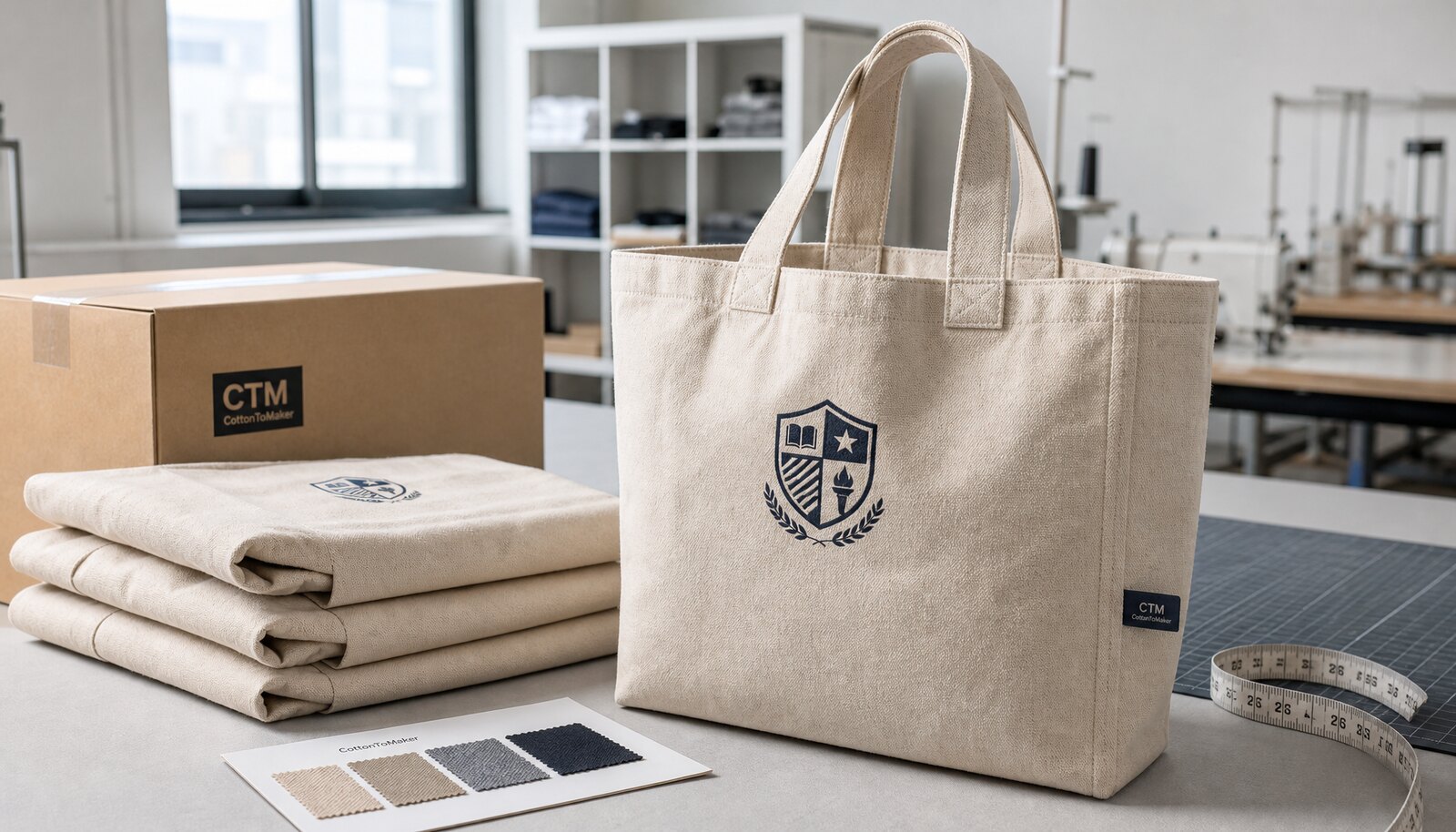
Why school buyers need a packaging spec before they quote
For school programs, the problem is rarely the tote itself. The real issue is whether the bag arrives in a format that is easy to receive, easy to distribute, and cheap enough to move in bulk. A heavy canvas tote can look simple on a quote, but the packaging spec decides carton count, freight cost, warehouse labor, and whether the school or distributor can hand it out without rework.
If you are buying for a district, retail program, or branded school campaign, do not let the supplier quote only the bag and print. Put the packaging instruction in the RFQ at the same time as size, fabric weight, and artwork. That is how you prevent the common mismatch where the sample looks fine, but the mass goods arrive folded differently, packed too tightly, or without the labels your receiving team needs.
- Packaging changes unit cost more than many buyers expect because it affects carton efficiency and shipping weight.
- School buyers usually need consistency more than fancy presentation.
- A clear packing spec reduces receiving disputes and rework at destination.
Choose the right canvas weight for books, kits, and daily carry
Heavy canvas for schools usually sits in the 12 oz to 14 oz range, which is strong enough for notebooks, library books, and student event kits without becoming overly stiff. If the bag will carry textbooks or bulkier classroom materials, 16 oz can be justified, but it should be a deliberate decision because it raises fabric cost and freight weight. An 8 oz or light 10 oz canvas may pass a sample photo, yet it often loses structure after a few days of use.
Buyers should specify canvas weight in both oz and GSM if the factory works across different markets. Do not rely on the phrase “heavy canvas” alone. Ask for the exact fabric construction, because two suppliers can quote the same term and still deliver noticeably different hand feel, opacity, and stitching behavior.
- 12 oz: best balance for general school campaigns and reusable education bags.
- 14 oz: better shape retention and better perceived value for retail or private label.
- 16 oz: only when load-bearing and premium feel are more important than unit weight.
Set the size and handle spec around how students will actually use it
A standard school tote should fit folders, notebooks, and a reasonable lunch or kit load without forcing the top opening open too wide. In practice, many buyers land around 38 x 42 cm or 40 x 45 cm, with gusset depth chosen according to whether books must stand upright. A gusset is not decorative; it changes usability and carton volume, so it should be part of the quote, not an afterthought.
Handle length and reinforcement matter more than most first-time buyers realize. A handle that looks comfortable in the hand can fail if it is stitched too close to the edge or if the box-X reinforcement is too small. For school use, long enough to shoulder-carry is helpful, but the handle must still sit flat and not twist after folding and packing.
- Keep handle width practical for daily carry; thin straps can cut into the hand under load.
- Use box-X or equivalent reinforcement at the handle join.
- Specify handle drop if the bag is meant for shoulder carry rather than hand carry only.
Compare supplier routes before you lock the packaging spec
The quote you get depends heavily on who is making the bag and how much of the work they control in-house. A direct factory usually gives better visibility on fabric, stitching, and packing, which matters when you need a repeatable school program. A trading company may be useful when you need mixed products, smaller test volumes, or sourcing support across multiple factories, but the buyer should expect less transparency on where decoration or packing is actually done.
For school tote procurement, the safest route is often the one that shows the real production steps clearly. If the supplier cannot describe the fabric roll source, print method, and packing line in plain terms, then the quote is not ready for comparison. A polished unit price means little if the supplier later changes carton packing or substitutes a lighter canvas.
- Direct factory: best for tighter control of specs and repeat orders.
- Trading company: useful for consolidated sourcing or pilot runs, but verify the real production flow.
- Importer-friendly route: ask for photos of fabric, stitching, print, folding, and carton loading from the same source.
Supplier comparison table buyers can actually use
The right sourcing route depends on how much control you need versus how much admin time you want to spend. For heavy canvas tote bags for schools, the main decision is not only price. It is whether the supplier can hold the same fabric weight, same print placement, and same packing count across a replenishment order.
Use the table below as a practical filter. It is meant to separate quotes that are comparable from quotes that only look comparable on paper.
- Write decisions in measurable language, not only descriptive wording.
- Ask for sample photos plus one physical approval sample for important orders.
- Keep quotation, sample approval, and inspection notes tied to the same spec version.
Understand the cost drivers hidden inside a school tote quote
Canvas weight is the most obvious cost driver, but it is not the only one. Print color count, print area, handle length, gusset depth, and folded packing method all affect unit price. A larger bag may only use slightly more fabric per piece, but if it changes carton loading efficiency, the landed cost can rise faster than the quoted ex-factory price suggests.
Buyers should also separate one-time setup charges from recurring unit costs. Screen setup, plate making, color matching, woven label development, and carton printing can be acceptable if they are transparent. The mistake is when those costs are buried in a “cheap” quote that later expands after sample approval.
- Fabric weight and bag dimensions are the biggest recurring cost drivers.
- Decoration setup costs are usually one-time, but they should still be shown clearly.
- Packing density can change freight and warehouse cost more than decoration does.
Use a quote format that reveals the real landed cost
A useful quote for school buyers should break out the bag cost, print cost, packing method, carton specification, and any setup fee separately. If the supplier only gives a single total price, it becomes hard to compare two factories with different assumptions. One may quote a flat-packed carton of 100 pieces, while another quotes 50 pieces per carton with extra poly bags; the unit price may look close, but the landed cost is not.
For importers and distributors, ask the supplier to quote both EXW and FOB if possible, or at least state which freight assumptions are excluded. That makes it easier to compare against your freight forwarder’s numbers and avoids last-minute surprises when the goods are ready to ship.
- Ask for unit price, setup charges, packing cost, and carton details separately.
- Separate sample charges from mass production pricing.
- Request the quote currency, Incoterm, and validity period in writing.
Sample approval should test fabric feel, print, and foldability
A pre-production sample for heavy canvas school totes should not be judged only by appearance. The fabric hand feel should match the promised weight, the seams should sit flat, and the bag should fold into the same packing format used in mass production. If the sample is hand-finished differently from the bulk order, you may approve the wrong thing and discover it only when the cartons arrive.
During sample review, evaluate the print for edge sharpness, opacity, and curing quality. Rub the print lightly by hand, check whether the inside of the bag shows strike-through, and make sure the logo sits in the same position on every face. For school buyers, consistency is often more important than artistic perfection.
- Measure width, height, gusset, and handle drop against the approved spec.
- Check print rub resistance and visual alignment before sample sign-off.
- Confirm the folding method on the sample, not just the bag construction.
Packing specification: reduce damage, labor, and carton waste
For bulk school programs, the best packing is usually flat and uniform. Bags should be folded to a repeatable size, stacked consistently, and packed into cartons with a clear piece count. If inner poly bags are used, they should be there for a reason, such as keeping a light-colored print clean or separating retail packs. Otherwise, unnecessary poly only increases labor and disposal cost.
Carton size matters because it drives warehouse handling and freight utilization. A carton that is too large wastes cubic space; one that is too tight can deform the fold or crease the print. Ask for outer marks, carton count, net and gross weight, and whether palletization is included or optional. Receiving teams care about these details more than the decorative side of the bag.
- Keep folding simple and repeatable for bulk distribution.
- Use carton sizes that balance cube efficiency and print protection.
- Specify outer carton marks for SKU, quantity, and destination handling.
Lead time, MOQ logic, and schedule risk for school buying cycles
School orders often have fixed delivery windows tied to term starts, orientation weeks, or annual events, so lead time risk is real. A standard timeline usually includes sample development, sample approval, material booking, production, and packing. If the bag is custom-colored, has a special print, or uses branded labels, add time for color matching and label approval. The production clock does not start when the PO is issued; it starts when the sample and artwork are frozen.
MOQ should be read against the exact spec, not the product family name. A supplier may accept a lower MOQ for one-color natural canvas totes but require a much higher MOQ for dyed canvas, custom handles, or individual retail packing. Buyers should avoid mixing unrelated specs in one RFQ line if they want a clean comparison. Keep one base model, then list optional packaging or decoration upgrades separately.
- Build time around sample approval, not just the factory’s stated standard lead time.
- Higher customization usually means higher MOQ and more schedule risk.
- Request a realistic production calendar that includes packing and final inspection.
Specification comparison for buyers
| Spec decision | Recommended option | When it fits | Buyer risk to check |
|---|---|---|---|
| Fabric weight | 12 oz to 14 oz cotton canvas, with 16 oz only for very heavy book loads or premium gifts | School book bags, library programs, student welcome packs, or reusable event bags that must keep shape | Too light at 8 oz will collapse; too heavy raises cost, unit weight, and carton freight |
| Print method | Screen print for 1-2 spot colors; heat transfer or DTG only for small runs with detailed artwork | Simple school logos, mascot marks, text-based campaigns, and strong repeat color control | Complex art can look soft or crack if the wrong method is paired with the fabric finish |
| Handle construction | Self-fabric or same-canvas handles with box-X reinforcement | Daily student use and book carry loads where handle failure is the main complaint risk | Thin webbing handles can cut into the hand; weak bar-tacks may pass sample but fail in use |
| Bag size | Around 38 x 42 cm or 40 x 45 cm with a comfortable gusset if books or folders must fit upright | School pack sets, classroom kits, and standard A4-sized materials | Oversized bags increase fabric consumption and carton space; undersized bags create return complaints |
| Packing format | Flat packed with uniform folding, bulk-packed by carton, with inner poly only if artwork must stay clean | Importers and distributors who need low freight cost and easy warehouse handling | Loose folding causes carton inefficiency; over-packed poly adds cost and can trap moisture |
| Labeling method | Woven side label or printed care label plus carton marks | Retail-ready, school-resale, or private label projects that need brand visibility and traceability | Heat-applied labels can peel; missing carton marks slow receiving and carton allocation |
| MOQ route | 1-color screen print on standard canvas for best MOQ efficiency; custom size or color pushes MOQ up | Budget-sensitive school orders with repeatability across terms or districts | Special fabric colors, custom zippers, or branded hangtags often trigger higher minimums and longer lead time |
| Supplier route | Direct factory for spec control; trading company only if you need mixed-category consolidation or small trial orders | Procurement teams balancing control, speed, and quote simplicity | Middle layers can hide fabric source, decoration subcontracting, and real packing cost |
Buyer checklist before sampling
- Final bag size, gusset depth, handle length, and acceptable tolerance range
- Target canvas weight in GSM or oz, plus whether the fabric must be bleached, natural, or dyed
- Artwork file, print color count, print placement, and approval standard for first sample
- Packing method, carton size limit, carton drop-test expectation, and carton mark content
- Required test or inspection points for seams, handle pull, colorfastness, and odor
- Target MOQ, reorder logic, and whether the factory may combine orders across school variants
Factory quote questions to send
- What exact fabric weight, yarn count, and weave density are you quoting, and can you show the swatch code?
- Which print method are you pricing, how many colors are included, and what is the setup charge per color?
- What is your standard handle construction, stitch count, and reinforcement method at the handle join?
- How will the bags be folded and packed, how many pieces per carton, and what carton size and gross weight should we expect?
- What is the lead time for sampling, pre-production sample approval, and mass production after approval?
- What MOQ applies to the chosen canvas weight, decoration method, and packaging spec?
- Which costs are excluded from the quote, such as plate making, color matching, cartons, hangtags, or third-party inspection?
- Can you provide photos or videos of a similar school tote production line, stitching detail, and packing sample?
Quality-control points to confirm
- Fabric weight within agreed tolerance, with no weak thin spots or obvious slubs in visible panels
- Handle stitch reinforcement present and symmetrical, with no skipped stitches, broken thread, or seam twisting
- Print alignment centered to the approved artwork position and color density consistent across the batch
- Bag dimensions within the agreed tolerance after pressing and folding, including gusset and handle length
- No strong chemical odor, oil stains, loose threads, or fabric contamination inside or outside the bag
- Carton count, outer marks, and packing list matching the approved packing instruction and commercial invoice