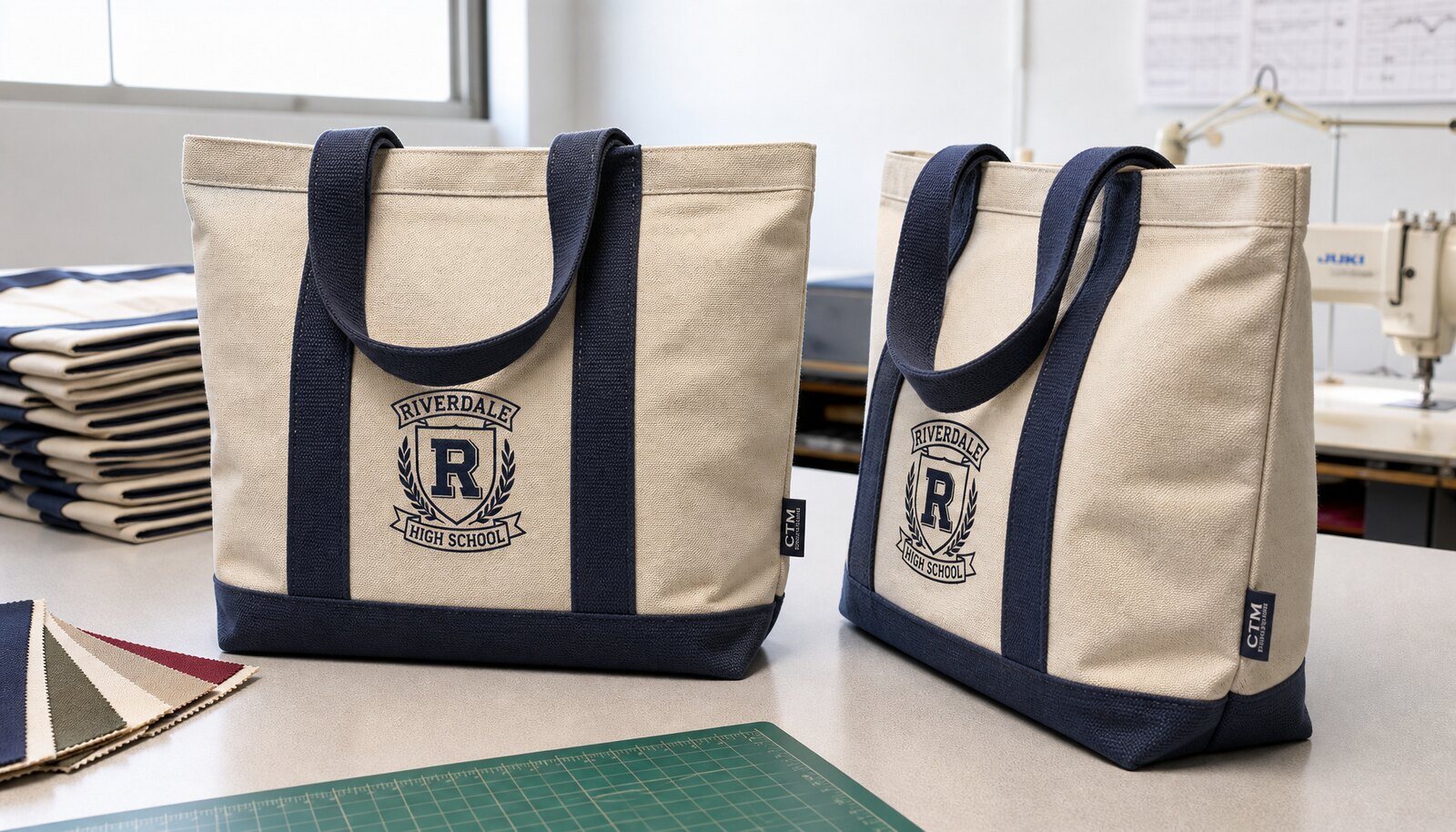
Why material choice matters more than decoration
For school tote bags, the real buying decision is not the logo or the tote shape. It is whether the bag can survive books, daily movement, and repeated handling without the handle tearing out, the base sagging, or the print cracking after a few weeks of use. If you are sourcing for a school program, a distributor catalog, or a branded retail roll-out, the material spec is what controls both complaint rate and landed cost.
Heavy canvas sounds simple, but suppliers may quote very different constructions under the same description. One factory may use a loose 10 oz body with strong-looking handles, while another uses a tighter 14 oz weave that prints better and wears longer. If the spec is not written clearly, the cheapest quote often becomes the most expensive after sampling, rework, or warranty replacement.
- Heavy canvas for schools is usually chosen for abrasion resistance, better print appearance, and better shape retention.
- The body, handle, stitch count, and packing all need to match the same use case; a strong fabric with weak finishing still fails in the field.
- A good RFQ should describe load, size, print, and packing, not just say 'cotton tote bag.'
Choose the right canvas weight for the school use case
For most school tote programs, the practical range is 12 oz to 16 oz plain canvas, which is roughly 340 to 450 GSM depending on how the supplier measures and finishes the cloth. At the lower end, the bag is lighter, folds flatter, and costs less to ship. At the higher end, the bag holds books better, feels more durable, and gives a cleaner premium impression in retail or admission kit use.
The right choice depends on what the bag actually carries. If the tote is for paper handouts, a 12 oz body may be enough. If it needs to carry textbooks, folders, a lunch container, and a water bottle, 14 oz or 16 oz is usually the safer commercial choice. Buyers often overfocus on handles and ignore the body fabric, but the body is what determines whether the bag stretches, wrinkles, and loses shape.
- 12 oz / about 340 GSM: suitable for low to medium load, lower cost, and broad distribution.
- 14 oz / about 400 GSM: the balanced option for most school buyers; good compromise between durability and freight.
- 16 oz / about 450 GSM: better for premium programs, heavier books, and bags expected to last across semesters.
- If the supplier quotes only 'canvas' without GSM or oz, that quote is not ready for comparison.
Weave density, yarn quality, and shrinkage are part of the spec
Canvas weight alone does not guarantee performance. A tight plain weave with controlled yarn variation prints more cleanly and resists edge wear better than a loose weave at the same GSM. For school bags, that matters because logos, school names, and mascots are often printed large and viewed from a short distance. If the weave is uneven, the artwork can look blurred or patchy even when the ink is technically correct.
Shrinkage also matters because school buyers usually care about functional size more than fabric language. If the bag is meant to fit A4 folders, exercise books, and a lunch box, the supplier should state the finished size after any washing or pressing process. A bag that shrinks 3% to 5% after packing may still pass on paper but will disappoint in use if the opening becomes too tight or the base loses depth.
- Request the fabric construction if available: yarn count, weave density, and whether the cloth is greige, dyed, or pre-shrunk.
- If the artwork includes fine text, choose a tighter weave and require a print strike-off on the actual fabric.
- If school use is rough and repeated, prioritize abrasion resistance and seam stability over a softer hand feel.
Print method should match the artwork and order size
The cheapest print method is not always the best for school tote bags. Screen print works well for simple logos, one or two solid colors, and repeat orders where setup cost can be spread over volume. It usually gives the most durable result on canvas when the artwork is bold and the supplier controls ink deposit properly. If the logo is too detailed or too small, the coarse weave may break the edges and make the design look older than it is.
For short runs, multi-color graphics, or fast-turn school events, heat transfer or digital printing may be useful, but the buyer should understand the tradeoff. These methods can handle more detail, yet the print feel, wash behavior, and abrasion resistance may differ from screen print. If the bags will be handled daily by students, durability matters more than a perfect looking sample under studio lighting.
- Use screen print for bold school names, mascots, and simple one-color or two-color logos.
- Use heat transfer or digital print when the art has gradients, many colors, or short-run personalization.
- Require a strike-off on the actual canvas weight, not a paper proof.
- If the bag will be washed, specify washing expectation before approving the print method.
Compare sourcing routes before you compare unit prices
When buyers source heavy canvas tote bags for schools, the supplier route changes the quote structure. A direct factory can usually control fabric, stitching, and print more tightly, which helps when the program repeats every term or every school year. A trading company may be useful if you need mixed SKUs, urgent consolidation, or multiple accessory items in one shipment, but the margin chain can hide the true material spec.
The right route depends on how much control you need versus how much administrative convenience you want. If you need a stable school supply program with the same bag repeated across campuses, direct factory buying usually gives better transparency on fabric and QC. If the order is one-off and bundled with notebooks, lanyards, or other printed items, a trading route can save time as long as the supplier can prove the bag spec in writing.
- Direct factory: stronger for repeat orders, material transparency, and lower process drift.
- Trading company: useful for bundled programs, but confirm who actually makes the bag and who owns sample approval.
- Local converter: faster communication, but often higher unit cost and less control over fabric sourcing.
- Mixed sourcing: practical for urgent school launches, but harder to compare like-for-like quotes.
Use this comparison table to separate real quotes from loose offers
A school tote quote should be comparable across suppliers only if the underlying spec is the same. Most pricing mistakes happen because one factory quotes a lighter cloth, another excludes print setup, and a third includes polybagging but not carton labels. The result looks like a price difference, but it is actually a spec difference.
The table below is a practical way to line up sourcing options before you send samples or place a deposit. Use it as an internal review sheet for procurement, merchandising, and operations.
- Write decisions in measurable language, not only descriptive wording.
- Ask for sample photos plus one physical approval sample for important orders.
- Keep quotation, sample approval, and inspection notes tied to the same spec version.
Set acceptable QC thresholds before bulk production starts
For heavy canvas tote bags in schools, quality control should be written in practical terms. If the bag is for daily use, the biggest failures are usually seam weakness, handle pull, bad print registration, and inconsistent sizing. A buyer does not need a long theoretical spec; the factory needs acceptance criteria that match how the bag will be used and inspected on arrival.
A useful approach is to define what is acceptable on the sample and what is not acceptable in bulk. For example, slight texture variation can be acceptable on canvas, but loose stitching at the handle attachment is not. This stops the factory from arguing that a visible flaw is 'normal' when it should have been caught before packing.
- Acceptable: minor natural slub variation within the chosen canvas grade.
- Not acceptable: skipped stitches, loose handles, visible oil marks, and print offset that distorts the school name.
- Acceptable: small dimensional variation within the agreed tolerance.
- Not acceptable: base width or opening size that prevents books or folders from fitting properly.
Sample approval should test function, not only appearance
A school tote sample is only useful if it reflects the real production build. Buyers should evaluate fabric weight, handle reinforcement, print appearance, opening size, and folding behavior. A sample that looks clean on a desk but collapses under books is not a valid approval. The best sample review is practical: load the bag with the items it will actually carry, then inspect the seams, handles, and print after that load is applied.
It also helps to separate the approval stages. A material swatch confirms the cloth feel and weave. A stitched pre-production sample confirms build quality. A print strike-off confirms artwork, color, and registration. If the factory only sends a fully finished sample at the end, you lose the chance to correct the fabric or print method before the order is locked.
- Test with books or dummy weight that reflects real school load.
- Measure finished size and handle length on the actual sample.
- Check print sharpness under daylight and indoor lighting.
- Look inside the bag for thread trimming, seam finish, and label placement.
Packing, carton planning, and school distribution flow
Packing is often treated as an afterthought, but it changes both cost and warehouse handling. Bulk-packed canvas totes are usually the most efficient for institutional distribution because they reduce labor and carton volume. Individual polybags can be justified for retail or direct-to-parent sales, but they add material cost, sealing labor, and waste. If the channel is a school purchase, packing should support fast receiving and easy counting rather than shelf presentation.
Carton size should also match the bag fold. If the tote is folded too tightly, creases may stay visible and create a poor presentation when the bag is handed out. If the fold is too loose, carton count drops and freight cost rises. Ask the factory to show the folding method and carton quantity on the sample pack, because this often changes the true landed cost more than the fabric choice itself.
- Bulk pack for school distribution unless retail presentation requires individual polybags.
- Use carton labels that show size, color, quantity, and PO number clearly.
- Confirm whether cartons are single-wall or double-wall based on shipping route and stacking height.
- If the bag includes inserts or hangtags, confirm whether those are packed inside or attached.
Build the quote around total landed cost, not just factory price
For heavy canvas tote bags for schools, the lowest ex-factory price can hide the highest total cost. Heavy fabric increases carton weight, and print setup charges can be significant on short runs. If the supplier uses a cheaper fabric with more defects, you may pay again through rework, inspection delays, or replacement stock. The quote should show exactly what is included so you can compare apples to apples.
A simple landed-cost view usually includes fabric, stitching labor, printing, packing, cartonization, inland move to port or warehouse, inspection cost, and freight. Even if your team does not calculate every line in the first round, you should know which part of the quote changes when the GSM changes or the print colors increase. That is how buyers protect margin when the school account is price-sensitive.
- Heavier canvas usually increases both material cost and freight weight.
- Extra print colors increase setup and labor, even if the ink area is small.
- Individual packaging can add meaningful cost on large school programs.
- Short runs are often priced more heavily because fabric waste and setup are spread across fewer units.
Specification comparison for buyers
| Spec decision | Recommended option | When it fits | Buyer risk to check |
|---|---|---|---|
| Fabric weight | 12 oz to 16 oz plain canvas, usually 340–450 GSM | Daily school use, books, notebooks, lunch items, and repeated carry cycles | Too light causes handle pull and body sag; too heavy raises landed cost and may feel stiff for younger students |
| Weave and yarn construction | Tight plain weave with good twist and low slub variation | When the bag must print cleanly and keep a neat retail or institutional appearance | Loose weave can distort logos, show uneven dye uptake, and create weak abrasion points |
| Handle style | Self-fabric or cotton webbing handles with reinforced X-box or bar-tack stitching | For bags carrying textbooks, folders, and water bottles | Short handles reduce usability; weak handle attachment fails before the body wears out |
| Print method | Screen print for simple logos, heat transfer or digital for multi-color short runs | Schools, distributors, and brands with clear logo placement and controlled artwork | Fine detail, small text, or gradient art can blur on coarse canvas if the print method is mismatched |
| Supplier route | Direct factory for repeat programs, trading company only if you need mixed product consolidation | Multi-season school supply, stable artwork, and repeat replenishment | Trading layers can hide fabric source, delay approvals, and make sample-to-bulk drift harder to control |
| MOQ logic | Start with fabric color and print color as the main MOQ drivers, not bag shape | For buyers trying to hold inventory risk down while testing school accounts | Low MOQ on paper may still create high cost if the supplier must open new fabric dye lots or print screens |
| Lining / structure | Unlined body with optional bottom insert or partial lining for premium school programs | Where the bag must stand better on shelves or carry sharper-edged items | Extra structure raises sewing time, material count, and carton volume; it is easy to over-spec for basic school use |
| Packing method | Bulk packed with size/assortment labels, then polybag only if required by retail channel | Institutional orders, warehouse distribution, or eco-focused school programs | Individual polybags increase labor and carton fill cost; poor folding can cause creasing and inspection rejects |
| Lead-time route | Standard canvas stock plus ready print method for shorter lead times | Back-to-school programs with fixed delivery windows | Custom yarn-dyed fabric, special wash effects, or complex branding can push bulk lead time beyond the school buying window |
Buyer checklist before sampling
- Confirm the exact use case: books only, books plus lunch, or books plus sports items, because the fabric weight and handle reinforcement should match the load.
- Lock the target GSM or ounce weight before quoting, and require the factory to state whether the weight is finished fabric or greige fabric basis.
- Specify canvas weave, color, and shrinkage expectation so the sample and bulk do not differ after washing or storage.
- Define print artwork size, Pantone target, number of colors, and acceptable registration tolerance.
- State whether you need bulk packing, individual polybagging, barcode labels, or assorted size/carton packing for distribution.
- Ask for sample photos, pre-production sample, and a bulk production reference from the same or similar fabric weight.
- Set an inspection standard for stitching, print clarity, dimensional tolerance, odor, and broken threads before shipment.
Factory quote questions to send
- What is the fabric weight in GSM and oz, and is that measured before or after finishing?
- Is the canvas combed, carded, or recycled, and what weave density do you use for this bag size?
- What handle construction is included in the quote, and how many stitches or reinforcement points are applied at each attachment?
- Which print method is quoted, how many colors are included, and what is the setup charge for screens, plates, or files?
- What is the MOQ for this exact fabric color, bag size, and print color combination?
- Does the price include inner packing, carton marks, and master carton export packing, or are these extra?
- What is the estimated sample time, PPS timing, and bulk lead time after sample approval?
- What are the acceptable dimensional tolerances, and what inspection standard do you follow for bulk quality?
- Can you provide a material swatch, stitched sample, and print strike-off before bulk commitment?
Quality-control points to confirm
- Fabric weight must match the quoted GSM within the agreed tolerance; do not accept vague 'heavy canvas' wording.
- Handle attachment should use reinforced stitching and show no puckering, skipped stitches, or loose thread ends.
- Print edges should be sharp enough to read school names, mascots, or logos at normal viewing distance.
- Bag dimensions should stay within the agreed tolerance after pressing and packing, especially if the bag needs to fit folders or books.
- Seams should remain flat, with no needle damage, broken stitches, or seam slippage at the side gusset and bottom corners.
- Odor, dust, and loose fibers should be low enough for retail or school distribution without extra cleaning.
- Cartons should be stacked cleanly, labeled correctly, and protected against moisture and compression during transit.