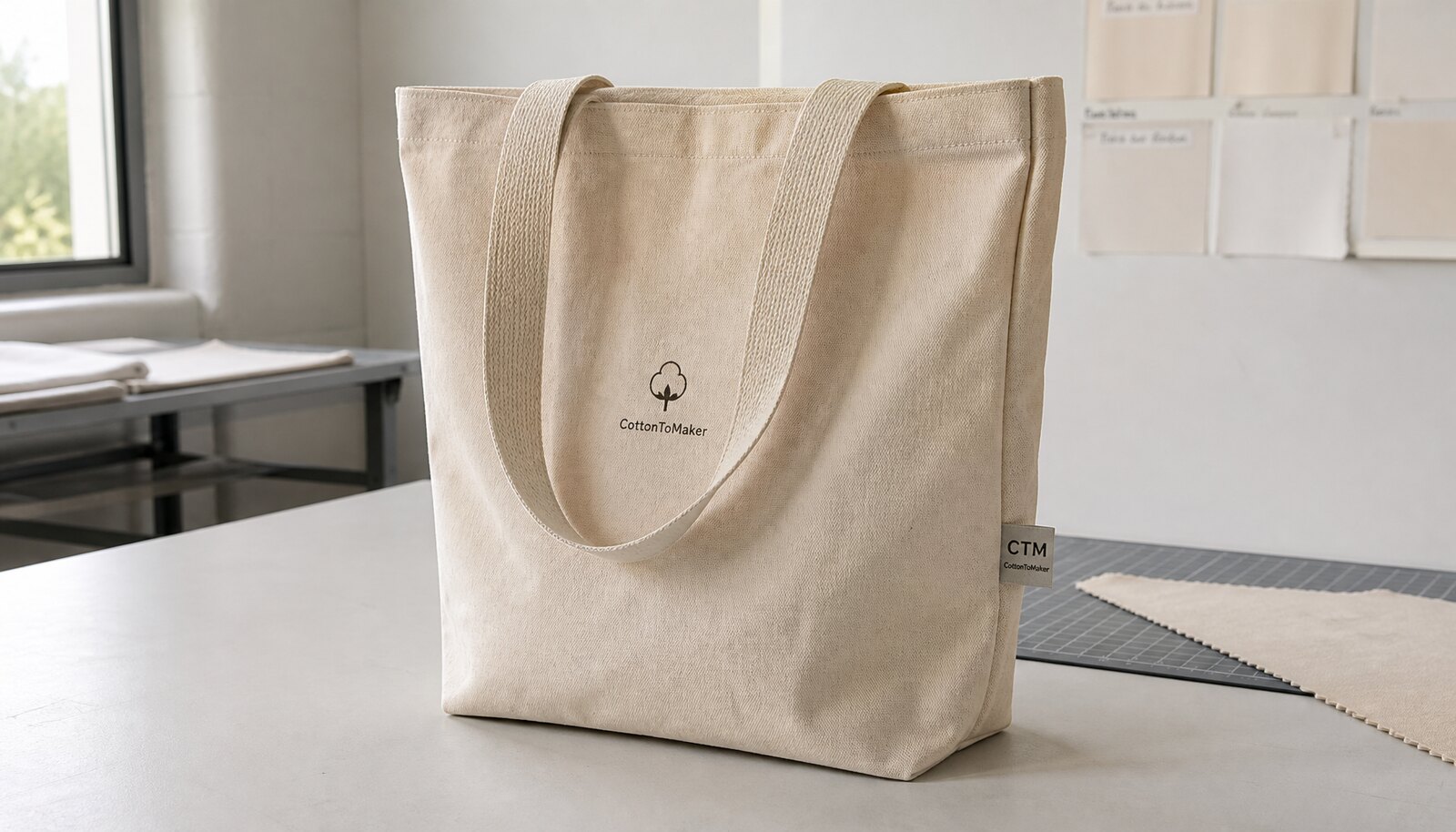
Why school tote quotes go wrong
Most quote mistakes on heavy canvas tote bags for schools begin with a brief that sounds clear to the buyer but leaves too much open for the factory. 'Heavy canvas tote with logo' can mean several different products in the same plant. One quote may assume 10 oz canvas and simple stitching. Another may price 12 oz fabric with standard reinforcement. A third may include 14 oz canvas, wider webbing, cleaner cutting, and more labor at the handle attachment. If the RFQ does not freeze those variables, procurement is comparing different products, not different prices.
School buying adds a second layer of complexity because the tote is usually tied to a calendar and a specific use case. The bag may be used for admissions packets, library distribution, open-day giveaways, school shop resale, first-day kits, or a fundraiser. Each use case changes the failure mode. A tote that only holds folders can be soft and light. A tote that carries textbooks, lunch, and a bottle needs more structure, stronger handles, and a more disciplined QC plan. The mistake most buyers make is treating a school tote like a generic promo item instead of a small load-bearing product.
The practical fix is to build the quote around the real use. Tell the supplier what the tote will carry, how often it will be used, whether the bag must stand upright, and whether it will ship bulk or retail-ready. If the factory has to guess the load and finish level, it will either underbuild the tote and create complaints later, or overbuild it and raise the price without adding value. A strong procurement brief removes both failure paths before price discussion even begins.
- Name the end use before asking for price.
- Treat construction details as price drivers, not optional notes.
- Do not compare factory quotes until the spec is normalized line by line.
Choose the right canvas weight before you compare prices
For school programs, 12 oz to 14 oz canvas is usually the useful range. In GSM terms, that is roughly 407 to 474 GSM, though two bags with the same nominal weight can still feel and perform differently if the weave density or finish changes. In procurement terms, 12 oz often works for general school giveaways, open-day packs, bookstore-style resale, and document carry. Fourteen oz is a better fit when the tote will see repeated use, carry textbooks, or serve as a more premium school shop item. Below that range, the bag can feel floppy, sag under books, and show seam stress earlier than expected.
Weight alone does not guarantee performance. A tighter weave can print more cleanly and hold its shape better, while a looser or softer weave may look similar in a sample photo but perform worse once loaded. That is why a supplier quote should state the measured fabric weight, not just the sales label. If the factory buys from different mills or changes lots after sample approval, ask for a written trigger that requires re-approval when the bulk canvas source changes. Otherwise, the sample and the bulk order may not be the same product.
The most useful buyer question is not 'what is your canvas weight?' but 'what weight will you commit to in bulk, and how will you verify it?' Ask the supplier to include the target oz/GSM, the acceptable tolerance, and the sampling method. If the tote is part of a school rollout or a recurring annual order, repeatability is often more valuable than shaving a small amount off the quote.
- 12 oz is often enough for general school distribution and light resale.
- 14 oz is safer for frequent use, books, or higher perceived value.
- Ask whether the bulk fabric will be matched to the approved sample lot.
Build the spec around load, structure, and carry comfort
A school tote is a functional carrying product, so the quote should reflect how the bag will behave under load. Handle construction is one of the biggest differences between a tote that survives a school term and one that comes back with complaints. Cotton webbing handles are common because they hold shape, sew cleanly, and give predictable strength. Self-fabric handles can reduce cost, but they may twist more, feel softer, or stretch differently under weight. For heavier school use, ask the factory to state the handle width, handle material, stitch layout, and reinforcement pattern at the attachment point.
The body construction matters just as much. A flat-body tote is economical and good for document packs, but it does not stand as well on a desk or in a distribution line. A modest gusset or flat base improves capacity and helps the tote keep its shape when students add books or lunch containers. That said, gussets are not free volume; they consume more fabric, more sewing time, and more attention to print placement. If the logo must remain clean and centered, the tech pack should show the exact print-safe area measured from seam lines, not just the artwork file.
Handle comfort should also be part of the brief, especially if younger students or parents will carry the tote for extended periods. A longer handle drop can improve shoulder carry but may look too long for hand carry. A shorter drop may look neat but be awkward with heavier contents. Procurement teams should ask the supplier to quote the carry profile explicitly. A tote that is easy to sew is not always a tote that is easy to use, and that difference shows up fast in school distribution.
- Specify finished width, height, gusset, and handle drop in one sheet.
- Choose webbing width and reinforcement based on actual carried load.
- Define a print-safe area that respects seams, handles, and gusset edges.
Use the right print method for the artwork and the canvas surface
Most school tote quotes are built around one or two print colors, and screen printing is often the lowest-risk option for a simple logo, school name, or event mark. It is familiar to factories, repeatable across large runs, and usually gives a strong cost advantage when the artwork is straightforward. For clean procurement comparison, screen print also makes it easier to compare supplier offers because the method is common and its price drivers are more visible. If the tote requires only one solid logo in black, navy, or a single school color, screen print is usually the first method to evaluate.
However, the print method cannot be separated from the fabric. The same artwork can look sharp on one canvas and fuzzy on another if the weave is too open, the ink coverage is too thin, or the curing is weak. Dark canvas makes opacity and edge quality more important, especially for white or light logos. If the artwork has small text, thin lines, or multiple colors, the buyer should ask for a printed strike-off on the actual canvas weight before bulk approval. A PDF proof shows layout, but not ink soak, edge sharpness, or whether the canvas texture swallows fine detail.
Heat transfer or digital transfer can be useful for small runs or more complex artwork, but buyers should treat those methods as conditional rather than interchangeable. They may add cost, and depending on the material and curing process, they can behave differently under rub or wash. The best RFQ question is not 'can you print it?' but 'which method will give the cleanest result on this canvas, at this quantity, with this durability requirement?' That question forces the factory to answer with a production-ready recommendation instead of a generic yes.
- Use screen print as the baseline for simple school logos.
- Request a strike-off on actual canvas for small text, white-on-dark, or multi-color art.
- Set a minimum line thickness if the artwork includes fine details.
Read supplier routes correctly: factory direct, trading route, or local converter
Sourcing route affects both the quote and the amount of control you keep over the final tote. A direct factory quote is usually the cleanest way to see what you are paying for: fabric, cutting, sewing, printing, packing, and export handling if relevant. That visibility matters when you need to compare a 12 oz construction against a 14 oz construction or judge whether one supplier is quietly upgrading the handle spec while another is not. With a factory-direct quote, procurement can ask sharper questions about process ownership and production capacity.
A trading company can still be useful if the buyer needs smaller orders, multi-item bundling, or help coordinating several supply steps. The tradeoff is that the quote may contain a service layer that makes the price harder to normalize. The buyer should insist on knowing whether the bag is being made in-house or subcontracted, and whether sampling and QC are controlled by the same party that will run bulk production. If the answer is vague, it becomes harder to resolve sample-to-bulk variation later.
Local converters and regional print shops can be practical for urgent school calendars, but they often rely on imported blanks or outsourced sewing. That may be perfectly acceptable for a simple promotional tote, yet it can limit control over seam reinforcement, fabric source, and repeat consistency. The right route depends on repeatability and quality control, not just lead time. If the tote is a one-off event item, convenience may win. If it is a recurring school program or resale item, process control matters more.
- Factory direct is strongest when spec control and repeat orders matter.
- Trading routes can help with smaller runs, but ask who actually manufactures the bag.
- Local conversion is useful for speed, but confirm the sewing source and QC owner.
How to handle MOQ without getting trapped by a low headline price
MOQ on heavy canvas tote bags is rarely a single number. It changes with fabric choice, color, print count, handle material, packaging style, and whether the supplier must source custom trims. A factory can look very competitive on a natural canvas tote with one-color print and bulk packing, then quietly raise the minimum when the buyer wants dyed canvas, a woven label, a zipper, or individual polybagging. That is not necessarily a bad quote; it is just an incomplete one if the MOQ driver is not explained.
For school buyers, the useful approach is to separate must-have items from optional upgrades before the RFQ goes out. The bag should first meet the use case: fabric weight, size, handle strength, and print durability. Once that baseline is fixed, add retail-like extras only if they genuinely serve the program. For example, a school store item may justify a hangtag, label, or better presentation carton, while a distribution tote for students may not. If the buyer tries to demand every upgrade at the lowest MOQ, the supplier will either decline or pad the unit price.
The key procurement question is: which spec element is driving the minimum? Ask the factory to break MOQ down by fabric color, print colors, handle style, and packing method. This helps you decide where to compromise. Sometimes changing from dyed canvas to natural canvas cuts MOQ significantly. Sometimes changing from individual polybag to bulk pack does the same. A quote that clearly shows the MOQ logic is more valuable than a quote that simply says 'minimum 3,000 pcs' with no explanation.
- Ask for MOQ by fabric, print, handle, and packing.
- Use a standard size first if you need a more realistic entry point.
- Check whether custom labels or dye lots are what push MOQ upward.
Sampling should test failure points, not just the logo placement
A strong sample process for heavy canvas tote bags for schools should move in stages. First, check a plain sample or material reference so the buyer can judge canvas hand feel, stiffness, color, and seam behavior. Second, review a printed sample or strike-off on the real canvas to confirm logo clarity, opacity, and placement. Third, for custom orders, deadline-sensitive shipments, or orders with multiple custom details, approve a pre-production sample that uses the final materials, final print method, final trims, and final packing format. Each stage answers a different question, and skipping one can create avoidable bulk problems.
The sample is most useful when the buyer tests the parts that fail in production. Load the tote with books or weighted contents, and check whether the handles stretch, the top edge ripples, or the base pulls out of shape. Inspect the stitch lines around the handle bases and corners. Look for seam puckering, loose thread tails, and print misalignment near the edges. If the logo is already too close to a seam on the sample, that will not improve in bulk. It should be corrected before production is released.
A buyer also needs to know what a sample does not prove. One printed sample does not guarantee every bulk bag will be identical if the factory changes canvas lots or print settings later. That is why pre-production approval is more than paperwork. It is the last chance to lock the actual production setup before the bulk line starts. For school buyers working to a fixed term date, sample discipline is often the cheapest insurance available.
- Use plain, printed, and pre-production stages when the order is custom or time-sensitive.
- Test load-bearing behavior, not only visual appearance.
- Approve the exact packing format if retail, barcode, or distribution handling matters.
QC thresholds that procurement should write into the PO
Many factory quotes mention 'QC standard' without giving a usable threshold. That is not enough for procurement. A school tote order should define the defect categories that matter in the real world: measurement errors, weak seam work, handle failure risk, print defects, stains, broken yarns, and packing mistakes. The supplier does not need a complicated lab spec for every order, but the buyer does need a clear definition of what passes and what fails. If a defect would be noticed by a teacher, student, parent, or store clerk at normal viewing distance, it should be written into the standard.
The most operational way to do this is to combine a written tech pack with a measurement checklist and an inspection method. The buyer should ask the factory whether final inspection is based on self-check, inline check, or third-party final inspection, and whether AQL applies. If AQL is used, put the level in the PO rather than leaving it open-ended. The quote should also specify measurement points: width, height, gusset, handle length, handle drop, print position, and carton count. That makes disputes easier to resolve because both sides are checking the same numbers.
For school-use totes, seam integrity and handle attachment deserve special attention. The handles are the most common stress point, while print quality is the most visible complaint risk. A simple pull or load test on the sample, plus a dry rub check on the print, is often enough to catch the major issues before bulk. The point is not to overcomplicate QC; it is to make the inspection concrete enough that the factory cannot interpret 'good quality' in a way that protects only the supplier.
- Write the inspection standard into the PO, not just the email thread.
- Use a measurement checklist for each bulk review sample.
- Define visible defect rules for seams, print, stains, and misalignment.
Packing and carton choices change the real cost more than many buyers expect
Packing is one of the easiest places for a quote to look cheaper than it really is. Bulk packed totes are generally the lowest-cost option for school distribution because they reduce handling and carton volume. If the bags are being handed out to students or staff, that is often the smartest route. But when the product is intended for retail sale or school-store resale, the buyer may need individual polybags, barcode labels, hangtags, inserts, or warning labels. Those extras are legitimate, but they need to be priced separately so the procurement team can compare like with like.
Carton planning also affects the shipment economics. A lower piece count per carton may seem safer, but it increases carton count, warehousing effort, and freight volume. An overloaded carton may reduce freight cost on paper but create damage risk, stacking problems, or labor issues at receiving. Ask the factory to quote carton dimensions, gross weight, and exact pieces per carton so you can calculate the shipping impact before order confirmation. For school programs, the best carton spec is usually the one that balances handling comfort with efficient pallet or container use.
One frequent failure case is a quote that hides packing upgrades in the unit price. The buyer sees a favorable bag price, but the supplier later charges more for polybagging, barcode application, or carton reconfiguration. Prevent that by asking for a single line-item breakdown. If your school program truly needs retail-ready presentation, price it as a separate requirement. If it does not, do not pay for it.
- Bulk pack is usually best for school distribution and lower landed cost.
- Individual packaging should be used only when retail or cleanliness requirements justify it.
- Ask for carton dimensions and gross weight before choosing the supplier.
Use landed cost and failure scenarios to compare real value
The cheapest ex-factory quote is not always the best procurement outcome. Freight, duty, inland transport, warehousing, and packing upgrades can quickly erase a small unit-price advantage. More importantly, a lower quote may hide a weaker construction that fails early in use. If the tote is intended for repeated school use, the cost of a better seam, stronger handle reinforcement, or cleaner print may be justified because it reduces complaint handling and replacement risk. Procurement should compare the quote in the context of the program, not just the invoice.
A useful way to compare offers is to normalize the spec, then test the failure case behind each price. For example, if Quote A is cheaper because it uses lighter canvas and simple handle stitching, ask what happens if the tote carries textbooks weekly for a school term. If Quote B is more expensive because it includes 14 oz canvas, box-X handle reinforcement, and a pre-production sample, ask whether that extra cost is actually buying lower defect risk and better repeatability. Those are the real tradeoffs. They matter more than a one-line factory price difference.
The landed-cost approach should also include risk. A bag that is cheaper to buy but more likely to distort, print poorly, or arrive with measurement drift is not genuinely lower cost. For B2B buyers, the best quote is usually the one that makes quality visible and repeatable. That is why a serious RFQ includes fabric, construction, print, QC, packing, and schedule in one package. If two suppliers are not quoting those variables in the same way, the comparison is not finished yet.
- Compare after matching fabric weight, construction, print method, and packing.
- Include freight, duty, and inland handling in the total view.
- Treat defect risk and rework exposure as part of cost.
Specification comparison for buyers
| Spec decision | Quote A to ask for | Quote B to ask for | What changes in cost / risk |
|---|---|---|---|
| Fabric weight and hand feel | 12 oz canvas, measured GSM on the approved lot; standard dry hand | 14 oz canvas, measured GSM on the approved lot; firmer hand and better body | 14 oz usually adds raw material cost, slightly more sewing effort, and more freight weight, but it lowers sag risk when students carry books or bottles |
| Weave density and finish | Standard plain canvas, natural or bleached, standard loom finish | Tighter weave or washed finish if the school wants a softer or more premium feel | Tighter weave can improve print sharpness and reduce see-through texture, while washed finish can improve feel but may widen consistency tolerances and add process cost |
| Body construction | Flat body with no gusset; simpler cut and sew | Flat base or 4 cm–8 cm gusset with boxed corners; higher usable volume | Gussets improve capacity and upright shape for books and folders, but they add fabric consumption, cutting steps, and seam intersections that must be controlled |
| Handle material and width | Self-fabric handle or 2.5 cm cotton webbing; standard reinforcement | 3 cm–4 cm webbing; stronger reinforcement at the attachment point | Wider webbing spreads load better and usually reduces handle failure complaints, but it increases material cost and can slow sewing at the stitch station |
| Reinforcement pattern | Single row reinforcement or basic backstitch at the handle end | Box-X, bar-tack, or equivalent multi-point reinforcement at stress points | Stronger reinforcement lowers the chance of seam creep and handle pull-out, especially on school totes that carry books or laptops |
| Stitch density and seam control | Standard stitch count on body seams; no explicit target for high-stress seams | 10–12 stitches per inch on high-stress seams, with stated control on skipped stitches and seam alignment | Higher stitch density and tighter seam control typically improve durability but can raise labor cost and slow line speed |
| Print method | 1-color screen print on natural canvas; standard ink system | 1–2 color screen print with strike-off approval; transfer only if the artwork truly requires it | Screen print is usually the best value for simple logos. Transfer methods can handle detail, but buyers should confirm rub resistance and curing behavior before release |
| Print durability checkpoints | Visual approval only from a PDF or JPEG proof | Strike-off plus dry rub check and edge-crack review on actual canvas before bulk | The stronger offer includes a real durability checkpoint, not just an artwork file. This lowers the risk of fuzzy edges, weak opacity, or early cracking after handling |
| Sampling route | Plain sample and printed sample only | Plain sample, printed sample, then pre-production sample with bulk materials and packing | More sample stages reduce bulk risk, especially when the order is custom or time-sensitive, but they add calendar time before PO release |
Buyer checklist before sampling
- Define the school use case first: book carry, library giveaway, admissions pack, student welcome kit, fundraiser resale, or retail shop item. The intended use changes the whole quote, because a tote for paper packets does not need the same load resistance as a tote for textbooks and bottles.
- Write the fabric spec in measurable terms: canvas weight in oz and GSM, weave type if known, and whether the bag is natural, bleached, dyed, washed, or garment-finished. 'Heavy canvas' is only a starting label, not a procurement spec.
- Lock finished dimensions for body width, body height, gusset depth, handle length, and handle drop. Ask the factory to quote the exact finished size and tolerances, not a similar size from an old order.
- State the intended load in practical terms. If the tote must carry folders only, the build can stay lighter. If it must carry books, lunch, and a bottle, require stronger handle attachment and seam reinforcement.
- Specify the panel construction clearly: flat body, flat base, boxed corners, or gusset. Ask the supplier to explain how the chosen structure affects capacity, print area, foldability, and sewing time.
- List the print method, number of print colors, print placement, and minimum line thickness if the artwork contains small text. If the logo has fine detail or a white print on dark canvas, request a strike-off on the actual fabric weight before bulk approval.
- Ask for the stitch spec in the quote: seam type, stitches per inch where relevant, and reinforcement pattern at handle ends and stress points. For heavier school totes, the response should mention box-X, bar-tack, or an equivalent reinforcement method.
- Set the sample sequence up front: plain sample, printed sample, and pre-production sample when the order is custom, high volume, or deadline-sensitive. Do not release bulk from a PDF proof alone.
- Request carton data in the quote: carton dimensions, gross weight, pieces per carton, carton marks, and whether the cartons are standard export cartons or reinforced. This matters for freight planning, palletizing, and warehouse handling.
- Ask whether the factory will provide a written QC plan, including inspection stage, defect classification, and whether AQL applies at final inspection. A good supplier can show how they inspect; a weak one usually hides behind 'factory checked.'
Factory quote questions to send
- What exact fabric weight will you quote in both oz and GSM, and will the bulk lot match the approved sample lot or a different mill lot?
- Is the canvas plain weave, tighter weave, bleached, dyed, or washed, and which finish is included in the price rather than treated as an add-on?
- How are the handles attached, what reinforcement pattern is used, and how many rows of stitching are applied at the stress points?
- What seam construction is included on the body and base, and do you use a box-X, bar-tack, or equivalent reinforcement on handle ends?
- What stitch density do you target on body seams and handle seams, and what measurement method do you use to verify it?
- Which print method is included, how many colors are priced, and what happens if the artwork needs a second print position or a second screen?
- Can you provide a strike-off or printed sample on the actual canvas weight before bulk production starts, and who signs off on it?
- What is the MOQ by fabric choice, print color count, handle style, and packing method? Please break out each driver instead of giving one lump number.
- What is the sampling path: plain sample, printed sample, pre-production sample, and what is the lead time for each stage?
- What size tolerance do you guarantee on finished bags, and what measurement points do you use for approval?
Quality-control points to confirm
- Use a documented inspection method instead of a generic 'QC passed' statement. For procurement, ask for final inspection using AQL 2.5 for major defects and AQL 4.0 for minor defects unless your internal standard is stricter. Write the level into the PO so the factory cannot reinterpret it later.
- Create a measurement checklist for every bulk review sample: finished width, finished height, gusset depth, handle length, handle drop, print position from top edge, and carton count. Measure against the approved tech pack, not against a verbal description from sales.
- Check seam performance where failures usually start: top edge, handle anchoring, side seams, and base corners. Look for skipped stitches, loose thread tails, seam puckering, seam slippage, or visible needle damage around reinforcement areas.
- Specify a simple load test for sample approval. For example, load the tote with school books or an equivalent weighted pack, hold or carry it briefly, and inspect whether the handle attachment stretches, the seam opens, or the top edge distorts. The goal is to catch weak reinforcement before bulk.
- Ask for a pull-test expectation on handle attachment or reinforcement areas if the factory can provide it. Even if the factory does not run a lab pull test on every order, the buyer should still define the expected stress-resistance standard in writing.
- Build print-durability checkpoints into approval. Review edge sharpness, opacity, alignment, and after-rub behavior on the actual canvas. For simple school logos, a dry rub test and a light damp-cloth check help expose weak ink bonding or poor curing.
- Check color consistency across cartons, especially if the order mixes natural, dyed, or washed canvas. Color consistency matters when the totes will be handled frequently, resold, or distributed in batches over multiple days.
- Inspect for visible defects at a normal viewing distance: stains, oil marks, broken yarns, holes, poor fabric cutting, twisted handles, wrong label position, and off-center print. If a defect would be noticed by a teacher, student, parent, or store clerk, it should be a defined rejection item.
- Confirm carton integrity before release: correct carton mark, correct quantity per carton, clean packing list, and carton strength that can tolerate stacking. A tote order can pass sewing QC and still fail in shipping if the cartons are too weak or overpacked.
- If individual polybags are required, check bag thickness, suffocation warning placement where applicable, barcode readability, and insertion consistency. Packing errors create avoidable warehouse delays and retail complaints even when the tote itself is fine.