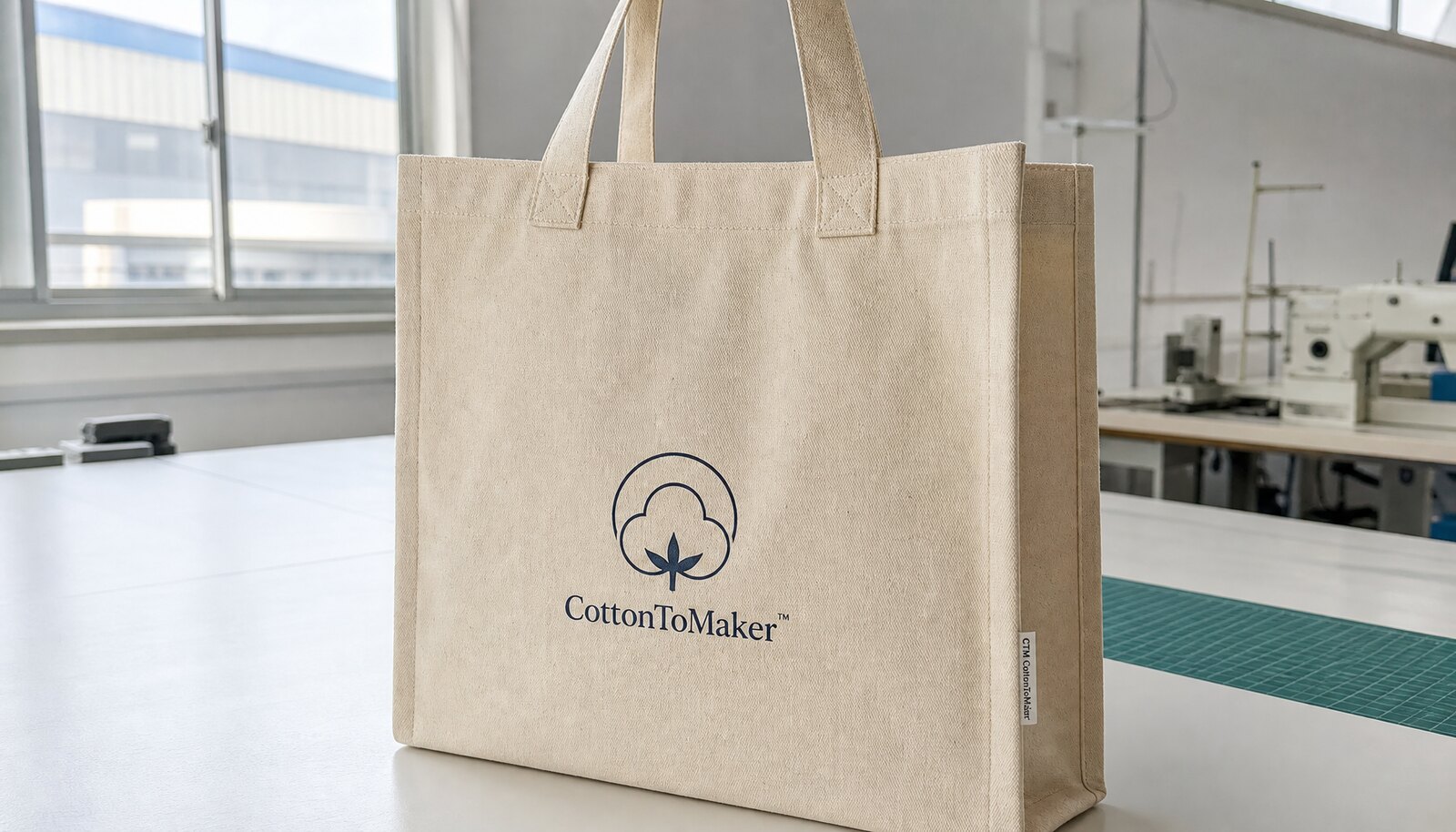
Why retail chains need a different tote buying plan
Heavy canvas tote bags for retail chains are not bought the same way as event giveaways or one-off promotional bags. A chain program has store-level replenishment, barcode receiving, shelf presentation, and a repeat-order calendar. That means the buyer has to evaluate not only the bag itself, but also how the supplier handles MOQ, packing, and lead time across multiple destinations or distribution centers.
The main sourcing problem is usually not the bag price alone. It is the mismatch between a supplier’s stated MOQ and the chain’s real launch schedule. A quote can look good on paper and still fail if the factory cannot lock fabric in time, cannot keep print registration consistent, or cannot pack to the retailer’s DC rules.
For procurement teams, the right frame is simple: treat the tote like a small packaged product, not just a sewn item. The spec needs enough detail to control the visual result, but also enough commercial structure to compare suppliers on the same basis. That means a realistic view of fabric weight, decoration method, packing format, inspection standard, and the time required to move from sample to shipment.
This is especially important for chain buyers because the order is rarely isolated. One tote may need to support seasonal displays, promotional windows, or a planned reorder cycle across several stores. A supplier that can meet the first delivery but not the follow-up shipment can create the same commercial problem as a defective product: missed sales and internal rework.
- Retail chain orders usually need cleaner packing and tighter spec control than general wholesale orders.
- The cost of a miss often shows up in DC receiving delays, store replenishment gaps, or markdowns on poor-looking bags.
- A good RFQ should make suppliers quote the same fabric, print, carton, and shipment basis.
Choose the fabric weight by use case, not by habit
For heavy canvas totes, the first buying decision is fabric weight. Most retail programs sit in the 12oz to 16oz range. In practical terms, 12oz canvas works for value retail and lighter store carry, while 14oz gives a firmer hand and better structure for premium shelf presentation. Sixteen-ounce canvas is used when the bag must feel substantial and hold shape, but it can push cost, sewing difficulty, and freight higher than buyers expect.
Fabric weight alone is not enough. Ask for the finished GSM or finished oz after washing and finishing, plus weave density. Two fabrics can both be called 12oz and still behave very differently in sewing and print. A looser weave may accept ink unevenly and create a softer, less stable bag; a tighter weave usually improves logo clarity and seam performance.
For retail chains, the buying question is not only, “Does it feel heavy?” It is also, “Will it keep its shape on the shelf, survive repeated customer use, and remain printable after sewing?” Heavier is not automatically better if the bag is sold at an entry price point or packed in a tight carton. The wrong fabric weight can lower margin without materially improving customer satisfaction.
A practical way to compare fabric options is to ask for three things in the same quote: the nominal fabric weight, the finished bag weight, and the expected effect on carton count or freight density. That gives procurement a more honest picture of the landed cost than a raw fabric number alone.
- 12oz: useful for mass retail price points and lighter merchandising carry.
- 14oz: often the best balance when appearance, durability, and unit cost all matter.
- 16oz: better when structure matters, but not always the best choice for chain margin.
- If the bag must stand upright on a shelf, test the finished stiffness, not just the raw fabric spec.
Print method changes MOQ, setup cost, and reorder behavior
Print choice is one of the biggest drivers of MOQ and quote spread. Screen print is still the most economical for one to three colors at scale, especially on heavy canvas where a bold retail logo is common. It has setup cost, but once the screens are made, the unit print cost is usually manageable for repeat orders. For small-volume launches or complex artwork, heat transfer or digital transfer may be easier to start with, but those methods must be tested for abrasion, cracking, and fold lines.
For retail chains, the real issue is repeatability. A supplier that can print the first lot well but cannot keep color density and placement consistent across reorders creates inventory problems. If the artwork is simple, many buyers choose a woven side label or a small sewn patch as a lower-risk branding option, then use screen print only for the main logo panel.
MOQ is affected by decoration in a way buyers often underestimate. A one-color screen print may need only a small setup charge and a moderate production floor, while two or three colors can increase labor, drying time, and waste. If the artwork uses fine lines or small type, the print route can move from economical to fragile very quickly. That is why it helps to ask the supplier which method they would choose for production, not just which method they can technically support.
There is also a tradeoff between speed and durability. Transfer methods can be quicker for a pilot run, but if the bag will be handled by shoppers, carried in wet weather, or folded repeatedly, the buyer should ask for abrasion expectations and sample testing before approving the route.
- Screen print: best for simple artwork, larger reorders, and stable unit cost.
- Heat transfer or digital transfer: useful for short runs or detailed graphics, but quality testing matters.
- Woven label or sewn patch: good for minimal branding or when print durability is a concern.
- Always define print size and placement in millimeters, not only in words.
How MOQ really works in a retail chain quote
MOQ is often quoted as a single number, but retail buyers should treat it as three separate items: fabric MOQ, printing MOQ, and packing MOQ. A factory may be able to sew 3,000 bags, but if the print screen or custom carton requires a higher threshold, the real order floor is higher than the sales quote suggests. This is where buyers lose time comparing suppliers who are not quoting the same production route.
For a chain program, the best MOQ logic is the one that matches forecast risk. If the design is stable and the chain expects reorder volume, factory-direct sourcing with a higher MOQ can reduce unit cost and keep fabric dye lot consistent. If the launch is still being tested, a stock base bag with custom branding may cost more per unit but protects timing and reduces overcommitment.
MOQ also changes with fabric availability. If the canvas is a standard natural color from stock, the order may start lower. If the buyer wants a custom dyed fabric, a washed finish, or a special coating, the fabric mill or sewing factory may require a larger batch to justify the run. The same is true for carton printing and retail hang tags. A simple carton with a standard mark is easy to support; a fully branded retail carton can quietly add another minimum that changes the commercial picture.
Buyers should ask whether MOQ applies per color, per artwork, per size, or per shipment. That single line often determines whether a supplier is truly competitive. A quote with a low headline MOQ may still be too expensive if the program needs several colors for different stores or regions.
- Separate base bag MOQ from print MOQ and carton MOQ in the RFQ.
- Clarify whether the supplier can mix colors or sizes inside one order.
- Ask whether fabric is made to order or booked from existing stock.
- For multi-store launches, confirm if the MOQ applies per color, per artwork, or per shipment.
Comparison table: sourcing routes and supplier types for retail chains
When buyers compare suppliers, the source route matters as much as the quoted bag spec. A factory direct offer, a stock-bag decorator, and a trading company may all quote a heavy canvas tote, but they solve different buying problems. The right comparison is not only unit price; it is control over fabric, print consistency, lead time, and reorder flexibility.
Use the table below to align sourcing options before you start negotiating. It helps procurement teams identify which route fits a chain launch, which route fits a replenishment program, and where the hidden risk usually sits.
In practice, the best supplier route depends on the buyer’s priority. If margin control and repeatability matter most, factory direct usually wins. If timing is tight and the launch is uncertain, a stock-base route may be the safer bridge. If the internal team needs one point of contact across several items, a trading company can simplify coordination, though usually at some cost in transparency. Buyers who understand those tradeoffs early are less likely to compare quotes that are not actually comparable.
- Write decisions in measurable language, not only descriptive wording.
- Ask for sample photos plus one physical approval sample for important orders.
- Keep quotation, sample approval, and inspection notes tied to the same spec version.
Sample approval should reflect the final product, not a best-effort prototype
Retail buyers should insist on a pre-production sample that uses the final fabric, final print, and final packing spec. A sales sample is useful for rough approval, but it is not enough when the bag needs to pass store presentation standards or DC receiving rules. The sample should show actual handle reinforcement, logo placement, color tone, and fold method, not a best-effort prototype made from different materials.
The sample review should be practical. Measure the finished bag, verify print position, inspect the seam finish, and test the handle under realistic load. If the bag is going to sit at checkout or on a shelf, the sample should also be checked for squareness and whether it stands neatly after folding and unpacking. Buyers often focus on the logo and overlook structure, but for a heavy canvas tote the silhouette is part of the product value.
A better sample process includes side-by-side approval of the bag, the sewn label if used, the fold method, and the carton mark. If the supplier can show a mini pre-production set—bag, packing unit, and outer carton photo—the buyer has a much lower chance of discovering late-stage surprises. The approved sample should be stored with the order file and referenced in any dispute about size, color, or print placement.
If the retailer uses barcode labels or internal hang tags, test them on the sample pack. A tote can be perfect as a sewn item and still fail the receiving process if the label location conflicts with store scanning or merchandising rules.
- Approve size, print position, handle drop, and stitch quality before bulk starts.
- If the retailer uses barcode labels or retail tags, test them on the sample pack.
- Photograph the approved sample and keep it as the bulk reference.
- Do not approve from artwork alone when fabric tone is important.
Packing affects warehouse speed, carton damage, and retail allocation
Packing is often treated as a low-value line item, but for retail chains it controls warehouse speed and damage risk. A tote that is folded loosely may arrive in good condition yet still slow down warehouse counting and store allocation. A consistent inner pack quantity, clearly marked carton, and stable folding method make receiving easier and reduce disputes between the supplier and the DC.
Heavy canvas tote bags are bulky, so carton design matters. Buyers should confirm gross weight, carton size, and the target number of units per carton before approving production. If the carton is too large, freight cost rises and bags may shift during transit. If it is too small, corners crush and the fold mark can become permanent. For chain buyers, the carton spec is not an afterthought; it is part of the product’s usable condition on arrival.
A practical packing spec should answer four questions. How is each tote folded? How many units go into an inner pack? What is the outer carton count? And where are the carton marks placed? If the answer is not written down, the warehouse team may receive bags in a format that is technically acceptable to the factory but awkward for store routing. That can create hidden labor cost or even repacking at the DC.
If the retailer needs hanging display or peg-ready presentation, the buyer should confirm whether the packing format supports that requirement or whether the bag should be packed flat for better carton efficiency. The right answer depends on how the chain sells the item, not just on how the factory prefers to pack it.
- Specify fold direction and fold dimension in the packing sheet.
- Confirm inner pack count and master carton count separately.
- Ask for carton marks that match store or DC routing requirements.
- If the chain needs hanging display, verify whether the packing format supports it.
Lead time review: separate production time from total landed time
A realistic lead time for heavy canvas totes is usually 30 to 45 days for a repeat spec, and 45 to 60 days for a new fabric, new print setup, or more complex packing. That production clock does not include ocean freight, customs clearance, or final DC distribution. Buyers often lose time by assuming the sewing calendar starts immediately after PO issue, when in fact fabric booking, artwork confirmation, and sample approval can each take several days.
The safest schedule is a split schedule. First lock the sample and artwork. Then get a firm promise for fabric booking date, bulk start date, and packing completion date. If the supplier cannot separate those milestones, the quote is harder to manage and the risk of store launch delay rises. This is especially true when the chain wants synchronized delivery across regions, because even a short factory slip can translate into a missed retail window once shipping and receiving are added.
For comparison purposes, ask suppliers to state the lead time in three parts: sample time, production time, and shipment time. A supplier that says “35 days” may mean only sewing and packing. Another may include fabric booking but exclude transit. Those are not equivalent answers. Procurement teams should push for a single calendar that shows what happens before bulk start, what happens during production, and what happens after ex-factory.
If a launch date is fixed, build buffer for inspection, rework, and booking delays. That buffer is not a sign of weak planning; it is a normal cost of doing retail chain sourcing well. The more custom the tote, the more the calendar needs to be managed with explicit checkpoints.
- Repeat orders usually move faster only if the fabric and trim are already available.
- New print colors and custom cartons add time even when sewing is simple.
- Transit time should be quoted separately from factory production time.
- If the launch date is fixed, build buffer for QC, rework, and booking delays.
How to compare supplier quotes without getting misled
A useful quote for retail chain sourcing should include more than a unit price. It should show fabric weight, size, print method, MOQ by route, packing configuration, sampling cost, and lead time split. Without those details, one supplier may look cheaper simply because they quoted a thinner canvas, a smaller print, or a looser packing standard.
The most common mistake is comparing a finished retail tote with a promotional tote that has different stitching, lighter fabric, or a simpler logo process. If the chain needs a bag that can sell at store level and hold up to customer use, the quote must reflect the real spec. Ask each supplier to quote the same artwork file, the same carton count, and the same Incoterms so the landed cost can be compared fairly.
There is also a question of where the quoted cost sits. Some suppliers are aggressive on ex-factory price but leave out setup charges, sample fees, carton printing, or export packing. Others quote a cleaner all-in basis and are easier to manage internally. Neither route is automatically better; the key is whether the buyer can see what is included. In a retail environment, hidden changes later often cost more than a slightly higher transparent price.
A strong procurement review should include a short comparison note next to each quote: what is included, what is excluded, and what risk remains. That kind of commentary is far more useful than a simple lowest-price ranking, especially when the buying team needs to explain the choice to merchandising, logistics, and finance.
- Compare like for like: same fabric, same print size, same packing, same shipment basis.
- Separate one-time tooling or setup cost from recurring unit cost.
- Review landed cost, not only ex-factory price.
- If a quote is unusually low, look for missing packing, lighter fabric, or unquoted setup fees.
Retail chain buyer checklist before PO release
Before a purchase order goes out, the buyer should be able to read the tote spec as a production document, not a marketing description. The goal is to remove guesswork at the factory and make receiving easier at the retail side. If a supplier still needs clarification after the RFQ and sample approval, the order is not yet fully defined.
A good checklist keeps the chain from discovering problems after the bags are already sewn. It also helps the sourcing team defend the quote internally because the cost drivers are visible and documented. The strongest PO packets include the signed tech spec, approved sample photo, carton specification, lead-time schedule, and QC sheet in one place.
If the retailer has a replenishment program, the checklist should also note whether the supplier is expected to hold fabric, keep artwork plates or screens, and support repeat orders on a shorter calendar. That matters because the first order is only part of the commercial story. For a chain buyer, the ability to reorder predictably is often as important as the initial price.
- Fabric weight, weave, and final hand feel are locked.
- Artwork file, print method, print size, and placement are approved.
- Sample, carton spec, and packing format are signed off.
- MOQ, lead time, and shipment basis are written into the PO or order confirmation.
- QC criteria for size, stitch, print, and packaging are attached to the order.
Specification comparison for buyers
| Source route | Typical MOQ profile | Lead time profile | Pricing and QC tradeoff |
|---|---|---|---|
| Factory direct, custom spec | Usually highest flexibility on fabric, but often starts at a few thousand pieces per color or artwork; MOQ can rise if the bag uses custom dyeing, special trim, or carton printing | Commonly 30-45 days for repeat specs and 45-60 days for new fabric or print setup, excluding transit | Best unit economics at scale and best control over fabric, stitching, and print consistency; requires the buyer to manage sample approval, artwork lock, and production QC closely |
| Factory direct, stock fabric + custom print | Lower MOQ than fully custom fabric because the base canvas is already available; print and packing still create their own minimums | Often faster than full custom because fabric booking time is reduced; lead time still depends on artwork approval and packing confirmation | Good balance for chain launches with a fixed date; risk is less control over exact shade and hand feel if the stock base is not tightly specified |
| Trading company / sourcing agent | MOQ can look low because the agent aggregates orders, but the real production floor still depends on the underlying factory | Can be similar to factory timing or slightly slower if approvals and communication pass through an intermediary | Useful when buyers need multi-item consolidation or easier communication; tradeoff is less visibility into factory capacity, inspection controls, and true cost breakdown |
| Stock bag decorator | Often the lowest entry MOQ, especially for short runs or test programs | Fastest route when the blank bags are already on hand; printing and packing may be the only production steps | Good for urgent retail tests or pilot launches; downside is weaker control over fabric weight, size tolerance, and exact color matching |
| Domestic or near-market converter | MOQ can be moderate, especially for faster replenishment programs | Shorter transit and simpler communication can compress the overall calendar | Helpful when a retail chain values speed and lower import complexity; unit price may be higher, but total landed risk can be lower |
| Bulk import with chain-wide replenishment | MOQ is usually tied to forecasted store volume, carton configuration, and shipping efficiency | Longer total calendar because transit, customs, and DC allocation must be built in | Best when the chain has stable demand and wants low landed cost; requires tighter forecasting and stronger pre-shipment inspection |
| Mixed-color program | MOQ often applies per color, per artwork, or per SKU, so the real floor can rise quickly if multiple store colors are needed | Lead time extends when each color requires separate material booking or print setup | Useful for assortment programs, but buyers should check whether color changes increase fabric waste, setup fees, or carton complexity |
| Private-label premium program | MOQ may be higher because of custom labels, branded packaging, and tighter finishing standards | Lead time often stretches due to label approval, carton print, and more detailed QC | Best for shelf presentation and margin positioning; tradeoff is more approval steps and a higher chance of rework if the spec is not frozen early |
Buyer checklist before sampling
- Confirm the finished fabric weight in oz and GSM, and state whether the buyer accepts a tolerance band on the finished bag rather than only on raw cloth.
- Lock the exact bag size, handle drop, opening width, gusset depth, and whether the tote must stand upright for shelf display or checkout presentation.
- Specify the print method, number of colors, logo size in millimeters, and placement points using a dimensioned artwork file or annotated tech pack.
- State whether the tote is a single-store item, a multi-SKU chain program, or a seasonal launch, because this affects MOQ, packaging, and reorder planning.
- Ask each supplier to quote the same Incoterms, the same carton count, and the same inner pack quantity so landed cost can be compared fairly.
- Request a production sample using final fabric, final print, and final packing, not a sales sample built from substitute materials.
- Define measurable QC acceptance criteria before PO release, including size tolerance, stitch density, color tolerance, handle reinforcement, and carton packing rules.
- Separate production lead time into fabric booking, sample approval, bulk sewing, printing, packing, and ex-factory date so delays are visible instead of hidden.
- Confirm whether cartons are marked for store, DC, or export routing, and whether barcode labels or retail tags need to be applied at factory level.
- Ask for the supplier’s inspection plan, including whether they use in-line checks, final random inspection, or third-party AQL inspection before shipment.
Factory quote questions to send
- What is the exact canvas construction after finishing, including nominal oz/GSM, weave density, and whether the bag uses 100% cotton or a blended canvas?
- What MOQ applies separately to the bag body, each print color, the label or patch, and the carton configuration?
- If we change from one-color print to two colors, how does that affect setup cost, unit price, and lead time?
- Can you quote the same tote in 12oz, 14oz, and 16oz so we can compare weight, structure, and freight impact side by side?
- What print method do you recommend for this artwork, and what are the setup fee, reprint risk, and durability considerations?
- Can you produce a pre-production sample with the final fabric, final handle reinforcement, final print size, and final folding/packing method?
- What are the planned dates for fabric booking, bulk start, printing, packing, and ex-factory completion?
- What carton size, gross weight, and inner pack quantity do you recommend for warehouse receiving and retail distribution?
- What tolerance do you hold on finished dimensions, color matching, and handle placement, and how do you inspect those items during production?
- Can you provide inspection photos, packing photos, and carton markings before shipment so our DC can plan receiving and allocation?
Quality-control points to confirm
- Use a finished-size tolerance rather than a vague fit check. For retail tote programs, buyers commonly hold a practical tolerance band of about +/- 1 to 1.5 cm on finished bag dimensions, but the exact limit should be set by the chain’s shelf or packaging needs.
- Check fabric weight on a finished basis, not only on a mill certificate. A buyer should ask whether the supplier can verify the canvas weight per square meter or oz after finishing, because washing, coating, or dyeing can change hand feel and thickness.
- Evaluate stitch density and seam consistency. A clear factory target is usually around 8-10 stitches per inch on core seams, with even tension, no skipped stitches, and clean back-tacks at stress points.
- Ask for handle reinforcement details in writing. Cross-stitch plus box stitch at the handle ends is a common retail expectation for heavy canvas; the reinforcement should be symmetrical, with no loose threads or pulled corners.
- Request a handle pull test or strength confirmation. If the bag is intended for retail carry, ask the supplier what load test they use for handles and seams, and record the threshold in the spec instead of relying on a visual check alone.
- Set a color tolerance standard before production. For solid canvas and printed logos, buyers should agree whether the supplier will follow a physical approved swatch, a Pantone reference, or a measurable Delta E target, because color disputes are difficult to resolve after bulk finishing.
- Inspect print registration and edge sharpness. The logo should be centered within the approved placement tolerance, with no blur, banding, cracking, wash-out, or heavy ink build-up at folded edges.
- Check for fabric defects and sewing defects separately. Common reject points include slubs, thin spots, seam puckering, broken stitches, skipped stitches, crooked handles, and visible oil marks or dirt on the packed bag.
- Use a simple AQL inspection plan for retail orders. For many chain programs, a final random inspection under AQL 2.5 for major defects and 4.0 for minor defects is a common commercial reference point, but the buyer should confirm the standard with their QC team or third-party inspector.
- Review packing quality as part of product quality. Incorrect fold direction, crushed corners, mixed carton counts, loose unit packing, or wrong carton marks can create receiving delays even when the bag itself passes sewing inspection.