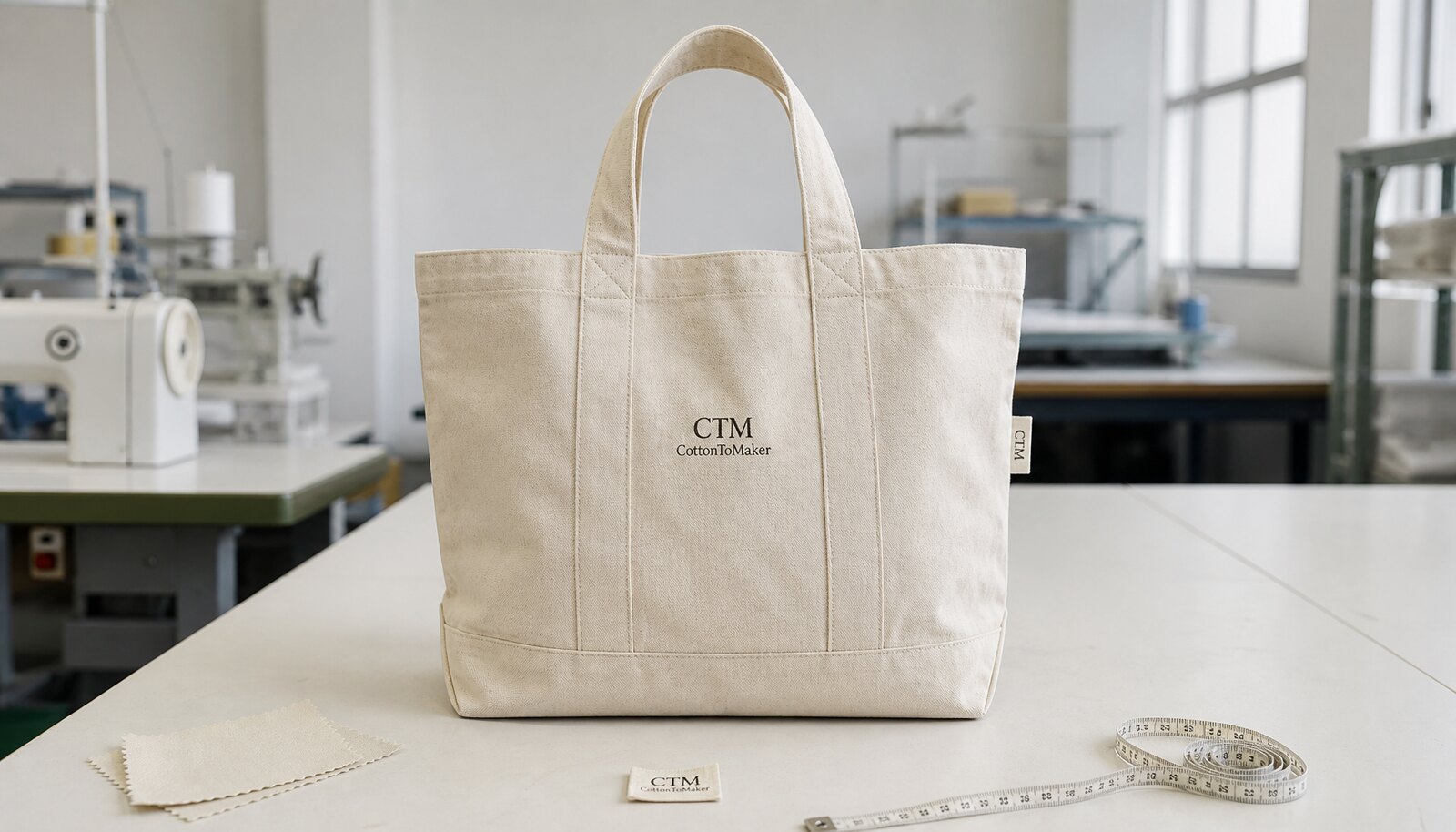
1. Start with the retail job, not the bag picture
For retail chains, heavy canvas tote bags are not just a branded giveaway. They are a working SKU that moves through stores, distribution centers, and customer hands. That means the material decision has to balance appearance, carry strength, fold bulk, print quality, and the cost of handling at scale. If the bag is too light, it feels temporary and can tear at the handle seam. If it is too heavy, freight cost rises, packing gets bulky, and the bag may feel overbuilt for everyday checkout use.
The right starting point is to define the use case in operational terms. Is the bag replacing plastic at checkout, sold as a premium impulse item, bundled with a promotion, or used as a reusable shopping bag that needs multiple-season durability? The answer changes the best fabric weight, finish, and packing format. A chain with frequent replenishment may care more about repeatable color and fast packing than about decorative finishing. A premium lifestyle retailer may accept a higher GSM if the bag holds shape on shelf and prints with a clean, dense logo.
- Checkout use: prioritize durability, flat packing, and low defect rates.
- Retail resale use: prioritize hand feel, color consistency, and cleaner edge finishing.
- Seasonal campaign use: prioritize fast sampling, simple print setups, and MOQ flexibility.
- Multi-store chain use: prioritize repeatability across orders and stable carton counts.
2. Choose canvas weight by how the bag will actually be carried
Heavy canvas for retail chains usually sits in the 12 oz to 14 oz range, or roughly 407 to 475 GSM depending on how the factory measures the cloth. That is a practical middle zone: strong enough for retail handling, not so heavy that sewing becomes slow or the bag turns stiff and expensive to ship. If the bag will carry a few folded apparel items or boxed accessories, 12 oz is often enough. If the chain wants a premium, structured feel and a more substantial shelf presentation, 14 oz is safer.
Do not compare quotes by weight alone. Two factories can both claim 12 oz canvas and still deliver very different results because of weave density, yarn quality, finishing, and shrinkage control. A loose weave may look thick before sewing but distort after print or washing. A tightly woven fabric can hold shape better and produce sharper screen print edges. The buyer should ask for the fabric composition, weave count if available, and whether the quoted weight is before or after finishing.
- 10 oz to 11 oz: lighter, lower cost, suitable only if the bag is promotional and load requirements are modest.
- 12 oz to 13 oz: common retail chain range, balances structure and cost.
- 14 oz and above: premium hand feel and stronger shape, but higher sewing labor and freight volume.
- Request a cut swatch and a sewn sample from the same fabric lot, not a generic reference swatch.
3. Fabric construction affects print sharpness and repeat order stability
A buyer evaluating heavy canvas tote bags for retail chains should treat fabric construction as a print-platform decision. Screen printing looks clean on a stable, even weave. If the yarn thickness varies too much or the surface is too fuzzy, small lettering can spread and edge definition suffers. For a chain logo that must look the same across multiple stores, a tighter and more controlled canvas is worth more than a marginal reduction in fabric cost.
Shrinkage is another overlooked issue. If the canvas is not pre-shrunk or properly controlled, panel sizes can shift after packing humidity, washing, or even the heat used during print curing. That creates headaches when replenishment bags arrive slightly smaller, handle points shift, or the logo appears off-center. Ask for the factory’s shrinkage expectation by fabric lot and whether they base cutting on post-finishing dimensions.
- Prefer stable weave for logos with small type, outlines, or barcode-like elements.
- If the bag is sold through stores, request shade and shrinkage tolerances in writing.
- For natural canvas, ask whether lint, slub, and fleck levels are controlled or random.
- If the chain plans seasonal reorders, lock the same fabric mill and finishing route.
4. Print method should follow artwork complexity, not habit
Screen printing is usually the most practical route for heavy canvas tote bags in retail chains because it gives durable color, good cost efficiency at volume, and repeatable placement. It works best for one- to three-color logos, bold typography, and art that can tolerate a solid ink layer. If the artwork is large and simple, screen print is usually the right default. For limited-run or multi-color artwork, heat transfer may be easier to set up, but the buyer must watch for cracking, edge lifting, and differences after folding.
Embroidery and woven labels are premium options, but they change the cost structure and the visual language of the bag. Embroidery is suitable for smaller logo marks on thicker fabric, though it adds needle perforation and may distort thinner panels. A woven label sewn into the seam or applied near the top edge is useful when the chain wants subtle branding and long-term reusability. For a retail chain, the main question is not which method looks nicest in isolation; it is which method stays clean across repeated production lots and store handling.
- Screen print: best for volume, simple logos, and lower unit cost.
- Heat transfer: useful for short runs or more complex artwork, but test crack resistance.
- Embroidery: premium appearance, but watch for puckering on lightweight panels.
- Woven label: good for subtle brand identity and lower risk of print rub-off.
5. Compare sourcing routes before you compare unit price
A retail buyer often receives quotes from direct factories, trading companies, and local importers. Those routes are not interchangeable. A direct factory quote may show the lowest ex-works price, but the buyer must manage artwork, sample timing, and packing details more closely. A trading company may offer smoother communication if the order has mixed SKUs or special retail packing, but the buyer is paying for that coordination margin. For chain programs, the best route depends on whether the project is standard, repeatable, and volume-driven, or whether it needs heavy front-end coordination.
When comparing quotes, reduce each supplier to the same landed-cost logic. That means the same bag size, same fabric weight, same print method, same packing count, same carton spec, and same delivery terms. Without that, one quote may look cheaper only because it excludes reinforcements, uses a lighter canvas, or charges separately for carton labels and barcode setup. The buyer should request a line-by-line quote structure to avoid hidden deltas.
- Direct factory: best for repeat programs, stronger spec control, and long-term cost leverage.
- Trading company: useful if the buyer needs mixed product consolidation or faster commercial coordination.
- Local stockist/importer: useful for urgent replenishment, but customization and fabric control are limited.
- Always normalize to the same spec before comparing price per piece.
6. Use the comparison route that fits the chain program
The table below shows how retail buyers can think about supplier options and material choices together. The aim is not to pick the cheapest quote; it is to align the sourcing route with the chain’s risk profile. A central procurement team with recurring annual volume can usually absorb longer sampling and tighter direct factory management. A distributor launching a new store group may need a more flexible supplier with packaging support and faster artwork handling.
A common mistake is to choose a route based on communication speed alone. Fast replies are useful, but if the supplier cannot hold the same fabric lot across reorders, the chain pays later in mismatched shades or inconsistent hand feel. The safest route is the one that can repeat the approved spec without improvisation.
- If the tote is a core retail SKU, prioritize repeatability over short-term price cuts.
- If the tote is seasonal or promotional, prioritize sample speed and packing flexibility.
- If stores require barcoded inner packs, choose a supplier that has done retail-ready packing before.
- For multi-country programs, ask where sewing, printing, and final packing actually happen.
7. What good sampling looks like for a chain order
A sample is not only about visual approval. For heavy canvas tote bags, the sample should prove that the chosen fabric, reinforcement, print method, and packing method work together. The buyer should request at least one pre-production sample made from the same canvas weight and print process intended for bulk. If possible, ask for a pilot sample after the factory has finalized the cutting pattern and stitching sequence. This exposes alignment issues before the full run begins.
The sample review should focus on measurable details. Check the body width and height, handle length, seam allowance, stitch density, print centering, and fold behavior. For retail chains, one of the most useful sample tests is a filled carry check using realistic contents. A bag that looks fine empty can twist, flatten, or pull at the handle seam when loaded with actual merchandise. That is exactly the type of issue that appears after delivery if it is not caught early.
- Approve the sample against written dimensions, not photos alone.
- Test the print under normal store lighting and daylight-equivalent light.
- Put real retail contents in the bag to confirm carry comfort and handle stress.
- Require a revised sample if placement, shade, or stitching drift from the approved spec.
8. QC thresholds that prevent expensive store-side complaints
The quality control plan for heavy canvas tote bags should be simple enough for the factory to follow and strict enough for the retail team to trust. Start with finished size tolerance, then fabric weight tolerance, then stitch and print criteria. For example, if the approved bag is 15 by 16 inches, define what variation is acceptable before production starts. The same goes for handle length and top edge symmetry. If the factory is allowed to improvise, the buyer will get a mixed batch that looks inconsistent on shelf.
Print defects should also be defined in practical terms. Buyers do not need cosmetic perfection in every thread, but they do need consistent logo registration, solid ink coverage, and no visible cracking on first fold. If the bag is natural canvas, a small amount of fiber variation may be acceptable, but heavy smudging, misalignment, or ghosting is not. Set the rejection threshold before mass production so the factory knows what will be accepted at final inspection.
- Finished size tolerance: define acceptable variance for height, width, and depth.
- Stitch quality: confirm stitch length, back-tack at stress points, and no skipped stitches.
- Print quality: no major misregistration, ink bleeding, or flaking on fold lines.
- Carton quality: no crushed corners, broken straps, or mixed color lots in one carton.
9. Packing and lead time can make or break the landed cost
Packing is not an afterthought for chain orders. The way the tote is folded and boxed affects carton count, warehouse labor, cube usage, and the final freight bill. Flat packing is usually the cleanest route for retail chains because it preserves carton efficiency and makes receiving easier. Inner pack counts should be set so that store replenishment teams can distribute units without opening too many loose bundles. If the chain uses barcode receiving, the barcode label format and carton marks should be confirmed before production starts.
Lead time should be read as a production timeline, not a promise. The real schedule usually includes sample approval, material booking, printing, sewing, packing, inspection, and freight booking. If the order includes custom fabric dyeing or special label work, the risk of delay rises. A buyer who needs a seasonal launch should build in buffer time and consider whether partial shipment or phased production is necessary. For tote bags, one delayed artwork sign-off can push the whole schedule because cutting and printing are linked to the final approval.
- Flat pack to protect carton efficiency and reduce DC labor.
- Agree inner pack counts that match store allocation logic.
- Use clear carton marks for color, size, and PO number.
- Build buffer time for artwork approval, fabric booking, and inspection rework.
10. How to turn a quote into a usable purchasing decision
A usable quote should let procurement compare factories without guessing. It should show fabric weight, bag size, handle spec, print method, setup charges, MOQ by color or artwork, packing count, carton dimensions, lead time, and the validity period for the offer. If any of those are missing, the quote is incomplete. A low unit price with vague terms is often more expensive after revisions, sample changes, or shipping adjustments.
The best procurement move is to request one structured quote for the approved spec and one alternate quote for a lower-cost option. That gives the chain a clear tradeoff: stronger canvas or lighter canvas, screen print or woven label, standard packing or retail-ready inner packs. When the team sees the cost difference by variable, it becomes easier to decide where to save money and where not to compromise. Heavy canvas tote bags for retail chains are won or lost in those small choices, not in broad slogans.
- Demand a quote that separates fabric, print, labor, packing, and setup charges.
- Keep one approved spec and one cost-down option for comparison.
- Use the same freight assumption across suppliers when comparing landed cost.
- Treat vague quotes as incomplete until the factory clarifies each line item.
Specification comparison for buyers
| Spec decision | Recommended option | When it fits | Buyer risk to check |
|---|---|---|---|
| Canvas weight | 12 oz to 14 oz cotton canvas | Retail chains that need a sturdy carry bag with good printability and manageable freight | Too light looks thin at shelf; too heavy raises cost, fold bulk, and sewing wear during production |
| Fiber source | Combed cotton canvas or blended canvas with controlled shrinkage | When consistent feel and lower distortion matter across large repeat orders | Uncontrolled shrinkage can warp panels, shift logo placement, and change bag size after wash or humidity exposure |
| Handle construction | Double-fold self-fabric handles with bar-tack or box-X reinforcement | When bags will carry retail purchases, catalogs, or boxed items at checkout | Weak handle stitch density can fail in transit testing or when stores overfill the bag |
| Print route | Screen print for simple logos; heat transfer or embroidery for limited color runs; woven label for premium branding | When artwork is stable and the chain wants repeatable appearance across stores | Fine gradients, small type, or low-resolution files can blur, crack, or misregister |
| Color strategy | Natural, black, navy, or pigment-dyed base with controlled shade tolerance | When the chain wants a standard retail look and easy replenishment | Shade drift between batches can cause store-to-store inconsistency and complaints from brand teams |
| Supply route | Direct factory sourcing for recurring volume; trading company only if artwork, packing, or mixed SKU consolidation is complex | When the buyer needs better cost control, direct spec communication, and long-term reorders | Middlemen can hide fabric origin, add margin layers, or delay sample approvals if the scope is unclear |
| Packing format | Flat pack with bulk carton inner counts, barcode label, and carton mark system | When retail DC receiving requires fast count-in and pallet efficiency | Loose folding or inconsistent inner packs create receiving errors, crushed corners, and higher labor at distribution centers |
| MOQ logic | Base MOQ tied to fabric dye lot, print setup, and carton configuration; separate MOQ for custom color or special wash finish | When one SKU must serve multiple stores or seasonal campaigns | Ignoring MOQ structure can lead to hidden setup charges or excess stock in the wrong colorway |
| Testing level | Dimensional tolerance, seam strength, print adhesion, and carton drop verification | When the chain needs predictable inbound quality and low return risk | Skipping test standards leaves disputes open between buyer, factory, and freight forwarder after damage is discovered |
Buyer checklist before sampling
- Lock the bag use case: checkout carry bag, promotional resale item, or private label everyday tote.
- Define target canvas weight in oz or GSM and set acceptable tolerance before sampling.
- Approve artwork as vector file with Pantone references, placement dimensions, and print size limits.
- State handle length, handle width, reinforcement type, and seam allowance on the tech pack.
- Specify packing: flat fold, inner pack count, carton size limit, barcode format, and shipping mark.
- Request a pre-production sample from the exact fabric, print method, and trim set planned for bulk.
- Set acceptance criteria for dimensions, shade variation, stitch quality, and print registration.
- Ask for production photos or a pilot run if the order is chain-wide or split across stores.
Factory quote questions to send
- What exact fabric weight, weave count, and shrinkage allowance are you quoting?
- Is the quoted price based on finished bag size after wash or before wash, and what tolerance do you hold?
- Which print method is included, how many colors are covered, and what is the setup charge per color?
- What is the MOQ by fabric color, print color, and carton configuration?
- Which handle construction and seam reinforcement are included in the standard quote?
- What packing method, carton spec, and inner pack quantity are included?
- What sample stages do you offer, and is the pre-production sample made from the same material lot as bulk?
- What lead time applies after sample approval, and what events can extend it?
- Which QC reports or inspection photos can you provide before shipment?
Quality-control points to confirm
- Measure finished size after ironing or light steaming, not just cut size.
- Check fabric GSM or ounce weight against the approved reference lot.
- Inspect seam density, bar-tack placement, and stitch backtracking at handle stress points.
- Verify logo placement centerline, top-to-bottom distance, and color match under daylight-type light.
- Pull-test handles on a filled sample to confirm the reinforcement holds without stitch distortion.
- Check for puckering around print areas, especially on thick inks or large solids.
- Confirm carton count, inner pack count, and barcode readability before sealing cartons.
- Reject bulk if shade variation creates obvious mismatch between cartons or store allocations.