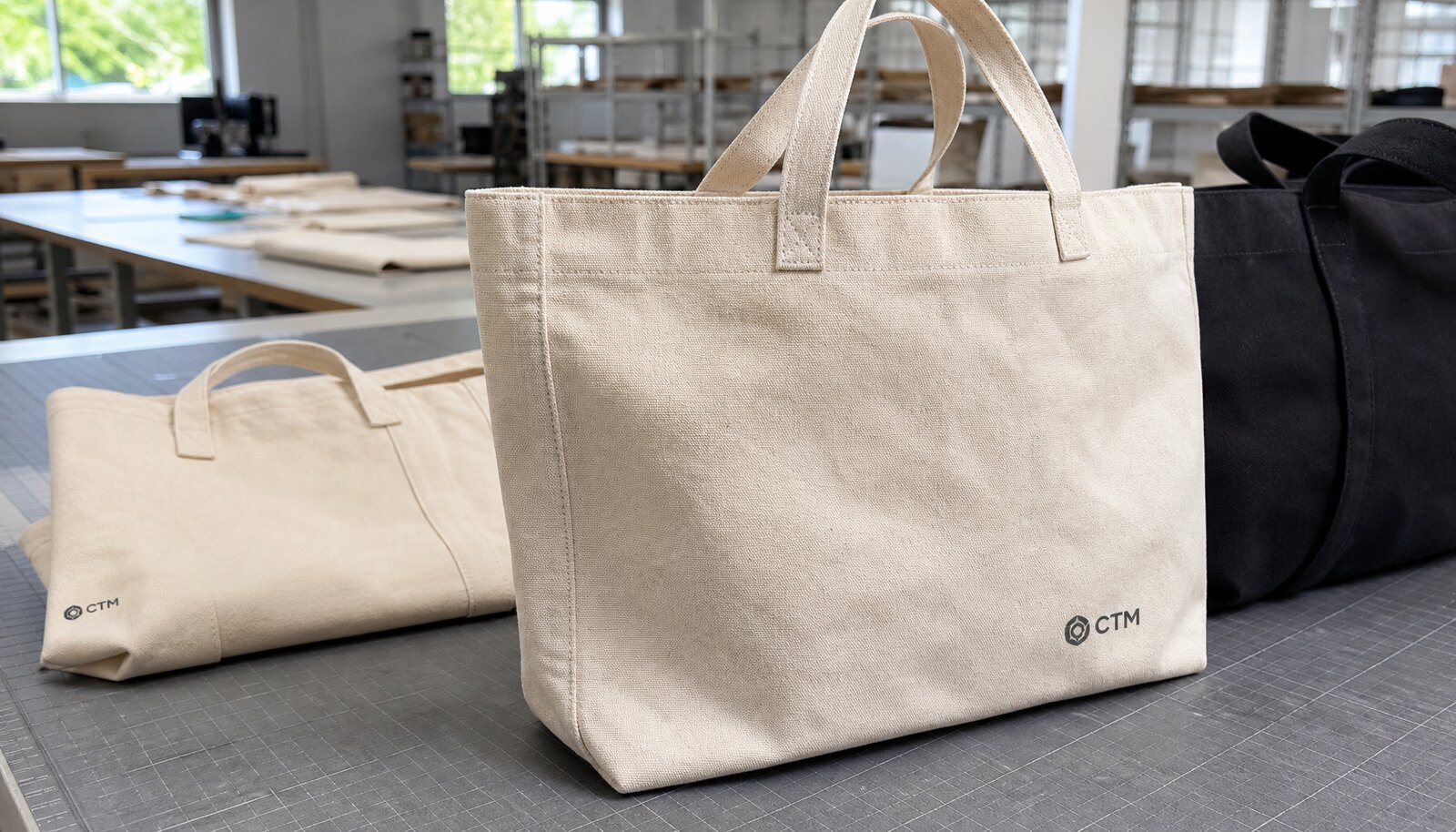
1. Start with the retail job, not the bag
For retail chains, heavy canvas tote bags are not a generic promo item. The first sourcing mistake is to buy a bag that looks good in a photo but cannot survive store handling, replenishment, and repeat customer use. Before you compare suppliers, define the job: is this a checkout add-on, a private-label SKU, a seasonal launch, or a reusable carrier tied to a campaign?
That use case drives the spec. A tote sold as a retail SKU needs stronger perceived value, cleaner stitching, and more consistent print placement than a giveaway bag. If the chain wants the bag displayed on shelf, the body needs enough structure to stand and the fabric must not look limp under retail lighting.
- Retail checkout item: prioritize fast replenishment, moderate GSM, and low defect rate.
- Private-label SKU: prioritize print quality, packaging, and shelf-ready appearance.
- Gift-with-purchase or launch item: prioritize cost control and carton efficiency.
- Campaign bag with a short life cycle: prioritize MOQ flexibility and quick art approval.
2. Choose canvas weight by shelf feel and real use
For most retail chains, 10–12 oz canvas is the practical starting point. It gives enough body for a cleaner shape, supports simple branding, and keeps unit cost under control. If the bag must feel more premium on shelf or carry heavier items, move to 14 oz, but understand that the sewing gets harder, freight weight rises, and the factory may need more time on the stitch line.
Do not specify GSM only because it sounds technical. Tell the factory the actual retail target: whether the bag should stand upright, whether it will carry apparel, books, or groceries, and whether the customer is expected to reuse it many times. That context helps the supplier recommend the right weave and reinforcement instead of just quoting the cheapest cloth that meets a number.
- 10 oz: good for controlled cost, lighter retail baskets, and higher-volume launches.
- 12 oz: common balance point for retail chains that want better body without a large cost jump.
- 14 oz: better shelf presence and perceived value, but higher material and sewing cost.
- Lighter than 10 oz: only if the item is clearly promotional and not sold as a durable retail tote.
3. Compare sourcing routes before you compare quotes
A retail chain usually has three sourcing routes: direct factory, trading company, or local stockholder. Direct factory sourcing is the cleanest path when the spec is fixed and the chain wants control over fabric, print, and packaging. The cost is usually better, and the factory can explain production limits more honestly because it owns the sewing line.
Trading companies are useful when you need mixed products, multiple packaging formats, or consolidated shipments across categories. Local stockholders can solve urgent replenishment, but they often have less control over exact canvas weight, shade, and print consistency. If your retail launch depends on a specific branded look, do not compare only unit price; compare who actually owns the production risk.
- Direct factory: best for repeat retail programs and tighter spec control.
- Trading company: best when you need one contact for mixed-category procurement.
- Local stockholder: best for urgent replenishment, not ideal for locked brand specs.
- For chain launches, ask who approves fabric, printing, and final packing at source.
4. Use a comparison table that actually changes the order decision
When buyers review heavy canvas tote bags for retail chains retail launch buying guide quotes, they should compare more than price and MOQ. The useful decision is often between a lower-cost route with more variance and a slightly higher-cost route with better print control and fewer receiving issues. The right table forces the supplier to show what is included and what is missing.
A good comparison also exposes hidden costs. A quote that looks cheaper per unit may exclude print setup, overage allowance, inner packing, or carton marking. If those items are not visible in the RFQ, the first shipment may be technically on time but operationally unusable for the distribution center.
5. Lock print method before artwork approval
For a retail launch, screen print is usually the safest method when the logo is simple and the order volume is meaningful. It delivers stable color and better unit economics than many decorative methods. Heat transfer can work for short runs or more detailed artwork, but it needs stricter control on adhesion and placement. Embroidery gives a premium look, yet it adds cost, changes the handle feel near the area, and can distort on thinner canvas if the stitch density is not managed.
The mistake to avoid is approving artwork before the factory has confirmed printable area, safe margins, and ink behavior on the chosen fabric. Heavy canvas absorbs differently from lighter cotton, so a color that looks correct on screen can dry darker or softer in production. Tie the print spec to the bag size, not just to the logo file.
- Screen print: best for 1–2 color brand marks and volume launches.
- Heat transfer: useful for short runs, gradients, or temporary retail programs.
- Embroidery: suitable for premium positioning, but request a stitched sample first.
- State print location tolerance, maximum color count, and approved Pantone reference if needed.
6. Build the quote around material, sewing, and packing cost drivers
A useful factory quote for canvas totes should break out more than one unit price. The important cost drivers are fabric weight, handle construction, print method, packing format, and order quantity. A direct factory may quote a lower bag price but add charges for larger prints, woven labels, or customized inner packing. If those line items are not visible, the buyer cannot compare suppliers fairly.
Ask for landed-cost inputs, not just FOB or ex-works. Carton size and gross weight affect freight cost. Overly bulky packing can wipe out a small unit-price advantage. For retail chains, the real number is the cost to receive, store, and allocate the tote into stores without repacking. That is the number procurement should present to merchandising and finance.
- Separate fabric cost from print setup when evaluating multiple suppliers.
- Request carton dimensions and gross weight for freight planning.
- Confirm whether overage allowance is priced or only permitted.
- Ask whether inner polybags are included or optional.
7. Set MOQ logic from artwork and production efficiency
MOQ for heavy canvas totes is not only about fabric purchase volume. It is also driven by print setup, machine changeover, handle cutting, and packing labor. A single-color logo in one size can often tolerate a lower MOQ than a multi-color design with large coverage or mixed variants. The factory needs enough quantity to run fabric cutting efficiently and reduce setup waste.
For a retail chain launch, the best MOQ is the one that protects continuity, not just the one that looks low. If the initial store rollout is small, a supplier with a slightly higher MOQ may still be the better choice if they can keep the same fabric lot and re-run the same print without shade drift. For chains that plan reorders, ask how they manage repeat lots and whether they keep cloth reserve or print records.
- Simple one-color logo: usually the easiest path to a practical MOQ.
- Multiple SKUs or colorways: expect higher MOQ or extra setup charges.
- Repeat program: ask whether the factory can match prior fabric shade and print placement.
- If MOQ is very low, inspect whether the supplier is using stock fabric or a standard base bag.
8. Approve samples like a retail QC team, not a merch photo shoot
Retail buyers should approve three things before bulk: a blank sample, a print strike-off, and a sewn pre-production sample. The blank sample confirms size, handle length, and fabric hand-feel. The strike-off confirms ink coverage, logo sharpness, and color on the chosen canvas. The pre-production sample confirms that the factory can assemble the bag without drifting from the approved dimensions.
Write sample acceptance criteria in plain language. For example, state whether the logo may move by a small tolerance, whether the handle length must match exactly, and whether shade variation is acceptable between panels. If the sample is approved informally by email with no reference photo, the bulk order is exposed to avoidable disputes when the first cartons arrive.
- Measure overall size, gusset depth, and handle drop on the sample.
- Inspect both sides of the print for alignment and coverage.
- Check inside seams for loose threads and skipped stitches.
- Sign off the sample with a dated reference photo and saved measurement sheet.
9. Packaging and carton marking decide warehouse acceptance
For retail chains, packing is not an afterthought. The distribution center needs clear carton labeling, predictable pack counts, and a format that supports fast receiving. Bulk polybag packing is usually enough unless the tote is sold as a premium standalone item on shelf. If the tote is going straight to stores or backroom inventory, over-customized retail packaging can create labor cost without improving sell-through.
Make sure the supplier understands the destination. Store replenishment, DC intake, and e-commerce fulfillment each need different carton and label logic. A bag packed well for export but badly for the retailer’s system still causes delays. The carton should carry PO number, SKU, color, quantity, and country of origin format required by the buyer.
- Use one carton pack count per SKU if possible to reduce receiving errors.
- Ask for barcode-readable labels if the chain scans cartons at intake.
- Confirm whether polybags need suffocation warnings or retail-specific marks.
- Require carton dimension and gross weight in the final packing list.
10. Control lead time by controlling the approval path
Lead time for heavy canvas tote bags often slips because the buyer approved the wrong sample too early or changed artwork after fabric was cut. The realistic schedule starts with art confirmation, then sampling, then bulk fabric reservation, then sewing, printing, inspection, and packing. If the retail launch date is fixed, build a buffer for peak season, especially when the factory is balancing multiple tote and pouch programs.
A short lead time quote is only credible if the factory can explain its daily output and what happens when print plates, threads, or fabric are delayed. Ask for the sequence, not just the date. If the supplier cannot describe when each approval happens, they usually do not have a controlled retail production plan. For chain programs, that is a schedule risk, not just an operations detail.
- Typical schedule components: artwork approval, sample approval, bulk production, inspection, and export booking.
- Push for a clear cut-off date for art changes.
- Confirm whether the factory reserves fabric before sample approval.
- Ask what part of the lead time is factory-controlled versus shipping-controlled.
Specification comparison for buyers
| Spec decision | Recommended option | When it fits | Buyer risk to check |
|---|---|---|---|
| Canvas weight | 10–12 oz for standard retail, 14 oz if the chain wants a more structured premium feel | Shelf display, fashion retail, bookstores, gift, and checkout merchandising | Too light and the bag collapses; too heavy and unit cost, sewing difficulty, and freight weight rise |
| Body construction | Single-layer canvas with reinforced stress points and a clean hem; add lining only if product protection matters | General retail launch where price point must stay controlled | Lining adds cost, lead time, and more sewing defects; it is often unnecessary for carry totes |
| Handle spec | Self-fabric handles or cotton webbing handles with bartacks at load points | High-traffic retail use and repeat carry | Short handles hurt usability; weak bartacks fail in store use and create returns |
| Print method | Screen print for simple 1–2 color logos; heat transfer only for short runs or detailed artwork; embroidery for premium positioning | Retail launches with clear brand marks and moderate volumes | Ink cracking, poor color matching, and print placement drift are common if artwork and placement tolerance are not written into the PO |
| MOQ route | Direct factory production for volume launches; trading company only if consolidation or mixed-category sourcing is needed | Chains that need steady repeat orders and consistent specs | Mixed sourcing can hide true factory capacity and make QC ownership unclear |
| Packaging | Bulk polybag with carton labeling for warehouse distribution; retail hangtag only if the chain will sell the tote as a standalone SKU | Backroom replenishment and store-level allocation | Overpacking wastes labor; under-labeling causes receiving errors and SKU mix-ups |
| Sample approval path | Pre-production sample with print strike-off and size reference sample before bulk start | Any launch with brand artwork or strict retail presentation | Skipping sample approval usually leads to off-center logos, wrong shade, or handle length errors |
| Carton strategy | Export master cartons with clear barcode, PO, color, and quantity marking | Multi-store distribution and DC intake | Weak carton marking slows receiving and raises mis-ship risk |
| Sourcing route | Direct OEM/ODM factory for controlled spec and lower unit cost at scale; local stockholder for emergency replenishment | Planned launches vs urgent in-season restocks | Stockholders can hide material variance and offer less control on exact GSM and print consistency |
Buyer checklist before sampling
- Define the retail use case: checkout add-on, seasonal gift item, private-label SKU, or campaign tote with a short sales window.
- Lock the fabric weight target in ounces or GSM, and state whether the bag must stand upright on shelf.
- Specify finished size, handle length, seam allowance, and whether bottom gusset or side gusset is required.
- Choose one primary print method and state the maximum number of colors and allowed placement tolerance.
- Set the packing standard for warehouse intake, including inner polybag use, carton pack count, and label format.
- Request a pre-production sample, a print strike-off, and a size reference sample before bulk approval.
- Confirm the factory’s realistic output per day, not just monthly capacity, if the retail launch date is fixed.
- Ask for landed-cost details separately: ex-works price, carton size, gross weight, inland freight, and shipping mode assumptions.
Factory quote questions to send
- What exact canvas construction are you quoting: fabric weight, yarn count if available, weave type, and whether the fabric is pre-shrunk or washed?
- Is the quoted price based on finished size or cut size, and what sewing allowance is included?
- Which print method is included in the quote, how many colors are priced, and what is the surcharge for extra colors or larger print areas?
- What is the MOQ by color, by artwork, and by order value, and can you combine colors in one production run?
- What sample types do you provide before bulk: blank sample, print strike-off, sewn pre-production sample, or full approval sample?
- What is the expected bulk lead time after sample approval, and what causes schedule extension during busy season?
- How are the bags packed for export, what is the carton quantity, and can you provide carton dimensions and estimated gross weight?
- What QC standard do you use for measurement tolerance, stitch defects, print misalignment, and needle damage?
- Can you share a real production photo set, inspection report, or packing example from a similar retail tote order?
Quality-control points to confirm
- Finished size tolerance should be written into the PO; keep critical dimensions within a practical retail range and reject bags that are visibly distorted.
- Handle attachment must include dense bartacks or reinforced stitching at both ends; pull test the strap area on a small sample lot.
- Print placement should stay centered within an agreed tolerance; reject obvious skew, blur, wash-through, or inconsistent ink coverage.
- Canvas surface should be free of oil stains, broken threads, heavy slubs in visible areas, and fabric shade variation across cartons.
- Seams should stay straight and closed at stress points; corner gaps and skipped stitches are a common failure on heavy canvas if the machine setup is rushed.
- Carton contents should match the packing list by color and SKU; verify count, barcode readability, and carton markings before dispatch.
- Pre-production approval should lock fabric shade, handle length, logo size, and any label position so bulk cannot drift from the signed sample.