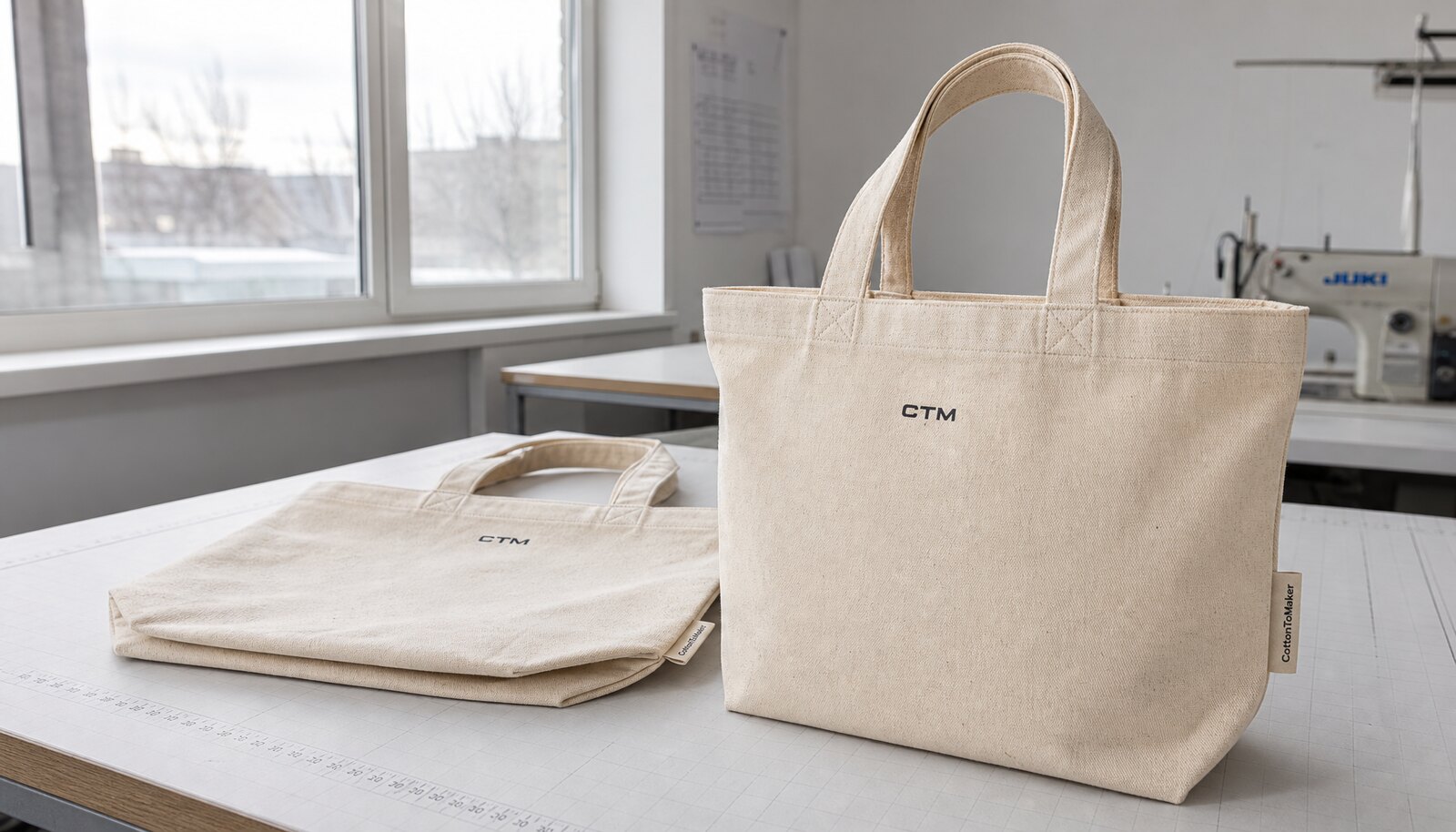
1. Why museum tote orders fail in the real world
Museums do not buy canvas totes the same way a fashion brand or charity event does. The bag has to sit on a retail shelf, feel substantial in the hand, carry books or exhibition catalogues without complaint, and still leave enough margin for store operations. That mix makes heavy canvas tote bags for museums unusually sensitive to small production mistakes. A slightly crooked logo, weak handle reinforcement, or fabric that feels thin after stitching can change how the bag sells and how the store staff talk about the line.
The most common mistake is to treat the tote as a simple promotional item. In museum retail, it behaves more like a low-ticket merch product with brand meaning. That means the buyer should evaluate not only price and lead time, but also shelf presence, re-order consistency, carting capacity, and the chance of retail returns or customer complaints. A bag that survives transport but looks sloppy on a pegboard is still a bad buy.
Another reason museum totes fail is the gap between approved sample and production reality. A sample may be sewn by a senior operator using clean material and extra attention, while bulk output runs faster with different fabric lots and less careful finishing. If the inspection plan does not lock the sample, the fabric lot, and the packing method together, the order can drift even when the supplier technically shipped the right style.
- Retail failure is often visual before it becomes functional: the bag can be usable but still unsellable if it looks inconsistent.
- Museum tote programs usually need more control than giveaway bags because visitors judge them as merchandise, not swag.
- The best quality system starts with the retail use case: what the bag must carry, where it sits, and what a customer notices first.
2. Set the tote spec from the museum use case, not from a generic sample
A museum shop tote used for carrying books and exhibition catalogues needs a different build from a light souvenir bag. Before asking suppliers for prices, define the contents you expect the bag to carry. If the tote is meant for paperbacks, postcards, and a small catalog, a 12 oz canvas may be enough. If the bag should comfortably carry hardback books or boxed merch, 14 oz is a safer default. If the museum wants a more premium hand feel, a thicker wall, and a bag that stands up more cleanly on display, 16 oz can be justified.
Size matters as much as fabric. A tote that is too shallow may look neat but becomes inconvenient in the store because it cannot take the products staff are trying to bundle. A tote that is too wide or tall may look generous but feel floppy and cost more in freight. For many museum programs, the useful working range is around 14 x 16 in to 16 x 18 in, with gusset depth selected by actual contents rather than habit.
Also decide whether the bag is meant to be sold as a fashion-like retail item or used as a practical carry-all. If it is a retail item, the print needs to read clearly from arm’s length and the handle should hang evenly on a rack. If it is functional event carry, durability and packing efficiency matter more than visual premium. Procurement gets easier when the product role is written down before the quote goes out.
- Define intended contents: books, catalogs, framed prints, stationery kits, or mixed souvenirs.
- Choose size around the merch you actually sell, not a generic tote template.
- Write whether the bag is a retail product, a gift-with-purchase, or a membership item, because the QC standard will differ.
3. Fabric weight, weave, and finish: what to ask for and what to verify
Heavy canvas tote bags are often quoted by ounce weight, but that number can be slippery unless you pin it down. Ask for both oz and gsm, plus the basis of measurement. Finished fabric weight after treatment is not the same as greige or prewash fabric weight, and shrinkage can change the finished bag dimensions even if the supplier claims the fabric specification is unchanged.
For most museum retail orders, 12 oz to 16 oz cotton canvas is the practical range. Twelve ounce fabric can work when cost pressure is high and the bag does not need to carry much weight. Fourteen ounce is often the best balance for museums because it supports a better hand feel, cleaner printing, and enough strength for day-to-day retail use without pushing the landed cost too far. Sixteen ounce is more robust and gives a more premium look, but it also increases material cost, sewing effort, and freight volume.
Weave quality matters as much as nominal weight. A loose, uneven weave can make a 14 oz bag look less premium than a tighter 12 oz bag. Ask for fabric photos in natural light and request a fabric verification document from the mill or from the factory’s incoming QC system. If the supplier cannot say where the fabric came from, the buyer is taking too much on faith. For museum orders that carry books, the fabric should also be checked for recovery after folding and for dimensional change after steam or wash.
The buyer should set a simple acceptance target before mass production begins. For example: confirm fabric weight within a narrow lot tolerance, confirm no visible shade banding, and confirm shrinkage below an agreed limit. That is more useful than a vague statement that the canvas should feel 'thick' or 'premium.'
- Ask for fabric weight in oz and gsm, plus measurement basis: finished, washed, or prewash.
- Request a lot-level fabric check, not only a sample swatch approval.
- Use shrinkage and weave stability as buying criteria because they affect bag size and shelf presentation.
4. Print, label, or embroidery: choose branding that survives museum retail handling
Museum tote artwork often looks simple on a screen but becomes demanding in production. A clean one-color logo can still fail if the print sits too close to the seam, if the screen is stretched, or if ink curing is weak. Screen printing remains the most practical method for most museum programs because it handles strong branding, short slogans, exhibition marks, and simple illustration work at a sensible cost. It also gives the buyer a clearer path to sample approval than more complex decoration methods.
If the museum wants a premium feel, a woven label or a sewn side label can be added, but it should not be used as a shortcut for unreadable front branding. Buyers sometimes ask for embroidery on heavy canvas because it sounds durable, but embroidery introduces its own risk: thread tension, puckering, artwork simplification, and cost escalation. Use embroidery when the design is simple enough to survive stitch translation and when the retail price can absorb the upgrade.
The approval rule should match the decoration method. For screen print, lock placement tolerance, color reference, and registration limits before bulk production. For woven labels, define label size, stitch position, and edge finishing. For embroidery, require a stitch-count or density guide, because a design that looks clean in a mockup may become too dense or too flat on the real bag. Museums that sell multiple exhibition lines should also ask whether the supplier can keep logo placement and color consistency across repeat orders, not just on the first run.
- Use screen print for bold museum logos and simple art.
- Use woven or side labels for subtle premium branding, but keep the main identity readable.
- Use embroidery only after checking artwork simplification, stitch density, and puckering risk.
5. Supplier comparison: direct factory, trading company, or local converter
The right supplier route depends on how much control the museum buyer needs over materials and workmanship. Direct factory sourcing is usually the strongest option for custom retail totes because one plant can control sewing, print, packing, and in-process inspection. That makes it easier to investigate problems when they appear, and it gives the buyer a cleaner path to corrective action if the lot fails. The downside is that the buyer has to do more supplier qualification upfront.
Trading companies can be useful when the museum needs multi-item sourcing, mixed merchandising packs, or help with consolidated shipping. They may also be helpful for buyers with lower order frequency or limited sourcing staff. The risk is not that trading companies are inherently bad; the risk is that they may not own the process. If they cannot disclose the actual sewing and printing partner, or if they cannot show QC evidence from that partner, the quote is not strong enough for a museum retail order.
Local converters or domestic printers can make sense when the bag is needed quickly, when the artwork is simple, or when a buyer wants easier communication for a short-run event. They may cost more per unit, but the total risk may be lower if the museum needs a small run for an opening, conference, or seasonal shop display. The decision should be based on order size, lead time pressure, and the cost of a missed launch date, not on unit price alone.
6. What a supplier quote should contain before you compare numbers
A museum buyer cannot compare tote quotes accurately if one supplier bundles everything and another leaves half the cost hidden. Ask for the commercial quote in line-item form. At minimum, it should separate fabric, cutting and sewing, printing or decoration, label application, packing, carton materials, sample fees, setup charges, and any third-party testing. If inland freight, export documentation, or local taxes apply, those should be shown clearly too.
The quote should also show whether costs are one-time or recurring. Screen setup and artwork setup are one-time expenses. Fabric, sewing, print labor, and packing are recurring. This split matters because a quote that looks expensive on the first order may be more competitive on replenishment. Museum procurement teams often need reorders after seasonal sell-through, and the cheapest first-order quote may become the most expensive total program.
Ask for quantity breaks that reflect your actual buying pattern, not just a random 5,000-piece tier. If the museum usually buys 500 to 2,000 units per run, the supplier should quote those levels. A quote built around huge volume can hide a weak mid-tier price or make the buying team over-forecast demand. Good procurement is about matching supplier behavior to real sell-through, not chasing a low headline number.
Finally, insist on a sample-fee and claim policy before the RFQ closes. If the factory wants payment for every sampling stage, ask what is refundable on bulk order. If the supplier refuses to state correction responsibility for failed production, the buyer may be carrying all the downside. That is especially risky for museum launches tied to exhibition dates.
- Require separate lines for recurring cost and one-time setup cost.
- Compare mid-tier quantity pricing, not only the largest MOQ tier.
- Ask for sample fee, tooling fee, and replacement policy before approval.
7. Sample approval workflow: the control point buyers most often rush
A good sample is not a blank tote with the right logo. It should represent the exact construction you expect in bulk: same fabric lot or equivalent approved fabric, same sewing method, same print method, same handle reinforcement, and same packaging style. If the supplier changes any of those between sample and production, the sample has limited value as an approval reference.
For museum buyers, the safest workflow is three stages. First, confirm the fabric and construction plan before decoration. Second, approve a pre-production sample with actual artwork and actual packing. Third, seal a gold sample and attach it to the PO or technical pack. This is not paperwork for its own sake; it is the simplest way to reduce argument if the bulk lot arrives with a different shade, weaker handle, or different folding method.
Sample approval should be written down in operational terms. Record measured dimensions, stitch count, print location, handle length, and observed defects. If the supplier says the bulk order will match the approved sample 'within tolerance,' the tolerance should already be in the buyer's document. Do not let the factory define the rule after the sample is accepted.
Museums that run multiple exhibitions should also ask for repeatability proof. If the tote will be re-ordered later, request the factory to note the approved fabric source, screen setup, and label code so the next production can match the first. That reduces the risk of a second batch looking like a different product on the same shelf.
- Approve the exact construction, not only the artwork.
- Keep one sealed gold sample and one photo set with dimensions and notes.
- Write tolerances into the sample approval document before the PO is released.
8. Inspection checklist with measurable pass/fail points
Quality inspection for heavy canvas tote bags should be built around measurable criteria, not vague impressions. Start with dimensions, then move to workmanship, print, load strength, packing, and carton traceability. A bag that looks fine on a table can still fail in the store if the handles twist, the print rubs off, or the size is inconsistent across cartons.
For dimensions, set a tolerance that reflects the real use case. Many buyers can work with ±0.25 in on finished width and height and ±0.12 in on gusset depth, but if the tote must fit a specific retail insert or display fixture, the tolerance may need to be tighter. The key is to state the number before production, not after inspection finds a problem.
For sewing, do not inspect only for thread ends. Measure stitch density at key seams and check whether reinforcement is placed where the load will actually sit. The top hem, handle attachments, and bottom seam are the stress points that determine whether the tote feels sturdy in the hand. Ask the factory to state the stitches per inch and the reinforcement pattern, and then verify the lot at inspection.
Load testing should be tied to real museum use. If the tote is likely to carry books or catalogues, a static load test of 10 kg held for 30 minutes is a sensible benchmark, with a tougher 15 kg spot test on samples if the use case is heavier. The inspection report should note whether the seam opened, the handle elongated, or the shape distorted beyond acceptable limits.
Print quality should be checked under daylight, not under dim warehouse lighting. Look for registration error, ink bleed, weak curing, and placement drift. For simple logo work, a placement tolerance of ±2 mm is a practical buyer standard. If the artwork is more complex, define the acceptable visual drift in the PO rather than letting the supplier decide after the run.
For a buyer-friendly inspection system, classify defects by impact. Critical defects stop shipment: wrong artwork, missing handle, torn fabric, contamination that makes the bag unsaleable, or carton count mismatch if it creates channel problems. Major defects affect function or shelf appearance: open seams, severe print misregistration, failed load test, size out of tolerance, or wrong label application. Minor defects are cosmetic but still count: loose threads, slight fold marks, small label drift, or small shade variation. That matrix makes the final decision much easier than a generic pass/fail note.
9. Carton packing, drop resistance, and receiving control
Packing affects complaints more than many buyers expect. If a tote is tightly folded in inconsistent ways, the front panel can take permanent crease marks, the print can scuff, or the bag may arrive looking older than it is. For museum retail, that matters because these products are handled by staff and displayed quickly after receiving. A neat, repeatable fold pattern is part of the product, not an afterthought.
Decide early whether you want individual polybags. Some museum channels prefer them for cleanliness and easier shelf handling, while others avoid them for sustainability or waste reasons. Either choice is valid if it is intentional. What is not valid is leaving the decision vague and finding out after packing has started.
Carton labels should do more than look tidy. They should support warehouse receiving and traceability. Each carton should show style, color, size, quantity, PO number, and lot code. If the museum uses multiple shops or a central warehouse, barcode labels are worth the small extra cost because they reduce receiving errors and simplify replenishment.
If the bags will be shipped through mixed freight or parcel networks, ask for a carton drop test standard. A practical buyer request is a 60 cm drop on three faces, three edges, and one corner, with cartons staying intact and goods inside not creased, crushed, or shifted into damage. If the freight route is harsher, the carton grade should be upgraded rather than hoping the bags will survive by luck. If cartons fail, the problem is not only the outer box; it is the receiving delay, repacking labor, and retail schedule disruption that follows.
- Approve fold method and packing units before mass packing starts.
- Use carton labels that support traceability, not just shipping compliance.
- Match carton strength to the real freight route, including parcel or mixed handling if relevant.
10. Escalation steps when a lot fails inspection
The strongest procurement process is not the one that never sees a problem; it is the one that knows exactly what to do when the problem appears. For museum tote bags, the escalation plan should be written before production starts. If the inspection finds critical defects, the lot should be quarantined. If it finds repeated major defects, the factory should stop, review the cause, and correct the process before more pieces are packed.
The claim path should be simple and documentary. Ask for inspection photos, defect counts by type, carton photos, and lot identifiers. Then decide whether the remedy is rework, remake, credit, or partial shipment. If the order is tied to an exhibition opening, the buyer may choose a partial release only if the released lot meets the agreed standard and the balance is clearly separated. That decision should be made by procurement and merchandising together, not by the factory alone.
Payment protection matters too. Where order size and timing justify it, use a structure that retains some leverage until inspection is complete. A holdback, final-payment release against passed inspection, or written replacement obligation can all reduce exposure. The exact structure depends on supplier relationship and payment norms, but the principle is the same: do not fully surrender leverage before the goods are cleared.
For repeat museum programs, keep a supplier scorecard. Track on-time sample approval, defect rate by lot, response time on claims, and consistency of fabric and print between runs. That scorecard is more useful than a one-time approval note because museum retail is repetitive: if one tote line works, the next season often depends on the same factory behavior.
- Quarantine failed lots and identify them by carton and lot code.
- Collect photo evidence and a written defect tally before discussing remedy.
- Use payment leverage and written claim terms to protect launch schedules.
Specification comparison for buyers
| Procurement decision | Practical recommendation | Why it matters for museums | Acceptance / verification point |
|---|---|---|---|
| Fabric weight and hand feel | 14 oz canvas is the safest default; 12 oz can work for lighter retail, 16 oz for premium or book-heavy use | Museums need a tote that feels worth buying at the gift shop, carries catalogs or books, and still prices competitively | Ask supplier to quote finished gsm and oz, plus shrinkage. Verify actual lot weight by weighing 5 random cuts from bulk fabric; each cut should be within ±5% of the approved sample average |
| Weave density and fabric stability | Tight plain weave with low visible slub count and controlled shrinkage | Loose canvas looks inexpensive on shelf and can distort after sewing or packing | Request weave photos under daylight, and require a shrinkage test from raw fabric to finished bag. Typical acceptable shrinkage should be no more than 3% lengthwise and 5% widthwise unless otherwise approved |
| Supplier route | Direct factory for custom retail programs; trading company only if they show the actual mill and sewing partner | Museum buyers need traceability when print, sewing, and packing problems show up after launch | Ask for factory license, sewing-line photos, subcontracting disclosure, and at least one recent in-house inspection report |
| Print method | Screen print for most museum logos; woven label for subtle branding; embroidery only for simplified artwork | Simple logos and exhibition marks are easier to keep crisp and repeatable than photo-style art | Require a strike-off or decorated pre-production sample. Accept print registration within ±2 mm on simple logos and color match within Delta E 2.5 to 3.5 if PMS is specified |
| Handle construction | Self-fabric or webbing handles with box-X or bar-tack reinforcement at each attachment point | Museum totes often carry books, catalogues, and souvenirs, so handle failure becomes a customer complaint quickly | Confirm stitch density, reinforcement pattern, and a load test of at least 10 kg held for 30 minutes without seam opening or visible distortion |
| Bag dimensions and gusset | Choose finished dimensions around 14 x 16 in to 16 x 18 in with gusset based on product mix | Shelf fit and usable volume matter when the bag is sold alongside books, framed prints, or bundled merch | Approve finished dimensions with a tolerance of ±0.25 in (±6 mm) for width/height and ±0.12 in (±3 mm) for gusset depth unless your packaging system needs tighter control |
| Inspection method | AQL-style pre-shipment inspection with measurement, workmanship, print, packaging, and carton tests | Visual count alone misses the defects that trigger returns or retail complaints | Use a written defect matrix: zero tolerance for missing handles, torn fabric, wrong artwork, or severe contamination; major defects at AQL 2.5 and minor defects at AQL 4.0 as a working benchmark unless your internal standard is stricter |
| Packing and carton control | Flat fold, size sticker, barcode, and master carton count agreed before production | Museum stores and warehouse teams need quick receiving and clean replenishment | Verify carton content counts, carton marks, and a drop test of the outer carton from 60 cm on three faces, three edges, and one corner if the bags are shipping through normal parcel or mixed freight channels |
| Commercial risk protection | Use sample approval, inspection hold points, and claim language in the PO | If the order misses the retail launch date, the hidden cost is bigger than the bag price | Keep one sealed gold sample, require photo evidence before shipment, and state replacement or credit terms for failed lots in the purchase order |
Buyer checklist before sampling
- Define the museum use case first: retail shelf item, membership gift, event handout, or book-carrying retail purchase. The same bag spec rarely fits all four well.
- Write the finished size, gusset depth, handle length, and target load in the RFQ. A flat sketch is not enough to protect fit or shelf presentation.
- State fabric weight in both oz and gsm, and specify whether the number is finished fabric or prewash fabric. Ask the supplier to show how they calculated it.
- Ask for the weave count, shrinkage expectation, and whether the fabric is bleached, natural, dyed, or garment-washed.
- Lock the artwork format before quoting: Pantone references, line thickness limits, minimum font size, logo placement tolerance, and whether the art is one-side or two-side print.
- Require a real pre-production sample made from the same fabric, same stitching method, same print method, and same packing method as bulk production.
- Compare supplier routes on evidence, not promises: factory license, sewing-line photos, subcontractor disclosure, recent QC report, and sample-room ownership.
- Ask for a line-by-line commercial quote that separates fabric, sewing, print setup, label, packing, carton, testing, and inland freight.
- Agree the test standard before bulk production: size tolerance, stitch density, seam strength, load test, print rub test, carton drop test, and defect classification.
- Include the claim path in the PO: what happens if the shipment fails inspection, arrives short, or has wrong artwork or carton count.
Factory quote questions to send
- What is the exact finished fabric specification in oz, gsm, and weave count, and is it measured before or after finishing or washing?
- Which print method are you quoting, and what is the setup charge, repeat charge, and color limit per artwork version?
- What are the exact finished dimensions, gusset depth, handle length, top hem width, and seam reinforcement pattern?
- What fabric source will you use, and can you provide mill name, lot number, or fabric verification document for the approved batch?
- What pre-production sample stages do you offer, and will the sample include actual material, actual print, actual label, and actual packing?
- What inspection standard do you use before shipment, and can you share a defect matrix or AQL-style report template?
- Can you show photos or videos of your sewing line, printing line, and carton packing area for the actual order location?
- How many pieces per carton, what is the carton size and gross weight, and can carton marks and barcode labels match our retail receiving format?
- What are your payment terms, and will you accept a holdback, final-payment release against inspection, or replacement for failed lots?
- If the lot fails, what is your rework, remake, credit, or claim process, and who pays for the correction and reshipment?
Quality-control points to confirm
- Finished size: measure 5 random bags per lot for length, width, and gusset. Accept within ±0.25 in (±6 mm) for width and height, and ±0.12 in (±3 mm) for gusset unless your packaging system needs tighter control. Record results by lot, not by carton only.
- Fabric verification: compare bulk fabric against the sealed approved sample. Check weight consistency, visible weave density, shade, slub level, and shrinkage. A practical shrinkage limit is no more than 3% lengthwise and 5% widthwise after test wash or steam treatment, unless your spec requires otherwise.
- Stitch density: measure stitches per inch at side seams, top hem, and handle joins. A workable target is 7 to 9 SPI for standard heavy canvas construction, with no skipped stitches, broken thread, or loose backtacks at stress points.
- Handle reinforcement: inspect each handle attachment for box-X or bar-tack reinforcement. Pull each sample handle under load and verify no seam opening, thread snap, or panel tearing. As a working benchmark, the bag should hold 10 kg for 30 minutes without structural failure and 15 kg static load for 10 minutes on sample bags if your use case includes books.
- Seam strength: check side seam and bottom seam opening after loading. No visible gap, wavy seam failure, or needle damage is acceptable in critical stress zones.
- Print quality: verify color, placement, registration, and opacity under daylight. For simple logo work, accept placement within ±2 mm of the approved position. Screen print should not show pinholes, heavy ink pooling, wet transfer, or edge feathering. If PMS colors are specified, request a Delta E target of 2.5 to 3.5 or better depending on artwork sensitivity.
- Rub resistance: conduct a dry rub test and a light wet rub test on the printed area. A practical buyer threshold is no visible transfer after 50 dry rub cycles and no obvious smearing after 10 wet rub cycles on a white cloth, unless your brand team sets a stricter internal requirement.
- Fabric defects: reject holes, oil stains, broken yarns, severe slubs, shade bars, and contamination visible from arm’s length under normal light. Minor surface irregularities should be counted and sampled by defect class, not ignored.
- Construction symmetry: check handle alignment, panel square, top hem straightness, and bag stand-up behavior. A retail tote that leans, twists, or collapses looks cheap even when it passes size checks.
- Packing integrity: verify folding method, protective insert if needed, barcode location, carton count, and whether printed surfaces are protected from scuffing. If bags are polybagged, confirm ventilation and retail policy compliance.