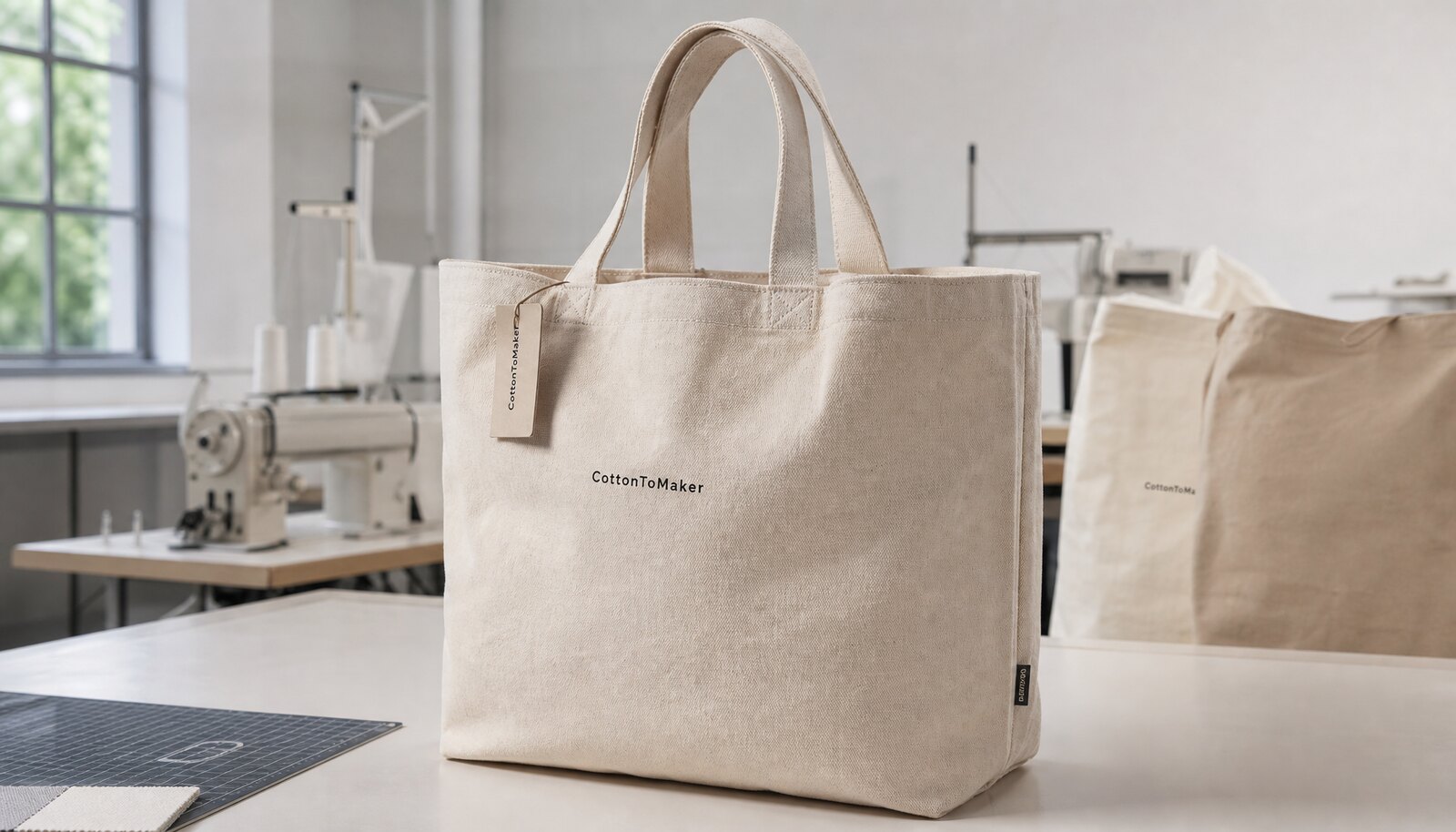
What museum buyers actually need from a heavy canvas tote
Museum tote programs are not judged like generic promo giveaways. The bag has to do three jobs at once: move merchandise safely, present the institution well at retail, and feel durable enough that a visitor keeps using it after the visit. That is why heavy canvas tote bags for museums sit in a sweet spot between souvenir and daily-use accessory. They look substantial on shelf, take imprint well, and usually have enough body to hold books or catalog purchases without collapsing into a thin, promotional shape.
For museum retail buyers, the starting question is not “What bag can we source cheaply?” It is “What will the bag be asked to carry, where will it be displayed, and how will it be replenished?” A tote for an exhibition opening may be judged on visual impact and date-specific artwork. A core store SKU may need conservative branding, stable reorders, and a format that is easy for staff to fold, count, and replenish. A member-gift tote may need higher perceived value even if the print is simple.
That use-case split matters because museum buyers often source from a broader merchandising plan rather than from a single campaign. A bag selected for general souvenir traffic may not be strong enough for bookstore traffic. A premium heavyweight canvas may look excellent but create unnecessary sewing cost if the tote is only carrying postcards and small gifts. Good procurement means defining the load, the shelf presentation, and the reorder horizon before asking for price.
- For gift shop retail, the bag should stand upright and fold neatly for display.
- For exhibition or membership programs, logo placement must stay consistent across reorders.
- For book-heavy use, handle reinforcement matters as much as canvas weight.
Choose canvas weight by load, structure, and shelf presentation
Heavy canvas tote bags for museums are commonly specified in the 12 oz to 16 oz range, roughly 400 to 540 GSM, but the right choice depends on what is going inside the bag and how the retailer wants it to look on the table. A 12 oz canvas can work well for lighter souvenir assortments, especially when the bag needs to be priced accessibly. It is easier to fold and usually cheaper to sew, which can matter for large retail runs. But it may feel too soft if the tote is expected to hold hardcovers or multiple packaged items.
A 14 oz canvas is often the procurement-friendly middle ground for museums. It gives a noticeably firmer hand, better shape retention, and a more premium feel without pushing the style into a top-cost bracket. In many museum-shop programs, 14 oz is the practical default because it balances perceived value, sewing efficiency, and print clarity. A 16 oz canvas moves the product into a sturdier, more premium category, which can be useful for hero SKUs, higher-ticket gift-shop assortments, or bags that need to stand up well on their own. The trade-off is that heavier fabric increases sewing load, can slow stitching, and usually drives a higher FOB or ex-works price.
The important sourcing question is not just the nominal weight. Ask whether the supplier is quoting raw fabric weight or finished fabric weight, and ask how the canvas is finished. Washed or enzyme-finished canvas can feel different after processing, and a bag that seems firm in a hand sample can behave differently once packed, folded, or printed. Also ask about weave tightness. Two totes labeled 14 oz can print and sew very differently if one has a dense weave and the other is more open.
- 12 oz / about 400 GSM: lighter retail souvenirs, lower cost, easier folding
- 14 oz / about 470 GSM: the most common balance of body and cost for museums
- 16 oz / about 540 GSM: premium hand feel, stronger structure, higher sew load
Decide the tote construction before you ask for artwork pricing
A museum tote quote becomes much clearer when the construction is fixed first. The supplier needs to know whether the bag is flat or gusseted, whether it has an inner pocket, whether the handles are self-fabric or webbing, and whether the tote includes a lining or only a single-layer body. These choices change cutting yield, sewing steps, and the amount of inspection needed. They also affect how the bag hangs in store and how it performs when loaded.
For museum retail, the safest construction is usually a straightforward body with reinforced handles, clean side seams, and enough body to hold shape. Flat totes can work for lightweight souvenirs, but museum buyers often prefer a gusset or depth if the bag is expected to carry books or boxed merchandise. A gusset also helps the tote stand open at the register and gives the bag a more premium retail profile. On the other hand, every extra seam adds labor and another place for defects, so there is no reason to add structure unless the use case justifies it.
Handle construction deserves as much attention as the logo. Ask whether the handles are sewn from the same canvas or from cotton webbing, how they are attached, and how far they drop from the top edge. A handle that looks elegant but is too short for over-the-shoulder carry can create complaints, while a handle that is too long can make a bag feel floppy and less retail-ready. For museum buyers, the right build is the one that looks good on shelf, holds a catalog without strain, and can be reordered with minimal variation.
- Flat tote: lower cost, simpler build, best for lighter loads
- Gusseted tote: better for books and boxed merchandise, better shelf presence
- Self-fabric handle: cohesive look; cotton webbing handle: often better hand comfort and durability
Print method should match artwork, fabric texture, and reorder plans
For most museum logos, one-color or two-color screen printing remains the safest commercial choice. It is durable, relatively cost-controlled, and easy to reorder if the design is kept within standard placement and ink limits. Heavy canvas is forgiving in the sense that it can absorb a strong print, but the surface texture can also distort tiny lettering, fine line work, and tightly spaced icons. If a logo depends on delicate details, ask the supplier for a strike-off or sample print before bulk production.
Screen printing is usually the first option when the museum wants a clear logo on a natural or dyed canvas body. It keeps the visual language simple, aligns well with procurement budgeting, and avoids dependence on more complex finishing steps. For premium gift-shop positioning, a woven label, sewn patch, or small leatherette badge can work well as a secondary brand treatment. That can elevate the tote without forcing a large, high-ink print across the front panel. But these methods add sewing or attachment steps, so they should be treated as a different cost and risk profile, not a minor add-on.
Heat transfer and digital decoration can be useful in special cases, especially when the artwork is too detailed for screen print or when the buyer needs a short-run event item. The limitation is that the factory must prove adhesion, rub resistance, and clean placement on the actual canvas. For museum procurement, the best decoration method is the one that stays stable across reorders, looks sharp under store lighting, and does not introduce avoidable color drift or touch-up work.
- Screen print: best for simple logos, strong contrast, and repeat orders
- Woven label or sewn patch: good for premium gift-shop positioning
- Heat transfer: only if the artwork is complex and the factory can prove rub and adhesion performance
Compare sourcing routes with a real procurement lens
A tote quote should never be compared only by the lowest unit price. The sourcing route changes what is included, who owns technical risk, and how easy it is to control reorders. Direct factories, trading companies, and local decorators all have valid use cases, but they are not interchangeable. A direct factory usually gives the buyer better visibility into cutting, sewing, printing, and packing. That makes it easier to tie quality issues to a specific process and to standardize future orders. A trading company can be useful when the museum is buying several items at once or wants one contact point for coordination, but the buyer should still demand the actual production spec and not rely on a vague product description.
Local decorators or regional print shops can be useful for very small runs, event timing, or domestic fulfillment, but they are not automatically the best choice for a heavy canvas retail tote. Many local shops can decorate well, yet may not be set up for high-volume sewing discipline, carton optimization, or consistent repeat production. Museums that expect the tote to become a core SKU usually benefit from a supplier that can control the full build, from fabric cutting through final packing. If the order is one-off and urgent, the trade-off may be worth it. If the bag will be reordered seasonally, the commercial logic usually shifts toward a direct factory relationship.
The key procurement move is to normalize the offer before comparing it. If one supplier includes print screens, packing, and carton marks while another quotes only cut-and-sew, the apparent savings are misleading. Ask each bidder to quote the same route, the same spec, and the same delivery terms so the comparison is meaningful. This is especially important for museum programs, where the buyer may need to balance retail margin, visual consistency, and calendar-driven launch dates.
- Use direct factory for stable repeat styles, tighter QC, and lower long-term cost.
- Use a trading route only when the buyer values speed, mixed product sourcing, or lower coordination burden.
- Use local decoration only for very small runs when freight and timing outweigh per-unit cost.
Use a sourcing comparison that separates route, spec, and risk
Procurement teams often need more than a spec matrix; they need a comparison that shows how the sourcing route changes the commercial outcome. The table below is designed for museum buyers deciding between direct factory, trading company, and local decoration. It does not just recommend a bag spec; it shows where the price usually comes from, where control sits, and what risk should be questioned in the quote.
When you use the table, keep the same artwork, same canvas weight, same finished dimensions, and same packing requirement across all three options. If one bidder changes the tote shape or reduces the print area to hit a lower price, the comparison stops being useful. The point is to compare like with like so the museum can judge the trade-off between price, speed, and specification discipline.
How MOQ logic changes the real cost of a museum tote
MOQ for heavy canvas tote bags is usually driven by fabric allocation, printing setup, and sewing efficiency, not just by how many bags the buyer wants in total. For museum programs, a practical quote discussion often starts around 500 to 1,000 pieces per color or per artwork, but the real number depends on whether the factory is using stock fabric, whether the design needs one or multiple print screens, and whether handles, labels, or lining are standard or special-order items. A low MOQ can be possible, but the buyer should expect the price per unit to move up when the factory loses cutting and sewing efficiency.
The biggest procurement mistake is treating total volume as the only quantity that matters. A museum may want 2,000 pieces total, but if that volume is split across four exhibition graphics, the factory is actually making four smaller runs. That means four setup events, four proof cycles, and more risk of variation. The same is true if the museum wants one design in multiple canvas colors. If the fabrics are not held in stock, each color can become a separate material procurement task. The quote can look simple while the production plan is not.
A better RFQ separates three numbers: total order volume, MOQ per artwork, and MOQ per color. If the institution expects to reorder, tell the supplier that upfront and ask whether they can hold the same fabric source, ink match, and sewing template for future repeat orders. That often matters more than shaving a small amount off the first PO. For museum retail, repeatability is a commercial asset; the bag should be easy to replenish without visible variation in the shop display.
- Single logo, one color, one fabric: easiest path to the best MOQ.
- Multiple print colors or mixed body colors: expect setup cost to rise.
- Seasonal museum programs should plan reorder quantity up front if the design is likely to repeat.
What to approve on the sample, and how to write the acceptance standard
The sample is the buyer’s best chance to catch avoidable production errors before they become bulk defects. For a museum tote, sample approval should not stop at a visual check on a desk. The first sample should be evaluated for bag dimensions, hand feel, print clarity, handle drop, seam symmetry, and how the tote behaves when loaded with realistic contents such as a hardback catalog or boxed retail item. If the bag tips over, twists, or looks collapsed when filled, that is not a small issue; it is a retail presentation problem.
Use a written acceptance standard rather than an informal yes/no. For example, require the logo to sit within a stated measurement from the top edge and side seam, require no major print bleed or broken lettering, and define what counts as an acceptable loose thread, fabric slub, or small imperfection. If the museum cares about exact color, compare the sample under normal store lighting and keep a physical reference sample sealed for future bulk comparison. Photos are helpful, but they do not settle shade disputes or texture differences.
If the design or construction is new, ask for a pre-production sample before bulk. That gives the factory a chance to correct artwork placement, handle length, or stitch sequence before the line is committed. It also gives procurement a clean approval record. If there is any doubt about the artwork scale, approve the sample with the actual file size and positioning dimensions noted directly on the sign-off sheet. That simple step can prevent a lot of “close enough” interpretations later in production.
- Request a pre-production sample if the artwork or structure is new.
- Approve placement measurements in centimeters from the top edge and side seam.
- Keep one sealed reference sample for factory and buyer comparison during bulk.
QC details museum buyers should write into the PO
A strong purchase order should define quality in manufacturing terms, not just in general language. For heavy canvas totes, buyers should specify the acceptable canvas weight tolerance, the minimum or expected stitch density, the seam allowance, and the reinforcement method at the handle points. If the supplier cannot describe these items clearly, the risk is that quality will be judged subjectively at the end of production instead of being controlled during it. Museum retail teams do not need lab-level complexity, but they do need enough detail to avoid debate when the first carton arrives.
Good QC language also protects the buyer from the “looks fine” problem. Ask for stitch-per-inch expectations on main seams and handle attachment areas. A tote that visually passes can still be weak if the seam density is too loose or if the top stitching skips under load. Similarly, the handle reinforcement should not rely on a single short tack if the tote is expected to carry books. Define the reinforcement shape, whether the stitch is bar-tack or cross-stitch, and how many attachment points are required.
For finish quality, use practical wording around print adhesion, abrasion resistance, and colorfastness. On natural canvas, print bleed or fuzzy edges are common sources of complaint. On dyed canvas or colored webbing, color variation can be more obvious under store lighting. If the tote will be sold as a premium museum accessory, ask for a rub test language or a simple abrasion check standard in the supplier’s internal QC. Also specify what defect levels are not acceptable: seam pop, major skew, visible oil stains, broken yarns in the front panel, or mismatched handle length. The more operational the language, the less room there is for dispute later.
- Canvas weight should match the agreed spec within the factory’s stated tolerance; verify by mill spec and weighed cut piece, not by hand feel alone
- Ask for stitch-per-inch expectations on main seams and handle attachment areas
- Load-test with realistic museum contents and reject seam pop, handle separation, or severe stretch
- Use a written defect list for print bleed, stains, major skew, broken yarns, and mismatched handles
Packing and carton specs affect retail handling, freight, and warehouse labor
Packaging is often treated as a minor detail, but for museum tote bags it can change both landed cost and store operations. A tote that packs efficiently can reduce freight volume and make receiving simpler. A tote that is overwrapped, overfolded, or shipped in oversized cartons can create unnecessary cubic cost and slow warehouse handling. If the gift shop team will receive the bags directly, they may also care about whether the product arrives retail-ready or whether staff need to unpack and refold it before display.
Bulk packing is usually the most efficient choice when the buyer is importing into a distribution center or warehouse. It reduces material use and often lowers the carton count. Individual polybags can still be useful if the tote is being sold on an open retail shelf and must stay clean, but they add labor, plastic, and carton volume. There is no universal right answer; the right format depends on the sales channel, warehousing setup, and the museum’s sustainability position. If the buyer wants reduced plastic use, that should be stated up front so the supplier does not default to polybagging.
Ask for carton dimensions, pieces per carton, and gross weight before you approve packing. Heavy canvas bags compress well, but sewn patches, thick webbing handles, or extra pockets can make the folded bag bulkier than expected. Carton marks should include style number, color, quantity, and case count so receiving teams can reconcile inventory quickly. For programs with multiple variations, size sorting matters. Mixed cartons can create avoidable warehouse delays and receiving disputes, even if the unit count is technically correct.
- Bulk-packed cartons are usually more efficient for importers and distribution centers.
- Retail-ready polybags add labor and material cost but may reduce in-store handling time.
- Carton marks should include style number, color, qty, and case count for easy receiving.
Specification comparison for buyers
| Option / decision | Best use case | Typical procurement upside | Main risk to control |
|---|---|---|---|
| 12 oz natural canvas, one-color screen print | Light retail souvenirs, postcard sets, member gifts | Lowest entry cost while still feeling substantial on shelf | May feel too soft for books; confirm handle reinforcement and fabric density |
| 14 oz canvas, one- or two-color print | Core museum shop SKU for general resale | Best balance of structure, print clarity, and repeat-order stability | Verify finished weight, not just raw fabric weight |
| 16 oz heavy canvas, premium print or label | Gift-shop hero tote, exhibition launch item, premium membership gift | Stronger body, higher perceived value, better shape retention | Higher sew load, higher unit cost, and potentially slower production |
| Direct factory source with in-house sewing and printing | Reorders, strict specification control, lower long-term cost | Cleaner technical communication and easier QC traceability | Need to verify the factory is not outsourcing critical steps |
| Trading company / sourcing partner | Smaller pilot orders, mixed product programs, urgent coordination | One point of contact and easier multi-item purchasing | Price layers can hide true production cost and process ownership |
| Local decorator or regional print shop | Very small runs, rapid event needs, domestic fulfillment | Fast turnaround and simpler transport for short-run campaigns | Usually weaker on heavy-canvas construction consistency and unit economics |
Buyer checklist before sampling
- Define the museum use case first: souvenir, gift shop retail, exhibition launch, member gift, or book-carry tote
- Specify canvas weight in oz and GSM, and state whether the fabric is raw, finished, pre-shrunk, or washed
- Confirm finished dimensions, usable interior volume, and the size of the bag when folded for shelf display
- Choose one logo method and state print location, size, Pantone references, and artwork file format
- Request handle length, handle width, stitch pattern, seam allowance, and reinforcement details at stress points
- Set MOQ by artwork and by color, not just total order volume
- Confirm packing format, carton count, carton dimensions, gross weight, and whether individual polybags are required
- Ask for sample approval criteria, defect limits, and pre-shipment inspection photos before balance payment
- Clarify lead time split: sample, artwork proof, material sourcing, bulk production, inspection, and shipping
- Ask whether the quoted price includes screens, plates, labels, packing, and carton marks
Factory quote questions to send
- What exact canvas construction are you quoting, including oz/GSM, weave density, and any washing or finishing treatment?
- Is the price based on direct factory production or through a trading layer, and which steps are in-house versus outsourced?
- What is your MOQ per color and per artwork, and how does the unit price change at 500, 1,000, and 3,000 pcs?
- Which decoration method do you recommend for this artwork, and what setup charges apply for screens, plates, labels, or patches?
- What stitch-per-inch range do you use on tote seams and handle attachments, and what seam allowance is standard on this style?
- What size tolerance, color tolerance, print registration tolerance, and stitch defect limits do you include in your normal QC standard?
- How are the bags packed, how many pieces per carton, and what carton dimensions and gross weight should we expect?
- How do you test or inspect handle strength, seam integrity, print adhesion, and colorfastness before shipment?
- How many days are needed for sample approval and mass production after artwork sign-off and deposit?
- Can you provide pre-shipment inspection photos, or allow a third-party inspection window before final balance payment?
Quality-control points to confirm
- Canvas weight should match the agreed spec within the factory's stated tolerance; verify by mill spec and weighed cut piece, not by hand feel alone
- Check weave density, yarn consistency, and panel alignment so the tote does not twist when filled
- Require a first-sample measurement for bag width, height, gusset or depth if any, and handle drop distance from top edge
- Set print-placement acceptance points from the top edge and side seam, then repeat them on bulk pieces
- Confirm print edges are crisp, with no major bleeding, pinholes, or ghosting; natural canvas can spread ink if the mesh or ink load is wrong
- Ask for stitch-per-inch expectations on main seams and handle attachments, and reject loose top-stitching, skipped stitches, or broken back-tacks
- Verify seam allowance consistency and bar-tack or reinforcement size at handle stress points
- Load-test the bag with realistic museum contents such as a hardcover catalog or boxed merchandise; accept no seam pop, handle separation, or alarming stretch
- Check colorfastness on dyed canvas and webbing using rub and light exposure language in the purchase spec; pre-agree what level of shade variation is acceptable
- Measure odor, finish residue, and surface abrasion where relevant, especially for washed canvas or coated trims