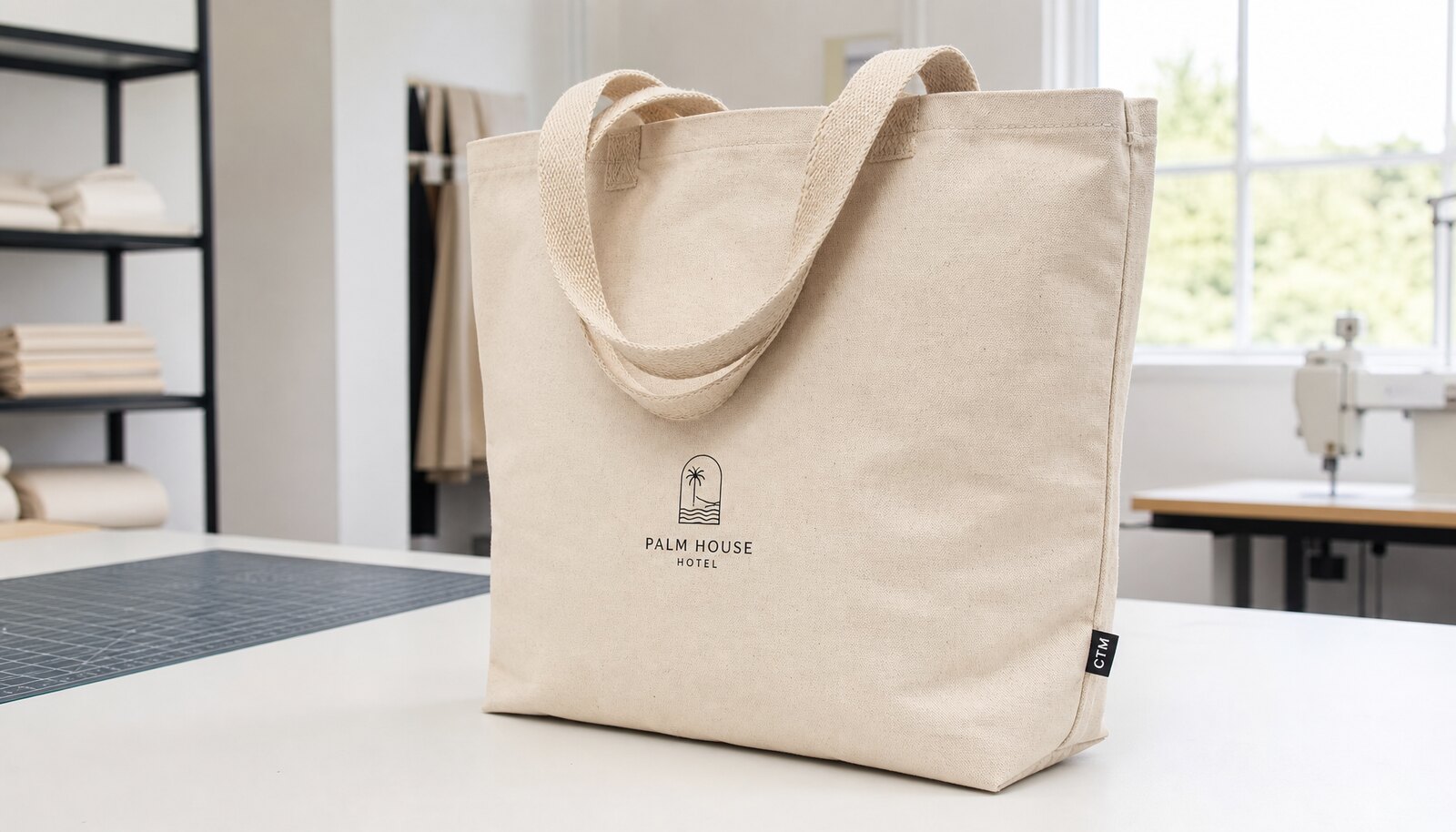
Start with the hotel use case before you compare print methods
When buyers source heavy canvas tote bags for hotels, the first question should not be which decoration method looks nicest in a mockup. It should be what the bag actually needs to do after delivery. A tote used as a spa retail item, a room-drop welcome gift, a housekeeping carry bag, or a conference handout all faces different handling, loading, and presentation requirements. Those use cases change what matters in the comparison: appearance, abrasion resistance, packing format, or repeat-order stability.
This is why hotel sourcing teams get better results when they brief the function first and the artwork second. If the tote will be handed to guests and carried home, the print must stay clean and readable, but the bag also needs to arrive flat, presentable, and free from odor or scuffing. If the tote is intended for bottles, brochures, or merchandise, handle reinforcement and seam strength matter as much as the decoration. The print method cannot be selected in isolation from the end use.
A practical RFQ should therefore name the use case explicitly. Ask suppliers to quote the same bag as a guest gift, retail tote, or utility carry bag if you are still comparing options. That will expose whether one decoration method only looks good on paper but does not hold up when the load, handling, or fold pattern changes.
What makes a canvas tote “heavy,” and why that changes the decoration decision
Heavy canvas tote bags usually sit in the 12 oz to 16 oz range, although some suppliers describe the same fabric in GSM. For procurement purposes, the exact label is less important than consistency: the bag should arrive with the same fabric weight, weave density, finish, and handle construction across the whole lot. A 12 oz bag may be enough for light gifting. A 14 oz bag is often a balanced choice for hotel programs. A 16 oz bag feels more structured but can increase sewing time, packing bulk, and freight cost.
Fabric weight also affects decoration behavior. On lighter canvas, ink can appear more saturated, but the body may distort more when the tote is filled. On denser canvas, print edges may stay flatter, but open weave or rough finish can expose small gaps in the image or make adhesive systems less reliable. Embroidery can look excellent on heavy canvas, but on smaller panels it may also stiffen the front and create puckering if the backing and stitch density are not matched to the fabric.
The buyer should ask the supplier to quote the bag as a complete build: fabric weight, weave type, wash or pre-shrink treatment, handle tape width, seam construction, and decoration method. If a supplier only quotes the bag shell and decoration separately without showing how they interact, the buyer cannot compare value accurately or predict reject risk.
Print method comparison: what each option is really good at
Screen print is still the default for many hotel canvas programs because it gives strong logo visibility, works well for one to three spot colors, and generally scales well once setup is absorbed. It fits straightforward branding: a property name, crest, icon, or a short slogan. The main controls are screen count, ink type, registration, and cure. If the screen mesh is wrong or the cure is incomplete, you can get dull color, weak adhesion, or image drift from lot to lot.
Heat transfer is more flexible when the artwork is detailed or likely to change. It is useful for seasonal graphics, multicolor images, and short launch runs where the buyer does not want to pay for a full screen setup every time. The tradeoff is that the decoration sits more on top of the fabric. On rough canvas or where the bag folds sharply, edge lift, bubbling, or cracking can appear if the transfer system is not matched to the textile finish and press settings.
Embroidery offers the most tactile premium feel and is often suitable for boutique hotel retail or higher-end guest gifting. It can make a tote feel more substantial, but it also introduces limits. Fine text can flatten, dense fills can stiffen the front panel, and very large logos can make the bag body pull or pucker. Buyers should ask for stitch density, backing type, minimum readable text size, and sew-out photos before approving a quote.
Woven or sewn labels are different from the three methods above: they are usually best as a restrained brand element rather than the main visual statement. A label can sit on the front panel, side seam, or hem and pair well with a small print or a tonal bag. The watchouts are label edge finish, sewing accuracy, and whether the label creates bulk where the tote is folded or stacked. For some hotel collections, this subtlety is exactly the point; for others, it is not visible enough on the shelf.
Comparison table: cost, lead time, artwork limits, and reject risk
For procurement buyers, the useful comparison is not just “cheap versus expensive.” It is how each method affects the total landed cost, production schedule, and reject exposure. Screen print usually gives the best price at medium and higher volume when the artwork is simple. Heat transfer can save time on artwork variation, but the per-piece decoration cost often stays higher and the method is more sensitive to the surface condition of the canvas. Embroidery is typically the most premium-looking, but it also adds digitizing, slower cycle time, and a higher chance of detail loss if the design is too small. Labels sit in the middle: they are repeatable, but the sewing labor and placement control still need attention.
The artwork limit matters as much as the price. A logo that looks sharp on a digital proof may be too fine for embroidery or too delicate for a rough canvas screen print. Buyers should ask suppliers to define the smallest readable line weight, minimum text height, and maximum decoration area for the chosen method. If a supplier cannot state those limits, they may be quoting a generic capability rather than actual production control.
The reject-rate risk should also be discussed openly. For example, screen print can be economical but will reject poorly if the supplier under-cures the ink or misses registration across repeated lots. Heat transfer can be very efficient in small launches, but if the press settings or canvas finish are wrong, the failure mode can be peeling after folding or handling. Embroidery has fewer adhesion problems, yet it can be rejected for puckering, broken threads, or distorted lettering. Buyers should compare those risks before they compare only unit price.
- {'item': 'Ask each supplier for the smallest readable text size by method.'}
- {'item': 'Request a lead-time estimate that includes sample approval, not just sewing time.'}
- {'item': 'Require the quote to show setup fee, decoration unit cost, and packing cost separately.'}
- {'item': 'Compare reject risk by failure mode, not just by vague quality promises.'}
How to compare factory quotes beyond unit price
The fastest way to make a bad sourcing decision is to compare only the finished bag price. With heavy canvas tote bags for hotels, the lowest line item can hide the largest total cost once decoration setup, artwork prep, sample revisions, and packing are added. Screen printing needs screens and registration work. Embroidery needs digitizing and sew-outs. Heat transfer may be simple to start but can become expensive if adhesion testing, special film, or extra revision cycles are needed. Labels add sewing labor and sometimes separate sourcing time.
Force every supplier to quote the same assumptions. Specify the same tote size, same fabric weight, same handle length, same print area, same number of colors, and same pack method. Then request pricing at 300, 500, 1,000, and 3,000 pieces. That shows whether the supplier has a real production curve or is only giving a one-size-fits-all estimate. It also helps buyers spot whether setup charges are being recovered honestly or hidden in a deceptively low unit price.
It is equally important to know where the work is actually done. A factory that cuts, decorates, and packs in one site has a different control profile than a trading company that outsources the decoration step. That does not make the trading company unusable, but it does change the questions. Ask where the bag is cut, where the logo is applied, who signs off on print or embroidery quality, and whether the final pack is done in the same plant or elsewhere. If the supplier cannot identify the production route clearly, the buyer is accepting unnecessary subcontracting risk.
Verify actual production capability, not just a sales sample
A decoration sample made in a sample room does not prove mass-production capability. Buyers need evidence that the supplier can repeat the same result at scale on the same fabric and the same method. Ask for a blank fabric swatch, a pre-production sample from the actual line, and a production reference from a similar canvas weight and tote size. If the supplier only sends a polished photo or a hand-finished sample without process evidence, the buyer still does not know how the bulk order will behave.
A capable supplier should also be able to explain how they control the critical steps. For screen print, that means screen count, ink type, cure method, and how they verify registration on coarse canvas. For heat transfer, it means press temperature, dwell time, cooling behavior, and adhesion checks. For embroidery, it means stitch density, backing choice, thread tension, and trim control. For labels, it means cut finish, stitch path, and how they keep label placement from drifting near the seam.
Subcontracting risk should be checked directly. Ask who owns the decoration equipment and whether any part of the order is sent out for printing or embroidery. If so, ask how the supplier verifies the subcontractor’s output before final packing. Buyers should not accept a vague answer such as “we work with a long-term partner.” The useful answer is the actual site, the process owner, and the action taken if the subcontracted batch fails to meet the approval sample.
- {'item': 'Request production photos that show the actual machine line, not only finished goods.'}
- {'item': 'Ask for the name or location of the decoration site if any subcontracting is involved.'}
- {'item': 'Require a pre-production sample from the intended production route, not a showroom sample.'}
- {'item': 'Confirm who signs off on print cure, placement, and final pack before shipment.'}
Sample approval: set pass/fail rules before the order starts
A sample should prove the exact bag specification, not merely something close to it. Approve the base bag first: fabric weight, body dimensions, gusset depth, handle length, top hem finish, and seam allowance. Then approve the decoration separately: logo size, placement, color match, and the clarity of the smallest text. If any of those points change between sample and bulk, the sample should not be treated as a true approval sample.
For screen print, the approval test is clean edge definition, even ink coverage, and no visible strike-through on the reverse side. Buyers should not rely on a photo alone. Hold the bag under normal viewing distance and check whether the print remains readable on the rough canvas weave. For heat transfer, inspect corners and edges after cooling and again after a light bend test. Early lifting at the corners is a reason to pause, not something to “watch in bulk.” For embroidery, check for puckering, thread tension imbalance, broken stitches, and text that becomes unreadable when the bag is stuffed. For labels, check edge finish, stitching quality, and whether the label distorts the hem or fold.
It helps to write the pass/fail logic into the purchase file. Replace vague approval language such as “looks okay” with measurable controls: placement tolerance from the seam or centerline, acceptable color variation, stitch density range, and whether the approved sample is a visual reference or a hard standard. That makes later disputes much easier to resolve, especially if the first production lot is slightly different from the photo used during quoting.
QC criteria buyers can enforce at receiving and inspection
Good QC on heavy canvas tote bags should be operational, not abstract. For incoming inspection, compare the bag against the approved spec sheet and sample with a simple plan: measure size, check construction, inspect decoration, and test packing condition. If the hotel order is important or repeated, buyers should use an AQL-based inspection plan rather than checking only a few random pieces informally. The goal is to catch lot variation before the bags are distributed to properties.
For dimensions, verify canvas width, body height, gusset depth, and handle length against the approved spec. A practical acceptance approach is to allow only a narrow variance around the signed spec and to reject visible mismatch even if the bag technically “fits.” For construction, inspect seam allowance, top hems, and handle reinforcement. If the tote will carry bottles or retail items, bar-tacks or box-X reinforcement should be consistent at every handle point. A bag can look neat flat and still fail when loaded if the reinforcement is weak or uneven.
For decoration, use simple but specific checks. Screen print should show no pinholes, no misregistration, no obvious strike-through, and no cracking at fold lines after light handling. Heat transfer should pass a dry rub and a light damp rub on the actual canvas with no visible transfer or corner lift. Embroidery should sit flat with no tunneling, no loose threads, and no broken stitches. Labels should not fray, curl, or cause the top hem to twist. These checks are easy to describe in an RFQ and much easier to enforce if they are written as acceptance criteria before production begins.
- {'item': 'Use AQL-style lot inspection for volume orders instead of spot-checking only a few cartons.'}
- {'item': 'Measure at least three pieces per carton or per lot sample for key dimensions.'}
- {'item': 'Do a dry and lightly damp white-cloth rub test on decorated areas.'}
- {'item': 'Reject visibly skewed logos, loose threads, curling labels, or weak handle reinforcement.'}
Packing, warehouse receiving, and hotel distribution should be specified in the RFQ
Many tote bag problems show up after packing rather than during decoration. A printed canvas tote can pass visual inspection and still arrive with scuffed ink, crushed embroidery, or crooked folding if the pack-out is rushed. That is why hotel buyers should specify fold direction, carton count, carton size, and protection method in the RFQ instead of treating packing as a minor afterthought. Packing is part of product quality, not separate from it.
The right pack depends on the route to the end user. If the bags are going straight to a hotel warehouse and then out to guest rooms, a bulk carton may be acceptable as long as the logo is protected from abrasion. If the bags are being sold in a gift shop or moved through a central distribution center, individual polybags or tissue wrap may be worth the added cost because they reduce handling damage and make the presentation more consistent. Ask the supplier whether the decorated face will be separated during packing so print-to-print rubbing cannot mark the surface.
Receiving teams should also have a short check list. Verify quantity per carton, carton marks, odor, moisture, and whether the fold line sits on top of the logo or label. If the tote includes a sewn label, confirm that the fold does not crush the label edge or twist the seam. A good pack spec reduces disputes because the product reaches the property in the same condition in which it was approved.
Lead time, artwork changes, and schedule risk for hotel programs
The schedule usually slips at artwork approval and sample revision, not at the sewing line. If the logo changes after screens, embroidery files, or transfer materials have already been prepared, the supplier has to redo setup and sometimes rework the whole decoration route. That is why hotel buyers should freeze the artwork early and keep the approved sample close to the bulk spec. Late changes are the fastest way to turn a two-week production plan into a much longer one.
Fabric consistency is the next risk. Heavy canvas can vary in shade, finish, or weave openness across lots. Even when the logo file is identical, the decoration may look slightly different if the base fabric changes. If the order is large enough to require multiple fabric lots, ask how the supplier will manage shade matching and lot segregation during cutting, decoration, and packing. Buyers should not assume that “same material” means identical visual result.
A realistic program timeline should include sample preparation, approval, production, inspection, and final packing. For a repeat order with unchanged artwork, that cycle can be shorter. For a new hotel launch or a multi-property rollout, the approval window may be longer than the actual sewing time. That is normal. The practical takeaway is to plan for the sample cycle first, then build the ship date backward from there rather than compressing the approval stage at the end.
- {'item': 'Freeze artwork before screen, embroidery, or transfer setup starts.'}
- {'item': 'Ask whether the fabric will come from one lot or multiple lots.'}
- {'item': 'Include sample approval and inspection time in the project schedule.'}
- {'item': 'Treat late artwork changes as a schedule and cost risk, not a minor revision.'}
Specification comparison for buyers
| Comparison factor | Screen print | Heat transfer | Embroidery | Woven or sewn label |
|---|---|---|---|---|
| Typical decoration cost band at 1,000 pcs | Usually lowest for 1 to 3 spot colors; cost drops once screens are amortized | Mid-range to higher on rough canvas; faster setup but higher per-piece cost on small runs | Usually highest because of digitizing, machine time, and slower output | Mid-range; label itself is repeatable, but sewing labor adds time and cost |
| Setup or decoration fee sensitivity | Screens, ink matching, and registration setup matter most | Artwork prep and transfer material matter most; tooling is lighter than screen print | Digitizing, approval sew-out, and thread matching are the key fees | Label artwork, weaving or printing, cutting, and sewing setup are the main fees |
| Lead-time impact | Moderate; usually efficient once screens are approved | Often fastest for short runs if artwork is stable; can slow if adhesion testing is needed | Often longer because sew-out approval and machine scheduling add steps | Moderate; label sourcing is quick, but stitching still adds labor time |
| Reject-rate risk if controls are weak | Moderate; misregistration, under-cure, and color drift are common reject drivers | Moderate to high; peeling, edge lift, and surface mismatch are common on coarse canvas | Moderate; puckering, thread breaks, and distorted text can push rejects up | Low to moderate; placement drift, fray, and crooked stitching are the usual issues |
| Best artwork type | Bold logos, one-color marks, simple icons, short text | Full-color graphics, gradients, seasonal art, short-run variations | Premium crests, monograms, simple icons, retail-style branding | Subtle branding, heritage cues, side-seam marks, and restrained front branding |
| Artwork limitation threshold | Best when line detail is not ultra-fine; tiny reverse type can fill in on open weave | Best when art is not expected to fold sharply across seams or high-wear edges | Best when text is large enough to stitch cleanly; very fine lettering is risky | Best when the brand wants a secondary mark, not the main visual asset |
| Durability on heavy canvas | Good if the ink is correctly matched to weave and fully cured | Variable; good systems work, but adhesion depends heavily on fabric finish | Very good abrasion resistance, though thread can snag and dense fills can stiffen panels | Very good when stitching is neat and label edges are sealed or well-finished |
| Primary procurement risk | Color registration, cure consistency, and repeatability across lots | Peeling, cracking, or weak adhesion if canvas finish or press settings are wrong | Puckering, broken thread, and logo distortion on small details | Fray, curl, placement drift, and seam bulk if cut or sewn poorly |
Buyer checklist before sampling
- Confirm fabric weight in GSM or oz, plus whether the canvas is natural, bleached, dyed, washed, or pre-shrunk.
- Define the hotel use case before quoting: guest gift, spa retail, housekeeping utility, minibar retail, conference kit, or event giveaway.
- State logo dimensions, artwork colors, print placement, and whether decoration is front-only, front-and-back, or label plus print.
- Ask the supplier to identify the actual decoration route in-house versus subcontracted, including cutting, printing, embroidery, and final packing.
- Request sample approval criteria in writing: color tolerance, logo placement tolerance, seam allowance, handle reinforcement, and bag squareness.
- Require a quote split showing blank bag cost, decoration setup, decoration unit cost, packing cost, and any artwork or digitizing fees.
- Ask for a blank fabric swatch, a pre-production decorated sample, and at least one production reference photo from a similar canvas weight.
- Confirm packing style, carton count, carton size, gross weight, and whether the supplier uses individual polybags, tissue, or moisture protection.
- Set an acceptance method for print adhesion and rub resistance before bulk approval, especially if the tote will be handled daily or sold in retail.
- If the bag will hold bottles or heavier items, specify load expectations and reinforcement requirements at handle attachments and bottom seams.
Factory quote questions to send
- What exact canvas weight do you quote in oz or GSM, and is the fabric pre-shrunk, washed, or treated before cutting?
- Which decoration methods do you offer on this canvas, and which one do you recommend for my logo size, artwork complexity, and hotel use case?
- Please quote the same bag in 300, 500, 1,000, and 3,000 pcs so I can compare setup costs and repeat-order pricing.
- What are the setup charges for screens, embroidery digitizing, transfer tooling, woven labels, or sample revisions, and are any of them waived on repeat orders?
- Who performs the decoration in your production flow, and what process controls do you use to keep color, placement, and curing consistent?
- What placement tolerance do you accept for the logo, and how do you check registration on a coarse canvas weave?
- Can you provide a blank sample, a pre-production decorated sample, and a production reference from a similar tote size and canvas weight?
- What wash, rub, or adhesion tests do you run before shipment, and can you share the acceptance standard?
- How do you fold and pack the bags, how many pieces per carton, and what protection prevents scuffing or transfer damage during transport?
- What is the normal lead time after sample approval, and what events most often delay a hotel order?
Quality-control points to confirm
- Fabric weight should match the agreed specification within the supplier’s declared tolerance; mixed lots should be identified before cutting, not discovered during inspection.
- Canvas width, handle length, body size, and gusset depth should match the approved spec sheet; use a measuring plan with at least three pieces per carton or per lot sample.
- Seam allowance should be stated on the tech pack and checked at approval; top hems, side seams, and bottom seams should remain even and not twist the bag body.
- Handle attachment should use reinforcement appropriate to the load; for hotel programs carrying bottles or retail goods, inspect for box-X or bar-tack consistency at every handle point.
- Print placement should stay within a defined tolerance from the seam or centerline; buyers should reject visibly skewed logos, uneven top-to-bottom spacing, or misaligned front panels.
- Screen print should show clean edges, full ink coverage, no pinholes, no strike-through, and no visible cracking at fold lines after simple bend handling.
- Heat-transfer decoration should pass an adhesion check on the actual canvas; reject peeling corners, bubbling, wrinkling, and weak edge bonding after pressing and cooling.
- Embroidery should sit flat without puckering, tunneling, loose threads, or broken stitches; fine text should be checked at a realistic viewing distance, not only in close-up.
- Woven or sewn labels should have neat edges, secure corners, and no fray; the label must not distort the top hem or interfere with folding and carton stacking.
- For a basic rub check, rub the decorated area with a clean white cloth both dry and lightly damp; visible color transfer or smearing should trigger review.