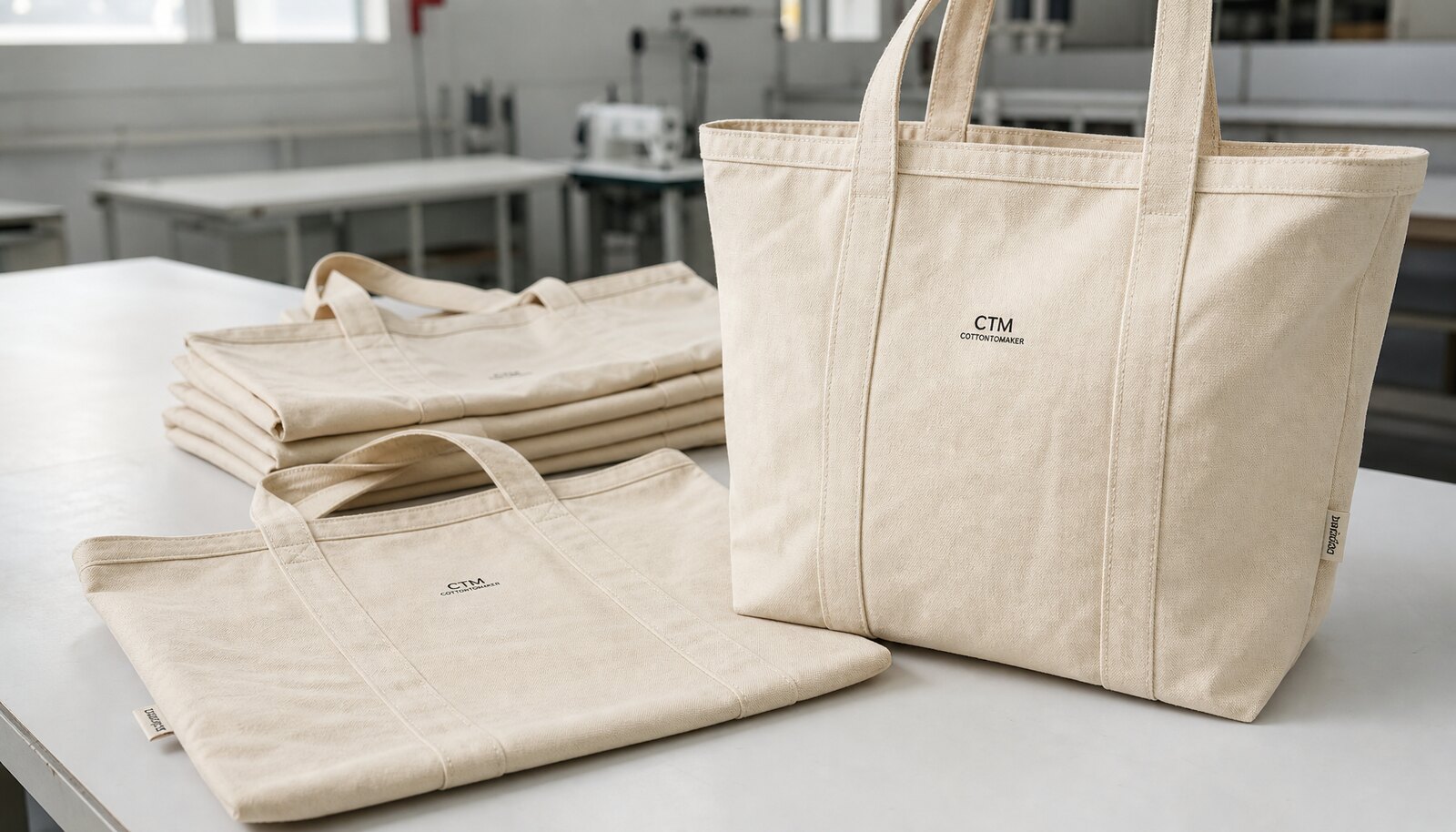
Why fabric selection matters more than fabric weight alone
For hotel tote programs, buyers often start with a simple request for a “heavy canvas” bag and then compare quotes only on GSM or ounce weight. That creates avoidable mistakes. Two bags can both be called 16 oz canvas and still behave very differently once they are cut, sewn, printed, and packed. The weave density, yarn quality, shrinkage control, and finishing method all affect how the tote looks on shelf and how it survives guest use.
A hotel buyer usually needs a bag that feels premium, holds shape, carries enough weight, and supports a clean logo. That means the correct material choice is not just “heavier is better.” The best spec balances structure, print clarity, sewing efficiency, carton efficiency, and unit cost. If you overbuild the canvas, you may pay more for freight and lose margin. If you underbuild it, you may save a few cents and then face seam failures, print complaints, and replacement costs.
- Use canvas weight as a starting point, not the final spec.
- Ask whether the weight is measured before or after finishing.
- Match fabric structure to the actual carrying load, not to a generic “premium” label.
Best material options for hotel tote bags by use case
For most hotel tote applications, 14–16 oz cotton canvas is the practical range. It gives a firm hand feel, enough stiffness to stand or hold shape, and good print results for one- to three-color logos. If the bag is part of a retail gift shop program, this range usually looks more credible than lighter promotional cotton. If the tote is for spa, beach, or resort guest use, the same weight also helps the bag avoid looking flimsy once folded or carried with towels and bottles.
If the program is mainly welcome gifting and the buyer needs lower landed cost, a well-made 12 oz canvas can work, but only if the cut size is modest, the handle is reinforced, and the customer does not expect a rigid structure. Anything below that starts to behave like a generic promo tote, which may not match the hotel brand position. On the higher end, 18 oz canvas is useful only when the tote must look very substantial or carry heavier loads; otherwise it adds sewing difficulty, carton bulk, and freight cost without clear commercial benefit.
- 12 oz canvas: lighter, lower cost, more flexible, but less premium and more shape loss.
- 14–16 oz canvas: best balance for most hotel retail and guest-use programs.
- 18 oz canvas: premium structure, but higher material, labor, and freight burden.
How weave, finish, and shrinkage affect quote comparisons
When suppliers quote canvas, one may use a finished weight and another may quote greige weight. That makes direct price comparison misleading. Greige fabric can shrink and tighten after washing or finishing, while finished fabric already reflects the final state. For a hotel tote, ask the factory to specify both the fabric weight and the finishing status. If the supplier cannot explain that clearly, the quote is not yet comparable.
Pre-shrunk or sanforized canvas is the safer route when logo placement matters. It reduces the chance that the bag will change size after pressing, humid storage, or guest washing. The weave should also be tight and even. Open weave can create a casual look, but it often prints less cleanly and can reveal minor construction flaws. For hotel buyers, a consistent surface is usually more important than a rustic texture unless the brand concept is intentionally natural and artisanal.
- Define whether the quoted weight is finished or unfinished.
- Require a shrinkage expectation in the sample approval stage.
- Inspect front panel weave for density and consistency under normal room light.
Print method selection: what looks good on approval sample and what survives bulk
Heavy canvas takes print differently from thin cotton. For simple hotel logos, screen print is usually the most dependable method because it gives strong color, good opacity, and repeatable cost on production runs. It works well for one to three colors, especially when the design uses bold shapes or text. If the logo is small and the brand wants a clean, understated look, a single-color screen print often performs better than complicated decoration.
Heat transfer can work for short runs or highly detailed artwork, but buyers should treat it carefully on heavy canvas. The print may look sharp on a sample and still behave differently after folding, rubbing, or repeated handling. Embroidery is durable and premium, yet it raises labor cost and can distort light canvas if the design is too dense. For most hotel tote projects, screen print plus a sewn side label or woven label gives the best commercial balance.
- Best default: screen print for stable logo reproduction and manageable MOQ.
- Use embroidery only when the brand wants a premium texture and accepts higher cost.
- Avoid overly complex artwork if the tote will be produced repeatedly across properties.
Supplier options and sourcing routes compared
Not every buyer needs the same sourcing route. A large hotel group may want direct factory production with full control over fabric, printing, and carton marking. A distributor may prefer a stock-base customization route for speed and lower sampling risk. A small brand or boutique hotel may start with a semi-custom model if volume is uncertain. The right route depends on the order size, artwork stability, and how much risk the buyer can accept on spec changes.
The main trap is comparing a direct factory quote with a trading-company quote as if they are the same thing. They are not. One may include more quality control and line transparency; the other may bundle sourcing convenience and higher margin. Use the table below to align the sourcing route with the actual business need, not just the lowest headline price.
Comparison table: choosing the right sourcing route for hotel totes
Define the measurable checks around fabric weight, size tolerance, handle pull, seam strength, logo rub, stains, loose threads, and carton count verification. Add tolerance ranges only where the buyer truly cares, and ask for photos that show the measurement point, not just a finished product overview.
For procurement decisions, the inspection note should say who checks, when they check, and what evidence is required. Photos without measurements are often not enough for remote approval.
- Write decisions in measurable language, not only descriptive wording.
- Ask for sample photos plus one physical approval sample for important orders.
- Keep quotation, sample approval, and inspection notes tied to the same spec version.
MOQ logic and how it changes the true unit cost
MOQ is not only a factory policy; it is a cost structure. For heavy canvas totes, the minimum often depends on fabric dye lot, print setup, and sewing line efficiency. A one-color logo on natural canvas can usually run at a lower MOQ than a fully custom dyed body with multiple print locations and special trim. If you ask for several sizes, handles, or colors at once, the supplier may split the order into smaller production batches, and the unit cost goes up quickly.
When comparing quotes, separate base bag cost from customization cost. You need to know the fabric, cut size, print color count, label sewing, packaging, and carton marking cost. A quote that looks cheaper may simply be missing one of those items. For hotel buyers, the better approach is to request a price ladder: at 500, 1,000, 3,000, and 5,000 units. That shows where the labor efficiency improves and where the true break point sits.
- Ask for MOQ by size, color, print version, and label version.
- Check whether the factory will mix property names or artwork variants in one run.
- Use a price ladder to see the effect of scale on printing and sewing cost.
Sample approval: what to measure before releasing bulk production
A heavy canvas tote sample should be judged like a production part, not a showroom accessory. Measure the body width, height, side gusset if used, handle length, handle drop, and opening width after pressing. Then test the bag with realistic weight and check whether the seams pull, the handles twist, or the print wrinkles near stress points. A good-looking sample that fails under load is the most common early warning sign in tote sourcing.
The best sample approval process includes a blank sample, a printed sample, and if possible a pre-production sample made from the actual fabric lot. That sequence catches two different risks: first, the base construction; second, how the artwork behaves on the actual surface. If the bag is intended for hotel retail shelves, also inspect folding consistency and carton fit, because a tote that stores poorly can cost more to ship than it first appears.
- Measure against an approved spec sheet, not verbal expectations.
- Test handle pull and side seam stress with a realistic fill weight.
- Approve print placement only after seeing the final fabric lot.
Packing, carton loading, and how to protect margin in freight
Packing details matter because heavy canvas already adds weight and volume. If the bag is folded inconsistently, the carton count can change and freight cost rises. For hotel tote bags, flat folding with a consistent fold line is usually the simplest route. Individual polybags are useful when the bags go to retail shelves or need dust protection, but they also add plastic cost and more packing labor. If sustainability is a priority, buyers can use a minimal protective sleeve or paper wrap, but only if the product will still arrive clean and crease-free.
Carton marks should be built into the production plan, especially for multi-property hotel programs. Each carton should show SKU, color, size, and quantity, with the master carton count matching the packing list exactly. Ask for estimated carton dimensions and gross weight before shipment, because these numbers affect ocean freight, airfreight, and warehouse receiving. A bag that looks inexpensive at ex-factory price can become expensive once packed inefficiently.
- Flat fold the bag to keep carton dimensions stable.
- Define whether each bag needs a polybag, tissue, or paper band.
- Match carton count to warehouse receiving rules before production starts.
Lead time risks, production bottlenecks, and realistic schedule planning
For standard heavy canvas tote bags, a realistic lead time after sample approval is often 25–40 days, depending on fabric availability, print complexity, and current line load. The longest delays usually come from artwork changes, not sewing. If the buyer keeps revising logo size, handle length, or label position, the factory may need to remake sample panels or change print screens, and that pushes the schedule back quickly.
To protect the schedule, lock the artwork early and avoid late changes to packaging text. If the order is seasonal or tied to a hotel opening date, build in time for first sample review, revision, and final pre-production approval. A clean schedule is more important than a promise of fast production. When a supplier says they can ship unusually quickly, the buyer should understand exactly which steps are being compressed and whether that affects QC depth.
- Treat artwork revision as the biggest schedule risk.
- Build time for sample approval, pre-production confirmation, and carton proofing.
- Do not compress inspection if the tote will carry premium hotel branding.
Specification comparison for buyers
| Spec decision | Recommended option | When it fits | Buyer risk to check |
|---|---|---|---|
| Fabric weight | 14–16 oz cotton canvas, or about 475–540 GSM | Hotel retail bags, welcome gifts, laundry tote alternatives, and premium amenity bags that need structure | Too light and the bag collapses; too heavy and unit cost, folding volume, and sewing defect risk rise |
| Canvas finish | Pre-shrunk or sanforized, with a tight, even weave | Programs that need stable dimensions after printing and washing | Unsanforized fabric can shrink after first wash and distort print placement |
| Handle construction | Self-fabric handles with X-box or bar-tack reinforcement | Hotels that expect repeated guest use and higher carry weight | Thin handles, weak stitching, or short handle drop will trigger early failures and complaints |
| Print method | Screen print for 1–3 colors; heat transfer or embroidery only for special cases | Logo-driven hotel totes with repeat production and stable artwork | Digital print may look good in samples but can vary on heavy canvas and raise cost on larger runs |
| Lamination or coating | Light internal coating only if spill resistance is required | Spa, beach, or housekeeping-related tote programs | Too much coating makes the bag stiff, noisy, and harder to fold; it may also crack on creases |
| Lining | Unlined unless the tote needs a cleaner interior or fine-item protection | Guest retail bags and amenity gift totes where value and simplicity matter | Lining adds cost, sewing time, and seam complexity; it can hide poor outer construction in samples |
| MOQ route | One-factory custom run if artwork and size are fixed; stock-base customization if volume is small | Importers testing a new hotel chain, distributor programs, or seasonal rollouts | Low MOQ quotes often hide higher unit price, limited color control, or changed hardware and trim |
| Packing | Flat packed with moisture protection and master carton marks by SKU | Export programs with multiple hotel properties or DC receiving requirements | Loose packing creates carton damage, print rub marks, and count mismatches |
| Lead time | 25–40 days after sample approval for standard constructions | Reorders and repeat hotel procurement cycles | Rush promises can mean skipped wash testing, incomplete QC, or split production from different lines |
Buyer checklist before sampling
- Confirm the final bag use: guest retail, welcome gift, spa carry bag, laundry tote, or housekeeping utility tote.
- Lock size, fabric GSM, handle length, and seam reinforcement before quoting.
- Approve a print reference: logo size, Pantone reference or artwork file, and placement tolerance.
- Request a pre-production sample with actual fabric lot and actual print method.
- Specify packing: fold method, polybag requirement, silica gel need, carton quantity, and label text.
- Ask for a carton loading plan and estimated gross weight for freight comparison.
- Set QC thresholds for dimensions, stitch strength, print alignment, and odor.
Factory quote questions to send
- What exact canvas weight are you quoting in oz and GSM, and is it finished or greige fabric weight?
- Is the fabric pre-shrunk, and what dimensional tolerance after steaming or washing can you guarantee?
- Which print method is included in the quote, and what is the setup fee for each color or side?
- What reinforcement is used at the handle ends and side seams, and can you show a stitch spec?
- What is the MOQ by color, by print version, and by size?
- What sample type is included: digital proof, blank pre-production sample, or full production-like sample?
- What packing is included per bag and per carton, and are carton markings customizable?
- What is the production lead time after sample approval, and what steps usually add delay?
- What QC records can you share before shipment: measurement report, inline inspection, or final AQL result?
- What freight-ready carton dimensions and weight should we expect for landed-cost calculations?
Quality-control points to confirm
- Fabric weight must stay within an agreed tolerance, typically within about ±5% of the approved GSM or oz spec.
- Canvas weave should be even, without thin lines, slubs that weaken seams, or visible loom defects across the front panel.
- Handle stitches must be straight and dense, with no skipped stitches, loose ends, or thread burns at stress points.
- Print should not crack, bleed, or show off-register placement beyond the approved tolerance.
- Bag dimensions should match the approved pattern after pressing, with acceptable variance defined in the PO.
- No strong odor from coating, ink, or storage; bags should be export-ready without musty smell.
- Carton count, SKU label, and inner packing must match the packing list exactly.
- Sample approvals should confirm actual handle drop, fold size, and logo placement before bulk release.