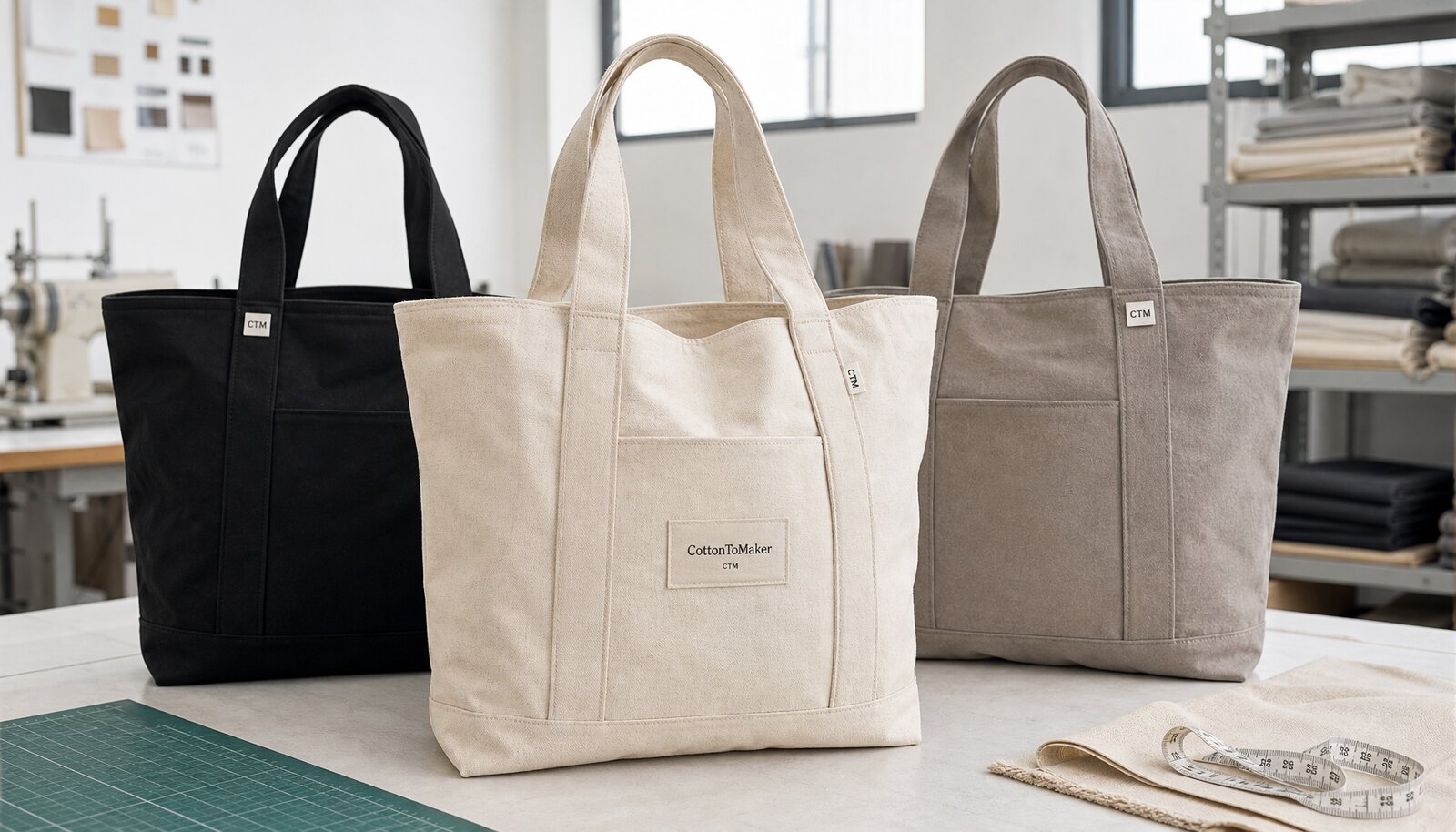
Why hotel retail launches need a different tote spec
Heavy canvas tote bags for hotel retail launches are not the same product as a trade-show giveaway or a generic grocery tote. In a hotel shop, the bag is merchandise, display object, and functional carry item all at once. It has to look premium on a shelf, survive the kind of use that comes with travel and repeat guest handling, and still make sense at the retail price the property is trying to hold. That changes the sourcing brief. The right spec is not simply “thicker canvas.” It is a controlled balance of body weight, structure, handle build, print method, packing, and the way the bag will be presented to the guest.
The commercial context matters. A hotel retail buyer usually needs a product that can sit next to travel accessories, body care, apparel, and local souvenir items without looking like a promotional handout. If the tote is too soft, too wrinkled, or too plain, it may not justify the shelf price. If it is overbuilt without a clear reason, the landed cost goes up, freight gets heavier, and the store can end up with a bag that feels expensive but not necessarily desirable. The buying decision starts with the intended role: is this a hero merchandise item, a practical resort carry bag, a destination souvenir, or an add-on purchase at checkout?
That role changes the spec. A beach resort tote may need more capacity, firmer handles, and a finish that photographs well in daylight. A city hotel shop bag may need cleaner lines, a more restrained logo, and a flatter pack profile for stockroom efficiency. A launch tied to a hotel opening date may also need simpler decoration and fewer color variants so procurement can stay on schedule. Buyers who define the use case early usually get cleaner quotes, fewer sample revisions, and fewer arguments about whether the product is “good enough” for retail. In practice, good enough is not enough if the bag is meant to sell at a margin.
One useful way to think about the tote is as a small retail program, not just a soft good. That means the spec has to support the store’s merchandising, the hotel’s brand standards, and the warehouse’s handling needs at the same time. The earlier those requirements are written down, the less likely the launch is to drift into a generic canvas order with a logo on it.
- Retail totes need stronger shelf appeal and cleaner finishing than giveaway bags.
- Define the commercial role before choosing fabric weight or decoration.
- A launch item should support merchandising, logistics, and brand presentation together.
Choosing the right canvas weight, weave, and finish
For most hotel retail launches, the practical starting range is 12oz to 14oz heavy canvas. Within that range, 12oz is usually easier to sew, a little lighter to carry, and slightly less expensive to move through the supply chain. It can work well when the tote is meant for light-to-medium retail use and the buying brief values a softer handfeel. Fourteen-ounce canvas is the better choice when the bag needs more structure, a more substantial shelf presence, or better resistance to droop after packing. Once you move beyond 14oz, the buyer should expect more stress on needles, more labor in sewing, and more risk that the bag looks sturdy but is less efficient to produce.
The weave is just as important as the headline weight. A tight, even weave with low slub tends to print more cleanly and gives the finished tote a more refined appearance. A looser weave can create a casual look, but it also makes small logo details less crisp and can make seam lines wander slightly after sewing. That matters in hotel retail because the bag is often judged at arm’s length, under store lighting, and next to competing accessories with much more polished finishing. If the brand story calls for a cleaner, more premium look, the buyer should ask for a swatch and inspect the weave in natural light. Look for thick slubs, uneven yarn spacing, and weak spots that may become visible after cutting.
Finish changes the risk profile. Unwashed canvas is usually the safest route when the launch needs repeatability across multiple properties or reorders. It is more predictable for size and shade, and the production economics are easier to hold steady. Washed or enzyme-washed canvas can make the bag feel softer and more lifestyle-oriented, which may suit a resort or boutique property, but those finishes bring more variance. Shrinkage, softening, subtle shade change, and slight dimensional movement are all more likely once washing enters the process. That is not a reason to avoid wash finishing, but it is a reason to write down what “acceptable” means before bulk cutting starts.
If dyed canvas is being considered, the buyer should ask how the color is achieved. Piece-dyed, yarn-dyed, and garment-washed routes do not behave the same way in cost, shade consistency, or MOQ logic. A quote that only says “heavy canvas” does not give procurement enough detail to compare suppliers. For a retail launch, the fabric description should include measured GSM after finishing, weave type, shade reference, and any wash or dye process the price assumes. That is the difference between a real sourcing decision and a rough estimate.
The most useful question is not “Is it heavy?” but “Does this canvas support the product story, the printing method, and the shelf price?” If the answer is yes, the fabric choice is probably aligned. If the answer is only “it feels thick,” the buyer should ask for a better sample or a better explanation.
- 12oz: easier sewing, lower weight, and better for entry-level retail carry.
- 14oz: better structure and shelf presence, but higher sewing and freight load.
- Washed finishes add texture and softness but need tighter size and shade control.
Handle construction: where tote failures usually start
Handles are the most common failure point on a heavy canvas tote, especially once the bag starts carrying real merchandise instead of sample filler. In a hotel retail program, a handle failure is not just a functional issue. It can become a guest complaint, a return, and a visible sign that the bag was not engineered for the price it was sold at. That is why procurement should ask for handle construction in detail, not as a one-line note. The supplier needs to specify handle width, handle length, attachment method, reinforcement type, and whether the handles are folded from self-fabric or made from webbing.
Cotton webbing is often the better option when the bag must be comfortable to carry or when the tote may be loaded with books, beach goods, toiletries, or multiple retail items. Webbing resists curling and can hold its shape well if stitched correctly. Self-fabric handles can look more integrated and more premium in a minimalist design, but they need more careful construction. If the fabric is too soft or the stitch pattern too light, the handle can twist, stretch, or feel narrow in the hand. That matters in hotel retail because the bag has to feel worth buying the moment the guest picks it up.
Reinforcement is where many quotes become vague. Buyers should ask for the actual reinforcement pattern: bartacks, box-X, or a combination. A clean box-X at the handle join is often a strong baseline for a retail tote, especially when the body is heavy canvas and the carry load may be irregular. Bartacks can also be effective, but the buyer should know how many and where they are placed. A long handle sewn only with a short straight stitch may look fine in a sample, then fail after a few normal loads because the join cannot absorb stress. The risk is highest on wide bags, deep gussets, and designs with long handles or top-heavy contents.
It is also worth asking the supplier how the handle angle affects the bag when loaded. A handle that sits too close together can make the bag fold inward; a handle that is too wide may pull the bag body out of shape. In retail, both look unrefined. During sample approval, load the bag with the same type of weight the guest is likely to carry and check whether the handles remain symmetrical, whether the attachment points pucker, and whether the bag body twists. That test catches more problems than a visual inspection on an empty sample.
A tote that feels good empty can still fail as a retail product if the handle package is underbuilt. Procurement should treat handle construction as a load-bearing spec, not a styling choice.
- Ask for handle width, attachment method, and reinforcement pattern in the quote.
- Test the bag under realistic load before approving bulk.
- Handle failures usually start at the join, not in the strap body.
Comparing sourcing routes: direct factory, trading company, and local converter
The sourcing route changes how much control the buyer has over the final tote. A direct factory is usually the strongest choice for a hotel retail launch when the bag needs custom dimensions, repeatable print placement, and dependable replenishment later on. The main advantage is control. The same operation that cuts the fabric is usually responsible for sewing, finishing, and at least part of the quality check. That makes it easier to keep the product stable from sample to bulk. The tradeoff is that factories may ask for clearer artwork, more detailed specs, and larger MOQs before they commit to production.
A trading company can be useful when the project needs coordination speed, broad sourcing support, or help managing several items at once. A trader may be able to move quickly on samples and may already know which factory can handle the bag style, the label type, or the requested packing. For a hotel launch with many moving parts, that can save time. But the buyer needs to know exactly what the trader is doing and what the actual factory is doing. If the quote does not identify the production source, then the apparent simplicity of the order can be misleading. The same is true when the trader presents a single unit price without showing what is included in that number.
A local converter or decorator can make sense if the hotel already has approved blanks or if the scope is mainly a branding update. This route is usually less suitable when the bag itself needs engineering work, because the converter may not control the base fabric, the handle construction, or the sewing spec. In a retail launch, those are not minor details. If the tote is intended to be a core item on the shelf, the buyer generally wants one supplier to stand behind the body, the decoration, and the final packing standard. That is easier to manage with a factory-led program.
The right route depends on the level of control the launch needs. If the tote is a one-off or low-risk accessory, a trader or converter may be acceptable. If the hotel expects to reorder the bag, distribute it across multiple properties, or keep it in the assortment for more than one season, the buyer usually benefits from the tighter control of a factory relationship. The long-term cost of a weak sourcing route tends to show up in rework, inconsistent reorders, and more time spent clarifying who is responsible when defects appear.
- Factory: best for custom spec control and repeat orders.
- Trader: useful for coordination speed, but verify the actual maker and responsibility split.
- Converter: better for decoration-led jobs than for full tote engineering.
How to structure an RFQ so supplier quotes are truly comparable
A vague RFQ is the fastest way to create apples-to-oranges pricing. For a heavy canvas tote bag, the supplier needs enough detail to quote the exact product the hotel expects to sell. That means final dimensions, target canvas weight, color requirement, handle type, decoration method, packing method, and the launch window. If the buyer is still deciding between 12oz and 14oz, ask for both. If the design may use natural canvas or a dyed color, request separate pricing for each. A quote based on assumptions the buyer never intended is not a useful quote, even if the unit price looks attractive.
A good RFQ separates technical requirements from commercial assumptions. Technical items include bag size, fabric weight, finish, handle reinforcement, and artwork placement. Commercial items include incoterm, carton packing, barcode requirements, insert cards, and testing obligations. When those are mixed together or left vague, the supplier may price a simpler bag than the buyer actually wants. That becomes a problem later when the hotel warehouse needs a specific carton size or when the store requires shelf-ready barcodes and the quote never included them. Most “surprises” in tote sourcing are really missing instructions.
For a launch item, the approval path should also be part of the RFQ. Tell the supplier what has to be approved before bulk, what can be decided during sample, and what cannot change once production starts. If the logo placement is critical, specify it. If the color is critical, ask for a fabric swatch before the decorated sample. If the opening date is fixed, state the shipment window and the date by which approvals must be returned. Suppliers work faster when they can see the consequence of delay. They also quote more accurately when they know the project is real rather than exploratory.
The RFQ should end with a request for line-item pricing. Ask the supplier to separate fabric, cutting, sewing, decoration, packing, testing, and freight assumptions. Without that breakdown, procurement cannot tell whether a low price comes from genuine efficiency or from omitted scope. A strong hotel buyer will usually compare more than the unit price. The right question is: what did the supplier have to assume to get to that number?
- Send final size, fabric weight, artwork, packing needs, and launch window together.
- Ask for separate prices for each fabric or color option.
- Require line-item pricing for fabric, labor, decoration, packing, and cartons.
Decision table: what to buy, when to buy it, and where quotes often mislead
The comparison below is meant to help procurement pressure-test supplier offers. It focuses on decisions that affect hotel retail use, not just product styling. The right spec is usually the one that matches the launch plan, the price tier, and the amount of operational risk the buyer can absorb.
A common mistake is to over-spec the first run. A hotel retail launch does not always need every possible option in version one. Sometimes the most sensible path is one core tote in one or two colors with a simple decoration method, then a second order only after sell-through data shows what guests actually want. That is especially true when the bag is being introduced across multiple properties with different customer profiles. A strong tote program can scale later. A confused first order is harder to recover.
Sample approval: how to treat the sample as the golden standard
A sample should do more than show the design. It should become the physical reference for the bulk order. That means the buyer needs to inspect fabric handfeel, exact size, stitch quality, print clarity, handle symmetry, and packing presentation before giving the green light. With heavy canvas tote bags, this matters because small deviations are visible. A logo shifted by a few millimeters, a handle set slightly unevenly, or a pocket of seam puckering can make the product feel less premium even if the bag is technically usable.
The sample review should happen under real handling conditions, not only on a desk. Load the bag with the kind of weight a guest is likely to carry, then check whether the handles sit evenly and whether the body twists or bows. Fold and unfold the tote to see how it behaves in storage and whether the canvas holds creases that would look poor on shelf. If the finish is washed, note whether the shade changes in different light and whether the bag loses its shape after handling. These are retail problems, not theoretical defects.
The most useful sample process has two stages: fabric approval and decorated sample approval. Fabric approval confirms the base material before the factory invests in cutting and decoration. Decorated sample approval confirms the final retail presentation. If the program is color-sensitive, approving the fabric swatch first is worth the extra step. It reduces the risk of discovering too late that the decorated sample looks right only because the logo draws attention away from a poor base color. Buyers should remember that the sample is not just for visual approval. It is for setting the standard the bulk order will be judged against.
Before sign-off, convert comments into written acceptance criteria. That can include target dimensions, placement tolerances, shade tolerance, stitch requirements, and packing format. The point is not to over-engineer the product. The point is to stop the factory from delivering something that is close in a technical sense but wrong for retail. A tote that is acceptable for a giveaway may be unacceptable for a hotel shop, and the sample should reflect the retail standard, not the easiest possible standard.
Once approved, keep one sealed golden sample with the PO and share the same reference with the supplier. That sounds basic, but it avoids the common situation where the buyer remembers one detail and the factory remembers another. In a retail launch, that gap can cost time and money.
- Inspect the bag loaded, folded, and viewed from multiple angles.
- Turn visual comments into written tolerances before approving bulk.
- Keep one sealed golden sample for both buyer and factory reference.
Printing and branding choices that hold up in retail
Decoration should support the hotel’s retail price point and the way guests will actually view the bag. For most heavy canvas tote bags, screen printing is the practical baseline. It is durable, relatively efficient, and well suited to bold logos or simple graphics. On textured canvas, it usually gives the best balance of cost and repeatability. If the logo has one or two colors and clear shapes, screen print often wins because it is easier to reproduce at scale and easier to control across multiple runs.
When the hotel wants a more restrained or premium look, woven labels, side labels, or embroidery can work. These methods can improve brand perception, but they change the commercial math. Embroidery can raise cost and may cause puckering if the canvas is dense and the stitch density is not tuned correctly. Woven labels can look very clean, but their placement must be planned so they do not interfere with seam lines, handle joins, or the fold. In other words, the decoration method is not just a branding choice; it is a manufacturing choice with cost and risk attached.
The safest artwork is usually simpler than the buyer’s first draft. Heavy canvas is not the best substrate for tiny text, thin lines, gradients, or very delicate registrations. If the logo depends on those details, the factory may need to simplify the art or enlarge the print area. That should be treated as a production adjustment, not a creative compromise. Many failed tote launches come from trying to print artwork that looks fine on a screen but does not suit textured fabric. Asking the supplier to review printability before sample production can save time and prevent a decorated sample that looks obviously off.
The decoration style should fit the bag’s retail role. A core brand staple may benefit from a clear, straightforward print. A premium resort tote may sell better with quieter branding and a cleaner label treatment. A destination souvenir may need stronger visual identity because it has to read quickly at the shelf. The buyer should choose the method that supports price, shelf distance, and repeatability. What looks elegant in a design review is not always what will be easiest to sell or reorder.
Whatever method is chosen, ask the supplier to show print position, line thickness, and tolerance in the sample. That is where most branding issues start.
- Screen print is usually the strongest default for bold retail graphics.
- Embroidery and woven labels can elevate the bag but need tighter placement and stitch control.
- Simpler art usually prints better on textured canvas than fine-detail graphics.
MOQ logic, pricing tiers, and how to compare real landed cost
MOQ deserves more scrutiny than many buyers give it. In tote bag sourcing, the minimum may be split across color, artwork version, decoration setup, packing style, and custom trims. That means a supplier can quote a low total minimum while still expecting each version to clear a separate threshold. A hotel launch that wants natural, black, and stone colors plus two logo placements may be creating six production scenarios, not one. Procurement should ask the supplier to state MOQ by variant, not only by order total.
Unit price alone rarely tells the full story. Canvas weight changes raw material cost, but freight also matters because heavier canvas adds real mass and sometimes larger carton volume. Packing choices can make the gap even wider. An individual polybag, size ticket, barcode label, insert card, or custom carton mark all add labor and materials. Testing, document preparation, and special packing can appear later as extra charges. A quote that looks cheaper at the factory gate may land more expensively once those items are included. For that reason, the more useful number is landed cost, not the sticker price per bag.
For a hotel retail launch, it can be smarter to narrow the first order to one core configuration and only add variants if the retail plan truly needs them. That reduces SKU fragmentation and helps the team see what guests actually buy. If the first run performs, there will usually be time to expand colors or finishes on the reorder. If the buyer starts with too many variants, slow-moving stock can sit in the warehouse and confuse replenishment. This is especially important when multiple hotel properties are involved, because distribution complexity often grows faster than expected.
A good quote comparison should show what the supplier assumed about the order. Was one print color included or two? Is setup included? Are cartons and labels included? Are freight assumptions based on air or ocean? A supplier who omits a line item is not always being evasive; sometimes the brief was incomplete. But from a procurement point of view, the quote is still not comparable until those assumptions are visible. The right price is the one the buyer can repeat, reorder, and land without surprises.
If a supplier is materially cheaper, ask where the difference comes from. Sometimes it is a real efficiency. Sometimes it is a thinner handle, lighter canvas, simpler packing, or missing testing. The only way to know is to pull the quote apart.
- Request MOQ by color, print version, and packing style, not just total units.
- Compare total landed cost, not ex-works price alone.
- Limit launch variants unless sell-through data supports a wider assortment.
Packaging, cartonization, and retailer-ready delivery
Packaging is part of the retail product. Heavy canvas tote bags can arrive creased, dusty, or visually distorted if the pack method is left vague. For a hotel retail launch, the safest default is usually flat pack with a clean barcode label and a defined fold standard. If the bag needs to present in a specific shape on shelf, that must be written into the packing spec. It should not be left to the factory’s normal practice, because “normal” varies from plant to plant.
Cartonization should protect the product without wasting freight. Overfilled cartons can crush handles and create permanent fold marks. Underfilled cartons waste space and inflate landed cost. Ask for carton dimensions, net and gross weight, and carton quantity per pack before bulk starts. This helps the warehouse plan receiving and gives procurement a clearer read on freight efficiency. If the tote will move through several touches before it reaches the store, carton strength matters more than buyers often expect. A weak carton can create damage that looks like a sewing defect when the real problem is packing.
Retail-ready details should be specified as precisely as the product details. That includes barcode placement, size ticket location, insert card language, and care label position if one is required. If the hotel’s warehouse prefers carton marks by style, color, and count, that should also be written into the pack spec. The less the factory has to guess, the less chance there is of mixed packs, crooked labels, or staff spending time re-sorting cartons at receiving.
Packaging also affects how premium the tote feels when the guest first sees it. A good tote can look flat or cheap if it is folded badly or packed with visible marks. A less expensive tote can look better than expected if the presentation is clean. That is why procurement should treat packaging as a merchandising requirement, not just a shipping requirement. For a hotel shop launch, first impression starts before the bag is even touched.
- Use flat pack unless the shelf presentation requires a structured shape.
- Define barcode, size ticket, insert card, and carton mark locations before production.
- Choose cartons that protect handles and preserve the tote’s retail appearance.
Specification comparison for buyers
| Buying decision | Recommended option | Best use case | Cost / performance tradeoff | Procurement risk to check |
|---|---|---|---|---|
| Fabric weight | 12oz to 14oz heavy canvas; use 12oz for lower ticket retail and 14oz when the tote must hold shape on shelf or carry heavier contents | Hotel retail launches where the tote is both merchandise and brand collateral | 12oz usually keeps sewing easier and lowers freight; 14oz improves body and structure but can increase needle wear, seam stress, and landed weight | A bag that looks “heavy” in a sample may still collapse after cutting or washing if the weave is loose; confirm measured GSM and finished handfeel, not only ounce claims |
| Weave and finish | Tight, even weave with controlled slub; unwashed for clean repeatability, washed or enzyme-washed only when softness is part of the retail story | Lifestyle hotels, resort shops, and destination merch assortments | Cleaner weave supports print clarity and consistent stitching; washing can add tactile value but introduces shrinkage, shade variance, and higher rejection risk | Loose weave can blur logos, cause seam waviness, and leave visible puckering; washed lots need tighter pre-approval on size and shade because one lot can look noticeably different from another |
| Handle construction | Cotton webbing handles for carry comfort, or folded self-fabric handles for a more integrated look; reinforce with bartacks or box-X at stress points | Bags intended for books, beach items, gift bundles, or repeat guest use | Webbing tends to carry better and reduce edge curl; self-fabric can look more premium but may stretch or twist if not stabilized | Handle failures usually start at the join, not in the middle of the strap; ask for stitch pattern, thread count, and reinforcement length, not just handle length |
| Decoration method | Screen print for bold logos and repeatable color, woven label or small side label for restrained branding, embroidery only if the logo and price point justify it | Retail bags where the hotel wants a clean, durable logo with predictable repeat orders | Screen print is usually the best cost-to-durability option; embroidery and labels can support a higher shelf price but may add puckering, setup fees, or placement sensitivity | Thin text, gradients, and small registration gaps are where tote graphics fail first; request artwork adaptation if the design is too fine for textured canvas |
| Supplier route | Direct factory for repeatable retail programs; trading company if coordination speed matters more than process control; local converter only for decoration-led jobs | Core SKU launches, replenishment programs, or multi-property hotel rollouts | Factories usually give better control over cutting, sewing, and QC; traders may move faster but can add margin and obscure responsibility; converters work best when the blank is already settled | Clarify who sources the fabric, who approves print setup, and who owns final inspection; otherwise the quote may be cheaper only because part of the work is hidden |
| MOQ strategy | Tiered MOQ by color, print version, and packing style instead of one pooled number | Launches testing several hotel properties, markets, or seasonal colorways | Tiered MOQ makes overstock risk easier to manage and helps isolate weak variants; a single total MOQ can look low while each version remains expensive | A low total MOQ can hide separate minimums for each color, label, or wash process; ask for minimums by variant, not only by order total |
| Retail presentation | Flat-pack with barcode sticker, size ticket, and defined fold standard; use stuffed packing only if the shelf presentation requires it | Hotel shop inventory, warehouse receiving, and shelf-ready replenishment | Flat packing usually lowers freight and storage cost; stuffed packing protects shape but raises volume and handling complexity | Poor fold instructions create wrinkles, crooked labels, and dust marks that make a good tote look second-rate before it reaches the shelf |
| Lead-time planning | Use a sample-to-bulk schedule with approval gates, fabric booking, and a freight buffer | Launches tied to hotel openings, holiday peaks, or seasonal merchandising windows | Structured planning is more reliable than chasing the shortest headline lead time; special wash, dyeing, or custom trims can extend the schedule quickly | Sample, wash, print, and shipping windows often slip for different reasons; don’t assume the factory’s standard timeline covers your exact spec |
| Quote structure | Line-item pricing for fabric, sewing, decoration, packing, testing, and freight assumptions | Comparing suppliers on a like-for-like landed-cost basis | A detailed quote reveals hidden costs and avoids false savings; all-in unit pricing can conceal omitted labels, cartons, or artwork setup | Watch for quotes that exclude inserts, carton marks, special packing, or setup charges; these often appear after sample approval |
Buyer checklist before sampling
- Confirm the final bag dimensions, target carry load, and whether the tote must stand upright on shelf, in photography, or when displayed upright in the shop.
- Specify the canvas weight range in ounces and GSM, plus whether the fabric should be unwashed, washed, enzyme-washed, dyed, or piece-dyed.
- Provide vector artwork, logo placement drawings, print colors, and acceptable registration tolerance for each decoration area.
- Set handle width, handle length, reinforcement style, and whether self-fabric, webbing, lining, piping, or hardware is required.
- Define the packing method: flat pack or stuffed, individual polybag or no polybag, barcode and size-ticket location, carton pack count, and carton mark format.
- Request MOQ by color and print version, and ask the supplier to state whether the MOQ changes with labels, wash processes, or custom trims.
- Ask for a sample-to-bulk schedule with approval milestones, a launch date buffer, and the consequence of late approvals.
- Confirm inspection standard, target AQL if used, and what photo/video evidence is required before shipment release.
- Request a landed-cost estimate that includes freight assumptions, carton dimensions, and any packing or testing charges that are often omitted from unit pricing.
Factory quote questions to send
- What canvas weight do you recommend for this retail use, and what is the measured GSM after any finishing, washing, or dyeing process?
- Is the price based on raw unbleached canvas, dyed canvas, or washed canvas, and what changes if we move to a different finish or color method?
- Which decoration method is included in the quote, how many print colors are covered, and what are the setup charges for screens, plates, or embroidery digitizing?
- What is the MOQ by color, by decoration version, and by packing style, and can mixed colors share one production run without changing the unit price?
- What handle reinforcement do you include as standard, and what is the incremental cost for box-X stitching, bartacks, or heavier webbing?
- What exactly is included in packing: individual polybag, insert card, barcode label, care label, carton marks, and master carton specification?
- How many samples are included, what is the sample lead time, and are courier fees refundable or deductible from bulk if we place the order?
- What tolerances do you commit to for size, stitching, print position, and shade, and can you share your in-line and final inspection standard?
- What are the assumed incoterms, shipping origin, and freight basis used in the quote so we can compare landed cost accurately?
- If the launch requires a rush schedule, what part of the process becomes the bottleneck: fabric booking, decoration, sewing capacity, packing, or export booking?
Quality-control points to confirm
- Measure fabric GSM on the approved lot and compare it to the agreed target, not only the supplier’s catalog description.
- Confirm weave consistency, slub level, and shade uniformity against the sealed reference swatch before bulk cutting begins.
- Inspect stitch density, seam allowance, bartack length, and reinforcement at all load-bearing points, especially handle joins and gussets.
- Set a dimensional tolerance for bag width, height, and gusset depth, and measure bulk output against the approved sample after sewing and finishing.
- Check logo placement, print opacity, edge sharpness, and print registration on the actual canvas color, not on white proof paper.
- Define an acceptable shade variance between sample and bulk, and require the factory to flag any lot-to-lot color shift before full production.
- Review handle symmetry and carry performance by loading the bag with the intended retail weight rather than a light demo fill.
- Verify packing quantity, barcode accuracy, carton marks, and carton strength before palletization or container loading.
- Require photo evidence of front, back, side, bottom, and inside views from the production run before shipment release.
- If AQL is used, align the defect classification in writing so critical, major, and minor defects are interpreted the same way by buyer and factory.