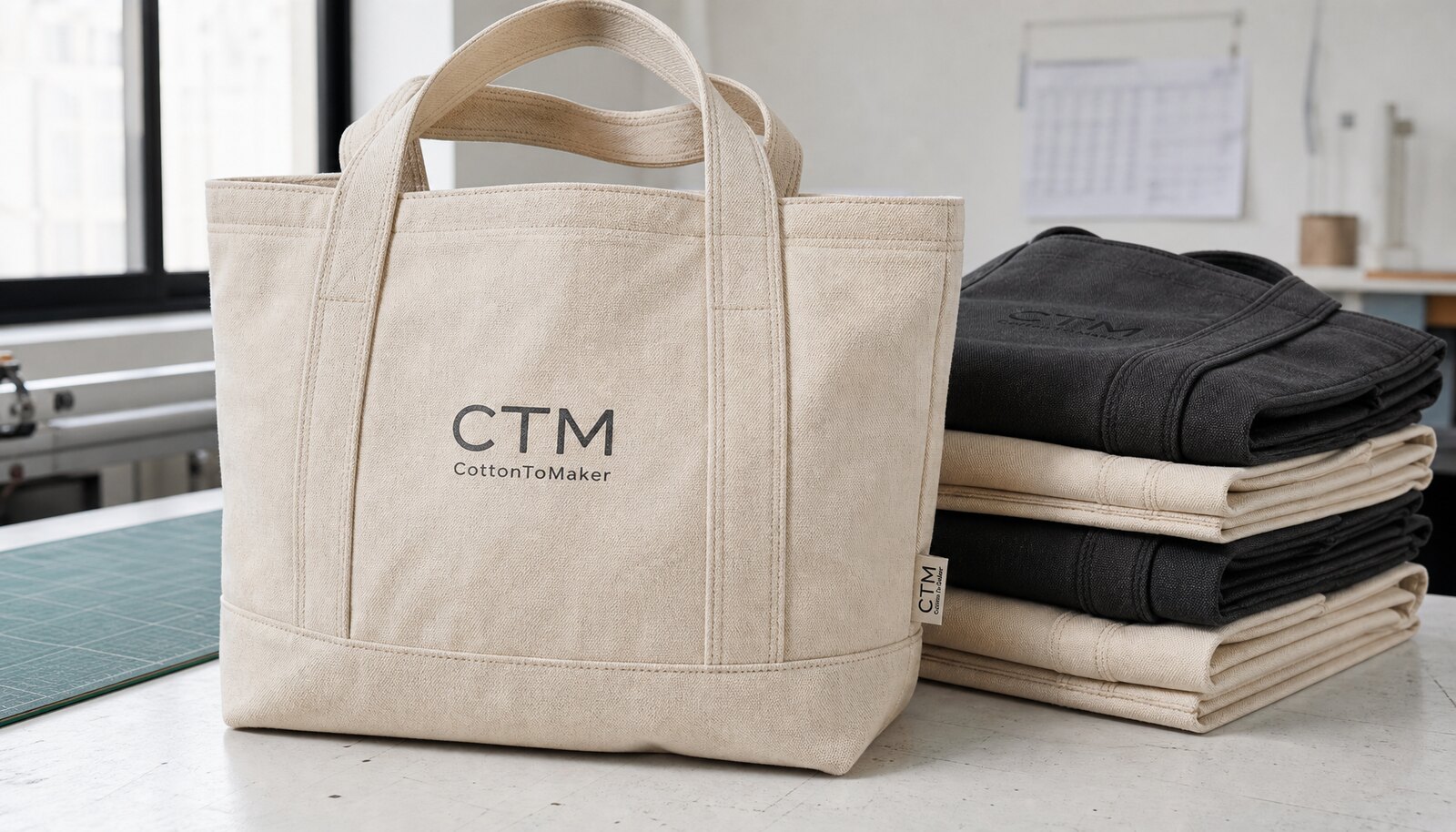
Why gift-shop buyers need a heavier canvas spec
Gift shops are different from grocery or event programs. The bag is often part of the merchandise, not just a carry-out item, so the product has to look structured on the shelf and still feel durable in the customer’s hand. For that reason, heavy canvas tote bags usually start around 12 oz and move up to 16 oz, or roughly 400–550 GSM. Below that range, the tote often looks too soft, especially after folding and carton compression. Above that range, the bag can become expensive to sew, harder to print cleanly, and heavier to freight in bulk.
A better buying question is not 'Can the factory make a heavy canvas tote?' but 'What construction gives the right shelf look, carry feel, and landed cost for my gift shop program?' That means deciding whether the tote is meant for postcards and small souvenirs, books and candles, or mixed merchandise with real weight. Once the load profile is clear, the fabric weight, handle length, and base structure become easier to specify and compare across quotes.
- 12 oz / ~400 GSM: lower cost, better for light gift items, less structure
- 14 oz / ~470 GSM: balanced option for most gift shop programs
- 16 oz / ~550 GSM: premium feel, better stand-up shape, higher sewing and freight cost
- If the bag must carry boxed gifts or bottles, ask for reinforced handles and gusseted construction
Start with the load, not the logo
A common sourcing mistake is to lead with artwork and forget what the tote must hold. In gift shops, heavy canvas totes often need to carry hard edges: books, boxed candles, ceramic items, or stacked souvenirs. A flat tote with a wide body might look fine in a sample, but if the base is too shallow, the bag will tilt, wrinkle, or feel unstable at retail. For a more practical comparison, decide whether the tote needs an open rectangular interior or whether a flat silhouette is enough for the selling environment.
Handle comfort matters more than many buyers expect. Heavy canvas with a short handle drop can dig into the shoulder when filled, while a long handle can make the bag look less premium if it hangs too low on the rack. For a gift shop buyer, the useful spec is usually a handle drop that lets the bag be carried by hand and on the shoulder without dragging the body on the floor. Put that in the RFQ instead of only listing overall bag dimensions.
- For books and flat souvenirs, a flat tote can work if the body width is stable
- For candles, boxed sets, and mixed goods, a gusseted tote usually sells better and packs more cleanly
- Ask for handle drop, not only handle length, because drop controls real carry comfort
- Request a full-scale sample with product weight inside, not just an empty bag photo
Compare sourcing routes before comparing unit price
For wholesale heavy canvas tote bags, the cheapest quote is not always the lowest-risk route. A direct factory can control fabric weight, stitching, and print setup more tightly, which helps repeat programs. A trading company may be useful when the order includes mixed colors, multiple print versions, or a buyer who needs broader coordination support. The right route depends on how much control you need over production details and how much time you have to correct problems before launch.
If you are buying for multiple gift shop locations or a distributor network, compare supplier routes with the same lens: control, speed, and documentation. A quote that looks low but lacks carton data, sample traceability, or clear MOQ logic can become more expensive once corrections, freight surprises, and print rework are added. Ask each supplier to quote the same spec line by line so you can compare them on equal terms.
- Direct factory: stronger for repeat programs and cost transparency
- Trading company: useful when you need coordination across multiple trims, colors, or deadlines
- Audit-backed sourcing route: better when you need clearer process control and less production ambiguity
- Always compare the same fabric weight, same print method, and same packing spec
What belongs in the quote: the numbers that change your landed cost
A usable quote for heavy canvas tote bags should not stop at unit price. It should show fabric weight, size, handle spec, print method, MOQ basis, sample charge, setup charge, packing detail, carton size, gross weight, and lead time. Without those items, the low quote may simply be missing some cost driver that reappears later. In practice, the cost gap often comes from print setup, heavier sewing labor, extra inner packing, or a carton size that increases freight volume.
For gift shop buyers, landed cost usually shifts on three points: fabric weight, print complexity, and packing style. A one-color screen print on 12 oz canvas can be efficient. Add multiple colors, larger print areas, or a more rigid 16 oz body with retail-ready folding, and the quote will move quickly. The point is not to chase the absolute cheapest bag; it is to choose a spec that matches how the bag will be sold, displayed, and replenished.
- Request separate lines for fabric, stitching, print, packing, and carton
- Ask for sample cost and whether it is refundable against order
- Confirm if the quote includes color split charges or only one colorway
- Require carton size and gross weight so freight can be estimated before PO
Print method choices that matter for retail sell-through
For most gift shops, screen print is the default choice when the logo is simple and the quantity is decent. It gives strong color, clean edges, and a solid retail look on heavy canvas. The risk is not the method itself; the risk is poor curing or poor alignment on a stiff bag that does not lay perfectly flat. Buyers should request a first-off print sample and not approve artwork from a digital mockup alone.
When the artwork has gradients, many colors, or a small quantity that does not justify screens, heat transfer or digital print may be acceptable. Those methods can be useful for short runs or seasonal designs, but they need tougher approval rules because the ink or film can change the hand feel of the canvas. If the tote is meant for premium gift retail, confirm whether the print should be matte, slightly raised, or visually flat, then make the supplier show that finish on the sample.
- Screen print: best for simple logos, strong coverage, repeat orders
- Heat transfer: useful for smaller runs or more detailed graphics
- Digital print: better for complex art, but confirm color consistency and rub resistance
- Approve print on the same canvas weight that will be used in production
A comparison table for supplier quotes and sourcing routes
Use the table below to compare supplier options the way a procurement team actually makes decisions. It is less about choosing a 'best' factory and more about identifying which route fits your risk, timing, and merchandising model. If two quotes differ in price but one uses a lighter body fabric, weaker handles, or a less stable packing method, the cheaper quote is not equivalent.
In gift shop programs, consistency matters because buyers often reorder the same SKU across seasons. The supplier that documents fabric weight, print process, and carton data clearly usually costs less in the long run than a quote that is vague at the start and expensive to correct later.
Pre-production sample approval: what the bag must prove
A pre-production sample should be treated as a production test, not a presentation piece. It needs to match the final canvas weight, body dimensions, handle construction, reinforcement, print method, and packing style. If the supplier sends a prettier sample made with different fabric or a different printer, it tells you almost nothing about the actual order. For heavy canvas tote bags in gift shops, the sample should also show whether the bag folds cleanly and whether the print survives handling without cracking or scuffing.
The most useful sample review is a simple pass/fail review against measurable points. Measure the body width, height, and gusset; pull on the handle; inspect stitch density at the top seam; rub the print area lightly; and pack a few sample items to see how the tote behaves when filled. If the bag leans, twists, or wrinkles too easily, the gift shop shelf presentation will likely suffer even if the logo looks fine.
- Sample must match final fabric weight and final color
- Sample must use the final handle attachment method
- Sample print must match final method and color count
- Sample packing should reflect the real order carton configuration
QC thresholds that prevent retail complaints
For wholesale tote programs, quality control needs to be practical rather than theoretical. The first issue to watch is dimensional drift: if one carton ships bags that are visibly narrower or shorter than another carton, the retail display becomes uneven. The second issue is stitching at stress points. Heavy canvas can hide poor workmanship until the first load test. If you wait until store complaints, the damage is usually more expensive than the bag itself.
Set a few hard acceptance points before production starts. Examples include no skipped stitches, no loose thread bundles at handle roots, even seam alignment, centered print placement, and no visible oil or dust stains on the body fabric. If your tote is a retail item, odors and packing wrinkles also matter. The buyer should define what is acceptable in bulk and what is not, because 'commercial acceptable' means different things to different factories.
- No skipped stitches at side seams, handle joins, or base corners
- Print centered within the agreed tolerance and consistent across cartons
- No visible stains, oil marks, heavy dust, or broken needles left in product
- Handles must be symmetrical; twisted handles are a retail defect, not a minor issue
Packing, carton planning, and shelf-readiness
Packing is where many heavy canvas tote projects lose margin. A bag that folds too loosely may arrive wrinkled and hard to merchandize; a bag packed too tightly can crease the print and distort the body. For gift shops, the right method depends on whether the bags are sold folded on a peg, stacked on a shelf, or shipped to stores for local display. Ask for a packing method that keeps the tote shape consistent and protects the print face.
Carton planning should include not just the count per carton, but the gross weight and carton dimensions. Heavy canvas adds up quickly in freight, especially if the tote has thick handles, gussets, or a retail insert. A buyer who knows the carton cube can compare sea freight, air freight, and local warehouse handling with fewer surprises. If the bag is a seasonal gift item, it is worth confirming whether cartons are mixed by color or separated by SKU so the receiving team can stock faster.
- Bulk packing: best for warehouse or distributor replenishment
- Retail-ready folding: best when stores need quick shelf setup
- Separate cartons by color if the receiving process is strict
- Confirm whether inner polybags are needed for dust control or retail presentation
Lead time risk: where projects usually slip
With heavy canvas tote bags, the production calendar usually slips at the sample stage or during print approval. Sewing is often straightforward once the fabric is in house, but if the buyer changes artwork, handle length, or packing after sample sign-off, the schedule can move fast in the wrong direction. Buyers should separate the timeline into sample, material booking, mass production, inspection, and dispatch rather than accepting one vague lead time number.
The safest schedule plan includes a small buffer for material delays and a second buffer for artwork correction. If your tote is tied to a store opening or seasonal gift launch, the actual risk is not just late delivery; it is receiving a bag that is technically on time but not fit for shelf display. That is why production timing and QC timing should be written into the RFQ together.
- Sample approval is often the longest variable, not sewing capacity
- Print corrections can add days if screens, plates, or files need rework
- Carton label approval can delay dispatch if store or SKU data is not final
- Build buffer time for inspection and any re-pack requirement
Specification comparison for buyers
| Spec decision | Recommended option | When it fits | Buyer risk to check |
|---|---|---|---|
| Fabric weight | 12–16 oz cotton canvas, or about 400–550 GSM | Gift shops selling premium souvenirs, museum merch, and reusable carry bags that need structure | Too light and the bag collapses; too heavy and unit cost, stitching load, and freight weight rise |
| Bag shape | Flat tote for simple fill, gusseted tote for better volume | Flat works for small gifts and books; gusseted fits boxed sets, candles, and mixed retail items | Gussets add sewing labor and carton thickness; confirm final packed size before quoting |
| Handle construction | Self-fabric handles with reinforced cross-stitch or boxed-X | Best for heavier retail loads and a more premium look | Thin handles cut into the hand; poor bar-tack placement causes early failure |
| Print method | Screen print for simple logos; heat transfer or digital for artwork with more detail | Screen print suits bold 1–3 color retail logos; digital is useful for short runs or complex art | Some inks crack on stiff heavy canvas if curing is poor; approval should include wash/rub expectations |
| Supplier route | Direct factory or audited trading company with production visibility | Direct factory suits repeat programs and tighter cost control; trading company can help with mixed SKUs and faster coordination | Hidden subcontracting can change fabric, trim, or packing; require factory photos and role clarity on the quote |
| MOQ strategy | Negotiate by color and print setup, not only total pieces | Useful when a gift shop wants multiple seasonal colorways or split store groups | A low total MOQ can hide high per-color minimums, expensive plate charges, or restricted carton mix |
| Sample path | Pre-production sample matched to final fabric, handle length, print, and packing | Needed for branded gift shop orders where appearance and hand feel drive sell-through | Counter-samples that use different canvas weight or print method are not a reliable approval basis |
| Packing route | Polybag + bulk carton with clear size labeling, or retail-ready insert if required | Bulk packing works for warehouse fulfillment; retail-ready packing fits store replenishment | Loose folding can crease print areas and distort bag shape; carton fill must protect corners and handles |
| Lead time plan | Standard production plus buffer for sample approval and carton confirmation | Best when launch dates are fixed to seasonal merchandising calendars | The biggest delay is usually sample sign-off, not sewing; build in time for corrections and reprint if needed |
Buyer checklist before sampling
- Confirm the exact canvas weight in oz or GSM and whether the fabric is bleached, unbleached, enzyme-washed, or dyed.
- Specify bag size, gusset depth, handle drop, and whether the bag must stand upright when empty or partially filled.
- State the print method, artwork colors, logo size, and whether the design must match a PMS, Pantone, or approved reference.
- Request a pre-production sample made from the same fabric, handles, stitching method, and packing spec as the order.
- Define acceptable stitching: seam allowance, bar-tack or cross-stitch reinforcement, and no skipped stitches at stress points.
- Set packing requirements for retail, warehouse, or e-commerce use, including inner bag type, carton count, and label placement.
- Align MOQ, reorder terms, and color split rules before quote comparison so the total order is not misleading.
- Ask for lead time by stage: sample, material booking, production, inspection, and dispatch.
- Request carton measurements and gross weight so freight and warehouse costs can be estimated before PO release.
Factory quote questions to send
- What exact canvas weight are you quoting in oz and GSM, and can you confirm the fabric source or mill spec?
- Is the quoted handle made from the same canvas body fabric, and what reinforcement is used at the handle root?
- What print method is included, how many colors are covered, and what are the setup or plate charges by colorway?
- Does the MOQ apply per color, per print design, or per total order, and what is the cost if we split colors?
- Will the pre-production sample use final fabric, final print method, and final packing materials?
- What are the carton size, bag count per carton, and estimated gross weight for each colorway?
- What inspection standard do you use for stitch defects, print defects, size tolerance, and odor?
- What is the production lead time after sample approval, and what are the realistic buffer points for material delay or rework?
Quality-control points to confirm
- Fabric weight tolerance should be stated before production; buyers should not accept a generic 'heavy canvas' description without an oz/GSM target.
- Cut size tolerance should be tight enough that bag width, height, and gusset do not drift between cartons; small variance becomes visible in store displays.
- Handle reinforcement must survive repeated load points; inspect bartacks, cross-stitches, and seam alignment at the top edge and handle root.
- Print registration should be centered and repeatable across the run; approve first-off samples for edge clarity, ink coverage, and cure quality.
- Smell, dust, and loose fibers matter for retail packaging; bags should be shaken, folded, and packed without visible contamination.
- Carton compression should not flatten gussets or crease the print area; check stacking strength and whether the packed carton keeps bag corners intact.