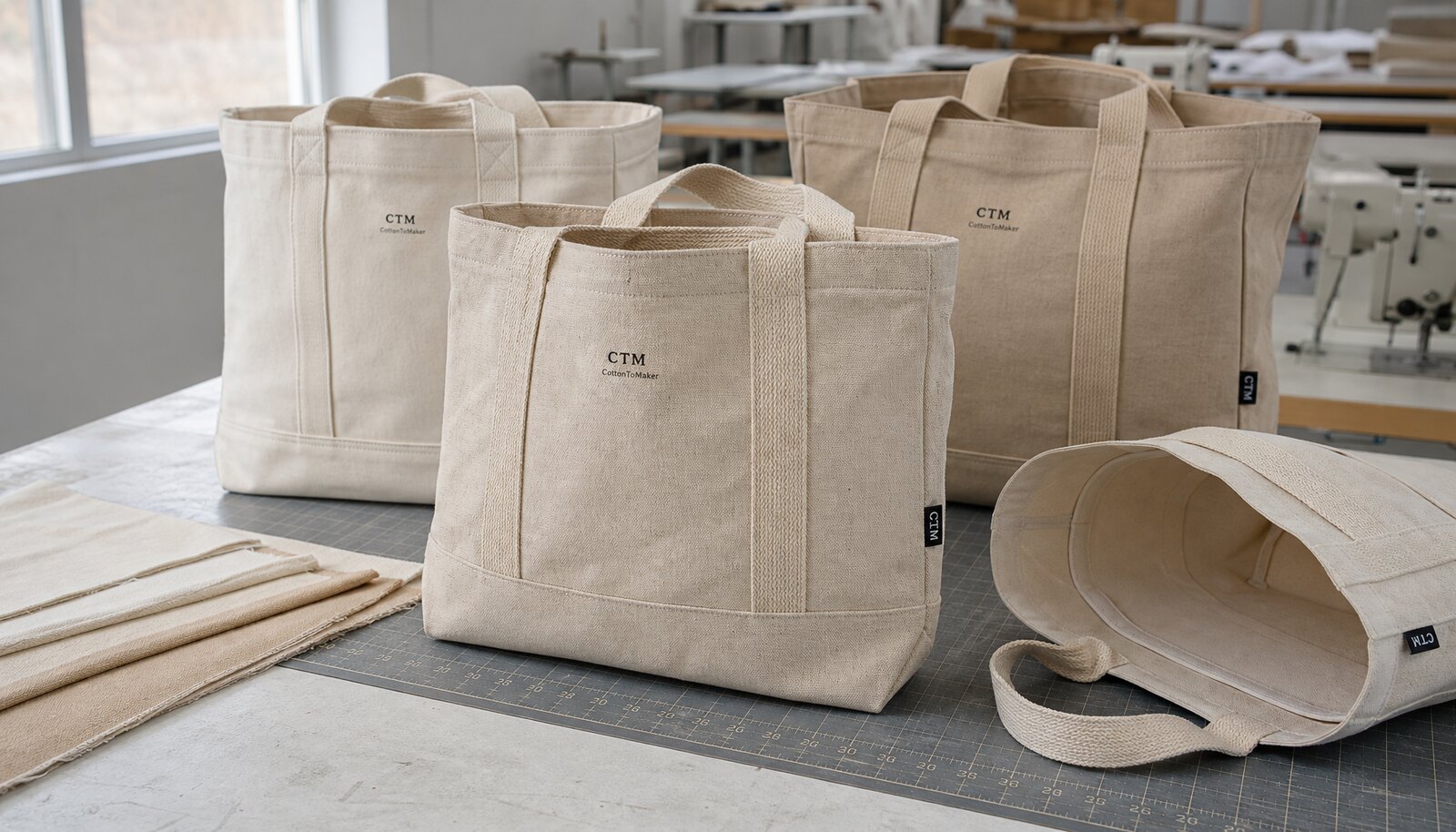
Why gift shops need a different canvas spec
A gift shop tote is not the same product as a cheap event giveaway. Buyers usually need the bag to look good on a display hook, hold shape when folded, and feel substantial enough to justify a retail price. That means material selection starts with the visual and functional job the tote must do, not just the lowest fabric cost.
Heavy canvas also behaves differently in production. When the fabric gets thicker, stitch penetration, print sharpness, fold memory, and handle comfort all change. If you source the wrong weight, the bag may look premium in the sample but feel bulky, distort at the seams, or become too expensive to retail once packing and freight are included.
- Gift shop totes often sell as impulse carry bags, souvenir bags, or branded add-on items.
- Shelf presentation matters almost as much as load capacity.
- The best spec balances structure, print quality, retail price, and repeat use.
Choose fabric weight by retail position, not by habit
For most gift shops, 12–16 oz canvas is the practical range. At the lower end, you get a lighter bag that still feels more premium than basic cotton sheeting. At the upper end, you get a structured tote that stands up better in display and holds shape around books, candles, boxed gifts, or apparel. The right choice depends on where the tote sits in your assortment and how customers will carry it.
A common mistake is specifying the heaviest possible fabric because it sounds premium. In reality, 16 oz canvas can be too stiff for certain handle styles, and it can push freight up quickly. A 14 oz bag often lands in the sweet spot for gift shops because it keeps enough body for retail value without making the tote feel like a hard carrier.
- 10–12 oz: better for light souvenir use, lower-cost programs, and fold-flat display requirements.
- 14 oz: balanced option for most branded gift shop totes.
- 16 oz: best for structured, premium positioning or heavier gift loads.
Fabric details that change cost and appearance
GSM alone does not tell the whole story. Two factories can quote the same nominal weight and deliver very different results because of yarn count, weave density, finishing, and shrinkage control. A tighter weave usually prints cleaner and gives a more consistent hand feel. A looser weave may look rustic, but it can absorb ink unevenly and show more surface fuzz after handling.
If your buyer spec includes washing, steaming, or post-print finishing, you need to set a shrinkage expectation. Canvas can tighten or distort after treatment, and that affects artwork placement and final dimensions. For gift shops, the visual impact of a clean, rectangular tote often matters more than a small difference in raw fabric cost.
- Specify weave density or request a cut-up fabric swatch for visual comparison.
- Ask whether the fabric is greige, bleached, dyed, enzyme-washed, or pre-shrunk.
- Request finished-size tolerance after pressing, not just cut size.
Compare sourcing routes before you compare prices
The cheapest quote is not always the best sourcing route. A direct factory quote is usually stronger when you need repeatability, artwork control, and room to change handle or lining details later. A trading company can be useful for small test runs, multiple bag styles, or mixed packaging requests, but the buyer should expect less transparency on fabric source and process control.
For gift shop programs, the most expensive mistake is often a quote that omits a small detail and adds it back later as a charge. Compare suppliers on the same basis: same GSM, same handle material, same print method, same packing, and same carton assumptions. Without that discipline, the lowest unit price may become the highest landed cost.
- Direct factory route: better for stable reorders and sharper process control.
- Trading route: useful for smaller MOQs or mixed product development, but verify who owns QC defects.
- Mixed-source route: can work for test runs, but only if material substitutions require written approval.
What the quote should include, line by line
A useful quote is more than a unit price. It should show whether the bag is priced with self-fabric handles, woven labels, print setup, individual polybags, carton marks, and export packing. When these are hidden, the buyer cannot compare suppliers accurately or calculate landed cost with confidence.
You should also watch for vague wording around weight and size. Terms like 'heavy canvas,' 'thick fabric,' or 'custom size' are not enough for procurement. The supplier should state the target GSM or ounce weight, the exact finished dimensions, the acceptable tolerance, and any assumed shrinkage. If those items are not written into the quote, they should be written into the purchase order.
- Unit price should separate basic bag cost from print, label, packaging, and special finishing.
- MOQ should be stated per artwork, per color, or per SKU family.
- Lead time should show sample stage and bulk stage separately.
- Carton pack should state quantity per carton and gross weight range.
Print method selection for gift shop artwork
Most gift shop canvas totes are sold with simple brand marks, local destination art, or seasonal graphics. For one- or two-color artwork, screen print is usually the cleanest and most economical method. It handles solid areas well and gives strong opacity on natural canvas, provided the mesh, ink deposit, and curing are controlled.
For complex illustrations, gradients, or small multicolor art, heat transfer or digital print can protect detail better than screen printing. Embroidery works when the logo is small and the buyer wants a premium texture, but it adds cost and thickness. A useful rule is to match the decoration method to the retail price point, not the designer's preference.
- Screen print: best for simple logos, bold art, and repeat orders.
- Heat transfer / digital: better for detailed graphics and short runs with multiple SKUs.
- Embroidery: premium look, but only practical for smaller logos and structured canvas.
MOQ logic and sample strategy that saves time
MOQ should not be treated as a fixed number divorced from the bag spec. A simple unlined tote with one-color print may fit a lower MOQ than a structured tote with lining, bottom board, woven label, and multi-color print. The factory's MOQ usually reflects fabric cutting efficiency, print setup, and sewing line changeover, so buyers should separate the 'development MOQ' from the 'repeat MOQ' when planning a launch.
Sampling should not stop at a pretty photo sample. The first approval sample must match the final fabric weight, print method, handle construction, and packing style. If the sample is made with substitute fabric or a different printing process, it is only a concept sample. For procurement, concept samples are useful for design sign-off, but they do not protect you from production problems.
- Development sample: validates shape, artwork placement, and retail presentation.
- Pre-production sample: matches final materials and build; use this for PO approval.
- Golden sample: keep one signed sample for incoming inspection reference.
Quality control thresholds buyers should write down
The most common defect in heavy canvas totes is not a catastrophic failure; it is a slow accumulation of small problems. The print may be slightly off-center, the handles may vary a few millimeters, or the seams may pull the bag shape sideways. On a shelf, those small issues reduce perceived value quickly.
Use acceptance criteria that a factory can actually measure. For example, define size tolerance, stitch density, print alignment, handle symmetry, and carton condition. If you need a premium gift shop presentation, also set a no-defect rule for visible staining, loose threads on the face panel, and label placement. That makes inspection objective rather than opinion-based.
- Center print should not drift beyond the agreed artwork tolerance.
- Handle lengths must be even and symmetrically attached.
- Top edge should sit flat without wave distortion.
- No visible oil stains, broken threads, or panel wrinkles on retail-facing surfaces.
Packing, carton loading, and freight impact
Packing has a bigger effect on landed cost than many buyers expect. Heavy canvas bags are bulky, so the carton size and fold method directly affect how many units fit in a container. A tote that ships in a loose fold with cardboard insert will protect shape, but it will also increase volume. A compressed fold may improve freight efficiency but create crease marks that hurt shelf appearance.
For gift shops, a good compromise is usually a controlled fold with a simple insert or banded pack, depending on the bag's finish. If the tote has a printed face, avoid fold lines through the graphic area. If it has a woven side label or embossed mark, protect that area from scuffing during carton compression.
- Define whether each bag ships flat, folded, banded, or polybagged.
- Ask for carton dimensions before approving the final quote.
- Check whether pack quantity changes if the bag includes lining or a board insert.
A practical landed-cost comparison for buyers
When comparing quotes, do not stop at ex-factory price. Heavy canvas tote bags for gift shops often vary in freight cost because of carton volume, bag stiffness, and packing method. A slightly cheaper bag can lose the comparison if it takes more carton space or requires extra packing labor. That is why the cheapest quote should be tested against the same freight assumptions as the others.
A simple way to compare is to calculate three numbers: unit cost, carton cost per bag, and estimated freight cost per bag. Then add expected duty or tax based on your import channel. This gives procurement a cleaner decision than comparing a quoted price alone. It also helps retail buyers decide whether to use one premium SKU or a two-tier assortment.
- Use the same carton count and carton dimensions across supplier quotes when possible.
- Include print setup and packaging charges in the comparison sheet.
- Treat sample freight and bulk freight as separate line items.
Specification comparison for buyers
| Spec decision | Recommended option | When it fits | Buyer risk to check |
|---|---|---|---|
| Fabric weight / GSM | 12–16 oz canvas, usually 340–540 GSM | Gift shops that want a structured, premium tote with repeat-use value | Too light and the bag slumps; too heavy can raise cost and reduce foldability for retail display |
| Canvas construction | Plain weave or tighter canvas with controlled shrinkage | When print clarity and shelf appearance matter more than ultra-soft hand feel | Loose weave can fuzz, distort print edges, and vary in finished size after washing or steaming |
| Handle build | Matching canvas handles or 2.5–3 cm cotton webbing with bar-tack reinforcement | For higher load ratings and a more gift-shop premium look | Thin handles cut into the shoulder and often fail first at the stitch point |
| Print method | Screen print for simple art; heat transfer or digital for complex artwork; embroidery for small premium marks | When art count, color count, and order size differ across retail programs | A beautiful sample can hide poor registration, weak ink opacity, or cracking after fold testing |
| Lining and structure | Unlined for low-cost basic SKUs; partial lining or bottom board for premium display bags | When the tote needs to stand upright on shelves or protect delicate gift items | Added structure changes cost, lead time, and carton count; some factories quote it loosely |
| Closure | Open top for broad retail use; zipper or snap only for premium/security positioning | When customers will carry souvenirs, books, candles, or fragile gift items | Closures add parts, sewing steps, and failure points; zipper tape color and pull quality must match spec |
| Decoration location | Front-centered print with optional side woven label | When the tote is sold as a gift shop branded item and shelf identity matters | Oversized artwork near seams may distort; side labels can be omitted if not written into the PO |
| Source route | Direct factory sourcing for repeat programs; trading route only for small test quantities or mixed SKUs | When the buyer needs stable spec control and predictable reorders | Trading routes can hide fabric source changes, inconsistent QC, or unclear complaint ownership |
Buyer checklist before sampling
- Confirm target fabric weight in GSM and acceptable tolerance before quote comparison.
- Lock bag dimensions, seam allowance, handle length, and finished gusset depth on a drawing.
- Specify print method, artwork size, Pantone references, and the maximum color count.
- State whether the tote must stand upright, fold flat, or carry a minimum load.
- Define carton pack, inner polybag requirement, and barcode placement before sampling.
- Request a pre-production sample that matches the final fabric, handles, print, and label build.
- Set an AQL or defect threshold for stitch skips, print smears, size deviation, and contamination.
- Ask for the factory's lead time split by sampling, bulk fabric booking, production, and packing.
- Compare landed cost using the same assumptions for carton count, shipping volume, and duty class.
Factory quote questions to send
- What exact canvas weight, weave type, and shrinkage allowance are included in the quote?
- Are the handles self-fabric or webbing, and what stitch reinforcement is included at each attachment point?
- Which print method is priced, how many colors are included, and what are the setup charges?
- Does the quoted MOQ apply per color, per artwork, or per total order across multiple SKUs?
- What is the standard finished-size tolerance, and what size variation will be accepted in mass production?
- Is the tote quoted with any lining, bottom board, zipper, snap, or woven side label, or are those extra?
- How many days are needed for sample approval, bulk production, inspection, and final packing?
- What carton size, pack quantity, and export packing method are used to calculate the freight volume?
- Which materials or processes are likely to change if fabric is unavailable, and who approves substitutions?
Quality-control points to confirm
- Fabric weight must match the agreed GSM target within a clear factory tolerance, not a vague 'about the same' description.
- Canvas should show even weave density, no broken yarn lines, and no oily residue or heavy dust on the surface.
- Finished dimensions should stay within the approved tolerance on width, height, and gusset after pressing and packing.
- Handle stitching should include consistent bar-tacks or box-X reinforcement with no loose ends or skipped stitches.
- Print edges should remain sharp, with no misregistration, pinholes, bleeding, or color shift beyond the approved sample.
- Seams should be straight and balanced, with no twisting at the side seams or uneven top-edge finishing.
- Cartons should protect the bag shape and prevent crush marks, moisture exposure, or heavy scuffing during transit.
- Random packed samples should be pulled from different cartons, not only from the top layer of the first carton.
- Any odor, staining, needle damage, or label mismatch should be treated as a production defect, not a cosmetic preference.