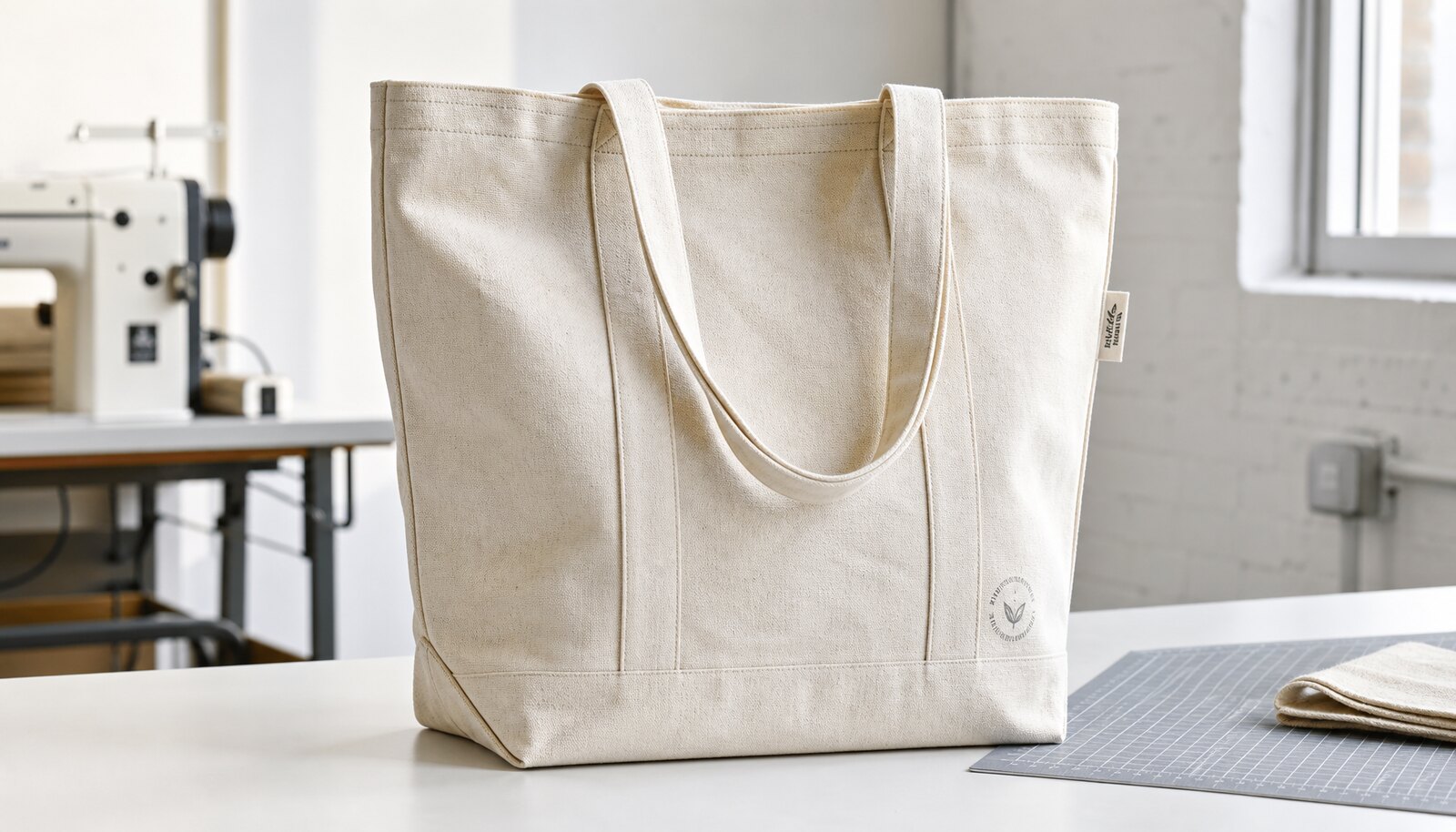
Start With the Market Use Case, Not the Logo
Heavy canvas tote bags for farmers markets are judged by what they carry after a long day, not by how the sample looks in a presentation. The buyer should define the abuse case first: apples, jars, flowers, bottles, damp produce, repeated weekly use, and whether the bag needs to stand upright at checkout. That determines whether a 12 oz promotional tote is enough or whether the program needs 14 oz or 16 oz canvas with reinforced handles and a boxed bottom.
For procurement, the useful question is not which tote is cheapest on paper, but which tote survives the intended use without creating returns, replacements, or complaints. A bag that twists under load, sheds ink, or fails at the handle anchor is not a branding problem. It is a spec problem. If the bag will be sold or handed out as a farmers market staple, spec it for repeat use, not for one-time promotion.
- Define the main load: produce, wine bottles, bakery items, mixed grocery carry, or handout use.
- Decide whether the bag must stand upright, fold flat, or hang from a peg or hook.
- Set the carry expectation early so handle width and drop are not guessed later.
- Treat repeat weekly use as part of the commercial requirement, not as a bonus feature.
What Actually Moves Bulk Price
The tote price usually moves in four places: fabric, construction, decoration, and packing. Fabric is the biggest lever, but procurement teams often underweight the effect of finish and origin. Natural canvas is usually the lowest-cost starting point. Dyed, bleached, garment-washed, or recycled-content canvas costs more because the mill work changes, the yield changes, or the proof requirements change. If a supplier quotes only one number for fabric weight, that is not enough to compare suppliers fairly.
Construction matters just as much. A simple open-top tote with standard handles is cheaper than a bag with a boxed bottom, lining, binding, a pocket, or heavier reinforcement at the stress points. Decoration also changes the number. A single-color screen print is usually efficient for larger runs, while embroidery, oversized solids, or tight type can raise waste and setup time. Packing can be a hidden cost center. Flat-packed totes are easier to ship, but retail-folded bags with inserts, labels, and barcodes cost more to prepare and often need tighter carton control.
- Ask for fabric in both oz and GSM, plus the finish and origin if the material claim matters.
- Price 12 oz, 14 oz, and 16 oz canvas separately before locking the build.
- Treat gussets, boxed bottoms, pockets, labels, and reinforcement as real line items.
- Keep setup, packing, freight, and compliance separate from the tote unit price.
A Bulk Pricing Plan That Buyers Can Actually Use
The planning bands below assume 14 oz natural canvas, one-color screen print, standard handles, flat packing, no lining, and no premium retail folding. They are for budgeting and supplier shortlisting, not for writing a purchase order. If you move to 16 oz canvas, add roughly 8 percent to 15 percent. If you switch to dyed, washed, or recycled-content fabric with proof requirements, add about 10 percent to 25 percent depending on the source and yield. Woven labels, embroidery, and retail packing should be priced as separate adders rather than absorbed into the base tote number.
The useful part of a pricing plan is not just the unit rate. It is the break between volume tiers and the cost of each build decision. Below 1,000 pieces, setup can dominate the quote. Between 1,000 and 3,000 pieces, the order often becomes workable for a first real program. Between 3,000 and 10,000 pieces, the buyer usually gets the best balance of unit price and control. Above 10,000 pieces, the unit price can keep falling, but cash flow, storage, and sell-through risk start to matter more than another small price cut.
- 500 to 999 pcs is usually the pilot band, where setup cost weighs heavily on the unit price.
- 1,000 to 2,999 pcs is often the first practical buying band for a seasonal tote program.
- 3,000 to 9,999 pcs usually gives the best mix of price, control, and repeatability.
- 10,000+ pcs can reduce unit cost further, but only if freight, storage, and demand support the larger buy.
- Use separate adders for 16 oz fabric, dyed fabric, woven labels, embroidery, and retail packing.
- Do not treat one supplier's all-in number as comparable unless the build and delivery terms are identical.
Compare Sourcing Routes by Cost and Control
Direct factory sourcing in East or Southeast Asia is usually the lowest-cost route when the spec is stable, the artwork is locked, and the buyer can accept a longer freight window. It becomes less attractive when the tote program needs frequent changes or a shorter replenish cycle. India or Pakistan can be competitive on heavy canvas supply, especially when the buyer wants a simpler sewn build, but finish and shade consistency need to be checked carefully. Nearshore suppliers in Mexico or Central America usually cost more per tote, yet the shorter transit can be worth it if the market timing is tight.
Domestic cut-and-sew or decoration is the highest-cost route in most cases, but it can still be the right commercial answer for small runs, urgent launches, or account-specific packs. Blank bag plus local print can look inexpensive at first, but the added handling and color-match risk need to be counted. Trading companies or sourcing offices usually sit above direct factory pricing because their margin is built into the quote, but they can reduce workload if the buyer needs one contact for bag, packing, export paperwork, and shipping.
- Choose direct factory sourcing when the tote spec is fixed and the order is large enough to absorb setup.
- Choose nearshore supply when replenish speed matters more than squeezing the last cent out of the ex-factory price.
- Choose domestic conversion when timing, small volume, or channel-specific packaging matters most.
- Choose blank plus local print only when handling controls are tight enough to protect quality.
- Choose a managed sourcing office when the team needs one owner across production and export paperwork.
Write the RFQ So the Quotes Mean the Same Thing
A good RFQ removes interpretation. It should define the finished size, gusset depth, handle length, handle drop, canvas weight, finish, decoration method, print area, label type, inner pack, master carton count, destination, and delivery term. If the buyer can attach a reference sample, a sketch, or a dimensioned drawing, that helps even more. The purpose is not to over-spec the bag. It is to keep every supplier quoting the same assumption set so procurement can compare the numbers without translating them first.
If alternate options are acceptable, such as natural canvas versus dyed canvas or screen print versus woven label, ask for separate line items instead of a blended price. That makes it obvious where cost increases come from and which features are actually worth paying for. The RFQ should also ask the supplier to state any deviation from the requested build in writing. A quote that quietly swaps fabric weight, construction detail, or pack format is not a comparable quote.
- Attach the artwork at final size and call out any minimum line thickness or small-text concern.
- Ask for a line-by-line price that separates bag price, setup, sample, packing, freight, and documents.
- State the destination and Incoterm so freight responsibility is not guessed.
- Require separate pricing for any alternate fabric, finish, decoration method, or pack format.
- If the supplier wants to change the build, have them show the price and lead-time impact separately.
Qualification Signals That Matter More Than a Polished Quote
Supplier qualification should start with production reality, not sales polish. Ask where the canvas is sourced or woven, where it is cut, where printing happens, and where the final packing takes place. If those steps happen in different facilities, the buyer should know who controls schedule and who owns rework. A clean quote is useful, but it is not proof of process control. A supplier that cannot identify the mill, the sewing line, or the pack site usually cannot support repeat ordering without surprises.
If the program depends on a material claim, ask for proof, not promises. That can include mill invoices, origin statements, transaction certificates, lot traceability, or certification documents when the claim requires them. If the buyer needs a social compliance posture, ask for a current audit report, the audit scope, and evidence that any corrective actions are closed. For testing, ask for the reports that fit the market: fabric weight, shrinkage, colorfastness, seam strength, print rub, and any chemical compliance needed by the channel. The biggest red flag is when the sample looks better than the quote can reasonably support.
- Ask for photos of the cutting, sewing, printing, and packing areas before award.
- Request fabric origin evidence when the source or claim affects the buying decision.
- If the tote is recycled, organic, or otherwise certified, ask for the certificate and traceability documents.
- Ask for a current social compliance audit if your vendor program requires it.
- Watch for failure cases such as the sample being 14 oz while bulk arrives at 12 oz, or print quality collapsing on the second production lot.
QC and Test Plan for a Tote That Will Be Used Hard
Quality control for heavy canvas totes should be written as a buying standard, not as a vague inspection note. Start with a golden sample and then translate it into measurable tolerances. Finished size, handle drop, print placement, and seam construction should be checked against that approved sample. A practical tolerance starting point is plus or minus 0.25 in, or about 6 mm, on width, height, and gusset depth, with fabric weight held within plus or minus 5 percent of the approved spec. If the bag is meant to carry weight, seam and handle construction matter more than a nice front-panel photo.
The defect list should be practical. Major defects include open seams, missing bar tacks, wrong size, broken handles, and gross print misregistration. Minor defects include loose threads, small shade variation, and light fold marks. A common starting point is AQL 2.5 for major defects and AQL 4.0 for minor defects, unless your channel requires a stricter standard. Test the decoration with the method that matches the print. At minimum, check dry rub and tape adhesion. If the bag is washable, run a wash cycle on retained samples and inspect cracking, bleeding, and distortion.
- Check handle symmetry and handle drop, because uneven carry is obvious in use even when the bag looks fine on a table.
- Verify stitch density on the main seams and confirm that the handle anchors are reinforced, not just visually finished.
- Inspect random cartons for count accuracy, fold direction, inner pack consistency, and label placement.
- Run a simple load test using the intended carry weight or a representative load, then inspect seams and handle anchors.
- Reject cartons that fail integrity checks, burst on corners, or expose the product to moisture or crush damage.
Packing and Freight Are Part of the Product Economics
Packing changes tote economics more than many teams expect. A flat-packed bag ships efficiently, but it may need more handling when it reaches the buyer's warehouse or store. A retail-ready fold with inserts, barcodes, and label rules costs more to prepare, yet it can reduce downstream receiving friction. The right choice depends on the channel. A farm shop or co-op may care most about simple shelf presentation. A distribution center may care more about carton marks, pallet pattern, and barcode placement that matches its receiving rules.
Freight also needs to be priced as part of the tote. If the quote is FOB or EXW, the buyer must compare freight separately so a low ex-factory price does not disguise an expensive landed cost. If the quote is DDP, the buyer should confirm the duty basis, the delivery point, and whether brokerage is included. Carton size, gross weight, and cube matter because they change freight and warehouse handling. A well-priced tote can become expensive if the carton is oversized, underpacked, or prone to crush damage in transit.
- Ask for carton dimensions, gross weight, and cubic volume before booking freight.
- Specify inner pack count and master carton count so counts do not drift by supplier.
- Require moisture protection if the bags will travel by ocean or sit in storage for a long time.
- Match the pack format to the channel: retail shelf, ecommerce, or bulk distribution.
- Hold a small rejection reserve in the budget so rework or replacement does not break the landed-cost model.
Choose the Supplier Type That Matches the Buyer Problem
The best supplier is the one whose strengths match the buying problem. If the buyer needs the lowest repeatable unit price and can manage a longer lead time, a direct factory in Asia is usually the first place to look. If the buyer needs faster replenishment or wants to reduce transit volatility, nearshore supply is often the better balance. If the run is small, urgent, or tied to a specific account, domestic cut-and-sew can be the cleaner option even if the unit cost is higher. A trading company or sourcing office is useful when the internal team needs one owner across bag, packing, and export paperwork.
Blank plus local print is best when the artwork changes often or when the buyer wants to keep decoration close to market control. That route is not automatically cheaper. It only wins if the handling, color matching, and transit between blank and decoration are managed tightly. The practical way to shortlist suppliers is to ask each one to prove the thing that matters most for its route: origin traceability for a factory, transit speed for a nearshore vendor, turnaround for a domestic converter, or process control for a local decorator.
- Use Asia direct for stable repeat programs that can absorb longer transit.
- Use nearshore when replenishment speed and supply continuity are more important than the lowest ex-factory price.
- Use domestic when the order is small, urgent, or tied to a channel that values fast correction.
- Use blank plus local print only when handling controls are strong enough to protect quality.
- Ask every supplier to prove the one thing that justifies its route, not just its price.
Make the First Order Small Enough to Learn, Big Enough to Matter
The safest first order is usually the simplest one. Keep the body spec to one size, one fabric weight, one decoration method, and one packing format. That makes the sample review manageable and the pricing clean. If the tote performs well, the next order can add a second color, a premium label, a heavier canvas option, or a different pack format. Launching with too many variants makes it hard to know which choice created the cost, the delay, or the defect.
For farmers market programs, the best buying discipline is to set a clear reorder trigger and hold one golden sample, one approved fabric swatch, and one approved print strike-off. That turns a one-time purchase into a repeatable supply process. If a later lot changes fabric source, finish, or decoration method, the buyer should treat that as a new approval event, not as a quiet substitution. The goal of a bulk pricing plan is not only to get to a lower unit price. It is to make the second order easier, faster, and less risky than the first.
- Start with one body spec and one print variant until the tote proves demand.
- Use landed cost, not headline unit price, when setting the budget.
- Keep the golden sample, print strike-off, and approved carton spec together for reorder checks.
- Add variants only after the core tote passes sell-through and inspection.
- Treat any material or decoration change as a fresh approval step, not a silent revision.
Specification comparison for buyers
| Sourcing route | Baseline assumptions | Planning ex-factory cost | Commercial risk | Best fit |
|---|---|---|---|---|
| Direct factory in East or Southeast Asia | 14 oz natural canvas, one-color screen print, flat pack, EXW or FOB, 1,000 to 5,000 pcs | About $1.45 to $3.15 per tote, with lower rates at higher volume | Medium risk if spec control is loose, but the lowest cost path for repeatable orders | Stable programs where the buyer can accept ocean lead time and manage freight separately |
| Direct factory in Asia with upgraded build | 16 oz canvas, dyed or washed finish, one-color print, woven label or reinforced trim, 1,000 to 5,000 pcs | About $2.35 to $4.55 per tote | Medium to high risk if fabric origin and finish claims are not documented | Premium retail tote programs where feel, durability, and branded detail matter |
| India or Pakistan cut-and-sew source | Heavy natural canvas, simple sewing, one-color print, 1,000 to 5,000 pcs | About $1.70 to $3.20 per tote | Medium risk on shade consistency and finish variation, depending on mill and dye control | Buyers who want competitive fabric access and can verify lot consistency |
| Nearshore supplier in Mexico or Central America | 14 to 16 oz canvas, one-color print, shorter run, 500 to 3,000 pcs | About $2.60 to $4.80 per tote | Lower transit risk, but fabric and labor usually cost more than offshore sources | Fast replenishment, seasonal launches, or buyers who want shorter supply lines |
| Domestic US cut-and-sew or decorator | Stock or cut-and-sew body, one-color print or sewn label, 250 to 2,500 pcs | About $4.75 to $8.25 per tote | Low transit risk, high unit cost, but easier coordination and faster correction cycles | Small runs, urgent launches, or retail accounts that value quick turnaround |
| Blank bag plus local print | Offshore or domestic blank tote, local screen print or transfer, modest decoration complexity | Blank bag about $1.10 to $2.10, plus local print about $0.45 to $1.20 | Handling and color-match risk can offset savings if the workflow is not tight | Artwork changes often, the run is small, or the buyer wants print control close to market |
| Managed sourcing office or trading company bundle | Factory build with buying office margin, packing, and export paperwork included | Usually 8% to 18% above the equivalent direct-factory quote | Lower coordination burden, but margin and scope clarity must be checked carefully | Teams that need one accountable contact across bag, packing, compliance, and shipping |
Buyer checklist before sampling
- Define the use case before asking for price: produce, bottles, flowers, mixed grocery, or giveaway use.
- Lock the finished size, gusset depth, handle drop, and carry weight so suppliers do not quote a generic tote.
- State the fabric in oz and GSM, and say whether the canvas must be natural, dyed, bleached, washed, recycled-content, or organic-certified.
- Ask for the fabric source and origin evidence when the material claim matters to your channel or brand.
- Lock the decoration method, print colors, print size, and print position, then price any alternate artwork separately.
- Request a line-by-line quote for unit price, setup, sample, packing, inland freight, export documents, and destination freight if applicable.
- Compare 500, 1,000, 3,000, and 10,000 piece tiers so you can see the MOQ break and not just one opaque number.
- Confirm the Incoterm and destination address before comparing quotes, since freight responsibility changes the real landed cost.
- Approve one pre-production sample and keep one golden sample for reorder comparison.
- Write the inspection tolerances into the approval record: size, stitch density, print placement, carton count, and pack count.
Factory quote questions to send
- Quote this tote at 500, 1,000, 3,000, and 10,000 pcs, and show the break between those tiers.
- What fabric weight, weave density, and finished size are you pricing, and what changes if I move from 14 oz to 16 oz?
- Where is the canvas sourced or woven, and can you provide lot traceability or origin evidence for the fabric claim?
- Is the price based on one-color screen print, multi-color screen print, heat transfer, embroidery, or a sewn label only?
- What changes in price if I switch from natural canvas to dyed, washed, or recycled-content fabric?
- What is the MOQ by size, fabric color, print color, and packing method, and can any of those be pooled across one body spec?
- Are screen charges, plate fees, setup, sample charges, carton charges, and export documents included or listed separately?
- What is the exact packing method, and how many pieces go in each inner pack and master carton?
- What stitch density do you use on the main seams and handle anchors, and what seam allowance is standard for this style?
- What tolerance do you hold for finished size, handle length, handle drop, and print placement, and how do you measure it?
Quality-control points to confirm
- Set a golden sample before bulk starts, and make it the reference for fabric shade, print placement, handle drop, and seam finish.
- Use a finished-size tolerance of plus or minus 0.25 in, or about 6 mm, on width, height, and gusset depth.
- Hold fabric weight within plus or minus 5 percent of the approved spec, and reject unexplained substitutions.
- Target 7 to 9 stitches per inch on the main seams, with reinforcement or bar tacks at the handle anchors.
- Check handle symmetry and handle drop against the centerline, because a bag that hangs unevenly feels wrong even when it passes a visual scan.
- Treat open seams, missing bar tacks, wrong size, broken handles, and gross print misregistration as major defects.
- Treat loose threads, light fold marks, and small shade variation as minor defects unless they affect function or branding.
- Use AQL 2.5 for major defects and AQL 4.0 for minor defects unless your channel requires a stricter plan.
- Run print durability checks that match the decoration method, such as dry rub, tape adhesion, and wash testing if the tote is meant to be washed.
- Inspect random cartons for count accuracy, fold direction, inner pack consistency, label placement, and carton integrity before release.