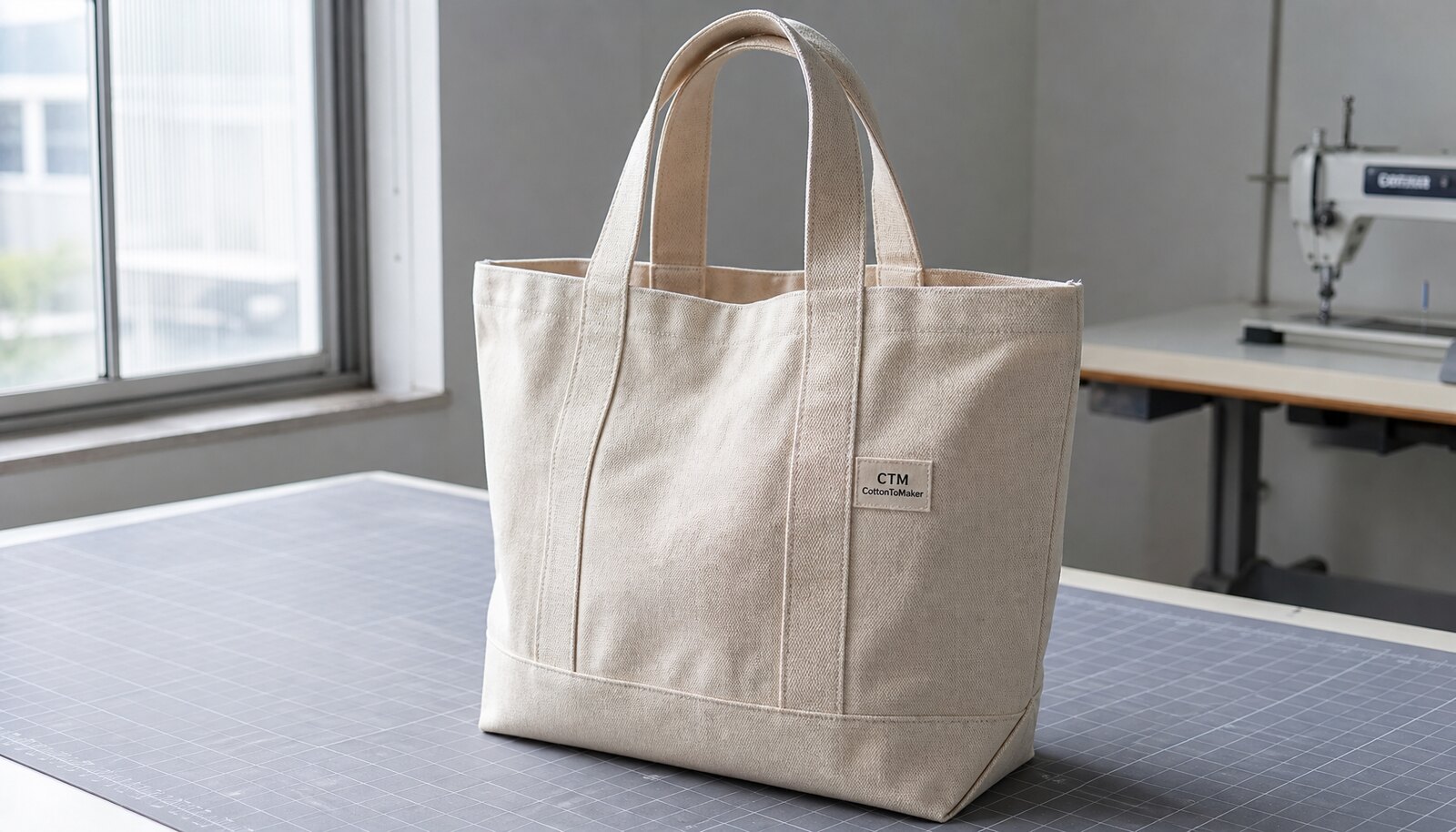
Why heavy canvas tote reorders need a different buying playbook
Heavy canvas tote bags are easy to underestimate because the product looks simple. In ecommerce, though, the bag is often doing more than one job. It may be a gift-with-purchase item, a retail add-on, a branded mailer insert, or a seasonal upsell. Once the bag starts repeating across campaigns, the buying question shifts from “Can a supplier make this?” to “Can the supplier make it the same way again, at the same cost, with the same pack-out and the same quality outcome?”
That repeatability question matters because tote bags have several cost and quality variables that can move independently. Fabric weight affects hand feel, freight, and structure. Seam construction affects failure rate. Print method affects unit economics and durability. Packing method affects cube and warehouse handling. A buyer who only chases the lowest ex-factory number may save pennies and lose margin later through damage, repacks, receiving delays, or mismatched reorders.
The most useful reorder mindset is operational rather than promotional. A good spec should hold through multiple purchase orders, multiple sales channels, and multiple factories if you ever need to dual-source. That means documenting the exact dimensions, the construction details, the decoration method, and the packing format, then using the same baseline when suppliers quote. If the bag is going to live inside a forecast, it should be treated like an inventory item with controlled variables, not a one-off merch idea.
There is also a timing issue that is easy to miss. Tote bags are often used in product launches, seasonal campaigns, influencer mailers, and gift programs where a late shipment damages a wider marketing plan. Reorder planning is therefore not just a procurement task. It is a demand-planning task, a QC task, and a landed-cost task at the same time. The earlier the spec is locked, the more room the buyer has to compare suppliers on true commercial terms instead of reacting to an urgent stockout.
- Treat the tote as a repeat SKU, not a one-time promo item.
- Control the variables that change across reorders: fabric, seam method, print, packing, and carton density.
- Set the spec once, then use the same document for every supplier quote and reorder review.
- Build in time for sample approval, freight booking, and a realistic safety buffer before stock runs low.
Choose fabric weight based on use case, not on the highest number available
For most ecommerce programs, heavy canvas totes usually fall in the 12oz to 16oz range. The right choice is not automatically the heaviest one. It depends on what the customer will carry, how premium the bag should feel, how often it will be reused, and how much freight sensitivity the item has in your channel. A 12oz tote can be perfectly acceptable for a value-led campaign or lighter retail goods. A 14oz bag is often the best middle ground when the brand wants the product to feel substantial without becoming too expensive to source and ship. A 16oz bag makes sense when the tote needs a firmer body, better abrasion resistance, or a more premium in-hand impression.
The important point for procurement is that ounce weight alone does not tell the whole story. Ask whether the quoted weight is finished fabric weight or greige weight. Those are not interchangeable. Dyeing, washing, pre-shrinking, and finishing all affect the final hand feel, opacity, and dimensional stability. If a supplier quotes 14oz greige canvas but ships a lighter finished bag after processing, the product may still technically be made from the quoted material while failing the buyer’s actual requirement. The RFQ should therefore state finished weight and, where possible, GSM as a secondary reference.
Structure matters as much as weight. Some bags have a firmer weave, better yarn balance, or tighter construction that makes them feel heavier than the number suggests. Others use a looser weave that looks substantial in a sample but stretches or softens after a few uses. For reorder planning, the buyer should compare not only weight but also weave density, shrinkage expectations, and the way the fabric behaves after folding. If the bag is supposed to stand upright for retail presentation or pack neatly in a fulfillment line, a slightly heavier and tighter weave can be worth more than a nominally cheaper, softer option.
There is a freight angle too. Heavy canvas is not just about product cost; it also affects carton weight and cube. If the tote is part of a high-volume ecommerce program, even modest changes in folded thickness can change carton density and shipping cost over a full container or a recurring airfreight replenishment. That is why the spec should include finished dimensions, expected folded size, and carton target, not just fabric ounce weight.
- Use 12oz for value-led programs and lighter fills; use 14oz for a balanced premium feel; use 16oz when structure and durability matter more than unit cost.
- Ask for finished weight, GSM, weave density, and shrinkage behavior, not only one headline fabric number.
- If the bag must stand upright or survive repeated use, prioritize tighter weave and better construction over a slightly lower quote.
- Include folded size and carton target in the spec because freight can change more than buyers expect.
Construction details that separate a durable tote from a costly return
A heavy canvas tote can still fail if the construction is weak. In procurement terms, the bag should be evaluated from the stress points out. Handles, top-edge seams, and bottom joins carry most of the load. If those are not reinforced properly, the bag may look fine on arrival and still fail after a few customer uses. That kind of issue is expensive because the bag may be cheap enough to pass purchase-order review while still generating damage claims or brand complaints later.
The most useful construction questions are practical. How wide is the handle? How much seam allowance is used? Is the handle attached into the seam or only topstitched onto it? Are the bottom seams double-stitched, chain-stitched, or locked with bar-tacks? These details determine whether the bag keeps its shape and whether the stress loads are distributed evenly. A supplier should be able to describe the construction without hesitation and show sample photos of the internal and external finish.
Handle reinforcement is the area buyers should watch most closely. Many tote bags fail here first because the handles are used repeatedly, twisted when the bag is full, and pulled from awkward angles in transit or at checkout. Good procurement practice is to request a clear reinforcement standard: bar-tack size, count, placement, and the stitch density on the top edge. If the bag will carry heavier items, buyers should also ask for a simple load test on the handle and seam area before bulk approval.
The bottom of the tote matters as well. If the bag has a gusset, the bottom seam should be planned for the product’s likely use, not just for appearance. A broad gusset can increase useful capacity, but it also requires better sewing accuracy to keep the bag square. If the tote will be packed flat and then opened repeatedly by the end customer, the bottom seam should be strong enough to avoid distortion. When a factory can show how it handles these details on repeat orders, the buyer gets a better signal than from a polished sample alone.
- Ask for seam allowance, stitch count, and reinforcement photos before approving the supplier.
- Treat handle anchors as the highest-risk defect area.
- Use a load test aligned to real use, not just a visual review.
- Check gusset alignment and bottom shape if the bag must stand or pack cleanly.
Print method, decoration area, and how to avoid expensive rework
Decoration drives both the look and the economics of a tote program. Screen printing is usually the default option for heavy canvas tote bags when the artwork is stable and the brand expects reorders. It scales well, keeps unit cost reasonable, and gives a durable result when the ink, mesh, and cure are correct. For a simple one-color or two-color logo, screen print is usually the most procurement-friendly choice because it is easy to quote, repeat, and inspect.
Alternative decoration methods can work, but each creates a different risk profile. Heat transfer can be useful for short runs or artwork that changes often, but the buyer should not assume it has the same lifespan as screen print. Cracking, peeling, and edge lift are common concerns if the bag is folded tightly or handled a lot. Embroidery has a premium look but adds cost fast and can distort heavy canvas if the design is large or dense. Patches and woven labels can be a smart option when the brand wants a tactile detail without covering too much surface area with ink.
The best RFQ practice is to specify the decoration in measurable terms. State the exact print size in inches or centimeters, the location on the bag, the number of colors, whether the print is single-side or double-side, and whether any additional effect is allowed. Ask the supplier to confirm the maximum print area they can hold without registration issues. Large solid areas should trigger an extra question about ink opacity and cure method because these are the spots where quality problems often show up first.
If the bag will be folded for fulfillment, decoration durability should be checked while folded and while flat. That is a small but important distinction. Some prints look perfect on a table and then crack when the bag is packed, compressed, or re-folded at the warehouse. Buyers should require rub testing, fold testing, and if relevant, a tape test before the bulk order is released. This is the kind of detail that protects a reorder program from avoidable brand damage.
- Screen print is usually best for stable reorders and simple artwork.
- Heat transfer is a backup option for short runs, not the default for long-life programs.
- Specify print size, placement, color count, and whether the bag will be folded after decoration.
- Ask for rub, fold, and cure confirmation on the actual production method.
How to normalize supplier quotes so the cheapest number does not mislead you
A useful quote for heavy canvas tote bags should be detailed enough to compare on a true like-for-like basis. Too many quotes mix the bag price with some setup charges, omit others, and hide the real cost in packing, carton size, or freight. That makes the first number look competitive while the landed cost turns out less attractive. Procurement teams should insist on a quote format that separates the unit bag price from artwork setup, screen charges, labels, packing, cartons, and export terms.
The easiest way to normalize quotes is to build one baseline spec sheet and send it to every supplier. The spec should include fabric weight, dimensions, handle length, handle drop, reinforcement, print area, packing format, and carton target. Then ask each supplier to quote EXW, FOB, and if possible delivered-to-DC. EXW is useful for understanding the bare factory price, but it leaves the buyer to manage pickup and export handling. FOB is often easier to compare across suppliers because it includes the handoff point for export. Delivered-to-DC is the cleanest answer for some teams, especially those buying against a strict margin target, but it only works if the vendor understands the destination receiving rules.
To compare landed cost properly, buyers should normalize carton count and cubic volume. A supplier that folds the bags more tightly may deliver fewer cartons per thousand pieces and a materially better freight cost. Another supplier may quote a slightly lower unit price but ship in bigger cartons, which can erase the savings in ocean or air freight. If the buyer ignores that difference, the procurement review is incomplete. It is also worth asking for gross weight per carton, because weight-based freight, warehouse handling, and some parcel systems can change the final economics.
A practical decision threshold helps. If one supplier is only a few cents cheaper but has weaker packing discipline, less stable print quality, or higher MOQ by color, the savings may not be worth the risk. If the difference is material, then the buyer should push into why it exists: fabric source, labor intensity, packing density, or whether the quote excludes a process step. That is the point where a procurement memo becomes useful instead of merely descriptive.
- Compare like for like: same fabric, size, print, packing, and carton spec.
- Ask for EXW, FOB, and delivered pricing when possible.
- Normalize by carton volume and gross weight, not just unit price.
- Treat vague exclusions as hidden risk until they are written into the quote.
Sourcing routes: direct factory, trading company, or stockist
The sourcing route should match the buying objective. If the brand needs repeated production of the same heavy canvas tote bag, a direct factory is often the strongest option. It gives better visibility into cutting, sewing, printing, and packing, which makes repeatability easier to control. That matters when the product is tied to a brand launch or a replenishment cycle because the buyer wants the next shipment to look and pack like the last one. Direct factory sourcing also gives more room to optimize cost over time if the relationship is stable and the order pattern is predictable.
A trading company can still be useful in specific cases. If the buyer needs multiple product categories bundled in one shipment, if the factory network is fragmented, or if the internal team wants a single point of contact, a trading company can reduce coordination work. The tradeoff is that the buyer must work harder to verify where the bag is actually made, who owns the artwork setup, and how the factory will maintain consistency from one order to the next. In other words, the quote may be easier to manage, but the production line may be less transparent.
Stockists and wholesalers are different again. They can help when the buyer needs speed or a bridge supply while the main reorder is in production. But they are generally weaker options if exact spec control matters. A stock tote may be close to the needed size or weight, yet still miss the handle length, print placement, or packing format that the ecommerce operation depends on. That can create internal handling issues or a mismatch with product photography and listing copy.
For procurement teams, the key sourcing criterion is control. Ask whether the supplier owns or directly manages fabric sourcing, cutting, sewing, printing, inspection, and packing. Ask how they handle a reorder six months later if the same fabric lot is no longer available. Ask what happens if a key process is outsourced. A supplier who answers those questions clearly is usually more useful than one offering the lowest headline unit price without process detail.
- Direct factory: strongest for repeatability and spec control.
- Trading company: useful for coordination, but verify who actually makes the bag.
- Stockist: useful for emergency replenishment, weak for exact brand specs.
- Ask every supplier how they would reproduce the same order six months later.
MOQ, color strategy, and inventory risk on ecommerce reorders
MOQ should be interpreted in the context of inventory risk, not as a single number on a quote sheet. With heavy canvas tote bags, suppliers may offer a low total MOQ but require a minimum per color, per artwork version, or per packing style. That can create hidden inventory problems. A brand may think it is ordering a flexible small run when in reality it is committing to a large amount of one slow color or an awkward mix of variants. The buyer should always ask for MOQ broken down by variant, not just the headline total.
The smartest reorder structure is usually a core-and-test model. Keep one main color or one main print version as the high-volume reorder SKU. Then use smaller quantities for limited editions, campaign colors, or seasonal merchandise. This allows the brand to protect its working capital while still giving merchandising room to test new ideas. If the supplier insists on higher MOQs for the test variants, that is not necessarily a deal-breaker, but it should be measured against forecast confidence. A low-confidence color should not consume the same inventory commitment as the main reorder line.
Once the bag design is approved, create a master spec sheet and a change-control rule. The spec sheet should cover all dimensions, decoration, packing, and carton details. The change-control rule should say what triggers a new sample and what triggers a price revision. This is especially important in reorders because suppliers sometimes make small substitutions to keep the order moving. Those substitutions may be acceptable if they are documented, but they should not happen quietly. A 5 mm shift in handle drop or a different folding method can be invisible on the quote but obvious in the warehouse or in customer photos.
If the buyer is negotiating MOQ, there are ways to improve the commercial outcome without changing the product spec. Staggered delivery can reduce cash pressure. Split shipments can help align inventory to launch timing. Mixed color cartons can sometimes improve flexibility, though not every 3PL likes them. The best option is the one that keeps the core SKU healthy while avoiding speculative stock in variants that have not yet proven demand.
- Ask for MOQ by color, artwork version, and pack style.
- Use a core SKU plus smaller test variants to protect inventory health.
- Lock the master spec sheet and define when a change requires a new sample.
- Prefer schedule solutions, such as staggered delivery, over silent spec substitutions.
Sample approval is where most reorder problems can be prevented
A sample is not just a preview. It is the point where the buyer confirms that the supplier can make the bag the way the PO says it should be made. For heavy canvas tote bags, sample approval should cover more than appearance. The sample should prove that the fabric weight is correct, the seams hold, the handles sit correctly, the print lands in the right place, and the bag folds in a way that fits the warehouse and the end customer. If the bag is for ecommerce, the sample also needs to align with the size claims and product photos used on the listing.
The sample review should be physical and practical. Measure the bag. Load it. Fold it. Check the surface after handling. Pull the handles gently and inspect the seam line. A tote that looks attractive on a table can still fail when packed or carried. If the supplier sends only photos or a digital proof, the buyer is still looking at a design intent rather than a production object. That is not enough for a first order and usually not enough for a reorder with any change in fabric, print, or packing.
Buyers should also think about sample timing as part of the schedule, not as a courtesy step. If artwork, labels, or packing instructions are still changing, the sample approval will drift and the production window will compress. That is how late orders happen. A clean sample path usually starts with a stable spec sheet, a clear sign-off process, and a final review that includes the warehouse or operations team, not only the merchandiser. When the people who receive the cartons later are involved early, there are fewer surprises at inbound.
The most effective sample approval memo is short but specific: what was checked, what passed, what still needs adjustment, and what is now locked for bulk. That record is valuable when the next reorder arrives. It makes it obvious whether the supplier stayed on spec or whether the team needs a new sample cycle before the next PO.
- Approve the physical sample, not only the artwork file.
- Measure dimensions, inspect seams, and test the bag under realistic load.
- Include operations or warehouse staff in the approval if packing matters downstream.
- Keep a signed record of what is locked for bulk and what still needs correction.
Packing choices affect freight, damage, and receiving speed
Packing is often where a good-looking tote becomes an expensive operational problem. Bulk packing usually gives the best freight efficiency because it reduces labor and keeps carton cube lower. Individual polybagging, barcode stickers, tissue inserts, or retail hangtags add presentation value, but they also add labor and may increase carton volume. Buyers should choose packing based on how the bag will actually move through the supply chain. A bag going straight to a warehouse for online fulfillment does not need the same presentation standard as a bag sitting on a retail shelf.
The fold direction matters more than many teams realize. Heavy canvas can hold creases, and a poor fold can make printed areas scuff against seams or carton walls. That issue does not always show up in sample approval because the sample may be folded by hand with more care than the bulk order. The best practice is to define the fold standard before production and test whether the bag still looks acceptable after compression in a carton. If the product is meant to look polished when received, that fold instruction should be part of the approved sample, not a verbal note to the packing line.
Carton data is essential. Ask for carton size, units per carton, gross weight, net weight, and outer mark format before the order starts. This supports freight planning and warehouse booking. A carton that is only slightly larger can materially change the cubic volume of a shipment, especially when the bags are heavy but not compact. If the order will be shipped by parcel or split into smaller replenishment drops, carton data also helps estimate handling fees and receiving time. For ecommerce buyers, that is part of the true landed cost.
The receiving team should also know whether cartons are mixed or single-SKU. Mixed cartons may help fill space and reduce empties, but they can complicate picking if the bags are going to different destinations. A simple carton rule reduces confusion at the 3PL and lowers the risk of miscounts. In tote bag programs, packing is not an afterthought; it is part of the product spec.
- Bulk pack lowers cost; retail-ready packing adds labor and cube.
- Define the fold standard so prints do not scuff in transit.
- Request carton dimensions, gross weight, and pack count before booking freight.
- Keep carton contents simple if the bags will be received by a 3PL.
Lead time, reorder triggers, and how to avoid stockouts
A standard production window for heavy canvas tote bags is often 35 to 55 days after sample approval, assuming the material is ready and the spec is stable. That range can stretch if the canvas needs dyeing, if labels change, if print setup needs adjustment, or if the supplier is busy with peak-season orders. Freight adds another layer. A buyer who only watches the factory ship date may still miss the stock arrival date by a meaningful margin. For reorder planning, the relevant clock is not production only; it is production plus freight plus receiving time.
The best reorder trigger is based on inventory cover, not on panic. If the tote is selling steadily, the next purchase order should usually go in before stock drops too far below the combined production-and-transit window. Buyers often build in a safety buffer so they can absorb delay without expediting. That buffer should be bigger when the tote is part of a launch, a holiday campaign, a marketplace promotion, or a bundle that depends on multiple items arriving together. If the bag is secondary to a larger campaign, the planner should still treat it as a critical path item because a missing insert can stop the whole shipment.
There is a useful threshold question: how much stock can you afford to have on hand before the next reorder? For ecommerce teams with repeat demand, a moderate buffer is often cheaper than rush freight or lost sales. The exact number depends on lead time volatility and forecast accuracy, but the principle is simple. Reorder before the last comfortable inventory week, not after it. If the factory needs time for fabric, printing, and final packing, and if freight can move around due to bookings or port conditions, the reorder window should be conservative.
Good buyers also separate promised timing into milestones. Sample approval date. Material ready date. Bulk start date. Packing completion date. Cargo ready date. These milestones make it easier to chase delays early and keep the supplier accountable. A single ship date is too vague to manage a reorder program well.
- Plan around production plus freight plus receiving, not production alone.
- Set reorder triggers from inventory cover, not from last-minute urgency.
- Add extra buffer for launch dates, promotions, and bundle programs.
- Track milestones so schedule drift is visible before it becomes a stockout.
Specification comparison for buyers
| Spec decision | Recommended option | Typical cost band impact | MOQ / sourcing risk to check |
|---|---|---|---|
| Fabric weight | 12oz to 16oz finished canvas, with 14oz as a common balance point | 12oz usually lowers fabric and freight cost; 14oz is mid-band; 16oz raises material cost but improves structure and durability | Confirm whether the quote is based on finished weight or greige weight, and whether finishing will change shrinkage or hand feel |
| Bag construction | Sewn side and bottom seams with reinforced handles and bar-tacks at stress points | Slightly higher sewing cost than basic seams, but usually better value than replacing damaged bags later | Ask for stitch count, seam allowance, and reinforcement photos; weak handle anchoring is a common failure point |
| Print method | Screen print for stable logos and reorders; transfer only for short-run or changing artwork | Screen print is usually the most economical at repeat volume; transfer can add unit cost and durability risk | Check ink coverage, rub resistance, cure method, and whether second-side printing changes setup charges |
| Supplier route | Direct factory with canvas bag production and export experience | Usually best for repeatability, tighter cost control, and lower long-run sourcing risk | Verify who actually cuts, sews, prints, packs, and books freight; outsourcing can weaken consistency |
| MOQ structure | Quote by color, artwork version, and packing style—not only total units | A low total MOQ can still create high cash tied up in slow variants | Ask for MOQ per color and per print version, plus whether mixed-color cartons are allowed |
| Sample approval | Physical pre-production sample with approved fabric, print, trims, and packing method | Adds time up front, but reduces rework and receiving problems later | Do not approve from photos only; confirm dimensions, fold, label placement, and print durability |
| Packing method | Bulk pack for lower cost; individual polybag only when retail-ready or barcode-controlled | Bulk packing lowers labor and cube; retail-ready packing adds labor and carton volume | Check folded size, carton count, and whether creasing or scuffing will affect presentation |
| Lead time | 35 to 55 days after sample approval for a standard reorder, assuming materials are ready | Rush orders may require air freight or overtime; peak season can add 10 to 20 days | Separate sample timing, bulk production, and freight booking in the schedule |
| Landed-cost route | Compare EXW, FOB, and delivered-to-DC using the same packing spec | The cheapest unit price can lose once freight cube, duty, and handling are added | Normalize carton size, gross weight, and pack count before comparing quotes |
Buyer checklist before sampling
- Confirm target fabric weight in ounces and GSM, and specify whether the weight must be finished fabric weight after dyeing or washing.
- Lock bag dimensions, gusset depth, handle length, handle drop, and seam allowance before requesting price.
- State decoration details: print method, number of colors, print size, front/back coverage, and whether any artwork sits near seams.
- Define packing requirements: bulk packed, polybagged, barcode labeled, retail-ready folded, or ship-ready for a 3PL.
- Request carton count, carton dimensions, gross weight, and units per carton so freight can be quoted on an apples-to-apples basis.
- Ask for a physical pre-production sample that matches final fabric, trim, print, label placement, and packing method.
- Set MOQ by color and artwork version so a strong seller does not subsidize slow inventory.
- Confirm lead time separately for sample, bulk production, and freight booking, and note which steps are vulnerable to delay.
- Ask for a write-up of reinforcement points, stitch count, and any load testing performed before bulk production.
- Require written approval of the master spec sheet and change-control rule for any future reorder.
Factory quote questions to send
- What is the finished fabric weight in oz and GSM, and does that figure change after washing, dyeing, or finishing?
- Can you confirm whether the canvas is woven in-house, sourced from a mill, or partially outsourced, and how you keep lot consistency across reorders?
- What are the seam construction details at the side seams, bottom seams, and handle anchors, including stitch count per inch and bar-tack count?
- What is the exact handle width, handle drop, and reinforcement method at the top edge?
- Which print method is included in the price, what ink system is used, and what are the extra charges for additional colors or second-side printing?
- Can you provide the maximum print area and tell us whether large solid blocks need an upgraded ink or cure process?
- What is the MOQ by color, print version, and packing style, and is it different for natural canvas versus dyed canvas?
- Will you provide a pre-production sample using actual bulk fabric, actual trim, and final label placement before bulk approval?
- What are the standard carton dimensions, pack quantity, gross weight, and estimated carton volume per 100 pieces?
- What are your EXW, FOB, and, if possible, delivered-to-DC quotes, and what is excluded from each price?
Quality-control points to confirm
- Use an agreed inspection standard before production starts; for many tote bag programs, AQL 2.5 for major defects and 4.0 for minor defects is a practical baseline, but buyers should set their own threshold based on channel risk.
- Measure finished dimensions against the approved spec and set explicit tolerances, such as ±0.5 cm on width/height and ±0.25 cm on handle drop where presentation matters.
- Check seam allowance, stitch alignment, and top-edge finish; any skipped stitch, open seam, or crooked bar-tack should be treated as a major defect.
- Require handle reinforcement to be visible and consistent on every piece; inspect for even bar-tacks and no seam puckering at the attachment point.
- Ask for stitch count guidance, such as a minimum of 6–8 stitches per inch on the main seams unless the factory proposes a documented alternate construction.
- Perform a pull test on sample bags and set a pass/fail target before bulk production; for heavy canvas programs, many buyers ask for handle or seam failure to exceed a practical use load rather than a decorative-only check. If your use case is heavier than normal retail carry, specify the load in kilograms or pounds in the RFQ.
- Check for fabric defects across the lot: slubs, thin spots, broken yarns, holes, shade variation, and contamination. Set clear reject criteria for visible defects in the final product area.
- Confirm shrinkage limits on finished bags, especially if the tote is washed or dyed. A common procurement rule is to keep dimensional change within a tight band, often 3% or less, unless the product spec allows more.
- Verify print cure by rub test, fold test, and tape test where relevant. Ink should not crack, flake, or transfer under normal handling, and large solid areas should not feel tacky after curing.
- Inspect print placement against the approved artwork file and tolerance, such as within 0.5 cm or 1/4 inch of the approved position on each side, depending on the design.