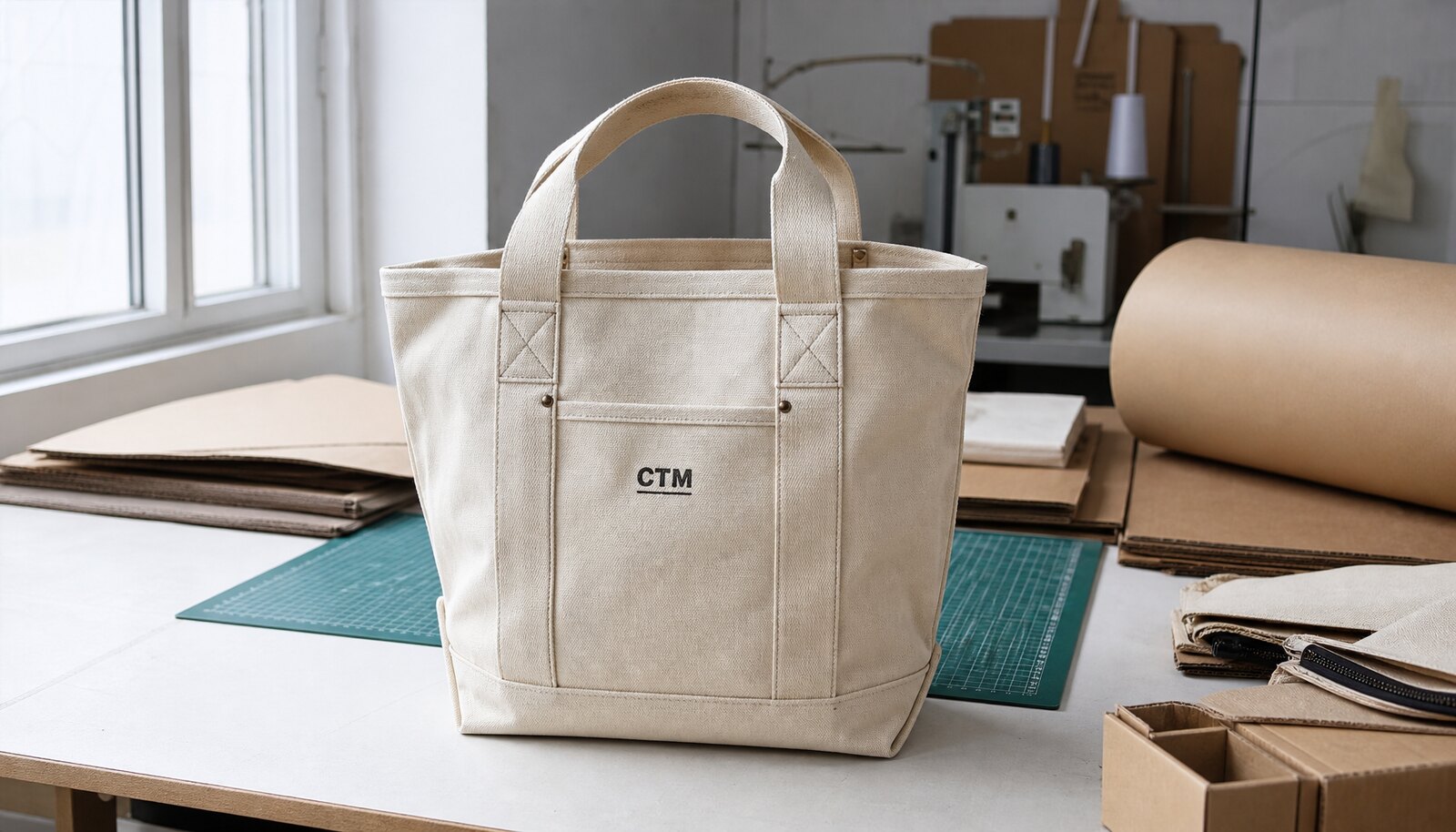
Why heavy canvas changes the buying equation
Heavy canvas tote bags are often treated like simple branded extras, but procurement teams know they behave more like a small sewn product program than a print-only item. The fabric is thicker, the stitching load is higher, the print surface is more textured, and the finished bag takes up more space in carton planning. That means the spec affects not only appearance, but also labor time, packing efficiency, freight cost, and customer experience once the bag reaches the warehouse or the end customer.
For ecommerce brands, that matters because the tote is visible at several stages of the order flow. It may appear in campaign photography, on the product page, in a fulfillment center, inside an outbound parcel, and later in customer photos or reviews. If the bag looks premium in a sample but arrives with soft structure, uneven seams, or a print that breaks at the folds, the damage is not just a quality issue; it becomes a brand issue. Buyers should therefore approach heavy canvas totes as a controlled specification project, not a generic accessory purchase.
A useful starting point is to think in terms of product intent. A tote that is mainly a resale item needs consistent structure and clean finishing. A tote that ships as a gift-with-purchase needs good presentation and predictable pack-out. A tote used as an ecommerce packaging insert needs carton efficiency, low defect risk, and easy warehouse handling. The right fabric weight and construction depend on which of those jobs the bag is expected to do.
- Heavy canvas is typically worth the added cost when the tote is resale-grade, reused often, or expected to carry heavier contents.
- If the bag is only a packaging insert, a lighter construction may reduce cost and freight without hurting the customer experience.
- The quote should be built around the use case first, then the artwork and brand finish second.
Start with the use case, not the artwork
Many tote programs begin with a logo file and end with a spec that is too vague to buy correctly. Procurement buyers get better quotes when they define the functional role of the bag first. Is it a retail tote that will be sold independently? Is it a premium insert that accompanies apparel or boxed goods? Is it part of a seasonal launch where visual appeal matters more than load capacity? The answers change the right fabric, handle build, print method, and packing format.
The most practical distinction is between presentation and performance. Presentation-heavy programs may accept a slightly softer bag if the print looks sharp and the unboxing feels polished. Performance-heavy programs need firmer fabric, stronger seams, and a handle construction that does not stretch out after a few uses. If the tote will hold squared-off products, such as boxed beauty items or footwear, the bottom seam and side seam stability matter more than the visual handfeel. If it will be folded into a parcel and reopened by the customer, crease behavior and print durability become more important.
For most ecommerce programs, finished fabric weight in the 12 oz to 16 oz range is the practical procurement band. Twelve oz can deliver a premium look while keeping cost controlled. Fourteen oz often gives a better balance of body and handling. Sixteen oz is usually chosen when the brand wants a firmer retail feel or expects the bag to carry heavier items. The key is not to pick the heaviest fabric available; it is to match bag behavior to the intended use and shipping path.
- Retail resale: prioritize structure, seam neatness, and print durability.
- Gift-with-purchase: prioritize presentation, pack-out consistency, and clean branding.
- Packaging insert: prioritize folding behavior, carton efficiency, and low damage risk during fulfillment.
Fabric weight, weave density, and finish are not interchangeable
Supplier quotes often blur the difference between canvas weight, weave density, and finishing treatment. Buyers should separate those items in the RFQ because each one affects how the bag behaves. Fabric weight is usually given in ounces or GSM, but two bags with the same nominal weight can still feel very different if one has a tighter weave, a different yarn thickness, or a finishing process that softens the hand. That is why a quote should request the exact fabric construction, not only the headline weight.
Weave density matters because it affects print sharpness, seam stability, and surface consistency. A very open weave may feel rustic but can make fine logo edges less crisp and increase the chance of pinholes or irregular ink absorption. A tighter weave generally gives a cleaner print and better shape retention, but it may require more careful needle selection and sewing control. Buyers do not need to overengineer the fabric spec, but they should ask enough questions to avoid comparing two very different canvases as if they were the same material.
Finishing treatment also changes the outcome. Bleached canvas usually gives a brighter, cleaner background for logos and product photography. Natural canvas may feel more understated and can be cost-effective, but it often shifts the look of printed colors slightly warmer. Washed or softened canvas may improve handfeel, yet it can also change shrinkage behavior and alter the final dimensions after production. If the tote is going into an ecommerce program with strict receiving and repeat order expectations, the finish should be declared explicitly in the quote.
A workable sourcing approach is to ask for the fabric specification in three parts: weight, weave, and finish. Then request the approved sample to be made from the same material lot, or at least the same production standard, so the sample tells you something real about the future shipment. This prevents a common problem where the sample looks great because it was made on a better fabric than the bulk order.
- Ask for finished GSM or oz, not only a generic description like “heavy canvas.”
- Request weave density or fabric construction notes when the supplier can provide them.
- State whether the bag must be natural, bleached, dyed, or washed, because finish changes both appearance and dimensions.
Handle construction and seam design decide whether the bag lasts
Handle failure is one of the easiest ways for a tote to disappoint a buyer. Heavy canvas places more load on the handle attachment points than a lightweight promotional bag, so handle spec should be written in detail. Self-fabric handles can work well for a clean look and lower cost, but they need adequate width and reinforcement. Webbing handles may feel stronger and more stable in use, but they can change the style and increase cost. Either option can perform well if the stitching and reinforcement are consistent.
For procurement purposes, the important details are attachment method and stitch control. Ask whether the handles are folded and sewn into the seam, attached with box stitches, reinforced with bar-tacks, or finished with a combination of methods. A good factory should be able to tell you the stitch pattern, where the reinforcement sits, and how many reinforcement points are used per handle. If the supplier cannot describe the structure clearly, they may not have disciplined production control.
Seam construction should be treated the same way. Side seams and bottom seams should not be left to factory preference. Heavy canvas can tolerate a range of seam methods, but the buyer should know whether the bag uses overlocked edges, turned seams, topstitch reinforcement, or a fully enclosed finish. A neat hem at the top opening is especially important because it affects both appearance and strength. For a resale tote, a sloppy top edge often reads as a low-grade product even if the fabric itself is good.
A useful acceptance mindset is to ask one simple question: if the bag is filled to its practical carrying load and used repeatedly, where will stress show first? The answer should be the handles, corners, and top opening. A supplier who has thought through those points will usually give a more credible quote than one that only talks about fabric weight and logo placement.
- Specify handle width, handle length, drop height, and reinforcement type in the RFQ.
- Ask for bar-tack count or box-stitch dimensions instead of accepting “reinforced handle” as a description.
- Check whether the top hem is turned and stitched cleanly or merely folded with loose edge exposure.
Print method choices and the durability tests that matter
Most heavy canvas tote bags for ecommerce brands use screen printing because it remains the best balance of price, opacity, and repeatability for simple logos. On thick canvas, screen print usually gives the most dependable result when the design is one or two spot colors and the artwork is not too detailed. Buyers should still ask about ink type, cure method, and mesh setup, because the texture of the canvas affects how well the ink sits on the surface.
Transfer methods, including heat transfer and DTF, can help with complex art, gradients, or smaller test runs. The tradeoff is that the print becomes more dependent on the adhesion layer, curing process, and handling after production. On a coarse canvas texture, a transfer that looks perfect when flat may perform poorly after folding, rubbing, or shipment compression. That does not make transfer printing a bad choice; it just means the approval process should be more demanding. The same is true for embroidery, which can deliver a premium look but may be too costly or too bulky for some tote programs.
For buyer approval, print quality should be tested in the same way the product will be used. That means fold the tote where the customer or warehouse will fold it, rub the printed area by hand, and inspect the edges of letters and solid fills under normal light. If the bag is intended for repeated consumer use, a simple dry rub test and crease check should be part of the sample review. If the tote may be washed, request a wash test or at least a manufacturer statement on shrinkage and print stability. Procurement teams do not need to turn the bag into a lab product, but they do need enough evidence to avoid expensive surprises after launch.
The most useful print questions are practical rather than artistic: does the ink sit cleanly on the weave, does the color hold on folds, and does the print stay legible after handling? Those three points predict whether the bag will look good when it arrives and still look good after the customer uses it.
- Screen print is usually the best fit for simple logos and repeat orders.
- Transfer methods should be approved only after a fold and rub review on production canvas.
- Print durability should be checked on the actual bag construction, not on a substitute swatch alone.
Quote logic: how to compare suppliers without being misled
A strong tote quote should break the product into visible cost drivers. If you only receive one unit price, you cannot tell whether the factory is using lighter fabric, fewer stitches, simplified packing, or a cheaper print process. That is why procurement buyers should request line items for fabric, sewing, printing, packing, and any special handling. This is especially important when comparing factories in different regions or comparing a direct factory against a trading company, because the same looking tote can hide very different internal assumptions.
The other issue is pack format. A quote that assumes bulk packing can look cheaper than one that includes polybags, barcode labels, or retail cards, but the total program may be more expensive if the warehouse then has to rework everything. The reverse can happen too: a better-packed tote may reduce receiving labor, error risk, and damage in transit. So the buyer should compare landed cost with the actual receiving process in mind, not unit price alone.
Quote comparisons also get distorted by hidden size changes. A bag that is only a little taller or wider can change sewing time, fabric usage, and carton efficiency. Even handle length can influence folding and packing density. For that reason, use one master spec sheet and require all suppliers to quote against it. If a supplier proposes a change, ask them to show the effect on cost, packing, and lead time rather than silently substituting a different build.
When a quote looks unusually low, check three things first: fabric weight, print method, and packing detail. Those are the places where a low number often hides a spec downgrade. When a quote looks high, check whether the supplier included every requested detail or simply priced in unnecessary complexity. Comparable data only becomes useful when the specification is tight enough to support it.
- Ask for line-item pricing so you can see fabric, labor, print, and packing separately.
- Require the same finished size, same packing format, and same carton assumptions across all quotes.
- Treat any price that is far below the group as a reason to verify fabric weight, stitch method, and packing scope.
MOQ, capacity, and where the real cost step-ups happen
MOQ is not a single fixed number for a tote program. It usually changes by fabric color, print complexity, trim options, and packing format. A supplier may accept a relatively small total order if the bag is simple, made from standard natural canvas, and printed in one color. The same factory may need a much higher quantity if the order uses custom dyed fabric, multi-color artwork, retail cards, or individually labeled packing. Buyers should therefore ask for MOQ at the component level, not just at the product level.
From a sourcing perspective, the main cost step-ups usually come from three places. First is material procurement, especially if the canvas is dyed or if the factory needs a specific weight or weave. Second is print setup, which becomes meaningful when the design has multiple colors or requires precise registration. Third is packing labor, because barcode labels, inserts, and retail-ready folding take time and increase handling risk. If a supplier is offering a low MOQ, the buyer should ask which of those three areas is being simplified.
A practical planning range for standard production is often in the 300-500 piece zone per style and color, with lower quantities possible when the spec is simple and the factory has stock fabric. But buyers should treat any MOQ range as context, not a promise. If the order includes custom dyeing, special closures, or multiple SKUs, the threshold can climb quickly. The safest approach is to quote the base bag and each add-on separately so the team knows which option is pushing the quantity requirement upward.
For ecommerce brands, MOQ should also be evaluated against replenishment needs. A small first order may look attractive, but if the same tote is likely to reorder, it is worth asking whether the supplier can repeat the same fabric lot or at least keep a consistent spec. A program that cannot be replenished consistently is often more expensive than it first appears.
- Ask for MOQ by fabric color, print color, trim option, and packaging format.
- Keep the first launch simple if you need a lower quantity and a cleaner approval cycle.
- For repeat programs, ask how the factory handles the same color and fabric standard on future reorders.
Sample approval should prove the bag, not just resemble it
A good sample is a verification tool, not a marketing prop. The buyer should use it to measure actual dimensions, confirm handle drop and width, inspect seam quality, and evaluate how the print behaves on the real fabric. The sample should also verify the fold and pack method if the tote will ship in a specific ecommerce format. If the supplier sends a “golden sample” that is not made from the same materials or on the same production process, it can create false confidence and later disputes.
The measurement review should be simple and disciplined. Check body width, height, depth if any gusset is present, and handle drop against the stated spec. Inspect whether both handles match in length and attachment position. Look at stitch density in several areas rather than only one visually clean corner. If the tote includes a pocket, zipper, snap, side label, or woven tag, confirm that each detail is aligned and secure. These are small points individually, but together they determine whether the product feels controlled or improvised.
A handling test is also useful before bulk approval. Fill the bag with the heaviest realistic contents, then observe how the handles stretch, whether the top opening distorts, and whether the bottom seam twists under load. Fold the sample the way it will be packed for distribution and check whether the print creases in a way that would bother a customer. If your program includes retail presentation, open and close the sample several times to assess how the bag recovers. These checks are quick, but they catch the failures that matter most.
The sample approval process should end with one signed reference set: dated photos, measured dimensions, print color note, packing format, and any approved exceptions. That single reference makes production conversations much easier when the factory asks for clarification later.
- Use a dated, signed reference sample with measured dimensions and packaging notes.
- Check handle symmetry, stitch neatness, and print placement under normal light.
- Fold and load the sample in the same way the customer or warehouse will use it.
Packing, carton logic, and ecommerce receiving
Packing is where many tote programs become more expensive than expected. Heavy canvas bags have body, so they do not always fold as tightly as buyers imagine. If the tote is being shipped into a warehouse, the fold direction, stack height, and carton dimensions can materially affect freight cost and receiving speed. This is why packing should be part of the RFQ, not an afterthought handled by the factory once sewing is finished.
For ecommerce distribution, the most important question is how the bag arrives. Bulk-packed totes may be fine for wholesale or internal distribution, but ecommerce fulfillment often benefits from a clearer pack structure: flat-folded bags, polybags if needed, barcode labels, and master carton marks that match the SKU system. If the bag is sold as a standalone product, a retail-ready card or hangtag may be necessary, but that adds labor and can affect how many pieces fit per carton. Buyers should ask the factory to show the folding method and a carton loading plan before mass production begins.
Carton logic should be written in a way that supports real distribution, not just neat-looking paperwork. Ask for carton dimensions, pieces per carton, and gross weight. Then check whether the carton count fits your inbound channel, whether the cartons stay within the receiving team’s handling limits, and whether the total packed weight makes sense for the shipping mode. If the program is air freight-sensitive, a few centimeters of wasted space can matter. If it is ocean freight, carton count and palletization may matter more. In both cases, the buyer should avoid approving packing only by style name or generic “bulk” language.
A good practical rule is that the bag should be packed the same way every time, with the same fold orientation and label placement. Consistency reduces warehouse confusion and lowers the chance of rework. For branded ecommerce programs, that consistency often matters more than a slightly lower unit price from a less controlled pack method.
- Specify fold method, polybag use, barcode placement, and master carton marks before production starts.
- Request carton dimensions and gross weight so freight and receiving can be checked against reality.
- If the bag is retail-facing, confirm whether the card or hangtag affects carton efficiency and pack labor.
Lead time, schedule risk, and why small changes create delays
Lead time for heavy canvas tote bags is not only sewing time. It includes fabric booking, print setup, sample approval, cutting, stitching, finishing, inspection, packing, and sometimes carton or label proofing. For standard programs, a factory may quote roughly 25-40 days after sample approval, but that range depends on fabric availability, print complexity, and the factory’s current capacity. If the order uses custom-dyed canvas or multiple print colors, the schedule can extend well beyond a simple tote program.
The biggest schedule risk is late change. A small edit to print position, handle length, carton text, or fold method can trigger a revision in multiple production steps. Even a dimension change can alter the way the bag packs into cartons and may require a new packing calculation. Buyers who want on-time delivery should freeze artwork, carton labels, and core dimensions before production begins. If the launch date is fixed, leave a buffer for sample revision and first-run approval rather than assuming the first quote can be produced without adjustment.
The procurement lesson is straightforward: lead time is a function of how many variables are still open. The more custom the spec, the more time you need to validate the material, print, and pack details. Buyers who want a fast launch should simplify the bag rather than trying to compress a complex design into a short schedule. That usually means standard canvas, one-color print, and a clear packing format.
If a supplier gives a lead time without explaining what it depends on, ask them to break it into milestones: fabric confirmation, sample approval, production start, QC, and shipment readiness. That timeline is much easier to manage and much more useful for an ecommerce launch calendar.
- Add buffer time for sample correction, print proofing, and carton label approval.
- Freeze artwork and carton text before mass production starts.
- Ask for milestone-based timing rather than a single lead-time number with no context.
Specification comparison for buyers
| Supplier / option | Best fit | Tradeoffs | What a buyer should verify |
|---|---|---|---|
| Direct factory with in-house sewing + printing + packing | Repeat programs, controlled specs, and replenishment orders | Usually better consistency and easier accountability, but you still need a disciplined spec and sample process; smaller factories may be slower on revisions | Ask whether fabric, print, and packing happen on the same line or in separate workshops; confirm who owns final QC and carton labeling |
| Trading company / sourcing agent | Teams that need communication support, multi-category sourcing, or consolidated shipments | Convenient, but quality drift can be harder to trace if sewing and printing are subcontracted; total quote may hide margin layers | Request the actual factory name, factory audit details, and a clear breakdown of fabric, labor, print, and packing costs |
| Stock canvas + limited custom print | Fast launches, promo campaigns, and lower MOQ trials | Lower setup cost and faster lead time, but size, color, and handle options are constrained | Confirm stock fabric origin, lot consistency, and whether the print is placed on already-finished bags or on cut panels |
| Fully custom dyed fabric + custom trim | Premium retail programs and branded merchandise with strong shelf presence | Best brand control, but fabric MOQ, color approval, and shade variation can add cost and lead time | Require lab dips or strike-offs, shade tolerance rules, and a clear re-order policy for the same dye lot |
| Screen print on heavy canvas | Simple logos, 1-2 colors, and repeat orders | Cost-effective and durable when cured correctly, but rough weave and thick folds can affect edge sharpness | Ask for mesh count, ink type, cure method, and rub/fold durability checks before mass production |
| Transfer print / DTF | Short runs or more complex graphics | More flexible artwork, but can show cracking, edge lift, or hand-feel issues on textured canvas if testing is weak | Require peel, fold, and abrasion checks on the actual canvas used for production |
| Bulk pack | Wholesale, carton-efficient distribution, and low-touch receiving | Lowest packing labor, but less retail-ready and less protection for finished surfaces | Verify fold method, carton loading plan, and whether bags are separated by style, color, or size |
| Polybag + barcode label + master carton marks | Ecommerce warehouses, cross-dock receiving, and SKU control | Better for warehouse handling, but adds labor and material cost | Confirm barcode placement, scannability, bag count per polybag, and carton label format |
| Retail-ready inner card or hangtag | Resale totes, branded merchandising, and shelf display | Improves presentation, but increases pack-out complexity and carton weight | Check trim quality, insertion method, and whether the card stock or hangtag can damage fabric during transit |
Buyer checklist before sampling
- Define the actual use case first: retail resale, gift-with-purchase, packaging insert, subscription bonus item, or merchandising tote.
- Lock the finished dimensions with a tolerance range, not just a nominal size.
- Specify fabric weight in GSM or oz, fabric type, color, and whether the canvas is natural, bleached, dyed, or washed.
- Ask for weave details when available: thread count, weave density, and whether the fabric is tightly woven enough for your print method.
- State handle construction clearly: self-fabric or webbing, width, length, attachment method, and reinforcement pattern.
- Set seam requirements: side seam type, bottom seam type, top hem, and bar-tack or box-stitch placement.
- Choose the print method based on artwork complexity, target run size, and durability expectations.
- Define how the bag should be folded and packed for warehouse receiving or retail presentation.
- Ask for carton dimensions, gross weight target, and pieces per carton before you approve the quote.
- Request a pre-production sample made from production fabric, not a lookalike substitute.
Factory quote questions to send
- What is the finished fabric weight in GSM or oz, and is that measurement for the final fabric after any washing or finishing?
- What is the canvas composition, weave structure, and fabric width used for production?
- Can you confirm the fabric lot or dye lot policy for repeat orders if we need replenishment later?
- Is the sample made on production fabric, and how many pre-production samples are included in your process?
- What seam construction do you use on the side seams and bottom seam, and what stitch count or SPI target do you run?
- How are the handles attached: folded self-fabric, webbing, box stitch, bar-tack, or a combination?
- How many bar-tacks are used per handle, and where exactly are they placed?
- What print method is included, how many colors are covered, and what setup or plate charges apply?
- What durability tests do you run on the print: rub test, fold test, or wash test, and what acceptance standard do you use?
- What is the finished size tolerance for width, height, and handle drop?
Quality-control points to confirm
- Finished dimensions within the agreed tolerance, typically ±0.5 cm to ±1.0 cm depending on bag size and construction complexity.
- Fabric weight within the approved range and consistent with the reference sample; inspect for obvious underweight fabric, loose weave, or shade inconsistency.
- Seam construction is straight, secure, and fully closed; no skipped stitches, broken thread, seam puckering, or raw-edge shedding beyond the agreed finish.
- Handle attachment passes a pull check and shows consistent reinforcement; verify bar-tacks, box stitches, and stitch density at each handle point.
- Handle symmetry is acceptable: both handle lengths, drop height, and attachment positions should match the approved sample within tolerance.
- Print alignment is centered or positioned exactly as approved; confirm opacity, edge sharpness, and no ghosting or misregistration.
- Print durability is checked with a dry rub test and fold/crease review; there should be no visible cracking, peeling, or heavy color loss on normal handling points.
- If the bag is washed or intended for repeated use, confirm shrinkage behavior against the approved reference and check for distortion after washing.
- Top hem, side seam, and bottom seam are trimmed cleanly with no loose threads, exposed needle holes beyond normal canvas behavior, or frayed corners.
- If a pocket, zipper, snap, or label is included, confirm that the add-on is aligned, secure, and does not twist the bag body.