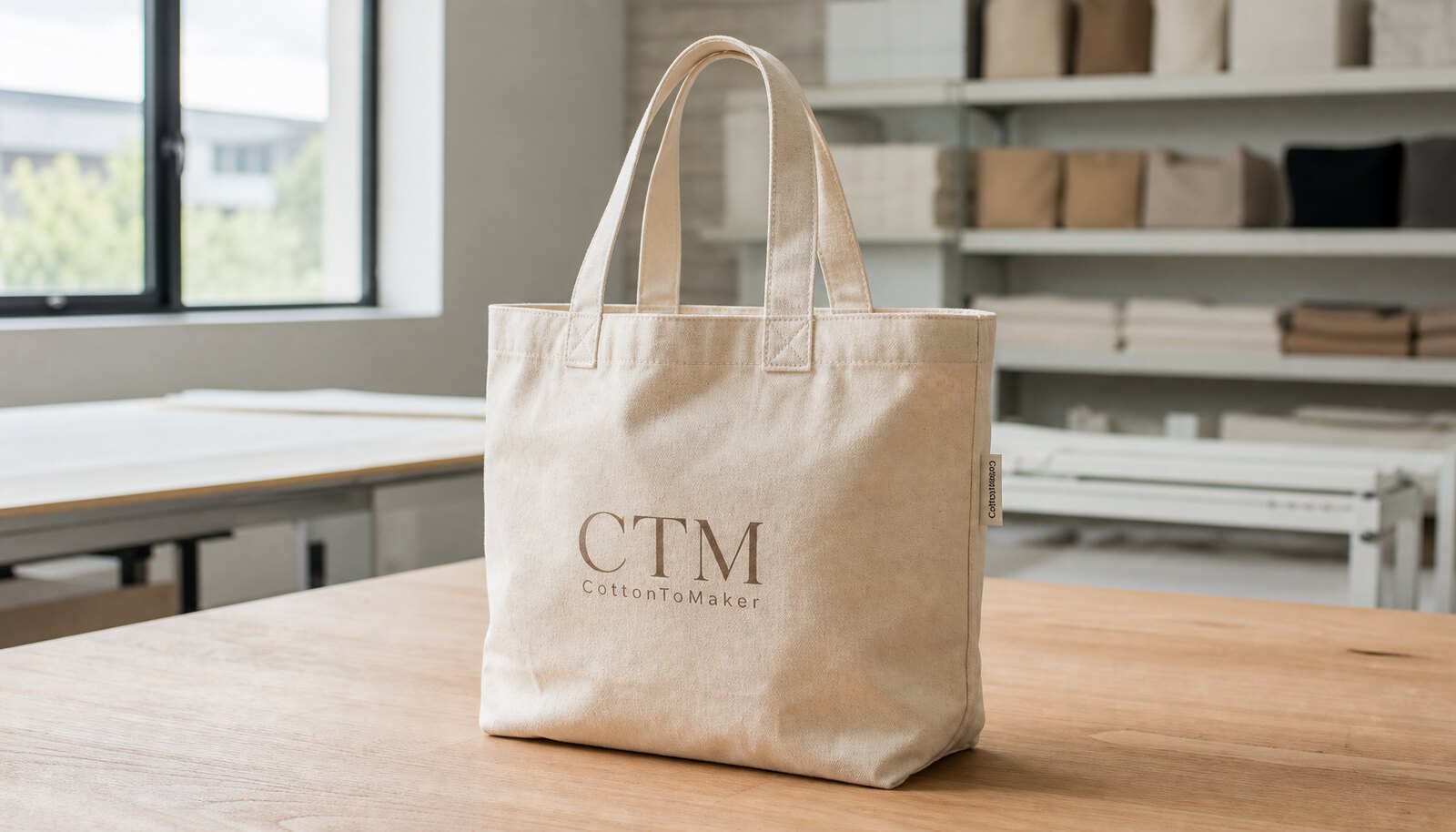
Why cosmetic brands choose heavy canvas instead of lighter promotional totes
Heavy canvas totes are used in cosmetics for a different reason than generic giveaways: the bag is part of the brand presentation, not just a carrier. The use cases are usually launch kits, gift-with-purchase programs, influencer mailers, store events, loyalty rewards, and premium retail merchandising. In each case, the tote has to carry products with weight, keep its shape, and still look intentional when it is handed to a customer or photographed on a counter. That pushes sourcing toward structure, print quality, and packing discipline rather than simple low-cost fabric.
The most common mistake is assuming every canvas tote behaves the same once the logo is applied. A lighter 8 oz to 10 oz bag may be acceptable for flat inserts or short-term promotion, but it can sag, twist, and show print bleed when packed with boxed skincare or glass jars. A heavier 14 oz to 16 oz tote can feel more premium and hold shape better, but it increases material cost, sewing time, and freight weight. The right spec depends on what the bag must actually carry and how the brand wants it to present in market.
Cosmetic brands also care about perception at the point of delivery. A tote used for a gift set should open cleanly, stand up enough to be packed neatly, and keep the logo visible after handling. If the bag is going into retail or PR workflows, it should be designed as a branded object first and a transport item second. That changes the procurement brief in a very practical way: structure and finish come before decoration and price.
The sourcing plan should therefore begin with function. Is the tote for a one-time campaign, a retail carry bag, a recurring subscription insert, or a promotional add-on tied to a product launch? Each of those uses places a different burden on fabric, handle construction, and packing. Without that clarity, supplier quotes become misleading because the same-looking tote can be built in a way that fails one program and over-specifies another.
- Use heavy canvas when the bag needs shape retention, repeated handling, or premium presentation.
- Keep the spec tied to the actual cosmetic bundle, not to a generic tote catalog.
- Treat structure, loading, and retail presentation as the primary design constraints.
Start with a usable spec: fabric weight, size, handle, and finishing
A serious RFQ begins with a complete spec. For heavy canvas tote bags for cosmetic brands, the most workable starting range is usually 12 oz to 16 oz finished canvas, with 14 oz often serving as the balanced option when the buyer wants structure without overspending on freight. Finished weight matters more than a catalog label because finishing, dyeing, and shrinking can change the actual hand feel. If the supplier cannot state whether the weight is measured before or after finishing, the quote should be treated as incomplete.
Dimensions should be set around the intended contents. A tote that carries flat boxes and sample pouches may need a shallower gusset and a wider face panel, while a set with bottles or jars may need a deeper gusset and a more stable bottom seam. Typical cosmetic buying sizes often sit near 12 x 14 x 4 in or 13 x 15 x 5 in, but the number matters less than fit. Specify the pack-out item or the internal volume target so the factory can engineer the right shape instead of guessing.
Handle design also drives price and usability. Buyers should state handle drop, handle width, handle material, and whether the handles are self-fabric, tape, or a blended reinforcement. A narrow handle on a heavy tote can feel cheap and may cut into the hand when the bag is loaded. A wider handle or reinforced shoulder drop is more suitable when the tote is expected to hold boxed cosmetics or sample kits. Handle attachment is not cosmetic; it is a load-bearing element and should be treated that way in the tech pack.
Finishing details should be specified as well. If the bag must stand upright, ask for bottom reinforcement or a firmer canvas hand. If it must fold flat for distribution, say so. If the opening should stay crisp for retail use, ask whether a top hem or binding is used. Every finishing choice affects cost, but more importantly, every unspecified choice invites supplier assumptions that may not fit your program.
- Write finished dimensions, not cut dimensions, into the RFQ.
- State the expected contents or target load so the bag size is engineered to fit.
- Specify handle drop, width, and reinforcement instead of leaving them to supplier default.
- Ask whether the bag needs a gusset, rigid base, or flat-fold packing requirement.
Comparison table: choose the sourcing route that fits control, cost, and reorder risk
The table below is intended to help procurement buyers compare sourcing routes on the criteria that actually matter for private label tote programs. The right decision is not only about unit price. It is about how much control you need over fit, print, packing, compliance, and repeat orders. A cosmetic brand with a seasonal launch and a fixed artwork system may value control and repeatability more than the lowest starting cost, while a one-off event run may prioritize speed and mixed-SKU flexibility.
When you compare suppliers, use one artwork file, one bag spec, one packing instruction, and one shipping assumption. If the quote does not separate material, sewing, decoration, and packing labor, ask for a revised quote. A quote that rolls all of those pieces together is hard to benchmark and makes landed cost analysis unreliable.
- Compare suppliers with the same spec sheet and the same artwork file.
- Ask each supplier to identify every subcontracted process before quoting.
- Treat sample quality as evidence of process control, not as a marketing sample.
What drives unit price: fabric, print complexity, and packing labor
Heavy canvas tote pricing is usually pushed more by labor and yield than by raw fabric alone. Fabric width, cutting efficiency, handle construction, stitch count, print setup, and packing method all show up in the final quote. A tote with a simple one-color front print and self-fabric handles may be relatively efficient. A tote with large print coverage, a second logo location, reinforced straps, or special fold instructions moves into a higher labor band quickly. Buyers who only ask for a unit price often miss the real driver of the difference.
Print area is one of the most visible cost levers. A small logo on the upper panel is cheaper than a full-width print that needs accurate registration across seams or around a gusset. If the design uses multiple spot colors, the factory may need separate screens or setup passes. If the design includes gradients or photo-like detail, the supplier may move to heat transfer or DTF, which changes hand feel and durability behavior. The right tradeoff depends on brand identity and how often the bag will be handled.
Packing can also create hidden costs. Bulk-packed totes are cheaper to produce but may not be usable directly in retail or PR workflows. Individual polybags, tissue wraps, barcode stickers, and hangtags all add labor and material, and they also affect carton density. If the bags need to be distributed through a warehouse or fulfillment center, an extra 5 to 10 seconds of packing time per unit can become meaningful at volume. That is why packing should be quoted separately whenever possible.
Freight is another landed-cost driver that buyers should not ignore. Heavy canvas is dense. A small unit price advantage can disappear when the cartons are heavy, the freight class changes, or the carton size increases because of loose packing. A reliable supplier should be able to estimate carton dimensions, gross weight, and pack count before production ends so the buyer can calculate true landed cost instead of relying on a factory-only quote.
- Most price movement comes from labor, print setup, and packing, not from fabric alone.
- Large print coverage and multiple art locations raise cost and risk.
- Separate factory price from freight-ready data so landed cost can be calculated early.
Print method choice: what holds up on heavy canvas
Screen printing remains the baseline option for many cosmetic tote programs because it gives solid color, acceptable durability, and predictable repeatability when the supplier controls mesh, ink deposit, and curing. It is especially effective for one-color or two-color logos that need a crisp brand impression on a textured surface. The buyer should still ask what ink system is being used, how the cure is verified, and whether the factory has a standard rub test for finished print. If those answers are vague, the print result may be visually acceptable but unreliable in handling.
Heat transfer and DTF can be useful when the art is complex, when the order volume is low, or when the brand wants more graphic detail than screen print can easily provide. The tradeoff is that the print may feel more layered on canvas, and repeated folding or abrasion can affect longevity. Cosmetic brands that use large launch graphics or photographic artwork should request a flex test and a light rub test on the approved sample so they understand how the print will age in use.
Embroidery and woven labels serve a different purpose. Embroidery works well for smaller emblem-style logos on heavier canvas, and it can create a premium look without large ink coverage. Woven labels are often best as a secondary brand signal on the seam, side panel, or interior binding. They do not replace a primary print if the brand wants visible front-face identity, but they can improve perceived quality and are sometimes more durable than a large graphic on a textured bag.
The practical rule is to match decoration to the brand objective. If the tote is meant to disappear into a campaign, simple print is sufficient. If it is meant to live with the customer and remain in use, more durable branding such as woven labels or smaller but well-controlled decoration may be the better choice. The wrong print method can create a bag that looks good on approval day and weak after the first few uses.
- Screen print is usually the strongest default for simple logos and medium to large quantities.
- Test heat transfer or DTF on the actual canvas before accepting it for a premium program.
- Use woven labels or embroidery when the brand needs a more restrained, premium branding approach.
MOQ logic: how to set a realistic first order without buying unused inventory
MOQ should be treated as a planning input, not a sales trick. For private label cosmetic totes, the right MOQ depends on whether the artwork is stable, whether the bag is tied to a fixed campaign, and whether the buyer expects to reorder. If the tote is part of a launch kit or a short-term retail program, a larger first run may be justified because the production line is already optimized and the branding is locked. If the bag is still being tested in market, smaller quantities can reduce the cost of a spec change later.
The buyer should ask for MOQ at three levels: by fabric color, by artwork, and by print color count. A supplier may accept a low MOQ on paper, but the price can rise if each variation needs a separate cutting or print setup. Mixed-SKU orders are possible in many factories, but the economics depend on how the cutting plan is shared and whether the decoration setup can be reused. This is why MOQ should be discussed with the full style plan in hand rather than as a standalone negotiation.
From a procurement perspective, the most common mistake is to overbuy flexibility. Brands sometimes order too many colorways, too many decorative variants, or too much inventory before the design is validated. A better approach is to size the first order against known demand and then confirm whether the factory can repeat the same materials, print, and pack format on reorder. Reorder consistency is often more valuable than a slightly cheaper first-run price because it protects the brand from product drift.
If the supplier offers a low MOQ that seems unusually attractive, ask what changes behind the price. The factory may be using leftover fabric, changing the handle spec, simplifying packing, or replacing one print method with another. Low MOQ is not inherently bad, but it has to be tied to a clear production path and an explicit list of what is and is not standardized.
- Ask for MOQ by artwork, colorway, and fabric color separately.
- Do not treat a low MOQ as a win unless the construction and packing stay unchanged.
- If you expect reorder demand, verify that the factory can repeat the same materials and process without substitution.
Sample approval and QC thresholds that prevent production surprises
Sample approval should be built around use, not aesthetics alone. A cosmetic tote can look right on a table and still fail in the field if the handles twist, the bottom seam distorts, or the print cracks when the bag is folded. For that reason, the pre-production sample should be made from the same material, the same print method, and the same packing plan intended for production. A showroom sample that is handmade with hidden labor or higher-grade material is not a useful control sample.
The approval process should include a golden sample, a supplier reference sample, and a buyer-retained reference. The buyer should record the approved dimensions, print location, print color, handle drop, and packing method in the tech pack or approval note. If the bag has a retail insert, gift card, or barcode label, verify that those pieces fit into the pack-out without causing wrinkling or seam distortion. Each of those details becomes important later if there is any dispute about what was approved.
QC for heavy canvas totes should be specific enough to inspect against. A practical inspection standard for many private label programs is AQL 2.5 for major defects and AQL 4.0 for minor defects, with a tighter buyer-defined threshold on critical failures such as handle failure, torn seams, or major print defects. Major defects should include stitch skipping, seam opening, print misregistration beyond tolerance, size out of spec, or a missing label where required. Minor defects can include loose threads, small ink variation within the approved range, or slight fold marks if the packing format allows them.
Testing should reflect the way the bag will be used. A load test with the intended product weight is more useful than a generic no-load inspection. For example, if the tote will carry boxed skincare, test it with the actual mass and shape of the set. If the bag is likely to be handled repeatedly, ask for a basic dry rub test and a flex test on the print area. If the brand uses the tote in retail, verify that the bag still looks presentable after folding and refolding. QC is not just about catching bad bags; it is about proving that the approved bag behaves correctly in the real workflow.
- Approve one gold sample made from the actual production materials and process.
- Inspect critical defects against an explicit AQL plan, not a vague visual standard.
- Test the tote with the real product load and a simple print rub check before bulk release.
- Record the approved dimensions, print location, and packing method so the factory has one reference point.
Packing, carton planning, and warehouse damage prevention
Packing is often under-specified, yet it directly affects retail appearance, warehouse efficiency, and freight cost. If the tote is going into a PR kit or retail package, a neat flat fold, tissue wrap, or dust protection may be worth the added labor. If it is going into distribution inventory, simpler bulk packing may be better because it saves money and reduces unnecessary handling. The right answer depends on where the bag enters the customer workflow. Buyers should not let the supplier choose a default packing method without approval.
Carton planning should be tied to the fold method and the bag size. A carton that is too full can crease the canvas permanently; a carton that is too loose wastes freight and can let the bags shift, rub, and pick up dust. The supplier should be able to state carton dimensions, carton count, gross weight, and loading estimate before shipment. That data is not just for logistics. It also helps the buyer confirm whether the program fits warehouse receiving, shelf-space planning, and export documentation.
If the program is retail-facing, ask for carton marks and SKU separation rules. Mixed cartons may be efficient at the factory but expensive at the warehouse if the receiving team has to sort them manually. If the program uses multiple artwork versions, the buyer should specify how those versions are labeled on the carton and on the inner bundle. The more complex the assortment, the more important it becomes to define packing rules before production starts.
Damage prevention should be part of the commercial brief. Heavy canvas is durable, but sharp folds, damp packing, or rough carton loading can still create visible defects. If the bag has a light-colored print or a structured front panel, ask whether tissue or a protective interleaf is needed. If the cartons will travel long distances or through humid lanes, the buyer should consider moisture protection and confirm whether the supplier uses carton strength appropriate to the packed weight.
- Choose packing for the downstream workflow, not just for factory convenience.
- Use carton dimensions and gross weight to estimate freight and warehouse handling before production ends.
- Define SKU labels, carton marks, and bundle rules if multiple artwork versions are being shipped.
Lead time planning and the schedule risks buyers should build in
For a standard heavy canvas tote with a simple one-color print, many factories can produce in roughly 25 to 40 days after sample approval, but that range is not a promise. Lead time expands when the artwork needs revision, when the bag requires special packing, when the order is large enough to queue behind existing production, or when the launch lands in a busy season. The biggest schedule risk is usually not sewing; it is waiting for approvals, material booking, and print-room availability. A launch plan that ignores those bottlenecks is too optimistic by design.
A stronger schedule includes separate milestones for artwork lock, sample approval, raw material booking, first-off approval, bulk production, inspection, and freight booking. Each step should have an owner on the buyer side and the supplier side. If the tote is tied to a launch event, build in a buffer for both QC correction and export transit. This is especially important for cosmetic programs because the tote often sits on the critical path for the rest of the launch kit.
The buyer should also ask the supplier what parts of the lead time are fixed and what parts are variable. For example, cutting and sewing may be predictable, while print cure time, packing labor, or carton supply may move with seasonality. A good supplier will separate these elements rather than giving one generic date. That lets procurement decide whether to pay for schedule priority, split the order, or reduce complexity to hit the deadline.
When timing is tight, reduce risk by reducing variation. One artwork, one fabric color, one packing format, and one approval round are far easier to execute than a multi-version launch with custom inserts. A clean, simple spec often delivers faster than a lower-cost spec with hidden exceptions.
- Treat artwork approval as part of the production schedule, not as a pre-production side task.
- Ask for a step-by-step timeline with dates for sample, materials, bulk, QC, packing, and shipment.
- Cut complexity if the launch date matters more than marginal unit savings.
Quote comparison: how to evaluate suppliers without getting trapped by low price
A useful procurement comparison starts by stripping out ambiguity. Every supplier should quote the same finished dimensions, fabric weight, handle spec, print method, packing format, and inspection expectation. If one quote includes tissue, barcode labels, and carton marks while another does not, the numbers are not comparable. The same is true if one supplier is quoting a finished 14 oz canvas and another is quoting a lighter unwashed canvas that only looks similar on paper. The buyer's job is to force the quotes onto the same basis before making a decision.
From there, compare the landed cost drivers that actually matter. Fabric weight, print method, labor count, carton efficiency, and freight weight usually explain most of the difference. A supplier with a slightly higher unit price may still be the better choice if they produce lower defect rates, cleaner packing, and fewer warehouse rejections. That is especially true in cosmetics, where presentation standards tend to be higher than in generic promo goods.
Do not let a quote be judged by the sample alone. A sample can be hand-finished, over-controlled, or produced in a separate sample room. The real question is whether the bulk line can repeat the same result at scale. Ask the supplier who owns the first-piece approval, who signs off on print color, and what happens if a production lot drifts from the approved sample. The answer tells you more about the quote than the headline price does.
The cleanest buying decision is usually the one that balances unit price, process control, and reorder consistency. For a cosmetic brand that wants a private label tote to become a recurring program, the best supplier is not the one that simply says yes to every request. It is the one that can define the process clearly, keep the bag on spec, and repeat the same result after the first order.
- Normalize every quote to the same spec before comparing prices.
- Evaluate landed cost, not factory price alone.
- Ask who owns first-piece approval and production drift control.
Specification comparison for buyers
| Supplier option | What to verify | Commercial advantage | Buyer risk to control |
|---|---|---|---|
| Direct sewing factory | fabric swatch, approved sample, seam close-ups, logo test photos, packing pilot, and final inspection evidence | Better sample-to-bulk control and faster production feedback | May be weaker on export paperwork or branded packing unless checked early |
| Trading company | Factory name, production photos, trim-source proof, and who owns QC decisions | Can coordinate small mixed orders and extra services | Markup can hide real factory capability and slow defect decisions |
| Specialized bag workshop | bag size, gusset, handle drop, seam allowance, stitch density, reinforcement patch, and loading expectation | More practical for detailed construction, trims, and repeat programs | Capacity may be limited during peak seasons |
| Low-price general supplier | 8-12 oz cotton canvas, 120-220 gsm cotton, recycled cotton, or blended fabric selected by use case and target price | Useful for simple promotional runs with loose specs | Material downgrades, weak packing, and vague inspection scope can erase savings |
| Retail-ready supplier | fold method, inner bundle, carton count, carton mark, moisture protection, SKU separation, and warehouse receiving needs | Can handle labels, SKU separation, carton marks, and receiving rules | Higher unit cost must be compared against reduced warehouse work |
| Compliance-focused supplier | Fabric records, labeling review, test plan, and production traceability | Safer for retail programs and repeat brand orders | Documentation claims need evidence, not only sales language |
| Local sample room plus bulk factory | Signed sample, bulk factory handoff, first-piece photos, and deviation owner | Good for complex branding before large production | Sample room quality may not match bulk line unless handoff is controlled |
Buyer checklist before sampling
- Define the end use first: retail carryout, gift-with-purchase, PR mailer, subscription insert, event bag, or internal merchandising.
- Fix finished bag dimensions, gusset depth if needed, handle length, and handle width before asking for prices.
- Specify the bag's target load, for example boxed skincare sets, glass bottles, or mixed sample kits, so the construction matches the use case.
- State fabric weight in both oz and GSM if possible, and say whether you want natural, bleached, dyed, or recycled canvas.
- Choose the logo method early: screen print, heat transfer, embroidery, woven label, or a combination.
- Set print requirements clearly, including number of colors, Pantone target, print placement, and whether a white underbase is needed.
- Ask for the packing format up front: flat folded, one-fold, polybagged, tissue wrapped, labeled, or bulk packed.
- Confirm carton count, carton dimensions, gross weight target, and whether your warehouse needs barcode or SKU marks on every carton.
- Request a pre-production sample made from the same materials and line plan as bulk production, not a hand-made showroom sample.
- Keep one approved golden sample sealed and tagged for production comparison and dispute resolution.
Factory quote questions to send
- What is the exact finished canvas weight you are quoting, and is that weight measured after finishing or from greige fabric?
- What are the finished dimensions, seam allowance, handle length, handle width, and gusset depth included in your quote?
- Which print method is included, how many colors are covered, and what is the surcharge for additional art locations or larger coverage?
- What is your MOQ by artwork, by fabric color, and by print color, and can mixed SKUs be combined in one production run?
- What are the sample charges, sample lead time, and whether the sample fee is refundable after order confirmation?
- What packing method is included, including tissue, polybag, barcode sticker, hangtag, or carton inner bundle requirements?
- What QC checkpoints are included before shipment, and can you share the inspection standard you use for acceptance and rejection?
- What is the estimated carton specification, gross weight, and loading quantity so we can calculate freight and warehouse handling cost?
- Who owns the final sign-off on print color, seam construction, and carton packing if the factory uses a subcontractor?
- Can you provide material traceability or test records if the order needs retail compliance documentation?
Quality-control points to confirm
- Use an inspection plan that is explicit enough for the factory to act on. For a standard buyer-managed program, pre-shipment inspection at AQL 2.5 for major defects and AQL 4.0 for minor defects is a practical starting point; tighten it for premium retail programs and loosen it only if the bag is truly promotional.
- Fabric weight should stay within a defined tolerance of the approved spec, ideally around plus or minus 5 percent for the finished canvas weight. Larger variation often changes drape, stiffness, and print appearance.
- Stitch density on the main body and handles should be set in the tech pack, with a common working target of 7 to 10 stitches per inch depending on seam type and machine setup.
- Handle attachment should include bartacks or reinforced stitching, and the buyer should require no missed stitches, broken thread, or seam slippage under a standard load test.
- Run a load test using a filled bag at the agreed target weight, then hold it by the handles for a defined dwell time and inspect for stitch pop, fabric tearing, or handle elongation.
- Measure bag dimensions against the approved sample with a practical tolerance, for example plus or minus 0.25 in on critical retail dimensions unless the product requires tighter control.
- Print evaluation should include no visible misregistration beyond the approved tolerance, no ink bleeding, no pinholes in solid areas, no cracking after controlled flexing, and no obvious off-color against the approved sample under normal indoor light.
- For screen print, ask the supplier to confirm cure conditions and to conduct a basic rub test on the printed area. A dry rub and a light wet rub should not cause obvious color loss or transfer.
- Carton inspection should confirm carton count, carton marks, pack method, and protection against dust and moisture. Cartons should not crush the bag shape if the bags are intended for retail presentation.
- Require photo evidence of the first-off sample, the packed carton sample, and the sealed final goods sample before shipment approval when the order is high-risk or time-sensitive.