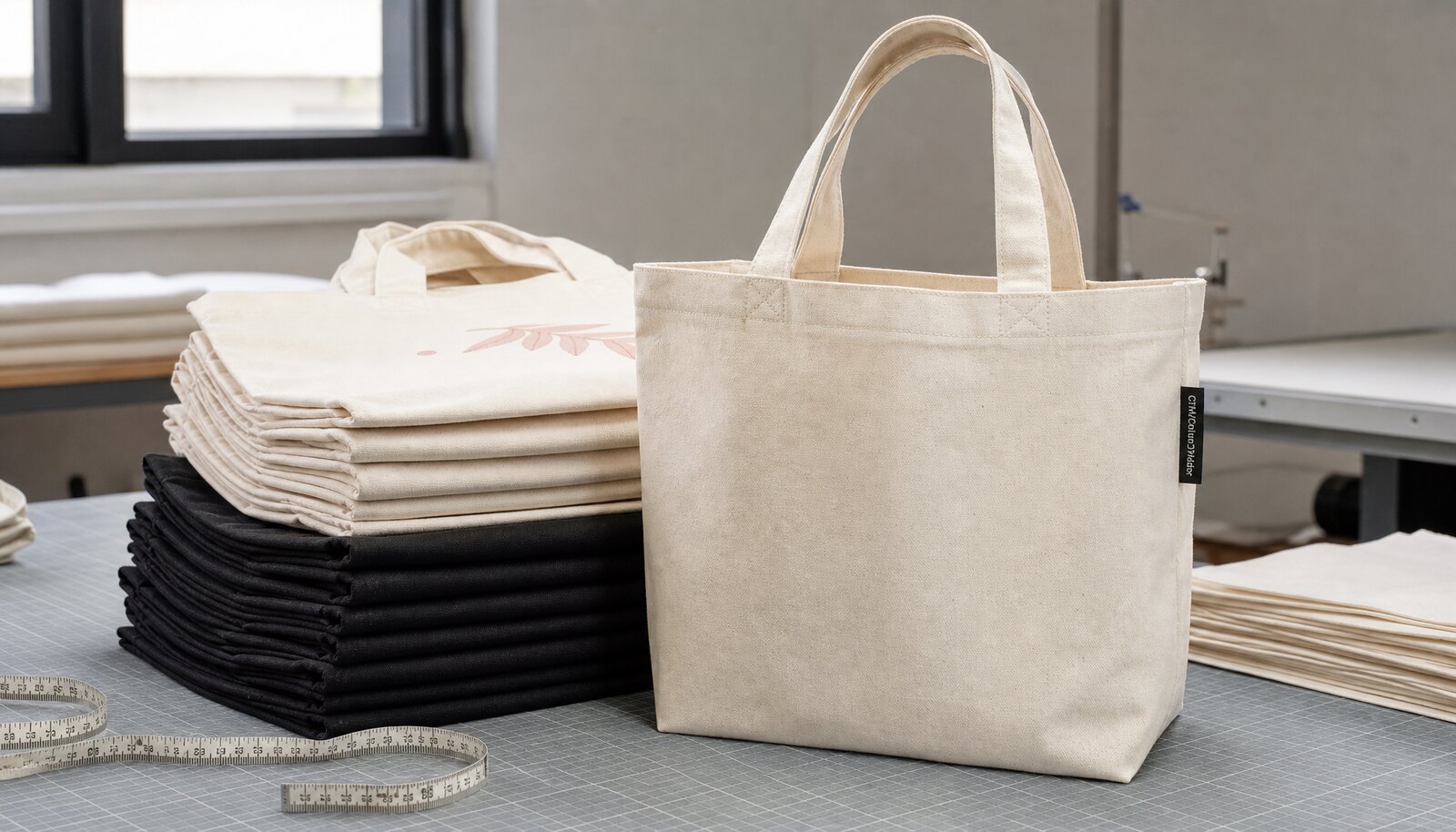
Why cosmetic brands should buy tote bags as a sourcing program, not a line-item accessory
For cosmetic brands, a heavy canvas tote is rarely just a bag. It may serve as gift-with-purchase packaging, a retail add-on, an event giveaway, a subscriber bonus, or the outer carrier for a premium skincare set. That puts the tote inside the brand’s margin structure, launch calendar, and customer experience. Procurement cannot evaluate it properly as a single unit price because the bag’s value depends on how it performs across merchandising, fulfillment, and repeat replenishment.
This is why a bulk pricing plan matters. The buying question is not only, “What is the ex-factory price?” It is, “What fabric weight, trim package, print method, packing format, and supplier route will hold quality at the target landed cost?” For a cosmetic campaign, a tote that looks fine in a quote may still fail in the warehouse if the handles twist, the print rubs, or the bag arrives creased and unsuitable for retail presentation.
A practical sourcing approach starts with the use case. A launch kit for a prestige serum line has different requirements from a high-volume checkout tote or a branded PR mailer. If the bag is meant to carry glass bottles or boxed skincare, structure and seam strength become non-negotiable. If it must fold flat for kit assembly, the fabric weight and reinforcement must be balanced carefully so the bag remains premium without becoming bulky or expensive to handle.
Procurement teams often gain more control by asking suppliers to price the bag as a spec-defined program. That means setting the same size, fabric weight, handle type, print treatment, packing method, and target volume band across all bidders. Once the scope is stable, a buyer can compare ex-works price, FOB price, and landed cost with much more confidence. It also makes negotiations more useful because the supplier can see exactly which elements drive cost.
Useful decision rule: if the tote affects brand presentation or retail sell-through, treat it like packaging, not merchandise. That shifts the discussion toward repeatability, QC discipline, and supply continuity instead of chasing the lowest headline quote.
- Use the tote in the same way your customer will: retail, gifting, shipping, or event carrying.
- Price the bag as part of a launch or replenishment program, not as a one-off accessory.
- Compare suppliers on the same spec sheet so the numbers are genuinely comparable.
Heavy canvas basics: how weight, weave, and finishing affect price and performance
Heavy canvas usually sits in the 12oz to 16oz range for most cosmetic-brand tote programs, although some buyers specify GSM instead. The number alone is not enough. Two fabrics can both be called 12oz and still feel different because the weave density, yarn quality, finishing, and shrink behavior are not identical. That is why procurement should ask how the supplier measured the weight and whether the quoted number refers to finished fabric after dyeing and printing or to greige cloth before finishing.
For premium beauty programs, 12oz to 14oz is often the practical range when the bag must look substantial but still fold efficiently for fulfillment or kitting. Move to 16oz when the tote must hold heavier gift sets, support a more rigid shape, or survive repeated daily use. Heavier cloth improves body and abrasion resistance, but it also increases sewing difficulty, freight weight, and sometimes print cost because the fabric surface is more textured and consumes more ink.
Another detail buyers should not overlook is fabric origin and finishing transparency. A supplier should be able to tell you whether the canvas is sourced from a known mill, from a regional grey-cloth converter, or from a trading network that books cloth after the order is placed. The exact commercial route changes how traceable the material is. If your brand has sustainability claims or wants repeat shade consistency, ask for lot traceability, origin documentation, and any material test records the supplier can provide without overpromising certifications they do not hold.
When you compare fabric offers, ask for the same information each time: weight, width, weave construction, finishing method, shrinkage expectation, and whether the cloth is bleached, natural, bio-washed, or dyed. If a supplier cannot state the final fabric width or cannot explain how they control shrink, the “cheap” canvas may become expensive in cutting waste or reject risk.
A simple buyer threshold helps here. If the tote is for short-term promotional use, 12oz may be enough. If it will be sold or reused as part of a premium cosmetic identity, 14oz is often the safer default. If the tote will regularly carry boxed products, samples, or heavier bundles, 16oz deserves a serious look, especially if the brand wants the bag to stand upright for shelf presentation.
- Ask whether the quoted weight is finished fabric weight or greige weight.
- Request canvas width, weave type, finishing method, and shrink allowance before comparing prices.
- Use 12oz for lighter promotional use, 14oz for balanced retail value, and 16oz for higher load or structure.
Material sourcing transparency: what procurement should ask before the quote looks attractive
One of the biggest gaps in tote sourcing is material transparency. A visually acceptable sample can still come from a supply chain the buyer cannot verify. That matters when your brand wants reliable color consistency, repeatability on reorders, or a documented story for sustainability-oriented packaging decisions. Procurement does not need a full mill audit on every project, but it does need enough visibility to know whether the factory controls the cloth or simply reacts to whatever the market can supply that week.
Start by asking where the canvas comes from and who owns the material decision. If the factory buys cloth in-house, ask how they qualify mills and how they record roll numbers and shade lots. If a trading company is involved, ask whether it can identify the actual sewing site and the material source or whether multiple subcontractors can be used. If the supplier refuses to answer even basic traceability questions, that is a sign the quote is more likely to hide substitutions later.
A useful transparency checklist includes: mill or source region, lot identification, fabric inspection method, shade control process, and whether the supplier can keep a cloth reservation for repeat orders. You are not asking for impossible certifications; you are asking for the chain of custody logic that keeps the bag consistent from sample to bulk. This is especially relevant for cosmetic brands that reorder seasonally, because a subtle fabric shift can change the way print density, handle color, and overall perceived quality appear to the customer.
Procurement teams should also check whether the supplier offers color matching on the actual fabric rather than on a paper standard alone. For natural canvas, “natural” can vary from warm beige to cooler off-white depending on fiber mix and finishing. If your brand needs a particular tone, request a daylight photo of the approved bulk shade and make sure the supplier records the acceptable range. For dyed canvas, ask how they manage lot-to-lot variation and whether the supplier can hold production until the dye bath is within the agreed range.
If your brand has any sustainability or responsible sourcing statements, keep the claims aligned with documentation the supplier can actually support. That might include country of origin, material composition, or general compliance records. Avoid building commercial copy around certificates the factory has not shown. The safest procurement habit is simple: ask for what can be verified, not what sounds good in a quote.
- Ask who owns the cloth decision: mill, converter, factory, or trading layer.
- Request lot and shade traceability for repeat orders.
- Do not rely on sample photos alone; confirm material identity and color control.
Trim sourcing and construction details that change the real cost
Heavy canvas tote pricing is influenced as much by trims as by cloth. Handles, labels, thread, zippers, snaps, rivets, and reinforcements all change the bill of materials. A supplier that quotes the body fabric well may still underquote the trim package, then substitute cheaper components later if procurement has not locked the detail. For cosmetic brands, that can be a serious issue because trims affect both appearance and durability.
The most common handle choice is self-fabric, but that broad label hides a lot of variation. Handle width, finished length, folding method, and reinforcement all affect comfort and strength. A short handle may look tidy in the sample room but become awkward once the tote is filled with skincare cartons. A narrow handle may save cost but dig into the shoulder. Ask for the handle drop dimension and test it with the products the bag will actually carry, not with empty-bag approval only.
If the tote uses a woven label, printed side label, or logo patch, ask where it is sourced and how it is attached. Woven labels are inexpensive in volume, but they still need correct stitch placement and thread color matching. Zippers, snaps, and rivets are more critical because they can introduce failure or rust risk if the source quality is poor. Even when these details seem minor, they can affect buyer confidence in the brand because customers often judge the bag by its trim finish before they judge the logo.
A serious supplier should be able to explain trim sourcing just as clearly as fabric sourcing. Ask whether trims are purchased from approved vendors, whether they are stocked, or whether they are bought per order. If the factory sources thread and labels from multiple small vendors, repeatability may be weaker. If they use only one vendor but cannot show backup options, resilience may be weak if the source runs short. Procurement is looking for a controlled system, not just a finished sample.
Good quote discipline here is to list each trim line separately: handle fabric, label, lining if used, zipper or snap if used, thread type, reinforcement tape if used, and any decorative element. Once those are separated, it becomes easier to see where one supplier is actually cheaper and where another is padding the base price with hidden assumptions.
- Break the quote into fabric, handle, label, hardware, thread, and reinforcement.
- Confirm who supplies each trim and whether substitutions are allowed.
- Test handle comfort and load behavior with the actual cosmetic contents.
Print, embroidery, and finishing: choosing the right brand method for coarse canvas
On heavy canvas, the branding method should be chosen with the fabric texture in mind, not just the logo artwork. Screen printing remains the most practical option for a simple mark or short message because it usually delivers the most stable bulk pricing and the cleanest repeatability. It works especially well when the brand uses one or two solid colors and wants the logo to read clearly from a distance. The key advantage is consistency: once the screen and ink are set, the factory can repeat the same look across a larger run.
Embroidery can create a more premium perception, but it is not automatically better. Large embroidery on a coarse canvas panel can distort the fabric, add cost, and create unnecessary stiffness. It is usually better when the logo is small and the brand wants a tactile finish rather than a large printed block. Heat transfer can be useful for artwork complexity or short runs, but procurement should treat it as a special case because some transfers hold up well while others are more sensitive to folding, heat, and abrasion.
The most important rule is to approve branding on the actual canvas weight and in the actual colorway. A design that looks clean on a computer screen may fail when the supplier tries to print tiny text or a thin-line logo on woven fabric. For that reason, ask for a strike-off, test print, or embroidered sample on the real material before bulk approval. If your artwork uses multiple colors, specify whether the supplier will use exact Pantone matching or visual approximation, because that difference can affect both cost and brand consistency.
Finishing matters too. Edges may be hemmed, turned, top-stitched, bound, or left with different reinforcement methods depending on the bag structure. Buyers should confirm whether the top edge is single-stitched, double-stitched, or reinforced with tape. Ask how the supplier controls print placement relative to the seam and whether the bag will be pressed, folded, or steamed before packing. These details show up in presentation and can affect how the bag photographs in retail and ecommerce settings.
A practical approval rule is this: if the artwork is simple and the order is bulk, screen print is usually the starting point; if the brand wants a tactile premium detail, consider a small embroidery or woven label combination; if the design is complex and the order is small, evaluate transfer only after reviewing durability and rub behavior.
- Use screen print for simple bulk branding and stable unit cost.
- Use embroidery only when the artwork size and placement suit the fabric.
- Approve print or embroidery on real material before mass production begins.
MOQ, volume bands, and the pricing curve procurement should expect
MOQ is not just a factory restriction. It reflects how the supplier allocates fabric, print setup, labor, and packing efficiency. In practice, a low MOQ can be helpful for a cosmetic brand testing a new launch, but it may carry a higher unit cost because setup and waste are spread across a smaller run. Once the order reaches a more efficient production band, the per-piece price often improves because cutting, printing, and sewing become more stable.
For custom heavy canvas tote bags, a common planning pattern is to ask for pricing at several bands rather than one. For example: 500 pieces for a test run, 1,000 pieces for first bulk, 3,000 pieces for a regional program, and 5,000 pieces if the bag becomes part of repeat merchandising. This makes the curve visible. Procurement can then see whether the supplier rewards scale fairly or whether the quoted drop is too small to justify a larger commitment.
It is also important to define what the MOQ applies to. Some suppliers quote MOQ per color, some per artwork, some per size, and some per total order if colors can be mixed. Those differences matter a lot when a cosmetic brand wants multiple seasonal colorways. A supplier may appear to offer a low MOQ but only if the same fabric and print design are repeated exactly. If you need a variant with a different handle color, label type, or trim package, the real MOQ may effectively be higher.
The cleanest negotiation question is not “Can you do less?” It is “At what point does the price step down, and what assumptions are required for that step?” That shifts the discussion to production efficiency rather than bargaining. It also reveals whether the supplier has a genuine costing model or is simply improvising a number to win the order.
For procurement planning, the right answer is often to forecast two rounds: a smaller test quantity to validate market response and a second, larger run that captures the better price band. That strategy lowers risk without forcing the buyer to overcommit before the design has proven itself.
- Request pricing at multiple bands: 500, 1,000, 3,000, and 5,000 pcs if relevant.
- Confirm whether MOQ applies per color, artwork, size, or full order.
- Ask what material, trim, or packing standard must be maintained to reach the lower price band.
How to compare suppliers: direct factory, trading company, stock source, and local production
The best supplier route depends on how much control the buyer needs versus how much speed and convenience the program requires. A direct factory is usually the strongest choice for a brand that wants repeatable fabric, controlled trim sourcing, and a stable long-term program. A trading company may be more useful when the tote is one line in a larger gifting or packaging basket, because it can coordinate multiple items and reduce coordination work for procurement. A stock importer or local converter is often the fastest path when the launch date is fixed and customization needs are moderate.
Each route has a different commercial profile. Direct factories often offer the best chance of competitive ex-works pricing, especially when the order size is stable enough to justify material booking. The tradeoff is that the buyer must be clearer on specs and QC. Trading companies may quote a higher price, but they can reduce workload by consolidating communication, handling multi-item packing, or solving logistics issues. Local production can save time, reduce communication barriers, or support compliance needs, but it is rarely the lowest-cost option on heavy canvas if the design is highly customized.
Procurement should verify capability before deciding that one route is “better.” Ask for photos of similar tote constructions, the sewing line’s capacity, recent production records, and the supplier’s QC process. If possible, request evidence that the factory has handled bags of comparable weight, not just light cotton pouches or simple promotional shoppers. Capability verification is especially important with heavier canvas because the seams, top edge, and handle attachment points require more reliable workmanship.
A fair comparison also includes who controls the trims and packing. Some suppliers own the sewing site but buy labels and hardware from outside vendors. Others may subcontract finishing or packing. That is not automatically bad, but the buyer should know where the actual risk sits. If a supplier cannot explain how production is controlled from cutting through packing, procurement should assume more handoff risk and longer problem-solving time.
The decision threshold is simple: choose the supplier model that matches your program complexity. If the bag is core to brand identity and reorderability, direct factory control is usually worth the extra effort. If the bag is one element in a bundled kit, a more service-oriented sourcing route may be justified. If speed is everything, a stock or local route may win, but the buyer should accept the limits that come with it.
- Direct factory: strongest for repeatability and controlled cost.
- Trading company: useful for consolidation and lower coordination burden.
- Stock or local source: fastest, but usually with less design and material control.
Supplier capability verification: audit criteria that matter before you scale
Procurement credibility improves when supplier verification goes beyond a polite introduction and a few sample photos. For bulk cosmetic tote programs, buyers should ask how the supplier checks raw material, manages sewing consistency, and controls packing. You do not need to run a full compliance audit for every order, but you do need enough evidence to confirm that the supplier can actually repeat the sample at scale. The gap between a nice prototype and a stable bulk run is where many tote projects fail.
A practical verification package includes factory identification, production floor photos or video, a brief capacity overview, and a list of comparable projects. The buyer should also ask who handles quality decisions: the sales contact, an in-house QC lead, or a subcontracted partner. If the supplier works through multiple facilities, ask which processes are in-house and which are outsourced. The more handoffs, the more important it is to understand how materials and approvals move through the chain.
Audit criteria should focus on the parts that affect tote consistency. Look for a clear incoming material inspection process, controlled cutting tables, a sewing line with enough operators for the order size, and a final inspection area where finished goods can be checked before packing. Ask whether the factory uses a defect grading system, how they record rejects, and whether they can share a non-confidential summary of recent QC practices. If the supplier cannot describe its own quality flow clearly, it may still be able to make bags, but it may struggle to make them repeatedly and predictably.
For brands with stronger governance requirements, ask whether the factory has experience with third-party inspections or buyer visits. Even if you do not plan a formal audit, the willingness to discuss process openly is useful. Transparent suppliers tend to answer detailed questions about cutting yield, needle control, print placement, and carton loading more confidently than casual brokers do. That responsiveness is often a better early indicator than a polished presentation deck.
A useful decision threshold: if the tote will be used in premium retail, media kits, or repeat purchase programs, capability verification should be treated as part of the buying cost, not a nice-to-have extra. One small visit, remote audit, or structured questionnaire can save far more than it costs if it prevents a recurring defect pattern later.
- Verify who actually controls production, not only who answers email.
- Ask for evidence of similar canvas projects and a clear QC flow.
- Treat capability verification as part of the sourcing cost for repeat programs.
Bulk pricing plan: what should be inside the quote and how to compare it cleanly
A serious bulk pricing plan should be built as a comparison sheet, not a single number. For heavy canvas tote bags for cosmetic brands bulk pricing plan work, procurement should ask each supplier to quote the same specification and then separate every cost element that could move later. That includes canvas, sewing labor, print setup, trim, packing, cartons, and freight assumptions. If one supplier folds several items into the unit price and another lists them separately, the buyer needs a normalized sheet before making a decision.
The most useful breakdown is a three-column comparison: ex-works cost, FOB cost, and estimated landed cost to the buyer’s warehouse or distribution center. Ex-works tells you what comes out of the factory gate. FOB adds export handling and port-side assumptions. Landed cost includes freight and the assumptions that matter after the goods leave origin. Heavy canvas is particularly sensitive to freight because the product’s weight and carton size can move the transport cost more than a lighter promotional item would.
You should also compare one-time charges separately from recurring charges. Printing screens, sample development, woven labels, and certain packaging setups may be one-time costs. Labor, fabric, and cartons are recurring. If a supplier discounts the unit price but inflates setup charges, the quote may only look attractive at the exact first order quantity. That is why buyers planning reorders need a landed-cost view over two or three runs, not only the opening order.
A practical comparison table inside the RFQ should include: size, fabric weight, weave/finish, handle length, handle reinforcement, print method, number of colors, trim package, packing count, carton dimensions, and delivery term. Once those inputs are identical, procurement can ask smarter questions about where the price difference comes from. Is one supplier using a heavier label? Better stitching? A more expensive print process? Or are they simply cutting quality to win the quote?
The real objective is not to find the cheapest tote in isolation. It is to find the most reliable cost structure for the planned program. If the bag is part of a premium skincare kit, a slightly higher unit cost may be justified if it reduces rejects, rework, and presentation problems. If the bag is a volume giveaway, the cheapest reliable configuration may be the right answer. The pricing plan should reflect the business purpose of the tote, not just the wish for a lower number.
- Compare identical specs across vendors before looking at prices.
- Separate setup charges from recurring production charges.
- Build a landed-cost sheet that includes freight and packing assumptions.
QC tolerances and testing standards: what to measure before you approve bulk
Quality control becomes much more useful when it is measurable. A tote approval that says “looks good” does not help much when a later shipment arrives slightly off size or with weaker handles. For bulk heavy canvas tote bags, procurement should define a simple tolerance sheet before mass production starts. That sheet should cover dimensions, stitch quality, handle placement, print alignment, and carton packing. It does not need to be overly technical, but it does need to be specific enough that the supplier knows what will be inspected and what counts as a pass or fail.
Good measurable checks include body height, width, gusset depth, handle length, handle drop, and logo placement from the seam reference. Ask the supplier what tolerance range they are willing to hold, then decide whether it is tight enough for your use case. For example, a promotional bag may tolerate slightly broader variance than a premium retail tote that will be displayed side by side in a store. Define acceptable ranges before cutting starts, not after the first bulk carton arrives.
Testing should also include load and stress checks. Place product-weight equivalents into the sample and examine whether the top edge deforms, the handles twist, or the bottom panel sags. If the tote is intended for heavier cosmetic sets, ask the supplier to confirm handle reinforcement and seam construction through a close-up photo or sample note. For screen-printed bags, a light rub or fold test can show whether the print cracks, peels, or transfers. For embroidered bags, check whether the backing causes puckering or uneven tension on the canvas.
A good QC plan also looks at packaging behavior. Folding order matters because a poorly folded bag can look wrinkled and lower the perceived value at arrival. Carton size matters because compressed packing can damage the print or crease the body. If bags are sent to a warehouse or distributor, confirm carton marks, SKU labeling, and packing count so the inbound team is not forced to rework the shipment. Many tote issues are not sewing failures; they are packing failures that appear at the end of the supply chain.
Useful acceptance guidance: ask the factory to state what it inspects at incoming material, in-process sewing, and final packing stages. If it can show a clear flow, not only a final photo, that usually signals better process maturity.
- Define measurable tolerances for size, handle drop, and logo placement.
- Include simple load, rub, and fold checks before bulk approval.
- Inspect packing quality as part of QC, not as a separate afterthought.
Specification comparison for buyers
| Sourcing option | Typical cost band | Best fit | Main tradeoff to manage |
|---|---|---|---|
| Direct factory, custom-made | Lowest to mid when volume is stable; best value improves at 1,000+ pcs per style/color | Brand-owned artwork, repeat programs, controlled fabric weight, custom trims and packing | Requires tighter RFQ discipline, stronger sample approval, and more supplier verification |
| Trading company / sourcing agent | Mid to higher once commission and service layers are included | Multi-item programs, consolidation across bags and gifting items, buyers needing one contact point | Less direct visibility into mill, trim, and sewing controls; confirm who actually owns production decisions |
| Stock importer / local converter | Mid to high depending on urgency and local overhead | Urgent launches, replenishment, or short seasonal windows with limited customization | Lower control over canvas weight, shade consistency, and trim sourcing; artwork options may be constrained |
| Regional low-cost factory | Lowest ex-works is possible, but not always the lowest landed cost | Large repeat orders where freight, labor, and standard materials are optimized | Audit depth, QC execution, and communication quality vary widely; verify capability before scaling |
| Premium domestic workshop | Highest per piece, sometimes justified by speed or local compliance needs | Short runs, prototype-to-launch programs, or retail campaigns needing fast turnaround | Unit price is higher and material options may be narrower; ask what is included in finishing and packing |
| Material | 8-12 oz cotton canvas, 120-220 gsm cotton, recycled cotton, or blended fabric selected by use case and target price | Before price comparison | Different cloth weights, backing, or certification claims make quotes hard to compare |
| Construction | bag size, gusset, handle drop, seam allowance, stitch density, reinforcement patch, and loading expectation | Before sampling | Weak stress points create returns and failed inspections |
| Decoration | screen print, heat transfer, embroidery, woven label, or hangtag matched to fabric texture and brand durability needs | Before artwork approval | The wrong method can crack, bleed, pucker, or fail on the chosen fabric |
Buyer checklist before sampling
- Final tote size in cm plus usable internal volume, not only catalog dimensions
- Canvas weight in oz or GSM, and whether the quote is based on finished fabric or greige fabric before finishing
- Weave type, yarn count if available, and whether the cloth is bleached, bio-washed, dyed, or piece-dyed
- Fabric sourcing transparency: mill name or source region, lot traceability, and whether the supplier can share material certificates or purchase records on request
- Trim specification: handle fabric, lining if any, zipper or snap hardware, label type, thread type, and reinforcement method
- Print method, number of colors, artwork file format, and acceptable placement tolerance on coarse canvas
- Sample stage required: visual sample, pre-production sample, or pilot run with actual trims and packing
- Measurable QC tolerances for dimensions, stitch count, seam alignment, print registration, and allowable defect rate
- Carton pack count, carton dimensions, gross weight, pallet pattern, and whether each bag is folded with tissue, polybag, or wrap paper
- Lead time split into sample, material booking, bulk sewing, finishing, and export packing
Factory quote questions to send
- What is the quoted canvas weight in finished fabric, and can you confirm the source mill or at least the production region for the cloth?
- What evidence can you share for supplier capability verification: recent product photos, factory audit summary, sewing line capacity, and examples of similar canvas work?
- Which trims are included in the quote, and are handle fabric, woven labels, zippers, snaps, rivets, and thread sourced from approved vendors or substituted locally?
- What is the MOQ by color, by artwork, and by trim combination, and does the price change if we mix colorways in one production run?
- Can you break out one-time setup charges from recurring unit costs for printing, woven labels, sampling, and packaging?
- What QC tolerances do you apply for size, stitch count, handle placement, print alignment, and carton count, and how are defects graded?
- Can you provide a pre-production sample made with the actual canvas, thread, trim, print method, and final packing spec before bulk cutting starts?
- What are the sample lead time, bulk lead time, and the point at which the schedule starts after approval?
- Which packing method is included, and can you quote both standard export packing and retail-ready packing separately?
- Can you quote EXW, FOB, and estimated landed cost with freight assumptions clearly stated, so we can compare suppliers on the same basis?
Quality-control points to confirm
- Fabric weight and width match the approved spec, with acceptance range defined before mass cutting starts
- Canvas shade is consistent within the approved lot; ask for lot photos under daylight and under standard indoor lighting
- Handle stitch reinforcement is symmetrical, with bar-tack or cross-stitch construction placed at the agreed seam points
- Handle drop, opening width, gusset depth, and body height stay within measured tolerances from the sample spec
- Seam slippage, skipped stitches, loose thread ends, and needle damage are checked on both the main panels and the handle attachments
- Logo placement is measured from the seam and edge reference points, not eyeballed from the top panel
- Print density, registration, and ink cracking are checked after folding and light rub testing
- If embroidery is used, density, backing, and distortion are checked so the canvas does not pucker
- Metal trims, snaps, and zippers are checked for function, burrs, corrosion risk, and alignment
- Cartons are sealed, labeled, and compression-tested as appropriate, with no wet damage, crushed corners, or mixed SKU packing errors