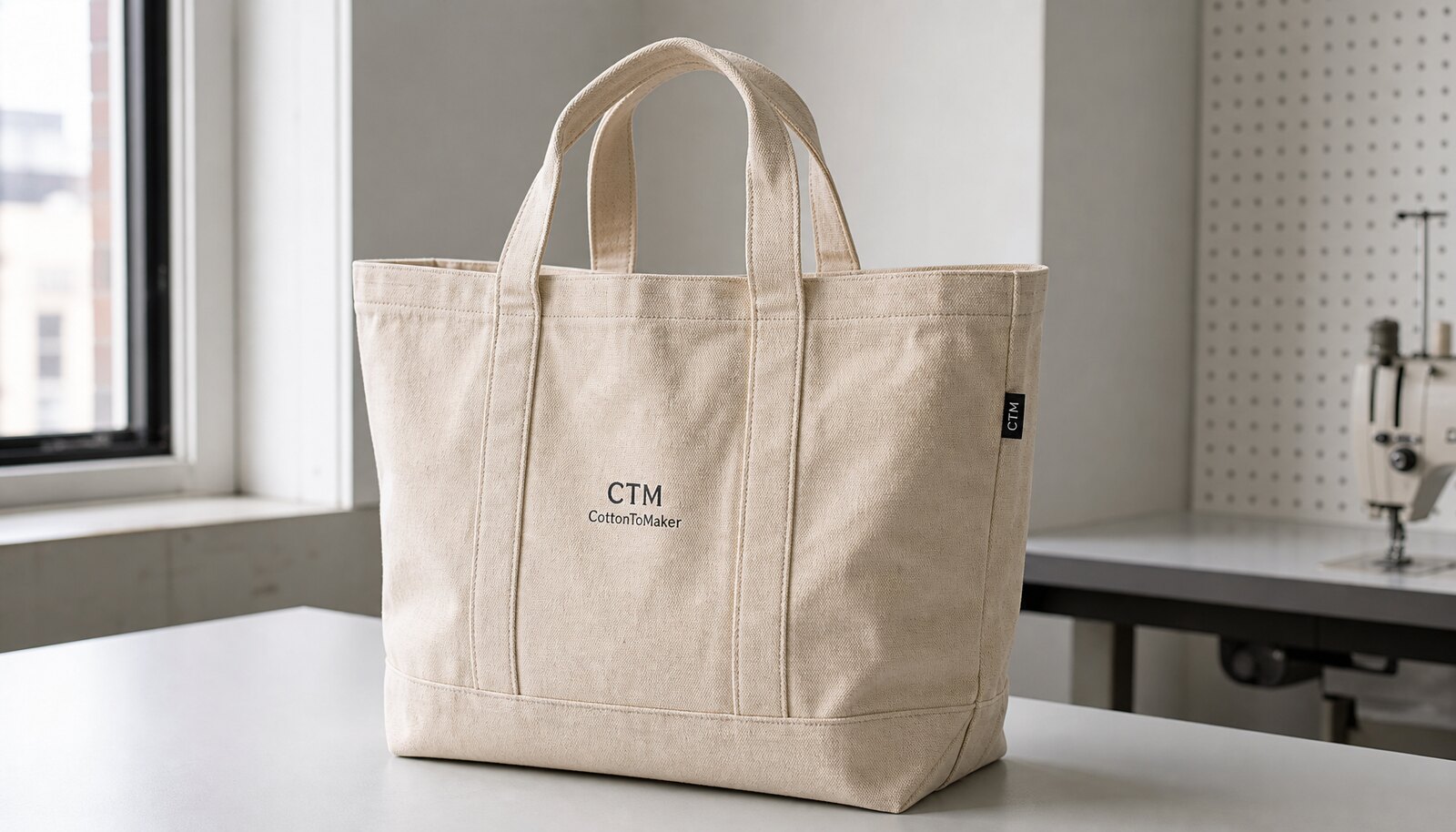
Why Heavy Canvas Totes Matter for Coffee Brands
For coffee brands, a heavy canvas tote is rarely just a giveaway. It may be sold as retail merch, attached to a subscription, included in a holiday bundle, or used at a café counter where the bag is effectively part of the product display. That makes it a branding item and a functional carrier at the same time. Buyers notice quickly when the tote feels flimsy, collapses on the shelf, prints unevenly, or loses shape after a few uses. They also notice when the bag is overbuilt and costs more than the channel can justify.
Procurement teams should therefore treat the tote as a controlled product. The real question is not whether a factory can sew canvas handles. The real question is whether the supplier can hold a repeatable spec, decorate it consistently, pack it efficiently, and reproduce the same result on a reorder without reworking the design. That is especially important for coffee brands, where the same tote may need to work across retail display, e-commerce fulfillment, events, and bundle programs.
Material choice affects the commercial result as much as the visual one. Heavier canvas gives the bag more structure and a more premium hand feel. It also slows cutting and sewing, increases needle wear, and can expose weak reinforcement or print work faster than lighter cloth. Buyers who only judge the sample on appearance often miss those production effects. Buyers who define the use case first are better positioned to balance cost, durability, and brand presentation.
- Match the tote to the channel: retail, event, subscription, or bundle.
- Heavy canvas improves structure, but it also raises sewing time and QC sensitivity.
- The best spec is the one the factory can repeat, not just the one that looks best in a mockup.
Start With the Buying Spec, Not the Logo
The fastest way to get vague quotes is to ask for a “heavy canvas tote with logo” and leave the rest open. A factory can interpret that request in many ways, and each version changes cost, MOQ, and lead time. A useful RFQ should define the finished dimensions, gusset depth, handle length, handle drop, top hem, reinforcement style, and whether the bag needs an inner pocket, bottom board, side label, or key loop. If the tote will hold packaged coffee, cups, or bundled merch, the opening width and base stability matter as much as the artwork.
Heavy canvas is usually discussed in oz or gsm. For many coffee-brand uses, 14 oz to 16 oz, or roughly 400 to 450 gsm, is a practical starting point. It gives the bag enough body for retail presentation without making it overly rigid. If the bag must stand upright on a shelf or carry a more premium look, 18 oz or about 500 to 520 gsm may be a better fit. The tradeoff is straightforward: heavier cloth often means slower sewing, stronger reinforcement, and greater risk that the tote feels more utilitarian than branded.
Fabric finish matters too. Natural plain weave, bleached cloth, dyed cloth, and washed cloth can look similar in a photo while behaving very differently in production. Washed cloth may shrink or soften; dyed cloth can introduce shade variation; coated cloth can change how the ink sits on the surface. If the buyer does not define the cloth state before quoting, the supplier may choose the easiest material to source rather than the one that best fits the brand standard.
- Specify fabric weight in gsm or oz, plus finish state: natural, bleached, dyed, or washed.
- Define finished size and construction details, not just the logo panel.
- Choose the cloth weight based on whether the tote must stand, fold softly, or carry inserts.
What MOQ Really Means for Heavy Canvas Orders
MOQ on canvas totes is not a fixed universal number. It is the outcome of several separate costs: fabric roll usage, cutting efficiency, sewing labor, screen setup, label sourcing, and carton packing. When buyers ask only, “What is your MOQ?” they often get a number that sounds arbitrary because the supplier is protecting setup cost. The better question is: what is the minimum order for this exact combination of size, fabric, decoration, and packing?
A direct cut-and-sew factory can often support a lower MOQ than expected when the specification is simple. For a standard size, one-color print, stock natural canvas, and basic bulk packing, a working MOQ range of about 300 to 1,000 pieces per style/color is common in many factory setups. Once the cloth must be custom dyed, the artwork uses multiple screens, the handles are upgraded, or the bag includes a sewn-in patch, the floor can move up quickly. Heavier 18 oz cloth can also push MOQ higher because production runs slower and the factory wants enough volume to justify the labor time.
A stock bag wholesaler with local decoration may support a smaller pilot order, sometimes as low as 50 to 500 decorated units, because the blank bags already exist. That can work well for a launch or seasonal event. The tradeoff is control. The buyer may not know the exact fabric lot, shrinkage behavior, or whether the next reorder will match the first one. Trading companies and sourcing agents can help with communication and combined purchasing, but they do not remove the underlying factory economics. Buyers should still ask who actually owns the production line, who owns QC, and whether the same maker will be used on the next order.
The practical sourcing takeaway is that MOQ is usually easier to reduce by simplifying the product than by negotiating harder. If the first run must be small, keep the spec stable: standard size, one color, stock canvas, and minimal decoration. Every extra variable makes the supplier hold more risk in the price.
- MOQ rises when fabric, print, labels, or packing become custom.
- The same tote can have a very different MOQ depending on whether the cloth is stock or mill-made.
- For a first launch, simplicity is the strongest lever for a lower order floor.
Lead Time: Break It Into Stages So It Can Be Managed
A quote that says “25 days” or “30 days” is not a real schedule unless the supplier explains what those days include. Heavy canvas tote lead time should be broken into stages: sample development, sample approval, material booking, cutting, printing, sewing, QC, packing, and dispatch. That is the only way a buyer can tell whether the order is genuinely fast or merely presented as fast. If the supplier already has stock fabric, standard handles, and an existing print setup, the early stages may move quickly. If the order needs custom cloth or special trim, the schedule expands immediately.
For a typical procurement review, a realistic sample window is often 3 to 10 days if the supplier has materials on hand, and 10 to 20 days if the bag needs custom sizing, new print tooling, or label development. Bulk production after approval often lands in the 20 to 45 day range for standard factory work, with the lower end tied to stock materials and simpler decoration. Heavier cloth can lengthen sewing time, especially if the bag has thick handles, extra reinforcement, or multiple stitch lines. Add inspection and export prep, and a buyer should treat 2 to 6 additional days as normal before cargo is actually ready to move.
Freight time is a separate clock. Sea freight, air freight, and courier transit each affect delivery differently, but none of them shorten sample approval or production. Procurement teams should ask for two dates: the goods-ready date and the shipping date. Those are not interchangeable. A supplier may be fast at finishing the bags but slow to book pickup or complete export paperwork.
Buyers should also confirm whether the supplier is quoting working days or calendar days. That difference matters around holidays, regional shutdowns, and port congestion. A clear schedule is more useful than a shorter number that fails under pressure.
- Ask for a stage-by-stage schedule: sample, approval, materials, production, QC, and dispatch.
- Treat freight as a separate timeline from production.
- Confirm whether the lead time is in working days or calendar days before you approve the PO.
Decoration Choices Change More Than Appearance
Screen print remains the default decoration for many coffee-brand totes because it gives strong color, predictable repeatability, and a good cost-to-durability balance. One or two colors are usually the most efficient. Every additional color adds screen setup, registration complexity, and a higher chance that small type or thin lines will blur on the rough canvas surface. On heavy cloth, print quality depends not only on the artwork but also on mesh choice, ink load, drying, and operator control. A design that looks clean on a mockup can lose detail if the weave is too coarse or the ink is too heavy.
That is why print approval should be done on the actual cloth weight, not on paper alone. Coffee brands often want a restrained logo, but even simple artwork can fail if the factory does not manage opacity well or if the print is placed too close to a seam. Buyers should specify print size, placement from the edge, color reference, and acceptable edge shift. For a retail tote, the print should read clearly from normal viewing distance, not only up close in a sample room.
If the brand wants a quieter visual result, a woven side label, small sewn patch, or subtle embroidery can be a better fit. These methods reduce the visual weight of a large logo and can feel more premium. They also create different production risks. A woven label can twist if the stitch path is not controlled. Embroidery on thick canvas can pucker or distort the panel. A patch may require extra seam allowance or backing to sit flat. Decoration choice should therefore reflect both the brand look and the manufacturing route, not only the price.
The key procurement issue is repeatability. If the tote will be reordered, the chosen decoration must be easy to reproduce. A print method that depends on a highly specific manual setup may look excellent once and drift on the second run. That is a sourcing risk, not just a visual one.
- Screen print is usually the best cost-to-durability option for simple coffee logos.
- Woven labels and patches can feel more premium, but they need placement control.
- Approve decoration on the actual canvas weight and actual production method.
Compare Supplier Routes by Control, Not Just Price
The right supplier route depends on how much control the buyer needs versus how quickly the bag has to move. A direct cut-and-sew factory is often the strongest option for repeat coffee-merch programs. It gives better control over dimensions, handle reinforcement, and production repeatability. It also makes it easier to standardize the bag for a reorder. The tradeoff is that the buyer must provide a cleaner RFQ and accept the factory’s setup logic.
A stock bag wholesaler with local decoration is often the fastest route for a test order. If the blank bag already exists, a small printed or labeled run can move quickly, sometimes in 7 to 20 days for decoration-only orders. This route is useful when the brand wants to test sell-through or launch a short seasonal item. The risk is that stock bags can vary in lot, finish, and shade, and the buyer may have less leverage if the next reorder needs the exact same fabric and trim.
Trading companies and sourcing agents are most useful when the buyer wants one point of contact, needs help with communication, or is combining several products into one shipment. They can reduce coordination friction, especially for buyers without a local sourcing team. But the buyer should still ask who the actual maker is, whether the factory changes between orders, and who is responsible for QC. If that answer is vague, the buyer may be paying for convenience at the cost of transparency.
The decision should be based on the program, not the pitch. For a small launch, stock decoration may be the most efficient route. For a retail tote that must reorder cleanly, a direct factory usually wins. For a multi-item campaign, a trading company may be acceptable if the factory disclosure and QC responsibility are solid.
- Choose the factory route when repeatability and spec control matter most.
- Choose a stock route when speed matters more than exact long-term matching.
- Choose a trading company only when the coordination benefit is real and QC ownership is clear.
How to Read a Tote Quote Without Missing the Hidden Costs
Two tote quotes can look close and still describe completely different products. That is why procurement buyers should normalize the offer before comparing price. The comparison only makes sense when the same finished size, fabric weight, decoration method, handle spec, packing count, and shipping term are being used. If one supplier quotes a 14 oz bag with one-color print and another quotes an 18 oz bag with a woven label, the cheaper quote is not necessarily the better one. It may simply be a different product.
Line items matter. Sample fees, print screen charges, label costs, carton charges, inner packing, moisture protection, and documentation can all be hidden or bundled into unit price. Buyers should ask for a transparent breakdown so they can see what is one-time setup and what is recurring cost. This matters because tote programs are often repeated. A slightly higher first-order setup can be acceptable if the reorder becomes cleaner and cheaper. The opposite is also true: a low quote with poor setup clarity can become expensive when the second run needs correction.
A useful comparison method is landed cost, not unit price alone. That means the buyer looks at product price, packing, inland freight, export handling, duty exposure if applicable, and any likely rework or shortage cost. It is also smart to ask for quote validity. Canvas and freight markets move, and a quote that is only valid for a few days may not support a real purchasing decision.
Carton efficiency is another hidden lever. If one supplier uses cartons that are too large or too heavy, the apparent unit price may be offset by higher freight cost. Carton optimization is not a side issue; for dense products like canvas totes, it can materially affect landed cost.
- Compare only normalized quotes: same size, fabric, decoration, packing, and shipping term.
- Separate one-time setup costs from recurring unit costs.
- Check carton size and gross weight because they directly affect freight efficiency.
QC Thresholds Procurement Teams Can Enforce
Quality control for heavy canvas totes should focus on measurable, visible, and functional outcomes. A buyer should not rely on broad language such as “good quality” or “same as sample.” Instead, define tolerances and inspection methods. For size, many buyers use a tolerance of about ±0.5 cm to ±1.0 cm on finished dimensions, depending on bag size and construction. For print placement, a tolerance of about ±3 mm to ±5 mm is often practical for a textile item, provided the print remains centered and readable. Handle lengths should be equal within about 0.5 cm so the bag hangs evenly.
Stitching is the most important functional control. Ask for bar-tacks, X-box reinforcement, or another agreed reinforcement pattern at the handle stress points and bottom corners. Define what counts as a defect: skipped stitches, thread nests, seam puckering, loose trim, open edges, or broken reinforcement. Also define whether slight color variation in canvas is acceptable. Natural canvas often has normal variation, but buyers still need a shade boundary. Without that boundary, every review becomes subjective.
Inspection method matters as much as the threshold. If possible, use an AQL-based inspection or at least a measured carton sampling plan. The goal is to inspect enough pieces to catch repeat deviations, not only one attractive sample from the top of the carton. Test the print by rubbing it on the actual canvas after curing. Pull the handles to check seam integrity. Measure the bag’s opening, depth, and gusset so the bulk run can be compared against the signed sample. If the product has a label, inspect placement and spelling on the sampled pieces because a small label mistake is easy to miss in production and hard to correct after shipment.
The best QC plan is short, specific, and enforceable. It tells the factory exactly what can pass, what must be fixed, and what will trigger rejection or rework.
- Write measurable tolerances for size, print placement, and handle length.
- Require reinforcement at load points and define the stitch pattern clearly.
- Use carton sampling and measured checks, not only a visual walk-through.
Packing, Cartons, and Freight Are Part of the Product Cost
Packing has a bigger impact on landed cost than many first-time buyers expect. A flat-packed tote is efficient, but it may not suit a bag that must arrive retail-ready, stay clean for fulfillment, or ship as part of a coffee bundle. A simple polybag can protect the surface, but it adds labor and volume. Individual insert cards, barcode stickers, and retail hang tags may look minor in the quote, yet they can add up quickly when multiplied across hundreds or thousands of units.
Carton optimization is especially important because canvas is dense. The bag itself may be inexpensive, but if the carton becomes too heavy or too bulky, freight cost rises. The buyer should ask for the planned pieces per carton, carton dimensions, gross weight, and whether the supplier has tried to balance weight against cube efficiency. A carton that is too small can cause compression or wrinkling; a carton that is too large can waste freight volume. Neither is ideal.
If the order will move by sea, the buyer should ask for a rough cube estimate and whether the supplier expects palletization. If the order will move by air, every kilogram matters, and even a small change in carton format can affect cost. Moisture protection should also be considered, especially for long transit or humid storage. A simple inner pack or carton liner may be worth the small added cost if the bags must arrive clean and presentable.
The packing spec should match the sales channel. A café counter bundle does not need the same retail packaging as an e-commerce resale unit. Procurement teams should decide this before the PO is issued, not after the first production batch is already packed.
- Match packing to the channel: retail shelf, café bundle, fulfillment, or event kit.
- Ask for carton size, gross weight, and pieces per carton before approval.
- Use moisture protection when storage or transit conditions are uncertain.
Simplify the Program Before You Push the Factory on MOQ or Lead Time
If the MOQ is too high or the lead time is too tight, the best fix is often to simplify the order rather than trying to force the factory into a bad setup. The fastest way to lower risk is to reduce the number of variables. Keep the fabric stock rather than custom-dyed, limit the print to one color, use a standard bag size, and avoid special wash effects or extra trims. For a first coffee-brand launch, that approach is usually better than insisting on a perfect but slow and expensive spec.
The mistake many buyers make is changing too many things at once: a new size, a new print, a new label, a new carton, and a new packing method in the same RFQ. That combination can be done, but not usually at a low MOQ and not usually on an aggressive timeline. If the launch date matters, split the program. Run a basic version first, learn how the market responds, and then move to the more polished version on reorder. This is especially useful when the tote is tied to a seasonal promotion or a limited coffee release.
Simplification also helps with reorder control. The more custom the first run, the harder it is to match fabric shade, trim supply, or print register later. For a brand planning ongoing merch sales, the first order should be designed not only for launch but for repeatability. A more modest first version can be commercially smarter than a highly customized one that cannot be matched later.
Procurement teams should think of simplification as a commercial strategy, not a compromise. It preserves schedule, supports better QC, and makes the supplier quote easier to compare.
- Reduce print colors before pushing for a lower MOQ.
- Keep the fabric spec steady if the ship date matters.
- Use a pilot-run-plus-reorder model when demand is uncertain or seasonal.
Specification comparison for buyers
| Buyer route | Typical MOQ range | Typical lead time range | Best fit | Cost drivers to watch |
|---|---|---|---|---|
| Direct cut-and-sew factory | 300-1,000 pcs per style/color | 25-45 days after sample approval; faster only when fabric, trims, and print setup are already in place | Repeat coffee-merch programs, custom dimensions, reinforced handles, and tighter control over sewing and print | Fabric weight, custom dyeing, screen setup, label stitching, carton optimization, and any rework from sample changes |
| Stock bag wholesaler + local decoration | 50-500 pcs decorated; 200-1,000 pcs if the bag itself is also customized | 7-20 days for decoration only; 20-35 days if stock must be replenished or relabeled | Fast pilot launches, event merchandise, and short-run seasonal campaigns | Blank stock availability, local decoration setup, print-position limits, and lot-to-lot shade or shrink variation |
| Trading company / sourcing agent | 500-2,000 pcs depending on the factory network and how many suppliers are involved | 30-55 days including quotation coordination, approvals, and factory scheduling | Multi-item programs, buyers who need language support, and orders that must be consolidated | Agent margin, slower decision loops, unclear factory ownership, subcontracting risk, and QC handoff gaps |
| 14 oz / about 400-450 gsm plain weave canvas | Often 300-800 pcs for standard sizes | 20-40 days once fabric is confirmed | Retail totes that need body without feeling overly rigid | Stock fabric availability, print setup, sewing efficiency, and reinforcement requirements |
| 18 oz / about 500-520 gsm canvas | Often 500-1,000 pcs because heavier cloth slows output | 25-45 days once fabric is confirmed | Premium retail, grocery-style carry, and bags that must stand upright | Sewing speed, needle wear, extra reinforcement time, and carton weight |
| 1-2 color screen print | Usually 300-1,000 pcs depending on fabric and size | 25-40 days after artwork and screen approval | Simple logos, readable branding, and repeated reorders | Screen count, registration risk, ink coverage, and rub durability |
| Woven label / small sewn patch | Often 300-1,000 pcs; lower if the label is stock and already available | 25-45 days depending on label sourcing and stitch placement | Subtle branding, premium feel, and lower ink risk | Label MOQ, folding direction, stitch path, and seam allowance |
| Split launch: pilot run then reorder | Pilot 100-300 pcs; reorder 300-1,000 pcs | Pilot 15-30 days if stock-based; reorder 20-40 days with a locked spec | New coffee launches and programs with uncertain sell-through | Spec drift, fabric matching, artwork changes, and carton changes between runs |
Buyer checklist before sampling
- Confirm the finished size, gusset, handle drop, top hem, and reinforcement style in writing before requesting price.
- Specify fabric weight in gsm or oz, and state whether the cloth is stock, mill-made, bleached, dyed, or washed.
- Lock the print method, color count, ink type, artwork format, and print placement before sample approval.
- Ask for a full pre-production sample that reflects the actual fabric, label, carton style, and finish effect.
- Define packing quantity per carton, inner packing method, barcode format, and carton mark format before PO issue.
- Split lead time into sample, material booking, production, inspection, packing, and dispatch so the schedule is measurable.
- Confirm whether the factory can hold matching fabric for a reorder and what happens if the next lot shade differs.
- Write QC tolerances for size, stitch quality, print placement, and shade variation into the order spec.
- Store one signed pre-production sample as the bulk reference and use it during inspection.
- Ask the supplier to state any setup charges separately so the unit price can be compared fairly on reorders.
Factory quote questions to send
- What exact fabric weight in gsm or oz will you use, and is the cloth stock, mill-made to order, or custom dyed?
- What is the MOQ for this exact size, print method, packing format, and color choice?
- Which steps are done in-house, and which steps are outsourced to another workshop, printer, or label supplier?
- What sample types do you provide: digital mockup, pre-production sample, and full bulk sample? Is there a sample fee?
- What is the production lead time after sample approval and material confirmation? Please break it into material booking, cutting, sewing, print, QC, and packing.
- How many colors or screens are included, and what setup charges apply for artwork or screens?
- What carton size, pieces per carton, and gross weight do you propose, and how many cartons per export case or pallet?
- What tolerances do you accept on size, stitch count, handle length, and print placement?
- Can you hold matching fabric for a reorder, and for how long? What happens if the next lot shade differs?
- What documents will you provide before shipment, including packing list, carton data, and inspection photos or report?
Quality-control points to confirm
- Fabric weight should match the approved spec within the agreed tolerance, commonly about ±5% unless a stricter range is written into the order.
- Visible panels should be free from holes, broken yarns, oil marks, major slubs, and obvious shade breaks.
- Handles should be equal in length within about 0.5 cm and reinforced with bar-tacks or X-box stitching at the load points.
- Seam allowance should be consistent, with no skipped stitches, loose thread clusters, or open edge fray at stress areas.
- Print should be centered within about ±3 mm to ±5 mm depending on bag size, with sharp edges and no double images.
- Ink adhesion should pass the agreed rub test on the actual canvas after curing, not only on a paper proof.
- Bag dimensions should fall within the agreed tolerance, often about ±0.5 cm to ±1.0 cm for retail totes.
- Label placement should be consistent and spelling should be correct on every unit, with no upside-down or crooked sewing.
- Carton count, carton marks, and packing method should match the PO and packing list exactly.
- Bulk output should match the signed sample for color, hand feel, handle reinforcement, and overall finish.