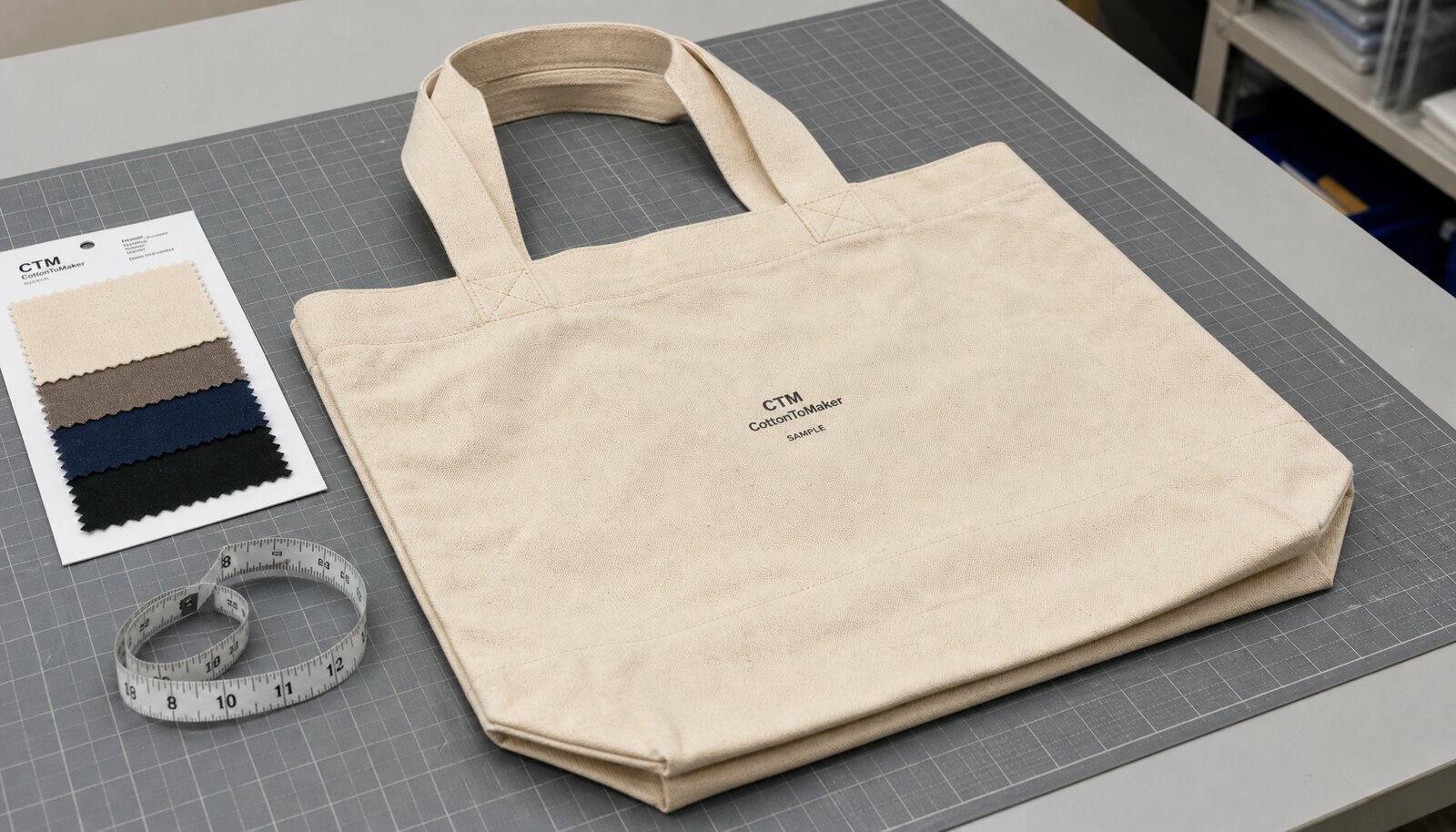
Why coffee brands buy heavy canvas totes instead of lighter promo bags
For coffee brands, a tote is often doing three jobs at once: it acts as merchandise, it supports retail presentation, and it works as an add-on to beans, mugs, filters, or subscription boxes. That combination makes the fabric choice more important than it looks on a spec sheet. A lighter promotional bag may be fine for an event handout, but it can feel flimsy on a retail shelf, slump when folded, and distort the logo once the bag is loaded. Buyers usually move to heavy canvas when they want the tote to feel like a sellable product rather than a giveaway.
The business reason is durability and brand perception. A heavier cloth typically gives the print a more stable surface, holds a cleaner silhouette, and reduces complaints about weak handles or distorted corners. If the tote will be sold alongside coffee in a store or shipped with a premium bundle, the bag should behave like part of the product range. That means the procurement spec has to cover not just fabric weight, but handle reinforcement, finishing, packing, and how the bag will be displayed after delivery.
- Use heavy canvas when the tote will be sold, not just handed out.
- Treat the bag as a retail SKU with a real quality standard.
- Base the fabric choice on the actual load and shelf expectations, not only on target cost.
Fabric weight, finish, and bag size: the decisions that drive usability and cost
For many coffee-brand programs, 12 oz canvas is a practical starting point, while 16 oz is often the safer choice when the tote must hold its shape, carry a heavier retail bundle, or support a premium feel. Some suppliers quote GSM instead of oz, so buyers should always convert the conversation into one consistent unit before comparing offers. A useful rough range for heavy canvas is often in the 340-450 GSM zone, but the real test is how the cloth behaves after cutting, stitching, and any finishing treatment. Ask for the exact weave, whether the cloth is raw or washed, and whether shrinkage has been measured before production begins.
Size should be tied to the use case, not chosen by guesswork. A tote for café counters and gift sets may be smaller and shallower than a tote meant to hold coffee bags, tumblers, and samples at once. The quote should state the finished dimensions, seam allowance, and gusset depth. Finished size matters because a bag can look acceptable as a flat sample yet lose practical volume after stitching and shrinkage. Procurement teams should also confirm whether the handles are cut from the same canvas or made from webbing, because that changes both cost and appearance.
If the bag will be printed, the finish affects contrast. Natural canvas gives a warmer retail look but can vary more from roll to roll. Bleached canvas gives cleaner logo contrast, but buyers should confirm whether the bleaching is even and whether it changes hand feel. Washed canvas can feel softer and more premium, but washing can also introduce dimensional variation if the supplier is not controlling the process closely.
- 12 oz canvas: good balance for merch programs and controlled cost.
- 16 oz canvas: better structure, stronger shelf presence, and less collapse when loaded.
- Natural canvas: common and versatile, but confirm shade consistency.
- Bleached or washed canvas: better visual refinement, but verify shrinkage and color uniformity.
Logo methods that hold up on textured canvas
Heavy canvas is not the easiest surface for every decoration method, so the print choice should follow the artwork, not the other way around. For coffee brands using bold one- or two-color graphics, silk screen remains the most predictable option because it is efficient, scalable, and usually gives the best cost-to-clarity ratio. When the logo is small and the brand wants a quieter, more premium feel, a woven label, patch, or neat embroidery application can work well. Each of those approaches raises labor and can change the hand feel, so they should be quoted separately rather than folded into a vague “custom logo” line.
The common failure point is artwork complexity. Fine text, tight serif fonts, thin lines, gradients, and detailed illustrations can all become fragile on heavy canvas. Ink can sit unevenly in the weave, and small text may fill in or lose clarity. If the brand’s logo is detailed, the buyer should ask the supplier to confirm the smallest printable line and font size in writing, then check that against the approved art file. In practice, simplifying the logo for the fabric often produces a better retail result than forcing a digital-style design onto a textured surface.
For a procurement team, the key is not to ask “Can you print this?” but “What version of this artwork will print consistently at scale?” That question forces the supplier to identify limits before sample approval rather than after bulk production has already started.
- Silk screen is usually best for bold, flat graphics and repeatable color control.
- Woven labels and patches work well for subtle branding and premium merch positioning.
- Embroidery can look strong on simple marks, but it is less suitable for very fine text.
- Require the supplier to define minimum line thickness and smallest text size before sample approval.
A side-by-side comparison of sourcing routes buyers usually receive
Buyers comparing heavy canvas tote bags for coffee brands custom logo order guide options usually see three sourcing routes: direct factory, trader or sourcing agent, and stock-base customization. These are not interchangeable. They differ on control, speed, transparency, and how much of the price is actually visible in the quote. The table below is more useful than a generic “pros and cons” summary because it ties each route to cost behavior, risk, and common use cases.
Use the comparison to decide whether you are buying a launch test or a repeatable retail program. A short-term promotional tote can tolerate more template-based sourcing, while a permanent coffee merch SKU usually needs tighter control over fabric, print placement, and reorder consistency.
- Compare quotes on the same spec version, not on marketing language.
- Ask which parts of the cost are fabric, labor, print setup, packing, and freight-ready carton work.
- Match the sourcing route to the product lifecycle: test order versus repeat retail order.
MOQ, sample stages, and how to tell whether a quote is real
MOQ is usually driven by fabric sourcing, printing setup, and sewing efficiency. A single-color print on stock fabric can support a lower MOQ than a multi-color logo on custom-dyed canvas with special trim. Buyers should avoid asking only for “your best MOQ.” Better questions are: what is the MOQ by fabric color, logo color, and total order quantity; what changes for a test run; and what cost penalty applies if the order is split into multiple colors or size variants? That gives procurement teams a real comparison rather than a vague promise.
Samples should be treated as a production control step. A strike-off or print sample is useful for checking artwork size, line clarity, and color tone. A pre-production sample is more important because it should use the final fabric, the final print process, the final handle method, and the final trims. If the sample is hand-made differently from bulk, it is not a reliable representation of the shipment. Buyers should only approve bulk after the sample matches the intended production method, not just the visual look.
A believable quote will usually separate sample charges, tooling or screen charges, unit price, packing cost, and any special processes. When all of those items are hidden inside one number, comparing suppliers becomes guesswork. Procurement teams should insist on line-by-line clarity, especially if they are choosing between a factory that quotes transparent process costs and a trader that bundles everything into a single landed-looking number.
- Request MOQ by fabric color, logo color, and total order quantity.
- Separate strike-off cost from pre-production sample cost.
- Approve bulk only after a sample is made with final fabric and final production method.
What should be inside a supplier quote for custom tote bags
A serious quotation should let the buyer reconstruct the product. At minimum, it should state finished dimensions, canvas weight, fabric finish, logo method, print size, handle construction, packing format, carton count, carton dimensions, and lead time. If those items are missing, the quote is too loose for procurement use. Two quotes can appear close on unit price but still be materially different if one includes a reinforced handle, better fabric, and retail packing while the other uses a simpler construction.
The best way to compare price is to move from unit cost to landed cost. That means adding sample charges, setup or screen charges, carton cost, internal labeling, inland delivery to port or forwarder, and any retail prep such as barcode labels or hangtags. Freight can matter a lot when the tote is bulky or packed inefficiently. A low factory price can disappear if the carton volume grows because of polybags, inserts, or overstuffed packing. For that reason, buyers should request carton dimensions before they approve the order, not after.
If the tote will go into a coffee chain, specialty retail, or an e-commerce kit, the packing specification should be priced as part of the product, not as an afterthought. That is especially true when the tote is folded a certain way to show the logo on opening, because folding labor and packing consistency both affect cost and presentation.
- Unit price alone is not a purchase decision.
- Packing format can change freight and warehouse cost materially.
- Ask for separate line items for tooling, sampling, printing, and retail prep where possible.
Direct factory vs trader: how procurement teams should compare the difference
Direct factory sourcing usually offers the best control over fabric weight, stitch quality, and repeat order consistency, especially when the tote is a recurring coffee-brand SKU. It is also the cleanest route for confirming whether the factory can actually make the bag the way the quote says. A factory can show you the sewing line, the cutting process, the print area, and the packing setup. That visibility matters when the brand plans to reorder the same tote for multiple seasons.
A trader or sourcing agent can be useful when the team needs consolidation across several products, support with paperwork, or a local contact who manages communication. The tradeoff is transparency. The buyer may see a polished quotation without seeing whether the factory behind it is actually controlling the fabric lot, print method, or final packing. That does not make traders bad partners, but it does mean procurement teams should ask a different set of verification questions. Who is the actual manufacturer? Can they share business credentials, process photos, or inspection records? Who owns QC if something goes wrong?
A practical decision threshold: if the tote is a one-off event item, a trader may be acceptable if the quote is clean and the sample is responsive. If the tote is a recurring retail line or a product that will be re-ordered after launch, direct factory sourcing is usually easier to control and easier to debug when quality drifts.
- Direct factory is usually better for repeat volume and tighter spec control.
- Trader quotes need extra verification of the actual manufacturer and QC responsibility.
- Choose the route based on reorder risk, not just on the first quote number.
QC criteria that are specific enough for a buyer to use
Quality control should be framed around visible failures that affect retail value. A heavy canvas tote does not need couture-level perfection, but it does need consistency. The buyer should define acceptance criteria before production starts, including size tolerance, logo placement tolerance, shade range, stitch condition, handle reinforcement, and carton count accuracy. If the brand wants the logo centered in relation to the bag opening or gusset, say that in measurable terms. Do not rely on “looks balanced” as a spec.
Useful acceptance criteria are simple to inspect. For example, logo placement can be checked against a seam reference point within a defined tolerance band; this is better than a general statement that the logo should be “around the center.” Seam quality should be assessed for skipped stitches, open seams, loose thread tails, and puckering. Print quality should be evaluated for pinholes, smear, uneven opacity, and obvious color shift from the approved sample. If the tote will be sold in retail, those are the flaws customers notice first when the product is displayed flat or hung on a hook.
QC should also be staged. First, inspect the incoming fabric and any print strike-off or sample against the approved reference. Second, check the first production run so the line can be corrected before too many pieces are made. Third, do an in-process check after the initial batch or carton. Finally, perform a packing inspection before shipment to confirm counts, carton marks, and outer carton condition. That sequence catches most avoidable problems earlier than a single end-of-line review.
- Set size tolerance, logo placement tolerance, and shade reference before production starts.
- Treat zero-tolerance issues as non-negotiable: wrong logo, wrong size, damaged packing, missing reinforcement.
- Use staged inspection: incoming materials, first-run check, in-process check, and final packing inspection.
Packing, carton load, and what they do to freight cost
Packing is not only a presentation decision; it affects freight and warehouse cost. Bulk packing is usually the most efficient option for café giveaways, internal stock transfers, or e-commerce bundles where the tote will be unpacked soon after receipt. Individual polybags, belly bands, and insert cards improve retail readiness, but they also add labor, material, and carton volume. Buyers should choose the format based on where the bag will be sold and how it will be handled after arrival.
Carton planning should be as specific as the tote spec. Ask for piece count per carton, exact carton dimensions, gross weight, and net weight. If the bag is heavy canvas and individually packed, cartons can become bulky long before they become heavy, which raises dimensional freight cost. If the supplier packs too tightly, the tote can hold deep fold marks that remain visible on shelf opening. If the cartons are too large, palletization becomes less efficient and warehouse receiving becomes slower. The goal is not simply to reduce carton cost; it is to keep the freight and handling cost from erasing the value of a lower unit price.
For coffee brands shipping to retail or distribution centers, carton labeling matters too. Outer marks should be readable, consistent, and matched to the purchase order. If barcode labels or SKU labels are needed, confirm whether the factory applies them or whether the buyer’s warehouse will do it later. That choice affects labor and lead time.
- Bulk pack is cheapest, but can create fold marks and less retail polish.
- Individual polybags improve shelf presentation but increase carton volume and labor.
- Confirm carton count, dimensions, gross weight, and outer mark format before shipment.
Lead time risk: where tote orders usually slip
The most common delays are not the stitching itself. They are artwork approval, fabric confirmation, and sample sign-off. If the buyer changes logo placement after the strike-off, the schedule resets. If the factory has to source a different canvas lot because the original shade or weight is unavailable, production can pause while materials are re-checked. Coffee brands often launch on a seasonal calendar, so a one-week slip can move the tote into the wrong sales window. The buyer should freeze the design early and limit changes after the sample stage.
A realistic timeline should split sample time, bulk production time, packing time, and freight booking time. When a supplier gives only one total lead time number, the schedule is too vague. Buyers should ask when sample approval is needed to keep the booking window, and whether there are common bottlenecks such as screen setup, canvas dyeing, or carton supply. That is especially important for programs that require multiple logo colors or retail-grade packing, because those steps often take longer than simple bulk sewing.
One practical threshold: if the supplier cannot explain the critical path in plain language, the promised lead time deserves skepticism. The best vendors know which steps drive delay and can tell you where the schedule has slack and where it does not.
- Freeze artwork before sampling whenever possible.
- Lock fabric weight, finish, and color before bulk approval.
- Build time for packing, labeling, and freight booking into the overall schedule.
Specification comparison for buyers
| Option | Typical cost position | Pros | Cons | Best use case |
|---|---|---|---|---|
| 12 oz natural canvas, 1-color silk screen, bulk packed | Lower to mid | Good structure for merch, clean print on bold artwork, manageable freight | Less premium feel than heavier cloth, may soften quickly after use | Coffee shop merch, seasonal retail, add-on gift tote |
| 16 oz natural canvas, 1-color silk screen, reinforced handles | Mid to higher | Best shelf shape, stronger hand feel, good for heavier carry loads | Higher fabric and freight cost, can feel stiff if not washed properly | Retail tote sold at full price or bundled with premium beans |
| 12-16 oz canvas, woven label or patch branding | Mid to higher | Premium appearance, durable brand mark, flexible for subtle logos | Usually slower to produce, higher setup or sewing labor, less suitable for large artwork | Lifestyle merch, minimalist branding, premium gift programs |
| 12-16 oz canvas, embroidery | Higher | Durable, tactile, upscale look for simple marks | Not ideal for fine text, can pucker on dense canvas, often slower and pricier | Small logo placement, limited-color brand marks |
| Stock-base tote with custom print | Lowest entry cost | Fastest route for launch tests, lower tooling risk, simpler sampling | Limited size/color/material control, may not match brand exactly | Pilot runs, event merchandise, short-term promos |
| Direct custom factory order | Best value at repeat volume | Better spec control, clearer QC chain, easier reorders | Requires stronger RFQ discipline and more sample control | Ongoing merch program, retail SKU, repeat seasonal drops |
| Trader or sourcing agent | Variable, often higher than factory | Can consolidate paperwork, help with multi-item orders, sometimes easier communication | Less visibility into actual production, margin may be hidden in the quote | Teams needing consolidation, compliance support, or small sourcing capacity |
Buyer checklist before sampling
- Lock the finished bag size, not only the flat cut size, and define the tolerance in writing.
- State canvas weight in oz or GSM, plus finish requirement: natural, bleached, washed, or dyed.
- Specify logo method, logo size, print color count, and exact placement reference points.
- Define handle width, handle length/drop, reinforcement method, and intended carry load.
- Decide packing format early: bulk, individual polybag, belly band, hangtag, or retail insert.
- Ask for a pre-production sample using final fabric, final print method, and final trim materials.
- Request carton dimensions, piece count per carton, gross/net weight, and outer mark format.
- Ask the supplier to separate sample cost, tooling cost, unit price, and packing cost in the quotation.
- Confirm test method for print durability, seam strength, and carton compression before bulk approval.
- Align lead time into sample stage, bulk production, packing, and freight booking windows.
Factory quote questions to send
- What is the exact finished size, seam allowance, and acceptable dimensional tolerance for this tote?
- What canvas weight do you recommend for this coffee brand use case, and what is the fabric weight tolerance by roll or panel?
- Which print method will you use for this artwork, and what is the minimum line thickness and smallest font size you can hold reliably?
- Are the handles self-fabric or webbing, and what reinforcement stitching is included at the attachment points?
- What is your MOQ by fabric color, logo color, and total order quantity, and how does it change for a test order?
- Will your quotation include strike-off, pre-production sample, setup charges, screens or plates, and packaging materials?
- What is the expected bulk lead time after sample approval, and which steps most often cause delays in your factory?
- How do you pack each carton, how many pieces per carton, and what are the exact carton dimensions for freight planning?
- Can you share the inspection criteria you use for print registration, seam quality, and carton count accuracy?
- Can you provide business license, relevant compliance documents, and a recent factory inspection report if available?
Quality-control points to confirm
- Fabric weight should match the agreed spec within the approved tolerance; verify by roll record and weighed cut panel where practical.
- Finished dimensions should stay within tolerance after stitching and after any agreed wash or press process.
- Canvas should be checked for shade consistency across rolls; define allowable shade variation against the approved reference sample before bulk starts.
- Print placement should remain centered within the specified tolerance from seam and edge reference points.
- Print quality should show no major pinholes, smearing, broken lines, double images, or ink bleed beyond the agreed visual standard.
- Handle attachment should be checked for stitch count, symmetry, and reinforcement at the stress point before bag packing.
- A practical seam control point is no skipped stitches, open seams, loose thread tails longer than the agreed trim standard, or seam puckering that affects function.
- Perform an in-line check on the first production run, a mid-line check after the first carton or batch, and a final AQL-style packing inspection before shipment.
- Set an acceptance threshold for obvious defects such as wrong size, wrong logo, wrong color, missing reinforcement, and damaged packing; these should be zero-tolerance items.
- Cartons should be verified for piece count, outer marks, carton condition, and packing consistency before freight handoff.