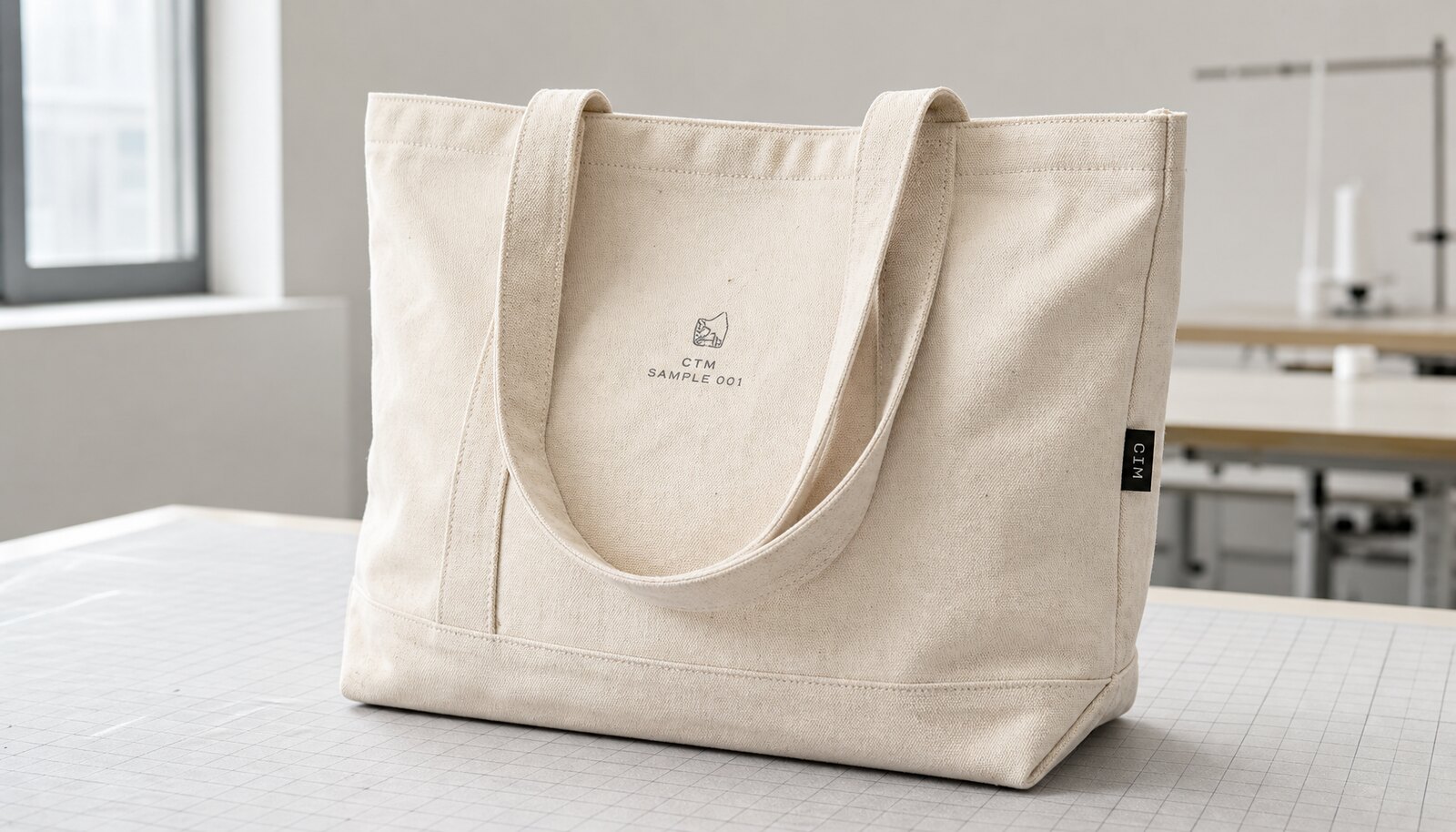
Why Heavy Canvas Works for Coffee Giveaways
Coffee brands use giveaway totes differently from fashion retailers. The bag is usually handed out at a launch, trade event, roast demo, or store activation, then kept because it has to carry beans, a tumbler, and a few printed inserts. That means the tote should feel substantial in hand, hold shape on a counter, and survive repeated reuse after the event ends.
For this use case, heavy canvas is usually a better fit than light cotton or thin nonwoven material. A 12 oz tote can work for simple leafleting, but most coffee brands should start at 14 oz and move to 16 oz when the bag is expected to carry heavier samples or function as a long-life brand asset. The thicker cloth also improves print readability because the panel lays flatter and looks less flimsy in photos.
- Use 14 oz as the practical baseline for most event giveaways.
- Move to 16 oz when the bag must feel premium or support heavier contents.
- Reserve lighter canvas only when the tote is purely a handout carrier and price pressure is extreme.
Spec the Tote Around the Load, Not the Artwork
Start with what the bag must carry, then size the body and handles around that load. A common coffee event tote is around 14 to 16 inches wide, 15 to 17 inches high, with a 4 to 6 inch gusset. That gives enough face area for a logo without turning the tote into a floppy square that collapses when empty. Handle drop matters as much as size because a short handle can pinch the shoulder and a long one can make the bag drag on the floor.
For construction, specify double-folded handles, reinforced top edges, and a bottom seam that can handle repeated load cycles. Ask for stitch count per inch where the factory can state it clearly, and require consistent seam allowance so the tote does not twist after first wash or first heavy use. If the bag is meant to be kept by customers, avoid a spec that only looks good in the sample room but cannot survive a real coffee event.
- Ask for finished measurements, not cut size only.
- Request a handle drop that suits the use case, usually around 9 to 11 inches for shoulder carry.
- Confirm whether the bag is pre-shrunk or whether post-wash shrinkage is part of the tolerance plan.
Choose a Print Method That Matches the Artwork
Most coffee giveaway programs should use screen print because it gives strong opacity on natural canvas and stays cost-effective when the design is simple. One to three spot colors is usually the sweet spot. If the artwork has gradients, fine type, or a photographic treatment, be careful: canvas texture will soften detail, and the result can look muddy unless the art is simplified first.
If the brand wants more premium finishing, a woven side label, woven brand tab, or small embroidered mark can support the main print without increasing the print complexity too much. Heat transfer can work for short runs or multicolor graphics, but buyers should treat it as a special-case option and confirm rub resistance, cracking risk, and wash behavior. For event giveaways, a clean print plus one sewn brand element is often more dependable than a highly decorative process.
- Use Pantone references for spot-color work and define the approved background color of the canvas.
- Keep small text above the minimum readable size for textured fabric.
- If the logo has thin strokes, request a strike-off to confirm whether the canvas weave distorts the detail.
Compare Supplier Routes Before You Compare Unit Price
A direct factory quote is usually the best fit when the buyer needs control over fabric weight, handle construction, print layout, and packing. It also makes it easier to lock a pre-production sample and hold the factory accountable to measurable tolerances. The tradeoff is that the buyer has to manage more of the specification work up front, which is where many event programs fail if the brief is vague.
A trading company or local decorator can be useful when the order is very small, the schedule is compressed, or the buyer needs mixed decoration across multiple products. The risk is that the quote may hide the real make-up of the bag, the fabric source, or the actual packing workflow. For coffee brands comparing supplier options, the cheapest quote is often the one with the fewest facts attached to it.
- Prefer a supplier that can show recent tote production photos, a measured sample, and carton spec before asking for a deposit.
- If two quotes are close in price, compare fabric weight, print method, and packing more than the headline unit cost.
- Treat missing details as a cost risk, not as a negotiation advantage.
Build the Quote Around Known Cost Drivers
The major cost drivers are straightforward: fabric weight, bag size, number of print colors, number of print locations, handle reinforcement, and packing complexity. Special finishing such as enzyme washing, garment dyeing, inside labeling, or custom inserts quickly changes the economics. If the supplier cannot itemize those drivers, the buyer will not be able to separate real value from packaging theater.
For a coffee event giveaway, unit price should be read together with overrun and underrun policy, carton packing, and shipping method. A quote that looks low but excludes inner packing, carton labels, or document prep can become expensive once the order is being released to the event warehouse. Ask for a cost line that makes it obvious what is included and what is optional.
- Request a unit-price breakdown by fabric, print, packing, and freight basis.
- Ask whether the quote assumes one artwork version or multiple versions.
- Confirm whether the factory prices on exact quantity or uses a price band with a minimum tolerance.
Use Sample Approval to Stop Mistakes Early
A digital proof is not enough for a tote bag that will be handled by customers and photographed on site. The buyer should insist on a pre-production sample that shows real canvas, real stitching, real handle attachment, and real print opacity. That sample should be measured, photographed, and signed off against the brief before bulk cutting starts.
The best sample review is practical. Measure body width, body height, gusset, handle drop, and print placement. Check how the bag sits empty and how it behaves with weight inside. If the tote is going to carry coffee products, the sample should also be tested with a filled pouch or sample pack so the buyer can see whether the handles dig into the hand or whether the side seam pulls.
- Keep one approved signed sample as the reference for bulk inspection.
- Check color under daylight and indoor light because natural canvas changes appearance by environment.
- If the design uses a dark print on unbleached canvas, verify edge sharpness and ink coverage at the first sample stage.
Set QC Thresholds That Match Real Event Use
Quality control should focus on the failures that matter in the field. For heavy canvas totes, the most important points are seam strength, handle reinforcement, print alignment, dimensional consistency, and stain control. A bag with slightly imperfect topstitching may still be acceptable, but a bag with weak handles or skewed print will damage the brand more quickly than a small cosmetic defect.
Define acceptable tolerance before production starts. If the tote size can vary by a few millimeters, say so. If the print can shift slightly but must stay inside a defined safe area, draw that safe area on the artwork. If the buyer wants a retail-grade finish, the standard should be tighter than a simple event handout, and the supplier should quote accordingly instead of guessing after production begins.
- Reject bags with broken stitches, open seams, or handle reinforcement failures.
- Set a clear limit for print misregistration and ink bleed.
- Require a check for odor, oil marks, and contamination before carton sealing.
Pack for the Event Team, Not for the Factory Floor
Packing should match how the bags will actually be distributed. If the event team needs to hand out totes by location or by coffee SKU, carton labels should reflect that logic. If the bags are being stored in a warehouse first, bulk packing may be better than individual polybags because it lowers waste and makes counting faster. The right answer is not the most protective pack; it is the one that balances protection, labor, and receiving speed.
Many buyers forget carton dimensions until freight quoting begins. That creates avoidable cost because the bag may fit the product spec but not the pallet plan or warehouse shelf. Ask the factory to confirm master carton size, gross weight, carton count per pallet if needed, and whether desiccant or moisture protection is required for the shipping lane. This matters more for long ocean moves or humid storage than many first-time buyers expect.
- Label cartons by style, color, and destination if the bags will be split across events or stores.
- Keep packing density reasonable so the canvas does not crease excessively in transit.
- Use individual polybags only when the receiving plan or retail display needs them.
Plan the Timeline Backward From the Event Date
A tote giveaway project should be scheduled from the event date backward, not from the purchase order date forward. Artwork approval, sample approval, material booking, cutting, printing, sewing, inspection, and shipment all need time. If the event is fixed, the buyer should build a buffer for one revision cycle because a clean proof often changes once the first physical sample arrives.
The largest schedule risks are late artwork, delayed sample feedback, and silent changes to carton or label specs after production has already started. Those changes can force a stop at the factory or create a mismatch between warehouse instructions and the packing format. If the timeline is tight, keep the design simple, freeze the spec early, and use one approval owner on the buyer side to avoid fragmented feedback.
- Allow time for one physical sample round if the tote is a new spec.
- Freeze artwork and carton text before bulk production starts.
- Reserve shipping time for customs, warehouse receiving, and event distribution.
Compare Landed Cost, Not Just FOB
For procurement teams, FOB or ex-factory price is only part of the picture. The landed cost of heavy canvas tote bags includes packaging, carton handling, freight mode, import duties where relevant, and the internal labor to receive and sort the bags. A lower unit price can disappear quickly if the quote adds costly packing, extra cartons, or a long lead time that forces air freight.
The most useful comparison is between sourcing routes under the same event requirement. If the direct factory can hold the price steady because the print is simple and the carton plan is standardized, it often wins. If the order is small and the deadline is aggressive, a local finisher may cost more per unit but reduce freight and schedule risk. Buyers should choose the route that protects event execution, not the route that merely looks cheapest on paper.
- Compare quotes on the same fabric weight, print count, and packing spec.
- Add freight, duties, warehousing, and internal handling to the unit price before approval.
- For reorders, track which spec variables were expensive and simplify them next round.
Specification comparison for buyers
| Spec decision | Recommended option | When it fits | Buyer risk to check |
|---|---|---|---|
| Fabric weight | 14 oz to 16 oz canvas, about 475 to 540 GSM | Coffee brand giveaways that should feel durable and keep being reused after the event | Too-light fabric can sag, wrinkle badly, and make the tote look cheaper than the brand intends |
| Handle build | Double-folded handles with box-X or cross-bar reinforcement | When bags may carry sample packs, merch, or a reusable cup plus leaflets | Weak handle stitching is the fastest way to get returns, complaints, and damaged brand perception |
| Print method | 1 to 3 color screen print for most event runs | When the logo is bold, the color count is limited, and the order size is moderate to large | Fine lines, gradients, and small text can fill in or misregister on textured canvas |
| Supplier route | Direct factory order with a clear PP sample and QC plan | When volume is enough to justify tooling, sampling, and coordinated packing | If the factory has no quote detail or sample discipline, hidden cost and schedule drift usually follow |
| MOQ logic | Tie MOQ to fabric stock, print colors, and carton configuration | When the buyer wants to balance low risk with acceptable unit cost | Low MOQ can look attractive but may force higher unit cost, limited customization, or longer wait for raw material |
| Sample route | Pre-production sample with approved artwork and measured dimensions | When the event date is fixed and the tote is part of the brand presentation | Digital proof alone does not show handfeel, stitch density, handle finish, or print opacity |
| Packing route | Bulk packed by style and color, then carton-labeled by event or destination | When the bags go directly to stores, warehouses, or event teams | Individual polybags add cost and waste unless protection or retail display requires them |
| Lead time route | Standard production slot with reserved fabric and confirmed artwork early | When the event is 8 to 12 weeks away or the order is not seasonally urgent | Any delay in artwork approval, strike-off review, or carton spec locks the shipment into a rush pattern |
| Cost control route | Limit to one base color, one print location, and one carton spec | When the main goal is a clean branded giveaway rather than a complex retail program | Extra colors, special linings, and custom inserts often cost more than the buyer expects at quote stage |
Buyer checklist before sampling
- Final tote size with tolerance, including body depth, gusset, handle drop, and finished seam allowance
- Fabric weight in GSM or oz, plus whether the canvas is bleached, natural, pre-shrunk, or enzyme washed
- Print artwork with Pantone references, placement diagram, and maximum ink coverage by panel
- Reinforcement details at handle attachment, bottom seam, and stress points near the gusset
- Packing method, carton count, carton dimensions, gross weight, and destination label format
- Approved sample reference, target ship date, and whether the order can ship only after sample sign-off
- Inspection standard, defect limits, and who pays for rework if print or stitching misses spec
- Incoterm, payment milestone, and whether the quote includes domestic freight to port or warehouse
Factory quote questions to send
- What is the exact fabric construction, weight, and yarn count used for this tote?
- How many print colors are included, what method is being quoted, and what is the extra cost per additional color or side?
- What is the MOQ by color and by artwork version, and is it driven by fabric stock or cutting efficiency?
- Will you supply a pre-production sample, and what dimensions and print tolerances will that sample represent?
- What are the packing details per inner pack, per carton, and per master carton, including carton test strength if required?
- What defect standard do you use for stitching, print alignment, stain control, and handle strength?
- What is the production lead time after sample approval, and what conditions would extend it?
- What documents and photos can you provide before shipment to prove the bulk order matches the approved sample?
Quality-control points to confirm
- Fabric weight matches the approved range and the handfeel is consistent across the bulk lot
- Body dimensions and handle drop stay within agreed tolerance after pressing and packing
- Handle seams show full reinforcement with no skipped stitches, broken thread, or loose bartacks
- Print placement is centered or positioned per artwork, with no major misregistration, pinholes, or ink cracking
- No visible oil spots, dye marks, needle damage, or strong odor at pack-out
- Cartons are sealed, labeled, and stacked so the event team can receive by style and destination without relabeling