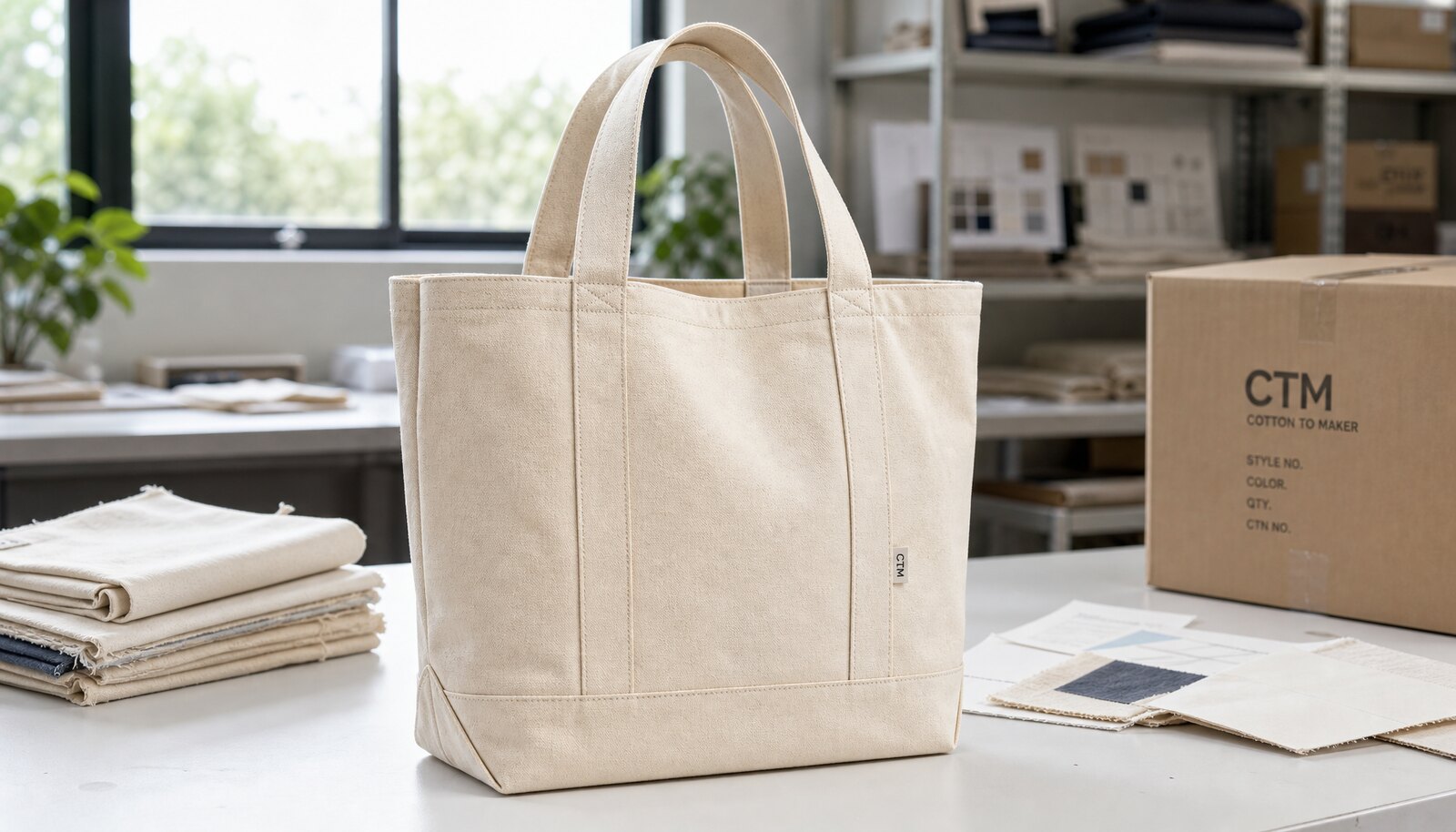
Start With The Campaign Outcome, Not The Tote Bag
For charity campaigns, the packaging specification should solve a distribution problem first and a branding problem second. A tote that looks good in a mockup but arrives bulky, difficult to fold, or expensive to ship creates friction at the exact point where the campaign needs to feel easy. Before you write a purchase request, define how the bag will be handed out, who will carry it, whether it will be reused after the event, and how much visual weight the brand mark needs to carry. Those choices determine the right fabric weight, print method, and packing format long before anyone compares price.
The most reliable way to manage a charity tote order is to write the brief around acceptance criteria instead of generic product language. A useful spec tells the supplier what success looks like: the bag must hold literature or sample packs, stack cleanly in cartons, survive folding without cracking the print, and arrive with a consistent finish. That gives procurement a better basis for comparing quotes and prevents each supplier from quoting a different interpretation of the same need. It also reduces the risk of late-stage arguments about whether a bag is “good enough” when the campaign date is already fixed.
A procurement team should also decide whether the bag is a campaign tool or a branded gift. That distinction changes almost every line of the specification. A handout bag can prioritize low freight volume, quick packing, and simple artwork. A donor gift or sponsor-visible item may justify thicker canvas, a cleaner finish, tighter seam standards, and more controlled carton presentation. If the team does not define that priority early, the supplier will guess—and guessing is expensive when you are buying at volume.
- Define the primary use: event handout, donor thank-you bag, retail sale, or mixed use.
- State the expected load, such as brochures only, apparel, books, or a small product kit.
- Set the visual priority: simple logo, sponsor-heavy layout, or premium retail appearance.
- Clarify whether the bag must be stored flat, nested, or pre-folded for distribution.
- Decide whether the charity will accept a lighter bag with better pack efficiency or a heavier bag with stronger reuse value.
Choose Canvas Weight For Performance, Not Just Appearance
Heavy canvas tote bags usually start around 16 oz finished cloth and move up from there, but the right choice depends on how the bag will be used. A charity campaign bag that only carries flyers can work at 16 oz to 18 oz with a clean weave and stable stitching. If the bag needs to carry gifts, samples, books, or a dense event pack, 20 oz to 24 oz gives a more rigid body and a higher perceived value. The wrong choice is common when a buyer specifies only a weight target and not the actual contents.
Ask the factory how the weight is measured and whether the figure refers to greige cloth, finished cloth, or a mill declaration. That distinction matters because finishing can change density, handfeel, shrink behavior, and print absorption. A supplier who gives a clear finished GSM, weave count, and sample swatch is much easier to work with than one who only states a nominal ounce weight. For charity campaigns, consistency matters as much as strength because a mixed handfeel across cartons makes the order look pieced together.
It is also worth specifying the finish. Natural, bleached, washed, or enzyme-treated canvas can all change how the bag prints and folds. A raw heavy canvas may feel more rugged but can show more natural variation, while a refined finish may improve brand presentation and reduce the chance of visible contamination. Procurement should ask for a physical swatch or cut sample from the same finish the factory will use in bulk, because finish changes are one of the easiest ways for a quote to drift after approval.
When the bag will be reused many times, the procurement target should shift from appearance to service life. If the charity wants the tote to remain in circulation after the event, seam strength, handle reinforcement, and abrasion resistance should be written into the spec. If the bag is only needed for a single campaign week, then pack efficiency and cost per delivered unit may matter more than ultimate durability. The supplier can optimize only when the intended life cycle is clear.
- 16 oz to 18 oz: solid handout bag, lower shipping weight, easier folding, and less carton bulge.
- 20 oz to 24 oz: better for premium campaigns, retail resale, or heavier inserts.
- Ask for finished GSM and a physical swatch, not only a catalog weight claim.
- Specify whether the canvas is bleached, natural, enzyme-washed, or raw finish.
- State the expected load in kilograms or pounds if the bag will carry dense kits or books.
Build Construction Around Reuse, Strength, And Carton Efficiency
Construction choices decide whether the bag feels like a campaign item or a durable retail product. Reinforced handles, bar-tacks at stress points, and a clean top hem do more for long-term performance than decorative extras. If the tote will be reused outside the event, the buyer should prioritize seam strength and handle anchoring over novelty touches that add labor without improving function. For charity work, the bag often becomes the visible part of the campaign long after the event ends, so build quality is part of the message, not just a hidden technical detail.
The bag structure should also match the way it will be packed. A thick, stiff tote with wide gussets can look excellent but may waste carton volume if the team never measured the folded footprint. A leaner construction may pack more efficiently while still carrying the required load. The supplier should be asked to show the flat-fold dimensions, the nested stack behavior, and the compressed height of a packed carton. These practical dimensions help procurement forecast freight cost and warehouse labor more accurately than any marketing description.
A good construction spec should name the stress points the factory must reinforce. Handles should have defined attachment stitch length, top hems should be folded and stitched consistently, and the side seams or base seams should not rely on decorative sewing alone. If the charity campaign will distribute the bags in public, avoid loose trim, unfinished edges, or small loose parts that can catch during handling. The simplest durable construction is usually the most procurement-friendly because it is easier to inspect and easier to reproduce across production lots.
- Use reinforced handle stitching or bar-tacks where the bag will carry heavier loads.
- Set a flat-fold requirement if the bags must be counted and packed in volume-efficient cartons.
- Confirm whether base gussets, side gussets, or both are needed for the planned fill.
- Avoid decorative seams that add labor but do not improve carry strength or packability.
- Ask for the folded thickness of one bag and the packed height per carton to estimate cube.
Select Print Method Based On Artwork, Handling, And Brand Risk
For most charity campaigns, screen print remains the most practical method because it gives strong color, predictable repeatability, and sensible unit cost at volume. It is the right default for logos, short slogans, and sponsor layouts with one to three colors. If the artwork is detailed, the order is short, or the campaign needs a photo-style image, transfer printing or heat transfer may be more appropriate. The decision should be driven by artwork complexity, required durability, and cost at scale—not by what the factory happens to promote first.
Print placement also changes the buying outcome. A large front print can look powerful but may reduce flexibility in packing and make minor registration shifts easier to see. A smaller chest-style mark, corner mark, or side label can feel more premium and be easier to keep consistent across batches. For charity campaigns, the best proof is a pre-production sample that shows the exact print size, color density, and edge sharpness on the chosen canvas weight. Do not approve artwork from a digital mockup alone.
Procurement should also ask how the print will react to folding and handling. Canvas bags are often packed, unpacked, and refolded before the end user sees them. Some print systems can look fine at first glance but show stress whitening, cracking, or surface rub after repeated flexing. If the bag is going to be used beyond the campaign date, the buyer should ask for a simple fold-and-rub check on the sample so the artwork does not degrade on arrival or after a few uses.
If the charity has a restrained brand style, a woven label or small sewn patch can be a better choice than a full-panel print. That route reduces visual clutter and can make the bag feel more reusable or retail-grade. The trade-off is cost and sewing complexity. In procurement terms, the question is not which method is “best” in abstract; it is which method matches the campaign’s visible brand intent, timeline, and acceptable defect risk.
- Screen print: best for solid logos, stable color, and repeat orders.
- Heat transfer: useful for short runs or detailed artwork, but confirm fold durability.
- Embroidery: premium feel, but higher cost, slower production, and potential backing thickness.
- Woven or sewn label: useful for restrained branding when the bag must look reusable, not promotional.
- Require the supplier to confirm whether the print is on one side or both sides and whether setup charges apply separately.
Specify Packing For The Real Distribution Path
Packaging is where many tote bag orders get expensive without anyone noticing. If the charity team will hand bags out by venue, bulk carton packing may be the cleanest route. If the bags are going to retail, donor mailers, or warehouse scan control, individual polybags with barcode stickers may be worth the extra cost. The right answer depends on who touches the bags after they leave the factory, not just on what looks neat in the production room. A packing format that works for the warehouse can fail badly if it adds unnecessary volume or creates sorting confusion on site.
Write the packing spec in a way the warehouse can actually use. State the bag count per inner pack or master carton, the target carton dimensions, and whether you want moisture protection. If the order will be split across multiple events, ask for carton marks that identify campaign name, color, size, quantity, and destination. Include whether cartons should be marked on two sides for racking or only one side for stack storage. Good packing saves labor downstream and reduces the risk of damaged or misrouted stock.
A useful packing specification should also define what the factory must not do. For example, if individual polybags are not wanted, say so explicitly. If inner tissue, inserts, or campaign cards are required, say whether they are pre-inserted or packed separately. If bags need to arrive with a neat face orientation for retail display, state that the stack direction matters. Most packing disputes happen because the buyer assumes the factory understands retail or distribution practice without being told the exact sequence.
The carton spec is part of the product spec. Ask for master carton dimensions, net and gross weight, carton quality, and the maximum safe weight before lifting becomes difficult. If the cartons are too large or too heavy, warehouse handling risks go up. If they are too small, freight cube gets worse and count verification becomes harder. For charity procurement, it is often better to optimize for practical handling rather than the absolute lowest carton count.
- Bulk pack for event distribution when the bags will be unpacked and sorted later.
- Individual polybag for retail, donor kits, or scan-based warehouse handling.
- Add carton marks that match the buyer SKU or campaign code exactly.
- Confirm whether the quote includes master carton labels, desiccant, or inner packaging.
- Ask for the carton gross weight ceiling and the packed carton dimensions before approving the PO.
Compare Sourcing Routes Before You Compare Unit Prices
Unit price alone does not tell you which quote is better. A direct factory with in-house sewing and printing can be the cleanest option when you need one accountable source for fabric, decoration, and packing. A trading company can help if you are combining multiple items or need flexibility across factories, but the buyer should expect less visibility into where each production step happens. For a charity campaign, that visibility matters because the bag spec, print quality, carton marks, and packing method all interact. The less transparent the route, the harder it is to manage risk.
The table below compares not just sourcing routes but the resulting product and packaging implications. Use it to decide whether you want fewer handoffs, tighter control over print and carton labeling, or more sourcing flexibility. Once the route is clear, then you can lock fabric, print method, and packing. That sequence is usually better than asking three suppliers for vague quotes and trying to compare them afterward.
Procurement teams should also decide where the shipment risk sits. A direct factory may give a simpler chain of responsibility, but a consolidator may be better when the bags must move with other campaign materials. If the order includes inserts, flyers, or gifts from more than one supplier, the route choice can affect whether the final bags are packed in the right sequence and labeled correctly for each event. The best sourcing route is the one that matches the distribution structure, not only the one with the lowest line-item quote.
- Prefer one supplier owning sewing, print, and packing when the delivery date is fixed.
- Use a consolidator only if your team needs split shipments or mixed item coordination.
- Ask where the print happens if the supplier says it is possible but not in-house.
- Tie the route choice to the destination plan, not only to the lowest listed unit cost.
Treat Sample Approval As A Production Gate, Not A Formality
A good sample should prove more than appearance. It should show the actual fabric weight, the handle drop, the stiffness of the bag when filled, the ink density, and the carton fit if packing is part of the order. For charity campaigns, the sample needs to reflect how the bag will be seen in use, not only how it looks on a table. This is where many orders fail: the approved image is attractive, but the bulk bag shifts in size, print tone, or fold behavior. A sample that is only visually approved is not enough for procurement control.
Insist on a sample stage that is close to production materials. If the factory changes the cloth, ink base, handle tape, or carton format after approval, the buyer should treat that as a new approval point. The simplest way to avoid disputes is to mark the sample with approval notes: exact dimensions, print size, packing format, and any acceptable variation. That gives procurement a reference if bulk goods drift. It also prevents the common problem where the factory assumes visual similarity is enough.
The sample should also be checked in a real distribution scenario. Put the intended content inside the tote, fold it the way the warehouse will fold it, and confirm that the bag still closes flat enough to fit the specified carton count. If the bag is handout-only, test how quickly a distribution volunteer can open and stack it. If it is a donor or retail item, check how it looks after handling, not only immediately after packing. These are small tests, but they reveal whether the design survives its actual route.
- Approve one physical sample, not only photos.
- Mark the approved size, print position, fabric swatch reference, and packing method.
- Confirm whether the sample uses production fabric and production print method.
- Require correction samples if any critical dimensions or print colors change.
- Test the sample with the intended contents before approving bulk production.
Use QC Thresholds That Match Campaign Risk And Are Easy To Inspect
Quality control should be measured against campaign risk, not a generic factory standard. If the bags are being handed to donors or VIP guests, the tolerance for stains, print blur, and inconsistent stitching is much lower than for an internal event handout. If the bags are meant for a one-day field campaign, you may accept slightly wider size tolerance in exchange for faster lead time. The key is to define which defects are unacceptable before production starts. That avoids arguments later when the supplier thinks cosmetic variation is normal and the buyer thinks it is a reject.
Useful QC thresholds are practical and visible. A procurement spec should include stitch density, seam strength, print clarity, odor, moisture, carton condition, and count accuracy. If a supplier cannot explain how those checks are done, the quote is not fully useful. For a heavy canvas tote, the failure modes are usually obvious: weak handle attachment, off-center print, uneven fabric weight, or cartons packed heavier than the agreed limit. These are easy to specify and easy to inspect if the buyer asks for the right evidence.
Below is the kind of detail that turns QC from a general promise into a testable standard. Exact numbers can vary by campaign, but procurement should always set a target or acceptable range before bulk production begins. If the supplier uses different internal standards, ask them to map those standards to the buyer’s acceptance criteria in writing. That creates a shared reference point for inspection and reduces the chance of surprise rejections at the dock.
For stitch quality, many buyers use a simple stitch-per-inch target for visible seams and reinforcement points. A reasonable procurement question is not “is the stitching strong?” but “what is your target SPI on side seams, top hem, and handle attachment, and how do you verify it?” Likewise for print, ask what rub or abrasion check they can perform after printing and folding. For cartons, ask what drop criterion they use and whether they seal and recheck cartons after the drop. For moisture and odor, define what is unacceptable at receipt, such as damp cartons, mildew smell, or visible mold, rather than relying on subjective judgment.
- Set stitch-per-inch targets for visible seams and handle attachment points.
- Require a simple handle pull or seam pull check on production samples and random bulk units.
- Inspect print opacity, registration, and rub resistance after folding and light abrasion.
- Set carton drop criteria, including no burst seams, no exposed product, and no crushed corners.
- Define moisture and odor acceptance limits: no damp cartons, no mildew smell, and no visible mold.
- Confirm that count verification happens before sealing, not only after goods are loaded for dispatch.
Put Shipment Verification Into The Packaging Spec
Shipment verification should be part of the packaging spec, not an afterthought for freight or receiving. If the cartons are packed correctly but the shipment paperwork is wrong, the order can still miss the campaign window. Procurement should define how the supplier proves quantity, carton configuration, and label accuracy before release. That means carton count photos, pallet photos, packing list reconciliation, and a final check that carton marks match the approved campaign code or SKU.
A practical shipment verification step starts with carton mapping. The supplier should confirm how many bags go in each carton, how many cartons go on each pallet layer, how the pallet is wrapped, and what the final pallet height will be. If the bags are shipping to multiple charity sites, ask for carton IDs or location marks that can be matched against the destination list. This is especially important when the same bag design is going to different cities or events. Without clear carton mapping, the warehouse can receive the right total quantity but still misallocate stock.
The shipping documents should also match the packaging language used in the PO. If the PO says bulk packed master cartons with no inner polybags, then the packing list should say the same thing. If a barcode sticker is required, the label format and placement should be shown in sample photos before dispatch. Ask for shipment verification photos that show closed cartons, pallet labels, and one opened carton with visible internal packing. Those images are not just documentation—they are the fastest way to catch a mismatch before the truck or container leaves the factory.
- Request pre-dispatch carton count photos and pallet photos with visible labels.
- Match carton marks, SKU codes, and campaign names exactly across PO, packing list, and carton labels.
- Confirm carton IDs or location marks if the order is split across multiple destinations.
- Require one opened-carton verification photo showing inner packing and product condition.
- Ask for shipment weight and carton count reconciliation before balance payment, if applicable.
Build Lead Time And Landed Cost Around Real Constraints
Lead time for heavy canvas tote bags is rarely just sewing time. Fabric sourcing, color approval, print setup, sample approval, packing materials, and freight booking all affect the final schedule. If you need bags for a charity event date, work backward from the delivery deadline and leave room for sample revisions. A factory may promise a short production window, but the buyer should still reserve time for artwork correction and pre-shipment inspection. The real risk is not sewing speed; it is late decision-making and missing approvals.
Landed cost should be compared on the same basis across suppliers. One quote may look cheaper because it excludes polybags, carton marks, or destination-side handling. Another may include better packing but a higher unit price. For procurement teams, the right metric is not just ex-factory price but the total cost to receive usable bags at the right location. Ask for a quote that separates fabric, print, packing, and freight-related assumptions so you can compare route by route instead of number by number.
It is also smart to ask where the lead time is concentrated. Some suppliers can sew quickly but need longer for print setup or carton procurement. Others have fabric on hand but slow sample approval processes. A supplier who explains the critical path is usually easier to manage than one who only gives a total number of days. If the campaign date is hard fixed, build in buffer for artwork approvals, factory holidays, and freight transit uncertainty. In charity buying, schedule risk is often more expensive than a small difference in unit cost.
- Build schedule buffer for artwork changes, sample correction, carton procurement, and freight booking.
- Compare quotes using the same packing format and the same Incoterm.
- Separate unit cost from packing cost so carton upgrades do not hide in the total.
- Ask which items trigger MOQ breaks, because one extra color or label can change price sharply.
- Request a milestone schedule: sample approval, material booking, production start, packing completion, inspection, and dispatch.
Specification comparison for buyers
| Specification | 16 oz–18 oz heavy canvas | 20 oz–24 oz heavy canvas | Procurement note / risk to check |
|---|---|---|---|
| Typical use case | Event handouts, brochures, donor thank-you bags, lighter inserts | Premium campaign bags, book kits, resale-ready totes, heavier sampling packs | Match the cloth to the actual fill weight, not the campaign theme |
| Handfeel and structure | Substantial but still flexible; folds more easily | Stiffer, more structured, and more premium in hand | Stiff cloth can increase carton volume and freight cost |
| Load confidence | Adequate for light to medium contents when seams are reinforced | Better when contents are dense, uneven, or repeatedly reused | Ask for a filled sample or load test using the intended contents |
| Print performance | Strong for solid logos; easier ink penetration on some finishes | Can look premium, but thick canvas may show more surface texture under print | Approve print on the exact fabric finish, not just on swatches |
| Packing efficiency | Usually nests and folds more efficiently in master cartons | May reduce carton count per case because of thickness and stiffness | Confirm flat-fold dimensions and master carton targets before PO |
| Cost position | Lower material cost and lower shipping weight | Higher material cost and often higher freight due to carton volume | Compare landed cost, not unit price alone |
| Best for charity campaigns when | The bag is a handout item and logistics speed matter most | The bag is part of donor kits, retail sales, or premium sponsor visibility | State whether durability or presentation has priority |
| Common buyer mistake | Specifying only nominal ounce weight and ignoring finished GSM and weave density | Choosing heavy cloth without checking folding behavior and carton fit | Ask the supplier to quote finished GSM, weave, and packing dimensions |
Buyer checklist before sampling
- Define the campaign use: handout, donor kit, retail sale, or mixed use.
- Provide finished bag dimensions, gusset depth, handle length, and handle drop.
- Specify finished fabric weight in GSM or ounce weight, plus finish type and color.
- State print method, number of colors, print size, and placement on each panel.
- Confirm whether the bag is lined, unlined, reinforced, or includes internal pockets.
- Set the required packing format: bulk carton, inner pack, individual polybag, or mixed.
- Request carton dimensions, master carton count, carton markings, and palletization details.
- State destination, Incoterm, required arrival date, and any split-ship requirements.
- Define sample approval criteria for fabric handfeel, stitch quality, print clarity, and odor.
- Clarify accept/reject rules for stains, loose threads, misprints, overage, and shortages.
Factory quote questions to send
- What finished GSM will you quote, and can you supply a swatch or cut sample before bulk production?
- Are sewing, printing, packing, and carton labeling completed in one facility? If not, which steps are subcontracted?
- What is the MOQ by color, print side, and print complexity, and at what quantity does pricing improve?
- Which print method do you recommend for this artwork, and what are the limits for fine text, registration, and solid coverage?
- Can you quote the bag with the exact packing format we need, including polybags, inserts, barcodes, carton marks, and master carton count?
- What carton dimensions do you propose, how many bags per carton, and what is the maximum carton gross weight?
- Can you provide palletization data, including pallet pattern, cartons per layer, layers per pallet, and total pallet height?
- What is the production lead time after sample approval, and which steps most often delay shipment?
- Which inspections, photos, or test reports will you provide before balance payment and dispatch?
- What costs are excluded from the quote, including special packing, sample charges, freight, customs handling, or destination delivery?
Quality-control points to confirm
- Finished dimensions, handle drop, and gusset depth stay within the agreed tolerance after cutting and sewing.
- Stitch density meets the approved target, with no skipped stitches, loose threads, or inconsistent back-tacking at stress points.
- Handle attachment, top hem, side seams, and base seams pass pull and visual inspection without seam popping or distortion.
- Print color, opacity, registration, and edge sharpness match the approved sample on the exact production fabric.
- Ink rub resistance is acceptable after a dry-rub check, and the print does not crack excessively after folding and handling.
- Carton count, packing sequence, carton marks, and SKU labels match the packing instruction sheet.
- Cartons are sound after a standard drop check and show no burst seams, crushed corners, or product exposure.
- No visible oil stains, mold, off-odor, fabric contamination, or damp cartons are accepted at pre-shipment inspection.
- Packed goods are dry, clean, and within any agreed moisture limit before carton sealing.
- Pallet loads are stable, wrapped correctly, and labeled consistently with shipment documents and consignee data.