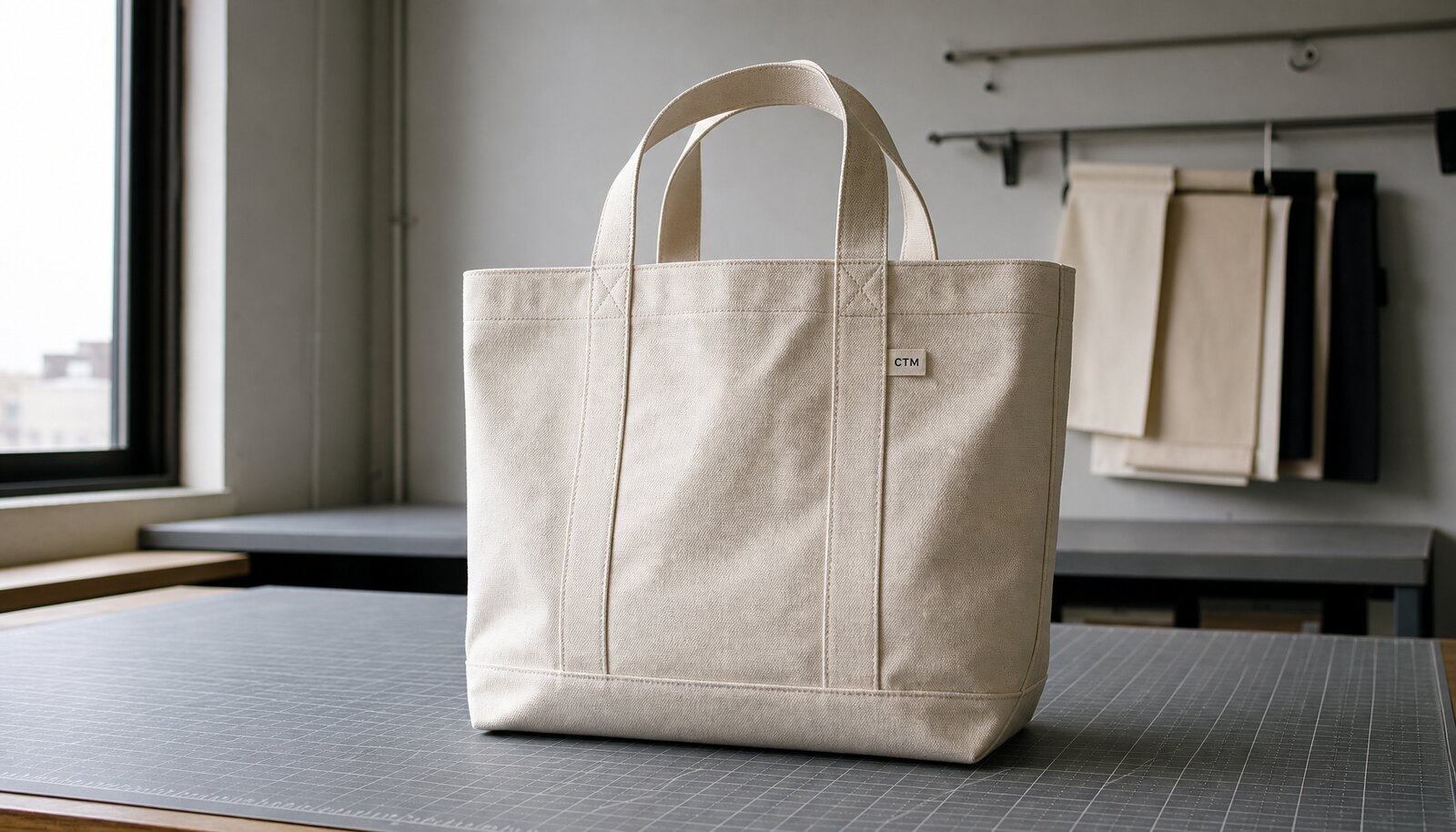
Why boutique tote bags need a different buying plan than standard promo totes
Heavy canvas tote bags look straightforward until they are bought in volume. A boutique buyer is not only purchasing a carrier; they are buying something that will sit on a shelf, be photographed by customers, carry enough weight for daily use, and still protect the brand look. That combination changes the commercial equation. A tote that works for a trade show giveaway may feel too thin, too plain, or too flimsy for a retail boutique environment.
The difference is usually visible in small details. The fabric may hold its shape better, the handles may sit flatter, the logo may need to read clearly from a distance, and the packing may need to support direct-to-store distribution. Procurement teams should treat the tote as a retail item, not a generic promo piece. That means spec discipline matters as much as price negotiation. If the buying brief is loose, the quote will be loose too—and the cheapest number may hide the weakest bag.
- Treat the tote as part of the boutique assortment, not just a packaging accessory.
- Start with a controlled base style and only then test variants.
- Separate product spec, decoration, and packing so the pricing logic stays visible.
Fabric weight, weave, and finish: the first pricing decision that actually matters
The biggest cost driver is usually the cloth itself. Heavy canvas for boutique use is commonly bought in the 12oz to 16oz range, which generally maps to about 340 to 450 GSM depending on weave density and finish. A 12oz cloth is often enough for everyday retail and gift shop use. It keeps the bag affordable and still gives a sturdier hand than light promo canvas. A 14oz to 16oz cloth pushes the tote into a more premium category: firmer body, better drape control, and stronger shelf presence.
Finish matters almost as much as weight. Raw canvas usually looks cleaner and more uniform, while washed canvas feels softer and more lifestyle-oriented. Washed styles can appeal to fashion boutiques, but they often show more shade variation from batch to batch. Garment-dyed or enzyme-washed effects may add a higher-end look, but they can also raise lead time and complicate shade matching. For bulk pricing planning, ask whether the finish is part of the quoted price or an assumed variable. If the supplier only says 'heavy canvas,' you do not yet have a usable comparison.
Weave density also affects how the bag behaves after sewing and decoration. A tighter weave usually prints more cleanly and holds structure better, while a looser weave may be softer but can look less polished. Procurement should ask for a physical swatch, not only a fabric photo, and should compare that swatch against the intended retail positioning. A boutique tote that is meant to feel premium should not feel paper-thin after one inspection touch.
- 10oz to 11oz: lower cost, lighter body, better for short promotional runs than for premium boutique presentation.
- 12oz to 13oz: common entry point for retail boutiques that need balance between cost and feel.
- 14oz to 16oz: stronger shape and higher perceived value, but sewing, material, and freight cost usually rise.
- Washed or dyed finishes: better fashion appeal, but expect more shade variation and a stricter approval process.
How to compare supplier routes without mixing up price and control
Not every supplier gives you the same commercial outcome. A direct factory is usually the cleanest route when you want repeatability, controlled fabric sourcing, and a stable spec for reorders. A trading company may be useful if you need mixed product sourcing or one contact handling several bag styles, but the tradeoff is often less visibility into material substitution and process control. A local decorator or assembler can be useful for urgent domestic replenishment, yet the unit cost for larger runs is often higher, especially when the bag needs custom fabric or special packing.
For boutique buyers, the key question is who controls the critical inputs. If a supplier owns the fabric sourcing, ask who approves the mill and whether they can hold a lot for your reorder. If the supplier is only decorating pre-made blanks, ask whether the blank bag can be sourced in the same color and weight every time. If the supplier is acting as an intermediary, ask who is responsible for QC when a material changes. The best quote is not just the lowest number; it is the one with the fewest unresolved handoffs.
A practical comparison method is to ask each supplier to quote the same base style and then list exactly what they include. If one quote includes woven labels, retail folding, and polybags while another does not, the unit price means very little. Procurement should normalize the offers before discussing margin. That saves time and reduces the risk of approving a cheap-looking quote that later grows through revisions and add-ons.
- Direct factory: stronger for repeat orders, custom spec control, and better cost transparency.
- Trading company: useful for convenience, but verify material responsibility and substitution rules.
- Local assembler/decorator: useful for quick turns, but compare landed cost, not just unit price.
- Always ask who owns fabric, decoration, packing, and final inspection.
The specification sheet that makes bulk pricing actually comparable
A tote RFQ becomes useful only when every supplier is quoting the same bag. The spec sheet should be short enough to read, but detailed enough to prevent interpretation drift. At minimum, state the finished size, gusset depth, fabric weight, finish, handle construction, decoration method, and packing style. If you do not define one of those pieces, the supplier will fill in the gap with an assumption—and assumptions are where quoting errors happen.
For boutique tote programs, one of the most common errors is under-defining the handle. Buyers often write 'long handles' or 'cotton handles,' but that leaves too much room for variation. Handle width, drop, attachment method, and reinforcement should all be stated. The same applies to decoration. 'Logo on front' is not enough. The quote should define print size, placement from the top edge and side seam, number of colors, and whether the artwork must be matched by Pantone reference or visual sample.
The spec sheet also protects the buyer during approval. If a sample arrives with a slightly different handle drop or a logo that sits too low, you can point back to the written document. That is much easier than trying to settle a dispute from memory. In procurement terms, the spec sheet is not paperwork; it is the basis of the price and the basis of acceptance.
- Use exact dimensions rather than descriptive language.
- Define the decoration location with measurements from seams or edges.
- State whether the bag should stand upright, fold flat, or pack for shelf display.
- Include any label, hangtag, or care label requirements in the same sheet.
Decoration choices: what looks premium on canvas and what raises defect risk
Screen print is still the most practical decoration method for many boutique tote programs. It gives strong opacity on natural canvas, performs well on simple logos, and keeps unit costs manageable on repeat orders. It is a good fit when the artwork is bold and the buyer wants a clean retail look. For very small logos, a woven label or side seam label can look more refined than a large printed image, especially if the brand wants the tote to feel like a merchandise item rather than a campaign giveaway.
Embroidery can add texture and a premium impression, but it is not always the safest option on thick canvas. Large embroidered designs can become stiff, distort near seams, or show uneven tension if the backing and stitch density are not managed correctly. Heat transfer can work for more detailed images or short runs, but it should be tested carefully on canvas texture, especially if the tote will be folded, handled, or sold in warm retail environments. For buyers planning bulk pricing, the important point is that the decoration method should match the artwork, not just the budget.
Ask the factory to explain setup costs clearly. Screen print may look inexpensive per unit, but the setup charge matters on smaller runs. Embroidery may look premium, but it can increase time and create more inspection work. If you want to compare decoration options fairly, request the same logo in two or three methods on sample fabric. That gives your team a better sense of visual quality, not just quoted price.
- Bold, simple logos usually suit screen print best.
- Small premium branding can be better served by woven labels or side seam branding.
- Embroidery needs careful placement away from thick seam intersections.
- Complex art should be tested with a strike-off before sewn sample approval.
MOQ planning for boutiques that want variety without blowing up cost
MOQ is often misunderstood as a factory rule, but it is really a reflection of setup burden. Every added variation—fabric color, logo color, label type, fold style, or size—creates more handling and more cost. For a boutique program, the most efficient strategy is usually to keep the bag body constant and vary only one visible brand element. That might mean one base tote in natural canvas with multiple small logo colors, or one standard tote with a choice of woven label colors. The fewer moving parts, the easier it is to keep price and quality stable.
There is also a difference between MOQ for material and MOQ for finished goods. A supplier may be able to produce 1,000 finished bags, but only if the buyer accepts a standard canvas color already stocked by the factory. A custom-dyed color can push the MOQ much higher because the fabric mill needs its own minimum. The same logic applies to packaging. A standard bulk carton may be easy to run, while a custom insert card or branded polybag can add another minimum quantity. Buyers should ask where the MOQ is really coming from so they can decide whether the extra inventory is worth the design flexibility.
A good commercial rule is this: if the tote is for a first-time program, keep the SKU count low and the visual variables simple. If the program proves out, then add color versions or packaging upgrades on reorder. That approach protects cash and makes the bulk pricing plan easier to defend internally.
- Keep the base tote constant if you want multiple visual variants.
- Separate MOQ by fabric, decoration, and packing so the real constraint is visible.
- Ask whether a stock canvas color lowers MOQ and improves lead time.
- Use reorder performance data before expanding the SKU mix.
Sampling and approval: what to request before production starts
A proper sample process should prove more than the logo. For a heavy canvas tote bag, the sample needs to show the sewn structure, the handle attachment, the seam behavior, and the final packed appearance. A decoration strike-off can be helpful for color or artwork verification, but it does not prove that the tote will look right once it is sewn. That is why the most useful approval path usually combines a print or embroidery sample with a full sewn pre-production sample.
Procurement teams should ask for the sample to be checked against the actual production method. If the bulk order will use one fabric lot, try to sample from the same lot or from a lot with the same stated construction. If that is not possible, the supplier should explicitly say so. Buyers should also record the important dimensions at the sample stage: logo placement, handle drop, gusset depth, and opening width. These are the details that often drift during bulk production if they are not fixed in writing.
Approval should be based on a practical checklist rather than a generic 'looks good.' Check whether the bag stands straight, whether the handles hang evenly, whether the print sits cleanly after folding, and whether the seams remain flat under light load. If the buyer team signs off only on a photo, the factory loses the reference point. A sewn sample with written comments is a much stronger commercial control.
- Request both a decoration proof and a sewn sample when possible.
- Approve against a marked spec sheet, not memory or email comments alone.
- Record placement measurements in millimeters or centimeters.
- Do not release bulk until the sample and the quote describe the same build.
What drives bulk price beyond fabric: the cost stack procurement should watch
The unit price of a tote is never just the fabric price. Sewing labor, handle construction, decoration, labels, internal structure, packing, and carton efficiency all affect the final number. A plain unlined bag with one-color print is usually the most economical structure. Once you add lining, base reinforcement, woven labels, retail folding, or a barcode-ready pack, the factory has more operations to perform and more chances for inspection failures. That extra work has a real cost even if the bag still looks simple from the outside.
Fabric consumption is a good example. A larger tote body or wider gusset means more cloth per unit. A heavier canvas may also require stronger thread and slower sewing speed, which increases labor. Print cost rises with size and color count, and some methods need higher setup charges than others. If the bag includes a lining or baseboard, the supplier may move the order into a different construction class altogether. In practice, that can mean a price jump that surprises buyers who only compared the first line of the quote.
A stronger pricing plan separates fixed and variable costs. Setup charges, sampling fees, and artwork work are fixed or semi-fixed. Fabric, labor, and packing are more volume-sensitive. If you know which parts are fixed, you can judge whether a reorder should get cheaper, or whether the supplier is quietly keeping the same price despite better scale. That is where procurement adds value: not by asking for a discount once, but by understanding the cost shape of the program.
- Heavier canvas can raise sewing time, not only material cost.
- Lining and baseboard can change both price tier and inspection workload.
- Setup fees matter more on smaller runs than many buyers expect.
- Packing changes can move freight cost even when the tote itself is unchanged.
Packing, carton count, and freight planning for wholesale and store delivery
Packing is often where a good-looking quote stops being a good landed cost. For wholesale distribution, the most efficient setup is usually flat bulk packing in standard cartons with clear carton labels. That keeps labor lower and lets the buyer control in-store presentation later. If the tote is going directly to boutiques, however, the buyer may want retail folding, individual polybags, or barcode labels. Those features can make inbound handling easier but add labor and often increase carton volume.
Carton planning matters because totes are bulky by nature. Two quotes with the same unit price can produce very different freight outcomes if one supplier packs fewer bags per carton or uses a larger carton footprint. Ask for carton dimensions, gross weight, and pieces per carton before you compare offers. If your warehouse uses shelf-ready receiving or cross-docking, ask how the carton markings will appear and whether the packing list matches the PO line structure exactly. Those details reduce receiving delays and prevent product from being set aside while the team reconciles the shipment.
For boutique programs, a smart packing choice is often the one that protects the shape without overprocessing the bag. If a tote must be retail-ready, make sure the fold style is specified clearly. State where the handles should sit, how the body should be folded, and whether the bag can carry a small insert or care card. Without those instructions, the factory may choose a convenience fold that saves them time but gives your store team more work.
- Ask for carton dimensions and pack count before freight comparison.
- Define whether the bag is bulk packed, retail folded, or individually polybagged.
- Confirm carton labels, barcode placement, and PO matching rules.
- Specify fold orientation if shelf presentation matters.
QC standards that are specific enough to use at receiving
Quality control should be written as a measurable acceptance standard, not a general expectation. For heavy canvas tote bags, the first checkpoint is fabric consistency. The cloth should match the agreed weight and show no obvious thin areas, strong shade streaks, or visible contamination. The second checkpoint is construction. Side seams, bottom seams, and handle joints need to be even, secure, and free from skipped stitches, puckering, or twist. If the tote has reinforcement, the reinforcement should be visible and consistent across the sampled units.
Dimension control matters too. Buyers should decide what variation is acceptable before production begins. A small tolerance band is normal, especially with sewn products, but the supplier should know that the tote must still meet the approved look and fit. That includes handle symmetry, bag opening alignment, and the final overall shape. If the bag is meant to stand upright on display, sample that behavior with a realistic load and not just an empty shell. A tote that looks fine flat on the table may look cheap when filled.
Defect categories should be named in advance. For example: major defects might include torn seams, missing handles, severe print misregistration, or wrong SKU packing; minor defects might include loose thread ends, slight print texture variation, or small fold marks that do not affect use. Also check carton-level issues. The right bag inside the wrong carton still causes receiving trouble. Procurement should specify carton marks, carton count, quantity per carton, and lot identification so the factory cannot improvise at shipment time.
- Set acceptance rules for fabric weight, seam quality, and print placement before bulk approval.
- Define defect categories: critical, major, and minor, with examples.
- Sample cartons for quantity count, label accuracy, and physical damage.
- If possible, use a simple AQL or inspection checklist rather than a subjective pass/fail note.
Specification comparison for buyers
| Buying decision | Typical spec range | Price impact / tradeoff | What procurement should verify |
|---|---|---|---|
| Fabric weight | 10oz to 16oz; boutique retail often lands at 12oz to 14oz, premium feel often at 14oz to 16oz | Heavier cloth usually raises material cost, sewing effort, and freight weight, but it improves shape and perceived value | Ask for GSM or oz, weave count, and whether the fabric is raw, dyed, or washed |
| Bag size | Small gift tote, medium daily-carry tote, or oversized merch tote | Larger panels consume more fabric and can increase print area and sewing time | Confirm finished width, height, gusset depth, and tolerance on each dimension |
| Handle build | Self-fabric handles or cotton webbing handles with bar-tacks | Webbing and stronger reinforcement cost more, but they reduce stress failure risk | Check handle width, drop length, stitch count, and whether reinforcement is single or double bar-tack |
| Structure | Unlined, lined, or lined with baseboard | Structure improves shelf presence but adds labor, inspection time, and material cost | Verify lining fabric, baseboard thickness, and whether the tote must stand upright |
| Decoration | 1-color screen print, multi-color print, embroidery, woven label, or patch | More complex decoration increases setup cost and defect risk, especially on thick canvas | Request artwork proof, print size, placement, color standard, and setup charge |
| Finish | Raw canvas, washed canvas, garment-dyed, or enzyme-washed style | Special finishes change hand feel and shade consistency; they can also affect shrinkage and lead time | Ask whether wash variation is expected and what shade tolerance is acceptable |
| Packing format | Bulk flat pack, retail fold, individual polybag, or barcode-ready pack | Retail-ready packing adds labor but can reduce in-store handling cost | Confirm fold style, polybag gauge, carton labels, and whether each tote needs an insert or barcode |
| MOQs and color splits | One base style with controlled color or logo variations | Every extra SKU split increases setup burden and usually raises unit cost | Separate MOQ for fabric color, logo variation, and packaging so you can compare true cost drivers |
| Sample method | Decoration strike-off plus sewn pre-production sample | Skipping sewn approval raises the risk of dimension, seam, and placement disputes | Require sample on correct fabric lot when possible, or at least a stated matching lot standard |
Buyer checklist before sampling
- Define the tote in measurable terms: finished size, gusset, fabric weight in GSM or oz, handle width, handle drop, and whether the canvas is raw, dyed, or washed.
- State decoration details up front: logo size, placement, number of colors, artwork format, and whether matching must follow a Pantone reference or a visual standard.
- Ask for a sewn pre-production sample, not only a print strike-off, and approve the sample against a written spec sheet with notes signed by both sides.
- Request a line-by-line quote that separates fabric, sewing, decoration, labels, packing, sample charges, and any setup fees so hidden costs do not get buried in the unit price.
- Confirm packing and shipping data before PO release: carton dimensions, pieces per carton, gross weight, whether each bag is polybagged, and whether retail folding is required.
- Set a QC acceptance standard before production begins, including tolerance limits, defect categories, carton marking requirements, and whether inspection is AQL-based or 100% checked at key steps.
- Compare suppliers on the same basis: same fabric weight, same handle build, same decoration area, same packing method, and same shipment timeline from sample approval.
Factory quote questions to send
- What is the exact fabric weight in GSM or oz, and can you also state the fabric composition, weave type, and whether the cloth is pre-shrunk or washed?
- What is the finished size, gusset depth, handle length, handle width, and handle drop for the quoted tote? Please confirm all dimensions in writing.
- Is the tote unlined, lined, or reinforced with a baseboard, and what materials are used for the lining and board if those options are included?
- Which print or decoration method is included in the quoted price, what is the setup charge, and what changes if we increase the number of colors or enlarge the logo?
- Can you make a sewn pre-production sample using the same fabric construction and the same decoration process planned for bulk production? If not, what is different?
- What is your MOQ by fabric color, logo color, and packaging style, and what cost changes if we combine variations in one order?
- What is your standard carton pack, carton size, and gross weight, and can you quote both bulk pack and retail-ready pack for comparison?
- What defect categories do you reject before shipment, and what inspection method do you use for seam quality, measurements, and packing count?
- How many calendar days do you need for sample making, sample approval, bulk production, and final shipment readiness after artwork confirmation?
- If fabric or trim availability changes, what substitution rules apply, and do you require buyer approval before any material change?
Quality-control points to confirm
- Fabric weight should match the agreed spec and not vary noticeably from panel to panel. For procurement purposes, ask the supplier to state the acceptable tolerance band before production starts, rather than relying on a vague 'same quality' promise.
- Check for thin spots, slubs, shade streaks, oil marks, and uneven weave density across the front, back, side gussets, and handle panels.
- Measure finished dimensions on a sampled carton set: width, height, and gusset should stay within the approved tolerance, and both handles should be even in length and placement.
- Inspect stitch quality along side seams, bottom seams, and handle joins. Look for skipped stitches, broken thread, loose ends, seam puckering, twisting, and uneven seam allowance.
- At stress points, confirm reinforcement is present and consistent. Bar-tacks should be secure, centered, and the same width on both handles; if X-box reinforcement is specified, the shape should match the approved sample.
- Review logo placement against the signed artwork proof. Check center point, top edge distance, print size, color density, and whether the print aligns correctly after the bag is folded or stuffed.
- For decorated bags, reject print that shows heavy cracking, severe bleeding, off-register layers, or patchy ink coverage. On canvas, a slightly textured print may be normal, but the image should remain clean and legible.
- Verify the tote can hold a realistic retail load without obvious distortion. For buyer testing, load the bag to a practical use weight and check handle pull, seam strain, and opening shape.
- Count packed units per carton and compare to the packing list. The carton should include the correct model, color, quantity, and lot number, with no mixed SKU unless that was approved.
- Check carton integrity, carton markings, and barcode labels. Corrugated boxes should arrive dry, square, and not crushed; carton labels should match PO data exactly to avoid warehouse receiving delays.