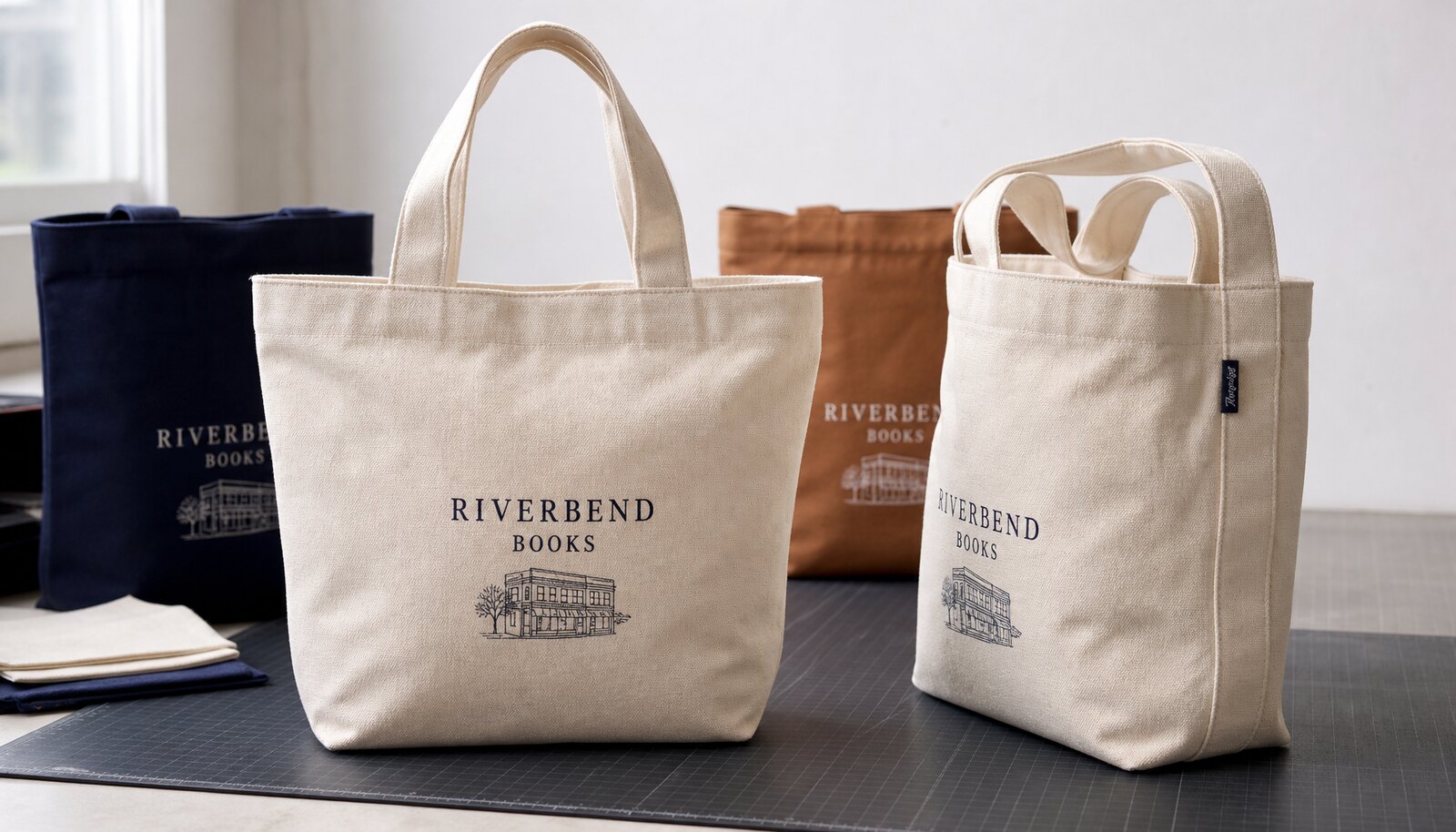
1. Start with the retail job, not the tote bag
A bookstore tote is not the same as a trade show bag or a generic fashion tote. It has to sit on a shelf, survive repeated carrying, and justify a price point that feels reasonable next to books, journals, and gift items. For a retail launch, the bag is part product, part display piece, and part margin tool. That means the first sourcing decision is not color or logo. It is how the bag will be used and how much shelf value it needs to create.
If the tote is a checkout add-on, the buyer usually needs a lower entry price and a simpler print. If it is a premium bookstore SKU, the bag needs a stronger hand feel, cleaner print, and better structure so it looks worth owning. The same canvas bag can serve both roles, but the spec and quote should not be treated as the same order. The wrong launch spec creates slow sell-through or a bag that looks underbuilt next to the books it is meant to carry.
- Retail checkout add-on: prioritize low setup friction and a clean one-color logo.
- Premium shelf SKU: prioritize heavier canvas, reinforced handles, and better print finish.
- Seasonal launch: keep the base bag stable and vary only the artwork or label.
- Gift-with-purchase: confirm whether the bag must be folded flat enough for warehouse or POS handling.
2. Choose canvas weight based on shelf feel and load, not just cost
For heavy canvas tote bags for bookstores retail launch buying guide decisions, the most common error is under-specifying fabric. A 10 oz bag may save a little on the quote, but it often feels too soft for a bookstore shelf and can collapse when filled with hardcovers or boxed sets. For most retail launches, 12 oz to 16 oz canvas is the useful band. A 14 oz bag is usually the safest default because it balances body, sewing speed, print appearance, and landed cost.
GSM and ounce language are often mixed in supplier conversations, so define the spec clearly. If the supplier quotes oz, confirm whether that is finished fabric weight. If they quote GSM, ask for the equivalent and whether the fabric is washed, dyed, or raw. A fabric that looks thick on paper can still feel limp if the weave is loose or the yarn quality is weak. For bookstore retail, the bag should hold shape on the shelf and not buckle when stacked with books, notebooks, and small gift items.
- 12 oz: workable for simple retail use, but test print opacity and handle stress carefully.
- 14 oz: best all-round launch spec for bookstore retail in many cases.
- 16 oz: premium feel and stronger shelf presence, but higher sewing and freight cost.
- Confirm whether the fabric is bleached, natural, garment-dyed, or piece-dyed, because color consistency changes with the process.
3. Compare supplier routes before you compare quote numbers
The supplier route can change the real cost more than the unit price on the first page of a quote. A direct factory with in-house cutting, sewing, and printing usually gives the cleanest control over lead time and defect responsibility. A trader or sourcing office can help if you need mixed products or smaller initial volume, but the supply chain can become harder to audit when printing, bag sewing, and packing happen in different places.
For a bookstore launch, the right route depends on whether you need repeatable SKUs or a one-off promotional run. If you plan to reorder, the factory route is usually better because you can lock the same fabric lot, print screen, carton spec, and label placement. If you only need a short seasonal test, a trader may be flexible on MOQ, but the buyer should ask where each process happens and who owns a defect if the print rubs off or the handle seam fails.
- Direct factory: better for repeat orders, tighter QC, and more stable landed cost.
- Trading company: sometimes easier for mixed sourcing, but verify process ownership.
- Local decorator: good for urgent short runs, but watch print durability and bag consistency.
- Integrated maker: ideal when you need one PO, one QC standard, and one carton spec.
4. Use a print method that matches bookstore artwork and handling
Most bookstore launch graphics are simple: logo, reading slogan, event name, or a small illustration. That makes screen printing the strongest default because it gives good opacity on natural canvas, holds up under retail handling, and keeps unit cost under control at medium volume. If the art has many colors or a photographic look, heat transfer may be faster for a pilot order, but the buyer should accept a different durability profile. Embroidery works when the mark is small and the bag is thick enough to carry the needle pull without puckering.
The print decision should be tied to shelf use and wash expectations. A bookstore customer may use the tote daily, so the logo should survive folding, carrying, and light abrasion. For a launch order, ask the factory for the print cure method, ink type, and a simple rub test result on the sample. If the artwork is delicate, reduce the print size rather than forcing a high-detail reproduction onto heavy canvas. Clean, bold artwork ages better on retail shelves than crowded graphics that lose edge definition after handling.
- Screen print: best for one to three solid colors and retail durability.
- Heat transfer: useful for short-run test launches or detailed art, but confirm adhesion.
- Embroidery: premium look for small logos; not ideal for large filled shapes.
- Ask for print placement measurements from seam to centerline so the artwork remains consistent across reorders.
5. Build the quote around real production cost drivers
A useful factory quote separates the real cost drivers instead of hiding them in one opaque unit price. The core drivers are fabric weight, bag size, print complexity, handle reinforcement, finishing, packing, and order quantity. A larger bag can consume surprisingly more canvas than buyers expect because gussets and seam allowance add material quickly. Two bags with the same face size can still differ meaningfully in cost if one has longer handles, denser stitching, or a more complex label package.
For comparison shopping, ask each supplier to break the quote into the same line items. That lets procurement see whether one supplier is cheaper because the bag is lighter, the print is simpler, or the packing is stripped down. A quote that looks low can become expensive after the buyer adds polybags, barcode stickers, master carton marks, and inland delivery. Landed cost, not ex-factory price, should drive the launch decision.
- Fabric weight and bag dimensions are the biggest cost base.
- Printing can add setup fees, especially for multiple colors or multiple placements.
- Handle reinforcement and bartacks add labor but reduce failure risk.
- Packing and labeling often look minor until retail receiving starts.
6. Use MOQ logic to avoid paying premium prices on the first run
MOQ should not be treated as a random factory rule. It usually reflects fabric setup, print screen preparation, cutting efficiency, and packing labor. For a bookstore launch, 500 to 1,000 pieces per color or artwork is often the practical range if you want a serious retail spec without overcommitting inventory. Lower MOQ is possible, but the buyer usually pays for it with higher unit cost, fewer material options, or weaker control over carton packing.
If you expect to reorder, it is better to design the launch around a scalable MOQ than to chase the cheapest pilot. For example, one color with one logo placement is easier to repeat than multiple color variants with different label combinations. If the supplier wants to split MOQ by color, compare that against your SKU plan. A launch with too many colors can trap inventory in the slowest seller while the best design runs out.
- One artwork, one bag body color, one packing spec is the easiest launch structure.
- Mixed-color orders can work, but unit cost and carton control usually rise.
- Lower MOQ often means fewer fabric choices or a simplified print method.
- If the first order is a test, keep the same size and structure you intend to reorder.
7. Approve samples against retail use, not against a pretty sample photo
The sample phase is where most tote launches are won or lost. A sample that looks good in a photo can still fail in real use if the handle angle is awkward, the print is too close to the seam, or the bag collapses when folded. For a bookstore retail bag, the sample should be judged for structure, print clarity, handle comfort, and how it sits on a shelf. The sample also needs to prove that the final fabric weight was used, not a substitute.
A good approval process uses one pre-production sample and one practical checklist. Measure the bag flat and filled. Load it with books of different sizes. Check whether the handles twist, whether the opening stays square, and whether the print cracks when the canvas flexes. If the bag includes a woven side label or a care label, confirm placement early because label movement is one of the easiest things to get wrong on a repeat order.
- Measure width, height, and gusset with a tape, not by eye.
- Test the bag with weight similar to your retail customer use case.
- Rub the printed area after folding and unfolding the bag several times.
- Approve the sample only when the actual production fabric and packing are confirmed.
8. Specify packing and carton details before the goods are sewn
Packing can create receiving problems even when the bag itself is fine. For a bookstore launch, the cleanest route is usually individual polybag packing with a barcode sticker, then bulk cartons labeled by SKU, color, and quantity. This keeps the retail team from having to sort loose bags and reduces dust or scuff marks on white or natural canvas. If the tote is meant to feel premium, the fold and insert method matters too, because a sloppy fold makes the bag look cheaper on arrival.
Carton planning matters for freight and warehouse handling. Ask for carton dimensions, gross weight, and pieces per carton before confirming the order. If cartons are too heavy, they slow down receiving and increase crush risk. If cartons are too large, freight cost rises and stacking becomes unstable. For a launch order, the carton spec should suit your warehouse receiving rules as much as the factory's packing line.
- Polybag or recyclable bag: protects the canvas surface during shipping.
- Barcode sticker: essential if the tote enters retail inventory individually.
- Master carton marks: should show SKU, color, quantity, and carton number.
- Avoid mixed-SKU cartons unless the warehouse has asked for them.
9. Protect margin by comparing landed cost, not just ex-factory price
Bookstore buyers often undercount the cost that sits after the factory gate. Freight, duty, inland transport, carton handling, barcode labeling, and repacking can change the final cost per unit enough to affect shelf pricing. A bag that is slightly more expensive at the factory can be cheaper on the shelf if it packs more efficiently, ships with lower gross weight, or reduces receiving labor. This is why quote comparison should include not only the unit price, but carton volume and packing method.
A useful comparison is to calculate the launch cost per sellable unit, not the cost per sewn piece. If a supplier gives a lower price but excludes polybags or uses a heavier carton, the landed cost may be higher than a quote that looked expensive at first. For a retail launch, a stable unit that arrives clean, on label, and ready for inventory is usually worth more than a cheaper unit that creates warehouse work.
- Compare unit price with packing, carton volume, and gross weight included.
- Use the same quantity basis across all quotes.
- Add estimated freight and duty before approving the launch budget.
- Track cost per sellable SKU, not just cost per bag.
10. Use a buyer checklist and factory questions to keep the order clean
The simplest way to avoid production mistakes is to force every supplier to answer the same practical questions. Many tote quotes are incomplete because the buyer leaves fabric weight, print method, or packing open. That creates room for substitution later. For a bookstore launch, the RFQ should read like a production brief, not a wish list. The goal is to remove ambiguity before the factory schedules cutting and printing.
The final order should have one approved sample, one written spec sheet, and one packing instruction set. That combination makes it easier to reject a bad batch and easier to reorder the same bag later. If your launch works, the re-order phase should be simple. The more precise the first order is, the less time you lose re-explaining the bag to the supplier on the second run.
- Keep one master spec sheet for fabric, print, packing, and carton data.
- Save the approved sample photos with measurement notes.
- Attach the same artwork file version to every supplier quote request.
- Record the exact approval date so later changes do not get mixed into the same PO.
Specification comparison for buyers
| Spec decision | Recommended option | When it fits | Buyer risk to check |
|---|---|---|---|
| Fabric weight | 12 oz to 16 oz canvas, with 14 oz as the safest bookstore retail default | Bookstores that want a premium feel, good shelf presence, and enough structure for books or gifts | Thin fabric can look cheap on shelves; very heavy fabric raises cost, slows sewing, and may reduce usable margin |
| Supplier route | Direct factory with print and sewing in one place | Best for private label launches, repeat SKUs, and tighter control of carton count and print quality | Confirm whether printing is in-house; split production between mills, printers, and bag makers can extend lead time and complicate defect handling |
| Printing method | Screen print for 1 to 3 solid-color logos; heat transfer only for short-run or complex art; embroidery for small premium marks | Screen print is strongest for retail durability and unit cost; embroidery suits small logo placement on thicker canvas | Fine text and gradients may blur on screen print; heat transfer can crack or peel if film quality is weak |
| Construction style | Topstitched open tote with reinforced handles and gussets | Bookstore shoppers need stable shape and load-bearing handles for books, stationery, and impulse buys | Unreinforced handles can twist or tear at the seam; weak gussets reduce shelf shape and perceived value |
| Size range | Approx. 13 x 15 x 4 in to 15 x 16 x 5 in | Fits most retail bookstore assortments without becoming oversized for casual carry | Overlarge bags increase fabric consumption and freight; undersized bags may not fit standard hardcovers or boxed gifts |
| MOQ route | 500 to 1,000 pcs per color/artwork for launch; lower MOQ only if you accept higher unit cost | New bookstores, seasonal launches, or test-market orders | Low MOQ quotes often hide setup fees, narrow size options, or mixed-quality packing that hurts shelf consistency |
| Packing method | Individual polybag with barcode sticker and bulk carton packing by SKU | Retail launches needing clean receiving, inventory control, and shelf-ready units | Loose packing creates dust, creases, and counting errors; too much retail packaging can raise cost and waste |
| Quality standard | AQL-based inspection with defined stitch, print, and measurement tolerances | Any order intended for retail sale instead of event giveaway use | Without clear acceptance criteria, defects become a dispute after goods are already in transit |
| Sourcing route for first launch | Sample-first RFQ, then pilot order, then full reorder | For bookstores testing region, genre, or seasonal designs | Skipping the pilot stage can lock in bad sizing, weak print adhesion, or packing errors across a larger order |
Buyer checklist before sampling
- Confirm the target use: shelf retail, customer checkout add-on, loyalty gift, or limited seasonal SKU, because each use changes weight, size, and acceptable cost.
- Lock the canvas weight, bag dimensions, handle length, and gusset depth before requesting quotes.
- Specify print size, number of colors, placement, and whether the artwork must match Pantone references or only approximate them.
- State whether you need woven side labels, care labels, hangtags, barcode stickers, or barcode-on-carton only.
- Ask for a real pre-production sample with the final fabric weight and print method, not a generic blank sample.
- Require carton count, carton dimensions, and gross weight in the quote so you can estimate freight accurately.
- Set tolerance expectations for stitch density, handle reinforcement, print alignment, and measurement variance.
- Decide whether the order will be mixed by color or one color per SKU, since mixed cartons affect labor and carton labeling.
- Ask for lead time separately for sample, pre-production approval, and bulk production.
- Build margin around landed cost, not ex-factory price, because bookstore retail launches often absorb packaging, inland delivery, and duty.
Factory quote questions to send
- What exact canvas weight do you recommend for this size and bookstore use case, and is that weight finished fabric or greige fabric?
- Is printing done in-house, and what method will you use for this artwork: screen print, heat transfer, or embroidery?
- What is your MOQ per color, per artwork, and per size if we keep the same bag style?
- Can you share the sample lead time, bulk lead time, and whether the clock starts after artwork approval or after deposit?
- What are the handle reinforcement details, seam allowance, and stitch count around stress points?
- Can you quote with individual polybag, barcode sticker, and master carton spec included separately?
- What carton size and gross weight do you expect for 25, 50, or 100 pcs per carton?
- What measurement tolerances do you hold for bag width, height, gusset, and handle drop?
- What artwork file format do you need, and do you charge a screen fee, plate fee, or color change fee?
- What inspection standard do you use before shipment, and can you share a random inspection report or QC photos?
Quality-control points to confirm
- Fabric weight should match the agreed GSM or oz spec within the supplier's stated tolerance; do not accept a lighter hand feel as proof.
- Handle bartacks or reinforcement stitching should be symmetrical, dense, and free of skipped stitches at the stress point.
- Print should be centered, properly cured, and free of pinholes, smearing, and obvious color shift versus the approved sample.
- Bag opening, body width, height, and gusset should fall within agreed measurement tolerances on a random carton sample.
- Seams should be straight, with no loose threads longer than a small trimming allowance and no seam slippage at corners.
- Polybag, barcode sticker, and carton marks must match the SKU list exactly to avoid receiving and retail picking errors.
- Cartons should not show crushing, moisture damage, or mixed-SKU packing unless mixed packing was explicitly approved.
- If you use a woven label or side label, the placement should be straight and sewn cleanly with no puckering.