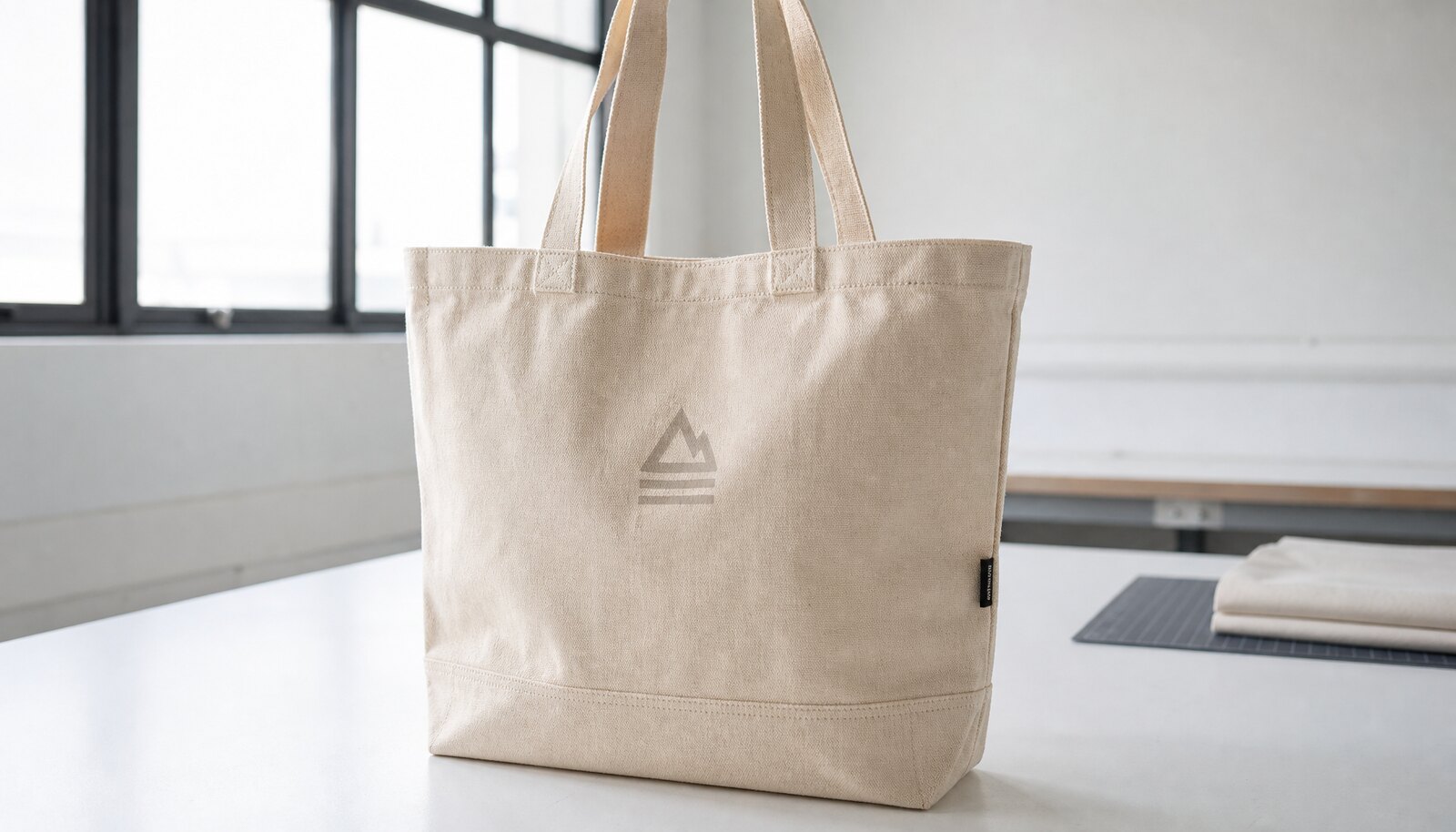
1) Why bookstore totes need a different sourcing plan
A bookstore tote is not just a carrier. It is also a shelf item, a brand signal, and part of the customer’s checkout experience. That changes the procurement brief. A buyer is not simply looking for a cheap canvas bag that can hold weight. The bag has to support the books being sold, look attractive when folded or hung, and keep its shape long enough to justify a retail price.
For heavy canvas tote bags for bookstores, the sourcing plan should start with the way the tote will be used. A campus store carrying textbooks needs a different build than a gift shop selling poetry and journals. A chain bookstore selling the tote as branded merchandise needs better print repeatability and cleaner retail presentation than a store using the bag only as an add-on carry item.
The commercial question is simple: what makes a customer buy the tote twice, or at least keep using it? That answer usually depends on three things: load performance, visual quality, and consistent reorders. If one of those is weak, the product can still be functional, but it stops being a strong private label item.
Buyers should therefore define the tote as a retail SKU, not as generic packaging. That means the spec should include the way it will be displayed, how it will be packed into cartons, whether it needs a barcode, and whether the bag should look premium enough to sit beside books on a shelf. Those decisions affect quote accuracy more than many teams expect.
- Treat the tote as a retail SKU, not only as a carry bag.
- Start from the bookstore’s actual use case: carry-out, gift item, membership perk, or branded merchandise.
- Match the tote’s appearance and construction to the store’s price point and brand position.
2) Set the product spec around load, size, and construction
For many bookstore programs, a heavy canvas tote works best in the 12 oz to 14 oz range. That is heavy enough to feel substantial, print cleanly, and hold shape, but not so stiff that the tote becomes awkward to fold or too expensive to move through retail pricing. A lighter bag can work for lower-cost promotions, but buyers should be careful if the tote will regularly carry hardcovers, boxed sets, or combined purchases.
The fabric weight alone is not enough. Finished size, gusset depth, and handle geometry are what determine whether the tote is actually useful at checkout. A bag that is too shallow may look tidy on shelf but become unstable with a stack of books. A bag that is too narrow may work for one paperback and a notebook, yet fail when a customer adds a hardcover or a gift item. Ask suppliers to quote the full construction, not just the fabric.
Handle build is where many low-cost programs fail. Self-fabric handles keep the look cohesive and can reduce material complexity. Webbing handles may feel more robust in daily use. Either can work, but the reinforcement needs to be explicit. Box-X stitching, bartacks, or another named method should be written into the spec so the factory cannot substitute a lighter finish later.
If the bag will be sold folded, ask for a fold test during sampling. Some canvas grades crease badly, especially on darker dyes. Others recover well but take up more carton space. You want to see how the bag looks after folding, stacking, and opening again. That is a retail decision, not an afterthought.
- Common bookstore range: 12 oz-14 oz canvas, depending on load and shelf price.
- Specify finished width, height, gusset depth, handle length, and handle drop together.
- Name the handle reinforcement method in the spec.
- Test fold recovery if the tote will be sold or displayed in a folded format.
3) Choose the branding method for repeatability, not just style
The branding method should be selected based on how consistently the artwork can be reproduced on rough canvas. Screen print is usually the most practical option for bookstore totes because it gives strong visibility and manageable setup cost. For simple logos, short copy, or bold illustrations, one-color screen print is often the cleanest commercial solution.
Two-color print can work, but the buyer should expect extra setup and more registration risk. Small type, fine detail, and weak color contrast are common failure points on heavy canvas. If the design depends on crisp edges or small letters, test it first on the actual fabric finish, not on a digital mockup. The weave of the cloth changes the result.
Embroidery can feel premium, but it is not always the best choice for bookstores. It adds cost, can stiffen the panel, and can distort lighter fabrics if the stitch density is too high. A woven label, sewn patch, or side label may give a better private label look when the goal is brand identity rather than prominent decoration.
The best artwork for a reorder program is the one the supplier can reproduce under real production conditions. Ask for the maximum print area, the safe distance from seams and edges, and the ink or thread method being used. If the artwork is too delicate for the fabric, simplify it before bulk order. A cleaner design can be better retail than a complicated one that fails in production.
- Use screen print for bold logos and repeat orders.
- Use a woven label or sewn patch when you want quieter branding with less print risk.
- Avoid hairline text, dense reverse text, and gradient-heavy artwork on rough canvas.
- Approve the decoration on the same fabric color and finish that will be used in production.
4) Compare supplier routes with real commercial variables
The supplier route matters because it changes control, not just pricing. A direct sewing factory usually gives the buyer the clearest path on fabric, stitching, and sample-to-bulk consistency. That makes it a strong option for bookstore private label programs that are likely to reorder. A trading company may be easier to work with on mixed requests or small-volume coordination, but the buyer must know which factory is actually making the bags and who owns QC decisions.
A specialized bag workshop can be a practical fit when the tote needs better seam control, better gusset shaping, or more careful retail finishing. These suppliers usually understand the real construction issues that matter on a bookstore tote. The risk is capacity: a workshop may be excellent on product quality but less flexible during peak seasons or holiday timing.
Low-price general suppliers can look attractive at first, especially for promotional runs. But the apparent savings often come from hidden assumptions: lighter canvas, smaller print area, simpler reinforcement, or weaker packing. If the quote is missing those details, the buyer is not comparing the same tote. For private label use, that is a major sourcing risk.
The comparison below focuses on the variables that matter in a bookstore program: MOQ, lead time, sample logic, defect exposure, and retail-ready packaging. If two suppliers quote the same bag but one is much cheaper, this table helps you see where the difference may actually be coming from.
- Direct factory: best when reorder consistency and construction control matter.
- Trading company: useful for coordination, but verify the real maker and QC authority.
- Specialized workshop: strong on bag construction, but ask about peak-season capacity.
- Low-price supplier: compare only after confirming the exact fabric, finish, and packing assumptions.
5) Quote the same spec across all suppliers before you compare price
A useful RFQ is one that removes room for interpretation. For bookstore tote bags, the buyer should send a spec sheet that includes the finished dimensions, canvas weight, reinforcement method, artwork file, label location, and packing standard. Without that, the supplier can price a lighter or simpler tote and still sound competitive.
Ask for the quote to separate product cost from add-on cost. One supplier may include label sewing, while another treats it as an extra. One may include retail polybagging and carton marks, while another assumes bulk packing only. If the team compares only the unit price, the order can become more expensive after sample approval when the missing items are added back in.
It also helps to ask for quantity tiers. Not every volume increase creates the same cost reduction. A lower unit price can reflect a real production efficiency, but it can also mean the factory changed something about the tote. By asking for multiple tiers, the buyer can see where the actual price break starts and whether the bag construction changes at each tier.
For a bookstore program, the most useful comparison is landed-useful cost, not only ex-factory unit cost. If shelf-ready packing saves labor at receiving, it may justify a slightly higher unit price. If a lower quote requires extra repacking at the warehouse, the cheaper bag may end up costing more overall.
- Send the same finished size, fabric weight, print method, and packing spec to every supplier.
- Ask each supplier to list exclusions and add-ons separately.
- Request 2-3 quantity tiers to expose true price breaks.
- Compare landed-useful cost, not only the opening unit price.
6) Use MOQ and lead time as planning tools, not just negotiation numbers
MOQ is usually driven by setup complexity, fabric sourcing, and labor planning. If a tote uses stock canvas and one-color print, the MOQ may be relatively low. If the order needs custom-dyed fabric, special washing, a sewn patch, or retail-ready packing, the MOQ usually rises because more materials and processes must be locked together.
Buyers should not treat MOQ as a pure sales tactic. It often reflects real production constraints. What matters is whether the MOQ fits the bookstore’s inventory plan. A seasonal campaign, store opening, or holiday promotion may need a smaller run even if the unit price is a little higher. That can be the better commercial decision if it avoids leftover stock.
Lead time should be read from the moment the final sample is approved, not from the day the quote is received. If artwork changes, label placement changes, or fabric needs to be dyed, the schedule moves. For a bookstore launch, build in time for at least one practical revision round. One missed approval can matter more than a small difference in sewing speed.
Ask the supplier to confirm whether the quoted lead time assumes material in stock. If not, material sourcing may become the hidden schedule risk. This is especially important for custom colors, premium labels, or any program where the bag has to match other branded store items.
- Simple stock-fabric tote: lower MOQ is more realistic.
- Custom-dyed fabric or special trim: expect a higher MOQ and longer lead time.
- Start the lead-time clock after sample approval, not at quotation stage.
- Build approval buffer into launch schedules for bookstore campaigns.
7) Make sample approval prove construction, not just appearance
A sample should answer three questions: does the bag feel right, does it carry the intended load, and does the branding land where it should? Buyers often focus on print position and forget to test the tote with books inside it. That is where handle balance, seam strength, gusset shape, and overall structure become visible.
The sample should be production-intent whenever possible. That means final fabric, final print method, final label placement, and final reinforcement. A rough prototype can help with dimensions and visual direction, but it should not be treated as final approval unless the buyer is comfortable with the variance. If the supplier only sends photos, ask for the physical sample or a clearly documented reference sample before moving forward.
Test the sample in the way the customer will use it. Put in books of different sizes. Check whether hardcovers pull the handles out of alignment. Look at the tote under normal store lighting. Fold it the way it will sit on shelf or in carton. This is especially important for bookstores because the bag is often sold as an item customers will keep, not as disposable packaging.
If the order uses natural or unbleached canvas, shade variation should be written into the approval notes. Buyers do not need impossible color uniformity, but they do need a reference point. The approved sample becomes the anchor for the production run and for future reorders.
- Load-test the tote with books before sign-off.
- Check print, shape, and hand feel under normal store lighting.
- Measure finished dimensions after sewing and pressing.
- Keep a physical approved sample tied to the PO and spec version.
8) Define QC acceptance criteria with measurable tolerances
A tote program is much easier to control when the QC criteria are written before production starts. For heavy canvas tote bags for bookstores, the factory should know what counts as acceptable variation and what counts as rejection. General reminders are not enough. The inspection plan needs measurable tolerances and clear defect calls.
Start with dimensions. Finished width, height, and gusset depth should be checked after sewing and pressing. If the buyer accepts too much variation, the bag may no longer fit the planned shelf format or carry the expected load. Next, inspect fabric weight against the approved range. A heavy canvas tote should not quietly drift into a lighter grade.
Handle and seam checks matter just as much. Look for even stitch spacing, secure reinforcement, trimmed thread ends, and full seam closure at corners and gusset joins. Print placement should stay within the agreed tolerance. Skew, cracking, and ink bleed should be listed as reject conditions if they affect retail appearance. For branded bookstore merchandise, cosmetic quality is not optional.
The cleanest QC plan is one the supplier can execute and the buyer can verify. That usually means a pre-production sample check, first-piece inspection, in-process checks, and final carton review. If the order is large or repeatable, ask the supplier to keep the approved sample, fabric lot reference, and artwork file linked to the same spec revision. That makes the next order easier to verify.
- Set a target range for fabric weight and finished dimensions.
- Require secure reinforcement at handle stress points.
- Define print skew, cracking, bleed, and seam gaps as explicit reject conditions.
- Tie approved sample, artwork, and fabric lot reference to one revision number.
9) Packing and carton control affect shelf presentation and inbound cost
Packing is part of the product, not a side note. A heavy canvas tote compresses well, which helps freight density, but too much compression can leave lasting creases or flatten the handles. If the tote is intended to go straight to shelf, individual polybags or a defined retail fold may be worth the extra labor. If the tote will be unpacked in a warehouse and displayed later, bulk packing may be the better choice.
The buyer should decide early whether the order is shelf-ready or warehouse-ready. That decision changes carton fill, fold method, barcode placement, and carton mark requirements. It also changes how much work the store or distribution center has to do after receiving. A lower factory price may not be a good deal if the receiving team has to repack the goods before they can be sold.
Carton size and gross weight should be part of the quote because they affect freight and handling. Ask whether the handles are protected from compression and whether the printed face is protected from rubbing against adjacent bags. If the tote uses a side label, sewn patch, or hangtag, make sure those features are not damaged during packing.
A packing pilot is worth the time if the tote is going into a retail program. Even a small carton test can show whether the fold holds, whether the labels line up correctly, and whether the bags look fresh when opened. That is especially useful for bookstore merchandise, where the customer sees the bag as part of the store brand.
- Decide whether the tote is shelf-ready or warehouse-ready before finalizing packing.
- Request carton dimensions and gross weight with the quote.
- Specify polybag thickness and sealing style if individual protection is needed.
- Protect the printed face, handles, and label area during transit.
10) Reorder control: lock the spec before the first PO
Private label sourcing is only successful if the second order matches the first. Reorders often fail when the initial sample was approved loosely or when the spec lived in too many places. The buyer should freeze the revision before the purchase order: same fabric weight, same construction, same branding method, same label placement, same packing, same carton marks.
Keep one approved sample as the physical reference and make sure the supplier keeps the same reference internally. If the order later needs a change, record it as a new version rather than a casual note. That discipline matters because bookstore tote programs often become repeat items once customers start recognizing them. At that point, inconsistency is more visible than it would be in a one-time promotion.
For seasonal or chain programs, shipment control should include lot-level receiving checks. Do not rely only on the final invoice. Check the goods against the approved sample, the spec sheet, and the carton labels as they arrive. If the first shipment is correct, reorder the same way and do not let minor process shortcuts accumulate over time.
The best private label sourcing plan is simple: define the tote clearly, approve it carefully, inspect it against measurable criteria, and keep the approved version stable. That is how a bookstore gets a tote that feels intentional to the customer and manageable to the buyer.
- Freeze the spec before the first PO and label every revision clearly.
- Keep one physical approved sample as the production baseline.
- Use lot-level receiving checks on repeat orders.
- Treat any change in fabric, print, or packing as a new version, not a casual tweak.
Specification comparison for buyers
| Supplier option | What to verify | Commercial advantage | Buyer risk to control |
|---|---|---|---|
| Direct sewing factory | fabric swatch, approved sample, seam close-ups, logo test photos, packing pilot, and final inspection evidence | Better sample-to-bulk control and faster production feedback | May be weaker on export paperwork or branded packing unless checked early |
| Trading company | Factory name, production photos, trim-source proof, and who owns QC decisions | Can coordinate small mixed orders and extra services | Markup can hide real factory capability and slow defect decisions |
| Specialized bag workshop | bag size, gusset, handle drop, seam allowance, stitch density, reinforcement patch, and loading expectation | More practical for detailed construction, trims, and repeat programs | Capacity may be limited during peak seasons |
| Low-price general supplier | 8-12 oz cotton canvas, 120-220 gsm cotton, recycled cotton, or blended fabric selected by use case and target price | Useful for simple promotional runs with loose specs | Material downgrades, weak packing, and vague inspection scope can erase savings |
| Retail-ready supplier | fold method, inner bundle, carton count, carton mark, moisture protection, SKU separation, and warehouse receiving needs | Can handle labels, SKU separation, carton marks, and receiving rules | Higher unit cost must be compared against reduced warehouse work |
| Compliance-focused supplier | Fabric records, labeling review, test plan, and production traceability | Safer for retail programs and repeat brand orders | Documentation claims need evidence, not only sales language |
| Local sample room plus bulk factory | Signed sample, bulk factory handoff, first-piece photos, and deviation owner | Good for complex branding before large production | Sample room quality may not match bulk line unless handoff is controlled |
Buyer checklist before sampling
- Define the actual carrying load before you ask for a price: paperback, hardcover, mixed books, gift items, or books plus drink/merch add-ons.
- Write the spec in measurable terms: finished width, height, gusset depth, handle length, handle drop, canvas weight, and reinforcement method.
- Choose the branding method early so quotes are comparable: one-color screen print, two-color print, woven label, sewn patch, or embroidery.
- Ask for a production-intent sample using the final fabric, final print method, and final label placement—not a generic prototype.
- State the packing standard in detail: fold direction, inner pack count, polybag thickness if used, carton quantity, carton marks, and barcode location.
- Get at least two supplier routes to quote the same spec version, then compare exclusions line by line.
- Approve artwork, fabric shade, sample, and carton mark in a written sequence before bulk production starts.
- Require the supplier to keep the approved sample, spec sheet, and artwork file tied to one revision number for reorders.
- Confirm who owns production QC decisions if you are using a trading company or multi-step sourcing route.
Factory quote questions to send
- What is the actual fabric weight in oz or GSM for the production lot, and what tolerance do you hold from the approved sample?
- Is the quote based on stock canvas, custom-dyed canvas, washed canvas, or pre-shrunk canvas, and how does that affect MOQ and lead time?
- What finished dimensions are quoted after sewing and pressing, and what tolerance do you guarantee for width, height, and gusset depth?
- What reinforcement do you use at the handle attachment points: box-X stitch, bartack, double stitch, or another method?
- What is the maximum printable area, and how far must artwork stay from seams, edges, and handle joins to avoid distortion?
- What setup charge applies per print color, per embroidery file, or per label type, and is that charge included in the unit price?
- Can you provide a pre-production sample made with the final fabric, final construction, and final packing method before bulk approval?
- What is included in the price: label sewing, hangtag attachment, polybagging, carton marks, and barcode placement, or are those extras?
- What carton size, gross weight, and pack count are you quoting, and are the handles protected from compression during transit?
- If we change artwork, label position, or packing after sample approval, what re-sampling or change-order fee applies?
Quality-control points to confirm
- Fabric weight should match the approved range; do not accept a vague 'heavy canvas' description without an ounce or GSM target.
- Finished dimensions should be checked after sewing and pressing, not from cut panels.
- Handle stitching should be even, secure, and reinforced at the stress points; loose bartacks, skipped stitches, or weak cross-stitching are reject conditions.
- Seams should be fully closed at corners, gusset transitions, and handle joins; visible open seams are not acceptable.
- Print should stay within the agreed placement tolerance, with no major skew, cracking, or bleed into the canvas weave.
- For natural or unbleached canvas, compare shade against the approved sample under normal store lighting, not only under factory lights.
- Thread ends should be trimmed, and the interior should not show oil marks, loose fibers, or needle damage.
- Cartons should protect handles and corners from compression; crushed totes often come from overstacked cartons or too-tight folding.
- If barcodes, hangtags, woven labels, or side labels are part of the retail pack, inspect the exact placement against the approved sample.
- For repeat programs, retain the approved sample, fabric lot reference, artwork file, and packing spec so reorders can be checked against the same baseline.