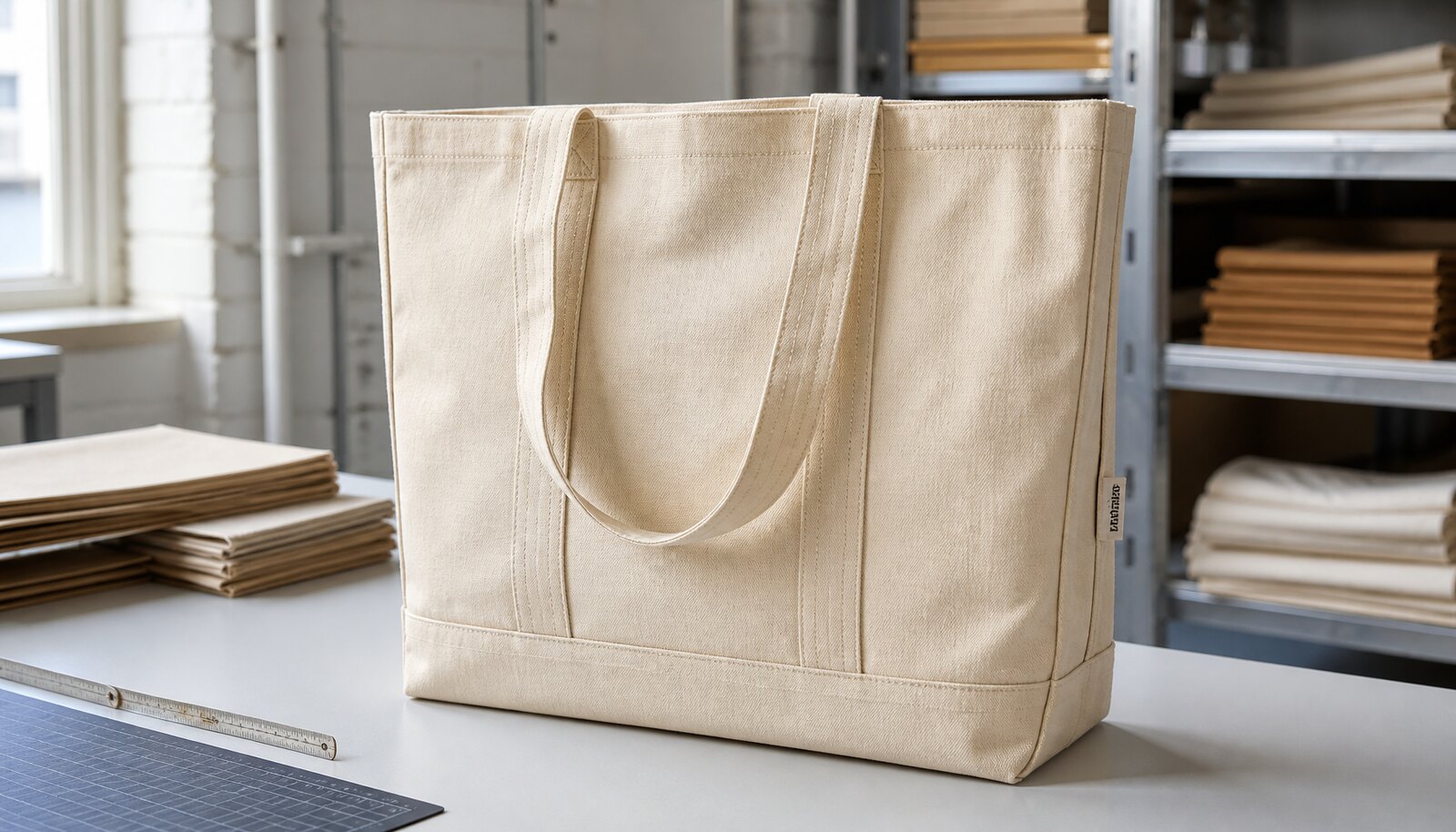
Why bookstores need a different tote specification than fashion or promotional buyers
Bookstores buy tote bags under different commercial pressure than fashion labels. The bag has to carry hardcovers, paperbacks, and impulse items without collapsing, but it also has to look neat enough to sit on a counter, in a display bin, or beside a cashier. That means the spec cannot be built around appearance alone. It has to balance load-bearing strength, shelf presentation, pack efficiency, and repeatable print quality. If the tote is too soft, it looks low value. If it is too heavy or overbuilt, freight and production cost rise without a proportional merchandising benefit.
The purchasing mistake most often seen in bookstore tote programs is starting with artwork and only later defining the bag body. From a procurement point of view, the right sequence is: use case, finished dimensions, fabric weight, handle construction, print method, then packaging format. Once those are fixed, supplier quotes become comparable and sampling is far less likely to drift. Without that order, one factory may quote a lightweight gift tote while another assumes a retail-grade carry bag, and both quotes can appear “reasonable” while describing different products.
Bookstore buyers also need to think about how the tote moves through the business. A tote sold at retail should pack neatly, scan efficiently, and display cleanly. A tote used as a promotional insert may prioritize cost and pack density. A tote used in a chain-store campaign may need stricter carton labeling and faster receiving. Those are not small differences; they directly affect fabric selection, stitch method, and pack-out.
The best way to avoid ambiguity is to write the purchase spec in business terms as well as manufacturing terms. State whether the tote will be resold, gifted, bundled, or used operationally. Then map that use case to the technical details the factory must hold. A good spec does not just describe a bag. It describes how the bag should behave from sewing line to store shelf to final carry.
For SEO purposes, the phrase heavy canvas tote bags for bookstores packaging specification guide should not be repeated mechanically in the body. The useful approach is to cover the actual buyer questions that phrase implies: how heavy the canvas should be, how the bag should be sewn, how it should be packed, and what to ask for before approving the order.
- Start from use case, not from artwork.
- Write the spec so a supplier can quote fabric, sewing, print, and packing separately.
- Make the tote work for retail display, carry performance, and warehouse receiving, not only one of those priorities.
Choose canvas weight by load, finish, and hand feel, not by a blanket oz target
Canvas weight is one of the most quoted specifications, but it is easy to overstate its importance if it is treated as a single answer. For bookstore totes, the practical zone is often around 12 oz to 16 oz finished canvas, with some programs moving above that when the tote must stand upright, carry multiple books, or feel more premium on a shelf. The right number depends on more than weight alone. Yarn count, weave density, finishing method, pre-shrinking, and whether the bag is lined or unlined all affect the final hand feel and performance.
That is why a blanket statement such as “14 oz to 16 oz is always best” is too absolute. A 12 oz finished canvas can be acceptable for lighter promotional use, especially if the bag is well constructed and not expected to carry heavy loads every day. A 14 oz bag may be the right commercial compromise for many bookstores because it balances shape, cost, and freight. A 16 oz or heavier build can make sense for premium retail programs, heavy book bundles, or customers who expect the bag to feel substantial, but the added weight can increase sewing difficulty, carton weight, and shipping cost.
The most important procurement point is to define what “weight” means. Ask the factory whether the quoted GSM or ounce figure is measured before or after washing, pre-shrinking, coating, or finishing. Two suppliers can both say “16 oz” while delivering noticeably different fabrics because one is quoting raw cloth and the other is quoting finished cloth. Put the basis in the RFQ so every quote is measured on the same standard.
If the tote must hold its shape on a shelf, ask for stabilized or pre-shrunk canvas and request the size tolerance after any wash or steam process used by the factory. If the bag is for high-volume promotions, you may accept a simpler construction and a lighter weight in exchange for a lower landed cost. If the bag will be sold at retail, buyers usually care more about perceived quality, stitching neatness, and drape than they do about one perfect ounce number.
A useful rule is to match the fabric weight to the actual load profile. Hardcovers, stacked books, or event bundles justify a firmer fabric and stronger reinforcement. A tote for light merch, journals, or stationery can sit lower on the weight scale. The right answer is therefore not “the heaviest canvas,” but “the lightest construction that still carries the expected load cleanly and looks right in the store.”
- Define weight as finished fabric weight and state the measurement basis in the RFQ.
- Use 12 oz to 16 oz finished canvas as a working range, then adjust for load and shelf presentation.
- Ask whether the fabric is pre-shrunk or stabilized if size consistency matters after finishing.
Specify the bag body like a product engineer: dimensions, seam allowance, gusset, and tolerances
A tote that is only described as “big” or “book size” is not ready for manufacturing. Buyers should lock the finished dimensions in centimeters or inches, and they should do so with seam allowance and gusset depth included in the drawing or spec sheet. For bookstore use, common sizes often need to fit standard books, magazines, and small boxed items without looking oversized. A useful spec should also define whether the bag has a flat body or a gusseted base and side, because that changes both carrying capacity and carton packing efficiency.
A procurement-ready spec should include finished width, finished height, gusset depth, handle length, and handle drop. Handle drop matters because it affects how the tote sits on a shoulder and how it appears when hanging in a store. If the handles are too short, the tote looks cramped and is less useful in daily carry. If they are too long, the bag drags awkwardly and may not sit well on a shelf hook. Buyers should also ask the factory to state the seam allowance used on each edge, because a dimension without seam allowance can be interpreted differently from one sewing room to another.
Tolerances need to be realistic but explicit. A common starting point is +/- 0.5 cm to 1 cm on sewn bag dimensions, depending on size and sewing complexity, but the actual acceptable range should be written into the approval file. Handle symmetry should also be checked, because a tote that is within width tolerance but has uneven handles will look cheap at retail and can twist during use. Where the design includes a gusset, the buyer should ask how the corners are finished and whether the bottom seam is reinforced to prevent strain at full load.
If the tote is meant for store display, consider how the body stands when empty and how much wrinkling is acceptable after folding. Some buyers want a bag that sits upright on a shelf, while others want a soft fold that lowers pack volume. These are conflicting goals, so the spec should prioritize one. An upright display bag may need slightly firmer fabric, a tighter gusset build, and more consistent shape control. A compact mailer-style tote may focus more on foldability and pack density.
Write the bag drawing so the supplier cannot misread it. The drawing should show finished dimensions, stitch path, handle attachment points, print boundaries, and any label placement. This is the simplest way to remove ambiguity before sampling starts and to prevent a later dispute about whether the factory made the bag “as requested.”
- State finished width, height, gusset depth, handle length, and handle drop.
- Include seam allowance and tell the factory which dimensions are finished dimensions.
- Write one tolerance rule for each critical dimension rather than leaving it implied.
Handle construction is where bookstore totes succeed or fail
Bookstore totes are often judged by the handle more than the body. That is where the load is concentrated, and it is also where customers notice comfort immediately. A handle that looks fine in a flat photo may still be too narrow, too short, or poorly reinforced for repeated book carry. For heavier canvas programs, buyers should define handle width, handle length, handle drop, edge finish, and stitch reinforcement in the RFQ rather than relying on a factory default.
A self-fabric handle is common because it keeps the look cohesive and can be efficient on a canvas tote. But the handle should not be treated as a decorative strap. Ask for the number of folds in the handle, the finished width, and the exact reinforcement pattern at the top edge and attachment points. For heavier use, a box-x stitch is usually more informative to specify than a vague note such as “strong stitch.” In some programs, bar tacks or back-tacks at the ends of the handle give added load security, especially if the tote is expected to carry multiple books or be used repeatedly over time.
Handle width deserves its own attention. A narrow handle may save sewing time, but it can bite into the hand or shoulder when the tote is full. A wider handle distributes load better and looks more substantial, but it uses more fabric and can change the visual proportion of the bag. The buyer should decide whether the bag is meant to feel casual, premium, or utility-driven and then specify the width accordingly. For many bookstore programs, a medium-to-wide handle is a better commercial choice because it improves carrying comfort and shelf impression without making the tote look too technical.
The handle drop should be tested with real contents, not just measured on an empty bag. Load the tote with the kind of items a customer will actually carry: one hardback, two paperbacks, or a mixed bundle of reading material and stationery. Then check whether the handle remains comfortable and whether the bag top stays open enough for easy use. If the tote is sold as a premium merchandise item, buyers may also want the handle seam to be neat enough to inspect closely under retail lighting.
Do not let the supplier describe handle construction only in general terms. Ask for a stitch detail photo or a construction sample if the order is large enough to justify it. Handle issues are among the most expensive problems to correct after shipment because they affect both safety perception and customer satisfaction.
- Specify handle width, length, drop, fold construction, and attachment point.
- Use box-x stitching, bar tacks, or another named reinforcement method.
- Test handle comfort with realistic book loads, not with an empty bag alone.
Print method, artwork control, and placement should be designed together
Print can make a bookstore tote feel premium, collectible, or campaign-ready, but only when the artwork and print process are matched correctly. For simple logos, one-color graphics, or straightforward branded slogans, screen printing is usually the most practical choice because it offers strong opacity on natural canvas and relatively predictable repeat pricing. If artwork becomes multi-color, highly detailed, or gradient-heavy, the supplier may suggest transfer or digital methods, but those methods should be evaluated for durability, opacity, and batch consistency rather than accepted automatically because they can reproduce more detail.
The buyer should specify print placement in a way the factory cannot misinterpret. A useful spec identifies the exact distance from the top edge, the print width and height, whether the design is centered or offset, and whether the artwork appears on one side or both sides. If the tote will be folded before packing, check how the print looks when the bag is folded flat. Some designs appear correct on an open sample but are awkward once packed for retail. That is a practical issue, not a design issue, and it should be checked before bulk production.
Color control is another place where quotes drift. The RFQ should state whether the supplier must match Pantone references or match a physical approved sample. If the artwork uses fine lines, the minimum line thickness should be noted so the print does not fill in or break during production. If the design contains text, specify the smallest text size the factory must hold. Those are easy details to miss, but they often become the reason one tote looks sharp while another looks blurry.
For bookstore programs that need a more premium touch, woven labels, side-seam labels, or small printed inserts can add retail value without complicating the entire body print. That said, every extra element should be priced separately. Labels, belly bands, hang tags, and insert cards all change labor time and carton packing behavior. They should not be buried inside a single blended tote price.
If the order will be repeated, ask the factory what happens when the artwork is reordered: are screens retained, do colors need to be recalibrated, and how much lead time is required for a reorder versus a first run? That question matters because repeat sales are common in bookstore merchandising, and the easiest way to lose margin is to treat a reorder like a fresh launch when the supplier has already been quoting a re-setup cost.
- Choose the print method after reviewing artwork complexity and durability needs.
- Define placement with measurements from the bag edge, not just “center front.”
- Keep labels, inserts, and hang tags as separate quote lines so they do not hide cost.
Comparison of sourcing and construction options for bookstore tote programs
A buyer table is most useful when it shows not only what to choose, but what each choice changes in production, inspection, and receiving. The table below compares the most common sourcing and build options for bookstore tote programs. Use it as a starting point for RFQs rather than as a universal answer. The best choice depends on retail positioning, inventory risk, and how much control you want over the factory process.
When comparing options, avoid judging only by unit price. A lower price may simply mean lighter fabric, less reinforcement, or a simpler packing route. For procurement buyers, the better question is: what exactly changed to create the price gap?
Comparison of sourcing and construction options for bookstore tote programs
Packing rules should cover fold method, inner bundle, carton count, carton mark, moisture protection, SKU separation, and warehouse receiving needs. These details affect cost, damage rate, receiving speed, and whether the goods can move directly into retail or distribution.
A canvas tote bag can pass product QC and still create claims if cartons are mislabeled, overpacked, crushed, damp, or mixed. Treat packing as part of the specification, not an afterthought.
- Write decisions in measurable language, not only descriptive wording.
- Ask for sample photos plus one physical approval sample for important orders.
- Keep quotation, sample approval, and inspection notes tied to the same spec version.
Packaging format affects shelf readiness, warehouse receiving, and freight cube
Packaging is often described too loosely in tote quotes. For B2B buyers, that is a problem because the packing route controls damage risk, receiving speed, and shipping cost. A clear spec should define how each tote is folded, whether it is placed in a polybag, whether a barcode or SKU label is attached to the bag or insert card, and how many pieces go into each master carton. If those points are not written down, two samples can look identical at flat inspection but arrive very differently in warehouse receiving.
A common retail-ready format is one tote per polybag with a visible barcode sticker and a master carton marked by PO number, SKU, color, and quantity. This is not the only option, but it is a practical baseline for bookstore buyers who need the goods to move cleanly from factory to distribution center to shelf. If the tote is going directly to a warehouse that uses carton-level receiving, the carton label needs to be readable at a glance and placed consistently on more than one side if your logistics team requires it. If the tote is destined for direct-to-store replenishment, the label format should match the retailer’s receiving rules before production begins.
Pack count should be chosen with both handling weight and cube in mind. A carton that is too heavy slows unloading and raises handling risk. A carton that is too small wastes labor and may increase carton count unnecessarily. A carton that is too large can crush the bags, create wrinkle recovery issues, and make the order look less controlled. Ask the factory to quote carton dimensions and gross weight alongside the tote price so you can estimate landed cost realistically. That request also helps you spot whether one supplier is hiding a higher freight burden inside a lower manufacturing quote.
The fold method should be fixed in the spec. A tote intended for retail display should fold the same way every time so the face panel, handle position, and barcode remain consistent in the polybag. Some buyers include a simple fold diagram in the spec sheet to remove ambiguity. That is especially useful if the order may be split across production runs or if the factory has more than one sewing line. Small packing differences become big receiving problems when they are repeated across thousands of units.
If you need to add an insert card, care label, or printed belly band, treat those as part of the packaging spec rather than optional extras. They change labor, carton fill, and appearance at the store level. They should also be tested during the sample stage, because the pack-out can interfere with folding and barcode visibility.
- Define one piece per polybag, carton count, barcode position, and fold method in writing.
- Request carton dimensions and gross weight in every quote.
- Use the pack-out that matches the receiving process, not the pack-out that looks simplest on paper.
MOQ, pricing structure, and the real cost of too many variants
MOQ is not just a supplier policy; it is often the hidden cost of complexity. The more variables you change at once—fabric color, print color count, handle length, label insert, bag fold, carton marks—the more setup time and material hold cost the factory carries. That usually translates into a higher minimum order or a more expensive unit price. For a first bookstore tote launch, it is usually smarter to hold the body spec constant and vary only the print or insert if needed.
If the factory is sourcing from stocked natural canvas, it may offer a lower and more flexible MOQ than a dyed or special-finish fabric. Custom-dyed canvas, custom woven labels, and special retail packaging can each create additional minimums. That is why buyers should ask for MOQ per color, per artwork, and per pack style. A single blended MOQ can hide the fact that one version is simple to run while another requires separate setup and material reservation.
There is also a commercial difference between a first run and a reorder. Reorders can be more efficient if the factory retained the print screens, labels, and pack instructions, but only if your spec version remained unchanged. If the buyer revised the handle drop, switched the printing method, or changed carton counts after the first approval, the reorder may no longer behave like a true repeat. Procurement teams should track those changes in a simple revision log so they can understand why a reorder quote moved.
When comparing quotes, normalize the numbers to the same basis: same fabric weight, same print method, same packing format, same carton count, same freight basis. Otherwise, a cheap price can simply be a different product. This is especially important in bookstore merchandising, where the tote may be sold at a fixed retail price and margin erosion can happen quickly if landed cost rises by a small amount across large volumes.
A clean RFQ should therefore separate direct manufacturing cost from packaging add-ons and freight assumptions. The more transparent the quote, the easier it is to compare suppliers without having to reconstruct the spec line by line after the fact.
- Keep the first order simple: one body, one weight, one pack style, one print route.
- Ask for MOQ by fabric color, artwork, and packaging variant.
- Compare reorder pricing only after confirming that no spec changes were introduced.
QC should be written as defect criteria, not a generic “good quality” note
Quality control on a canvas tote is straightforward only if the buyer defines what failure looks like. A tote can pass a casual visual check and still cause problems later because the handle anchor is weak, the print is off-center, or the carton pack is inconsistent. For procurement teams, the safest approach is to define defect criteria before production starts. That means specifying what counts as a major defect, a minor defect, and a packing defect, and then telling the factory what happens if a lot exceeds the agreed limit.
A practical QC program for bookstore totes should check fabric quality, size, seam consistency, print placement, folding accuracy, and carton marking. Visible oil marks, broken weave, holes, mis-sewn seams, and severe shade variation should be treated as clear rejects. Handle reinforcement deserves special attention because it carries the load and is visually easy to inspect. Ask the factory to show the exact stitch path at the handle anchors and to confirm whether the factory uses box-x, bar tack, or another named reinforcement pattern.
Inspection should not stop at the bag itself. Polybag seal quality, barcode scannability, and carton accuracy are equally important. If the receiving warehouse cannot scan the label or if the carton count is wrong, the order becomes an operations problem even if the tote construction is perfect. For larger orders, an AQL-style sampling plan or an equivalent buyer-defined inspection routine is useful because it gives both sides a common language for defect tolerance. The plan should state sample size, defect classification, and whether rework or replacement is required if the lot fails.
A good inspection checklist also includes how the bag behaves under load. That does not require a laboratory test for every order, but it does require a realistic carry check. Load the tote with books and a few common add-ons, then examine whether the handle stitching stays tight, whether the bag mouth deforms, and whether the body panels remain square. For premium retail items, buyers may also want to inspect the bag after folding and repacking to verify that the product still looks acceptable when presented to a customer.
The point of QC in a tote program is not to create paperwork. It is to prevent the most common commercial complaints before they reach the store or customer. Clear standards do that better than vague “high quality” language ever will.
- Define major, minor, and packing defects before the PO is issued.
- Inspect handle reinforcement, print placement, size, and carton labeling as separate checkpoints.
- Use AQL-style sampling or another written inspection rule for larger orders.
Specification comparison for buyers
| Buying decision | Option A | Option B | Option C | Procurement note |
|---|---|---|---|---|
| Fabric construction | Single-layer canvas | Canvas with bottom gusset reinforcement | Canvas with full lining | Single-layer is easiest to quote; gusset reinforcement helps book load; lining raises cost and inspection points |
| Fabric weight basis | 12-13 oz finished | 14-16 oz finished | 18 oz+ heavy duty | Use finished weight in the RFQ and clarify whether weight is measured before or after wash/finishing |
| Handle style | Self-fabric handles | Webbing-reinforced handles | Double-layer self-fabric handles | Webbing can improve strength but changes look; self-fabric needs stricter stitch control |
| Handle reinforcement | Straight stitch only | Box-x or bar-tack reinforcement | Box-x plus back-tack at ends | For bookstore carry loads, reinforcement should be specified in stitch geometry, not just “strong handles” |
| Print format | 1-color screen print | 2-3 color screen print | Transfer or digital print | Screen print is usually the best balance for simple bookstore branding; detailed art needs more testing |
| Packaging format | Loose bulk packed | 1 pc polybag + master carton | 1 pc polybag + insert card + barcode | Retail receiving usually needs a defined fold, barcode location, and carton mark set |
| Carton pack-out | 25-50 pcs/carton | 50-100 pcs/carton | Custom mixed pack/carton | Pack count should match carton cube, receiving speed, and handling weight limits |
| Supplier route | Direct factory | Trading company | Local converter | Choose based on control needs, not only unit price; direct factory gives better spec transparency |
| Approval route | Photo sample only | Pre-production sample | Top-of-production sealed sample | For color, size, and packing control, a physical approved sample is much safer than photos alone |
Buyer checklist before sampling
- Define the tote’s use case first: resale SKU, gift-with-purchase, event bag, or store-use carrier, because each one has different fabric, print, and packing priorities.
- Lock the finished size with seam allowance, handle drop, gusset depth, and acceptable tolerances before sampling starts.
- State the canvas weight as finished fabric weight in GSM or oz and note whether the factory measures before or after washing/finishing.
- Specify the print area, number of colors, print method, and whether artwork is on one side or both sides.
- Require the reinforcement method at handle anchors and stress points, including box-x stitching, bar tacks, or back-tacks.
- Define folding method, individual pack style, barcode location, master carton quantity, and carton labeling fields in writing.
- Request a pre-production sample made from the same fabric, same print process, same handle build, and same packing route as bulk production.
- Ask for carton dimensions, gross weight, and carton count per SKU so landed cost and warehouse receiving can be planned early.
- Set clear defect limits for size variance, stitch quality, print registration, stains, shade variation, and packing mistakes.
- Ask for one signed sealed sample or retained gold sample tied to the exact PO version and revision number.
Factory quote questions to send
- What is the finished fabric weight in GSM or oz, and is it measured before or after washing, heat-setting, or coating?
- Can you state the fabric construction, such as plain weave canvas, and whether the fabric is pre-shrunk, enzyme washed, or otherwise stabilized?
- What are the exact finished dimensions, seam allowance, gusset depth, handle length, handle drop, and approved tolerances?
- What handle construction do you recommend for book loads, and what reinforcement do you use at the attachment points?
- How many stitches per inch or stitches per 3 cm do you run on side seams and handle reinforcement, and do you use back-tacks or bar tacks at stress points?
- Which print method do you recommend for this artwork, what is the unit price by color count, and what is the setup fee per screen or per artwork change?
- What is the MOQ per fabric color, per artwork, and per pack style, and does the MOQ change if we add labels, inserts, or hang tags?
- What is the exact packing spec per piece, inner bundle, master carton, and pallet if applicable?
- What is the carton size, gross weight, and estimated cartons per 20ft/40ft shipment based on the proposed pack-out?
- What are your sample timing, bulk lead time, and the main reasons those dates might move?
Quality-control points to confirm
- Fabric weight matches the approved spec and does not rely on a vague supplier description such as “heavy canvas” without a measured value.
- Bag dimensions are within the agreed tolerance; a common starting point is +/- 0.5 cm to 1 cm depending on bag size and construction method, but the buyer should set one rule per dimension.
- Handle length, handle drop, and handle symmetry are consistent so the tote hangs evenly and does not twist on display racks.
- Seam allowance is even and fully captured; exposed raw edges, skipped stitches, and seam puckering should be defined as defects.
- Stitch density is consistent at stress points; for bookstore totes, weak handle anchors are more likely to fail than the body panel itself.
- Box-x stitching, bar tacks, or back-tacks are fully formed and not partially sewn, loose, or misaligned.
- Print registration matches the approved sample; no pinholes, smudging, cracked ink, ghosting, or obvious color shift beyond the approved tolerance.
- Fabric is free of oil marks, dirt, broken weave, holes, shade banding, or hard creases that cannot be removed by normal packing recovery.
- Polybags are clean, folded consistently, sealed properly, and sized so they do not distort the tote or split during warehouse handling.
- Barcode labels are scannable on first pass and placed exactly where the receiving team expects them.